
Wristwatches · Wristwatch
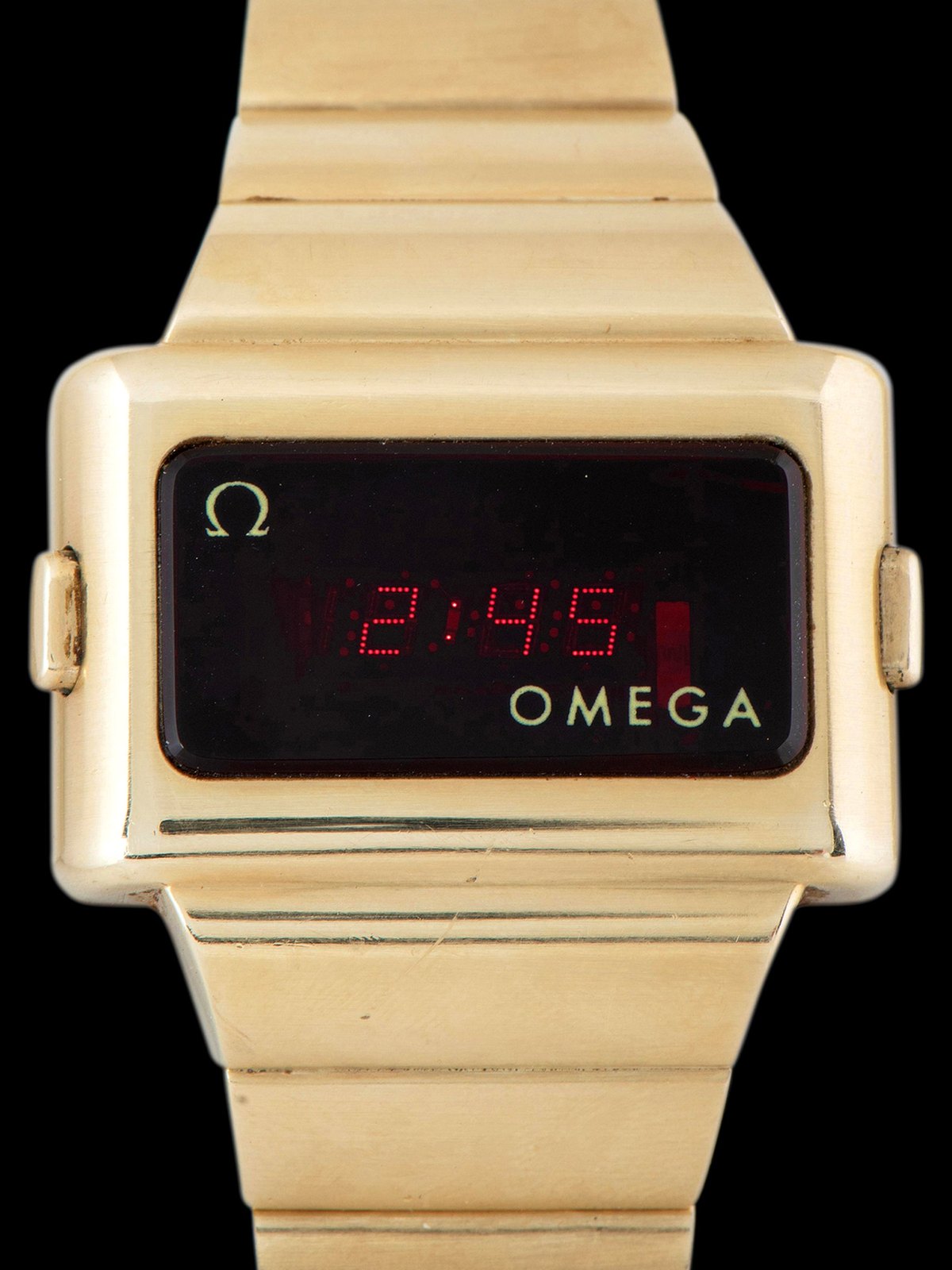
Omega Time Computer 2 Gold-Plate (Ref. 196.0039), 1974
- Maker / attribution
- Omega (maker)
- Date
- 1974
- Historical period
- Quartz Revolution (1969 – 1990)
- Country of origin
- Switzerland
- Object type
- Wristwatch
- Materials / technique
- gold
- Stock no.
- OMTC21960039
- Credit line
- Dealer listing, Craft & Tailored (OMTC21960039)
- Catalogue title (original)
- 1974 Omega Time Computer 2 Gold-Plate (Ref. 196.0039) W/ Box & Papers (English)
View the source record (dealer listing) ↗ (opens another website in a new tab)Suggest a correction
Record summary
Catalogued by Craft & Tailored (dealer), Los Angeles (stock number OMTC21960039), this is a wristwatch by Omega, made in Switzerland, dated 1974. The Atlas places it in the Quartz Revolution period (1969 – 1990) of its Wristwatches collection. Materials and techniques recorded by the source: gold. The record is illustrated with 6 photographs.
Assembled from the source record's structured fields. Dates and attributions are given as the source states them; where a field is missing the Atlas leaves it blank rather than estimating.
Catalogue description
Dealer description — Craft & Tailored
Follow on Instagram → The Omega TC 2 represents a fascinating moment in Omega’s history, blending forward-thinking quartz technology with refined, distinctly 1970s design. Introduced in the mid-1970s, the Omega Time Computer 2 represents a pivotal moment in the evolution of wristwatches, when Swiss manufacturers began seriously engaging with emerging digital technology. Just a few years earlier, in 1969, Hamilton had invested heavily in the development of LED technology, ultimately releasing the Pulsar P1 in 1972, the world’s first digital wristwatch. At the time, this was a radical departure from traditional mechanical watchmaking. Omega licensed this LED technology and applied its own design language and engineering standards to create the Time Computer series. Following the initial Time Computer 1, the TC-2 refined the concept with a more integrated, architectural case and bracelet design, along with improved functionality and ergonomics. While unmistakably futuristic for its era, the TC-2 maintained a level of restraint and quality that aligned with Omega’s broader identity. One of the most distinctive features of the TC-2 is its unconventional time-setting system. Rather than traditional crowns or pushers, the watch utilizes a magnet stored discreetly within a hidden compartment in the clasp. When aligned with specific notches on the caseback, the magnet allows for precise adjustment of the hours and minutes, a clever and distinctly 1970s solution that underscored the experimental nature of early digital watchmaking. Today, the Omega Time Computer 2 stands as a defining artifact of the digital transition era, increasingly appreciated not only for its technical significance but also for its confident, period-correct design and rarity in well-preserved condition. Executed in a yellow gold-capped case with an integrated bracelet, the watch carries a confident, architectural presence while maintaining the restraint and quality expected of Omega. SPECS Stock # OMTC21960039 Brand Omega Style Time Computer 2 Model 196.0039 Serial 38XXXXXX Size Men's Material Gold-capped Stainless Steel Dial Digital Millimeters 40x26 Bracelet Omega JB Campion Gold-Plated Bracelet CASE & BRACELET The yellow gold-capped case and Omega / JB Champion bracelet remain exceptionally well preserved, showing only light scuffs consistent with careful wear and minimal evidence of age. The integrated bracelet exhibits minimal stretch and retains its original hidden magnetic setting mechanism within the inner blades of the clasp. DIAL & HANDS The digital display remains bright and highly legible when the timekeeping function is engaged. The original red sapphire crystal is free of scratches, and the gold Omega text and logo remain crisp and well defined. ACCESSORIES The watch is accompanied by its inner and outer boxes, original papers, and the seldom-seen spare setting magnets. It has recently received a new battery and shows no defects in timekeeping performance.
Historical context
Quartz Revolution (1969 – 1990)
Seiko's Astron begins mass quartz timekeeping; traditional industries contract sharply.
Quartz and digital watches transformed the market after 1969. Swiss employment collapsed, Japanese and Hong Kong production soared, and the Swatch (1983) helped the Swiss industry recover; mechanical watches survived as luxury goods.
Read the period in the timelineMore wristwatches from this periodEarlier: Modern Mechanical Horology
Atlas type guide
Wristwatches
Bracelet watches were worn by women from the early nineteenth century — Breguet made one for Caroline Murat, Queen of Naples, in 1810–12 — but the wristwatch only became a man's instrument with military use and aviation in the early twentieth century. Between the World Wars it overtook the pocket watch; the 1920s and 1930s brought rectangular Art Deco cases, water-resistant cases and the first automatic winding systems.
After 1945 the wristwatch became a carrier of identity — dress watches, sports and dive watches, chronographs, calendars — produced by Swiss, American, Japanese, German, Soviet and Chinese industries. The quartz revolution after 1969 and the mechanical renaissance since the 1990s, including the rise of independent watchmakers, complete the story.
What to look for
- The reference number (between the lugs or inside the case back) and serial number, the starting point for dating.
- The calibre: its maker and number are often stamped under the dial or on the bridge.
- Originality of dial, hands and crown — refinished ('redial') dials are common.
- Case material marks: 18K/750, 14K/585, stainless steel, gold-filled, plated.
Dating clues
- Wire-lug cases: before c. 1925.
- Water-resistant screw-down cases: from 1926.
- Quartz movements: from 1969; sapphire crystals widespread after c. 1980.
General guidance written by the Atlas editors about this kind of object. It is not a statement about this particular piece; for that, rely on the source record above and on physical examination.
Related records

Instruments · 1950–1976
Omega Megaquartz 2400 marine chronometer, 1950–1976
Science Museum Group, London

Instruments · 1960–1979
Stopwatch / timer by Omega, 1960–1979
Science Museum Group, London

Instruments · 1960–1979
Stopwatch / timer by Omega, Switzerland, 1960–1979
Science Museum Group, London

Instruments · 1960–1979
Stopwatch by Omega, Swiss made, single-button type reading 0 - 60 seconds in fifths and 0 - 5 minutes in minutes on subsidiary dial, 1960-79.
Science Museum Group, London

Wristwatches · 1970
Wristwatch by Heno, Switzerland, 1970
Museum Rotterdam

Wristwatches · 1960–1986
'Tri-Compax' calendar chronograph wristwatch in gold case, by Universal, Geneva, Switzerland, 1960–1986.
Science Museum Group, London

Wristwatches · 1969–1970
Beta 21 Quartz wristwatch movement, made in Switzerland, 1970.
Science Museum Group, London

Wristwatches · c. 1969
Omega Speedmaster Moonwatch, ref. 145022-69st, c. 1969
Antiquorum auction archive, Geneva