
Wristwatches · Wristwatch
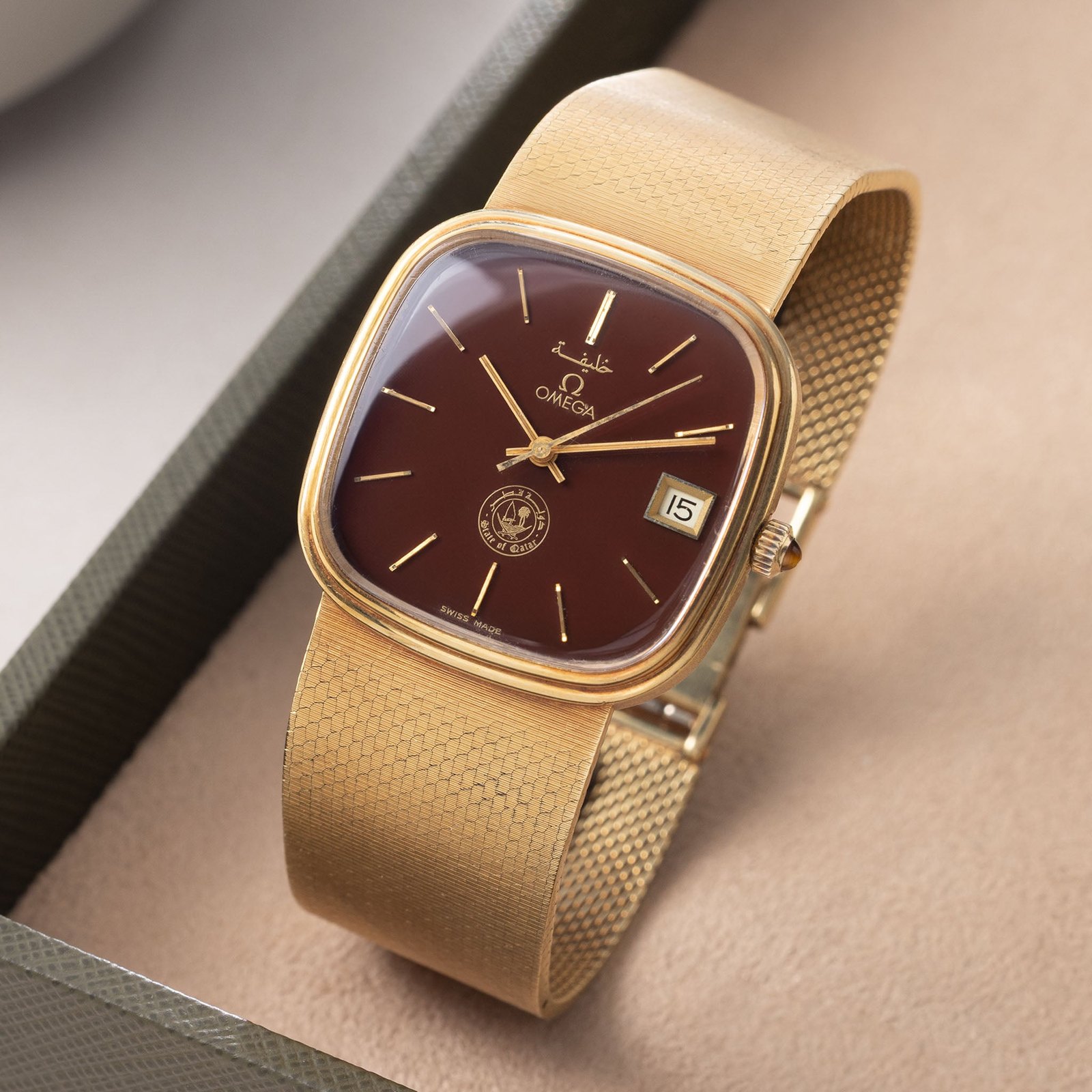
Omega "State of Qatar" Squared Dresswatch Oxblood Stella-esque Dial from Original Owner Family in 18k yellow Gold with integrated Woven Bracelet, late 1970
- Maker / attribution
- Omega (maker)
- Date
- late 1970
- Historical period
- Quartz Revolution (1969 – 1990)
- Country of origin
- Switzerland
- Object type
- Wristwatch
- Materials / technique
- 18k yellow gold
- Dimensions
- Case 32 mm
- Stock no.
- W-3892
- Credit line
- Dealer listing, Bulang & Sons (W-3892)
- Catalogue title (original)
- Omega "State of Qatar" Squared Dresswatch Oxblood Stella-esque Dial from Original Owner Family in 18k yellow Gold with integrated Woven Bracelet (English)
View the source record (dealer listing) ↗ (opens another website in a new tab)Suggest a correction
Record summary
Catalogued by Bulang & Sons (dealer), Copenhagen (stock number W-3892), this is a wristwatch by Omega, made in Switzerland, dated late 1970. The Atlas places it in the Quartz Revolution period (1969 – 1990) of its Wristwatches collection. Materials and techniques recorded by the source: 18k yellow gold. Recorded dimensions: Case 32 mm. The record is illustrated with 6 photographs.
Assembled from the source record's structured fields. Dates and attributions are given as the source states them; where a field is missing the Atlas leaves it blank rather than estimating.
Catalogue description
Dealer description — Bulang & Sons
Founded in 1848 by Louis Brandt in La Chaux-de-Fonds, Switzerland, Omega evolved from a small family-run workshop into one of the world’s most influential watch manufactures. Its legacy has been shaped by a relentless pursuit of precision, earning the brand a place in history through space exploration, deep-sea diving and its longstanding role as the Official Timekeeper of the Olympic Games. Offered here is a truly rare and fascinating Omega. Acquired directly from the heirs of the original owner, a former Minister of Tunisia, this elegant 18k yellow-gold dress watch measures 32 × 32 mm. While modest in size on paper, its square case, integrated bracelet and substantial gold construction give it a much greater presence on the wrist. Whether you call it square or television-shaped, the case remains in lovely condition, with crisp hallmarks still visible on the snap-on case back and a charming tiger’s eye cabochon set into the winding crown. The real highlight, however, is the spectacular oxblood-red dial. Finished in a rich lacquer with remarkable depth and gloss, it immediately brings to mind the celebrated “Stella” dials found on vintage Rolex Day-Dates. This particular watch was commissioned by the State of Qatar during the reign of Sheikh Khalifa and was intended as an official presentation piece. Watches such as this were often gifted to senior government officials, diplomats and close friends of the state. The example offered here was presented to a Tunisian government minister during the 1980s. We acquired this watch — together with an equally fascinating IWC bearing the green Omani Khanjar emblem — directly from his heirs. Out of respect for the family’s privacy, and in accordance with their wishes, we will not disclose any names or personal details. What we can say is that, throughout our conversations with the family, it became abundantly clear how deeply admired and respected their father and grandfather was. Returning to the dial, its restrained design allows the rich lacquer finish to take centre stage. Applied baton markers, a date aperture, the gold-printed emblem of the State of Qatar and the Arabic inscription “Khalifa” create a wonderfully balanced and highly unusual composition. Powering the watch is Omega’s red-gilt automatic calibre 1010, freshly serviced by our watchmaker and ready to provide many more years of reliable service. Completing the watch is its beautifully crafted integrated 18k yellow-gold woven mesh bracelet, which currently fits wrists up to 18.5 cm. Far more than an elegant gold dress watch, this remarkable Omega tells a story of diplomacy, craftsmanship and history. With its striking oxblood dial and fascinating State of Qatar provenance, it is ready to continue its journey with its next custodian. Get in touch with us! Specifications: Omega “TV shape” 18k Yellow Gold Dresswatch 32x 32 mm 18k yellow gold case with tiger eye stone cabochon on setting crown "State of Qatar" Oxblood Dial movement no 823xxx, case number 162 xxxx dating to the late 1970’s Omega Cal. 1010 automatic movement, red gilted Original integrated yellow 18k mesh style gold bracelet Fully serviced by our watchmaker From the family of the original owner
Historical context
Quartz Revolution (1969 – 1990)
Seiko's Astron begins mass quartz timekeeping; traditional industries contract sharply.
Quartz and digital watches transformed the market after 1969. Swiss employment collapsed, Japanese and Hong Kong production soared, and the Swatch (1983) helped the Swiss industry recover; mechanical watches survived as luxury goods.
Read the period in the timelineMore wristwatches from this periodEarlier: Modern Mechanical Horology
Atlas type guide
Wristwatches
Bracelet watches were worn by women from the early nineteenth century — Breguet made one for Caroline Murat, Queen of Naples, in 1810–12 — but the wristwatch only became a man's instrument with military use and aviation in the early twentieth century. Between the World Wars it overtook the pocket watch; the 1920s and 1930s brought rectangular Art Deco cases, water-resistant cases and the first automatic winding systems.
After 1945 the wristwatch became a carrier of identity — dress watches, sports and dive watches, chronographs, calendars — produced by Swiss, American, Japanese, German, Soviet and Chinese industries. The quartz revolution after 1969 and the mechanical renaissance since the 1990s, including the rise of independent watchmakers, complete the story.
What to look for
- The reference number (between the lugs or inside the case back) and serial number, the starting point for dating.
- The calibre: its maker and number are often stamped under the dial or on the bridge.
- Originality of dial, hands and crown — refinished ('redial') dials are common.
- Case material marks: 18K/750, 14K/585, stainless steel, gold-filled, plated.
Dating clues
- Wire-lug cases: before c. 1925.
- Water-resistant screw-down cases: from 1926.
- Quartz movements: from 1969; sapphire crystals widespread after c. 1980.
General guidance written by the Atlas editors about this kind of object. It is not a statement about this particular piece; for that, rely on the source record above and on physical examination.
Related records

Instruments · 1950–1976
Omega Megaquartz 2400 marine chronometer, 1950–1976
Science Museum Group, London

Instruments · 1960–1979
Stopwatch / timer by Omega, 1960–1979
Science Museum Group, London

Instruments · 1960–1979
Stopwatch / timer by Omega, Switzerland, 1960–1979
Science Museum Group, London

Instruments · 1960–1979
Stopwatch by Omega, Swiss made, single-button type reading 0 - 60 seconds in fifths and 0 - 5 minutes in minutes on subsidiary dial, 1960-79.
Science Museum Group, London

Wristwatches · 1970
Wristwatch by Heno, Switzerland, 1970
Museum Rotterdam

Wristwatches · 1960–1986
'Tri-Compax' calendar chronograph wristwatch in gold case, by Universal, Geneva, Switzerland, 1960–1986.
Science Museum Group, London

Wristwatches · 1969–1970
Beta 21 Quartz wristwatch movement, made in Switzerland, 1970.
Science Museum Group, London

Wristwatches · c. 1969
Omega Speedmaster Moonwatch, ref. 145022-69st, c. 1969
Antiquorum auction archive, Geneva