
Wristwatches · Wristwatch
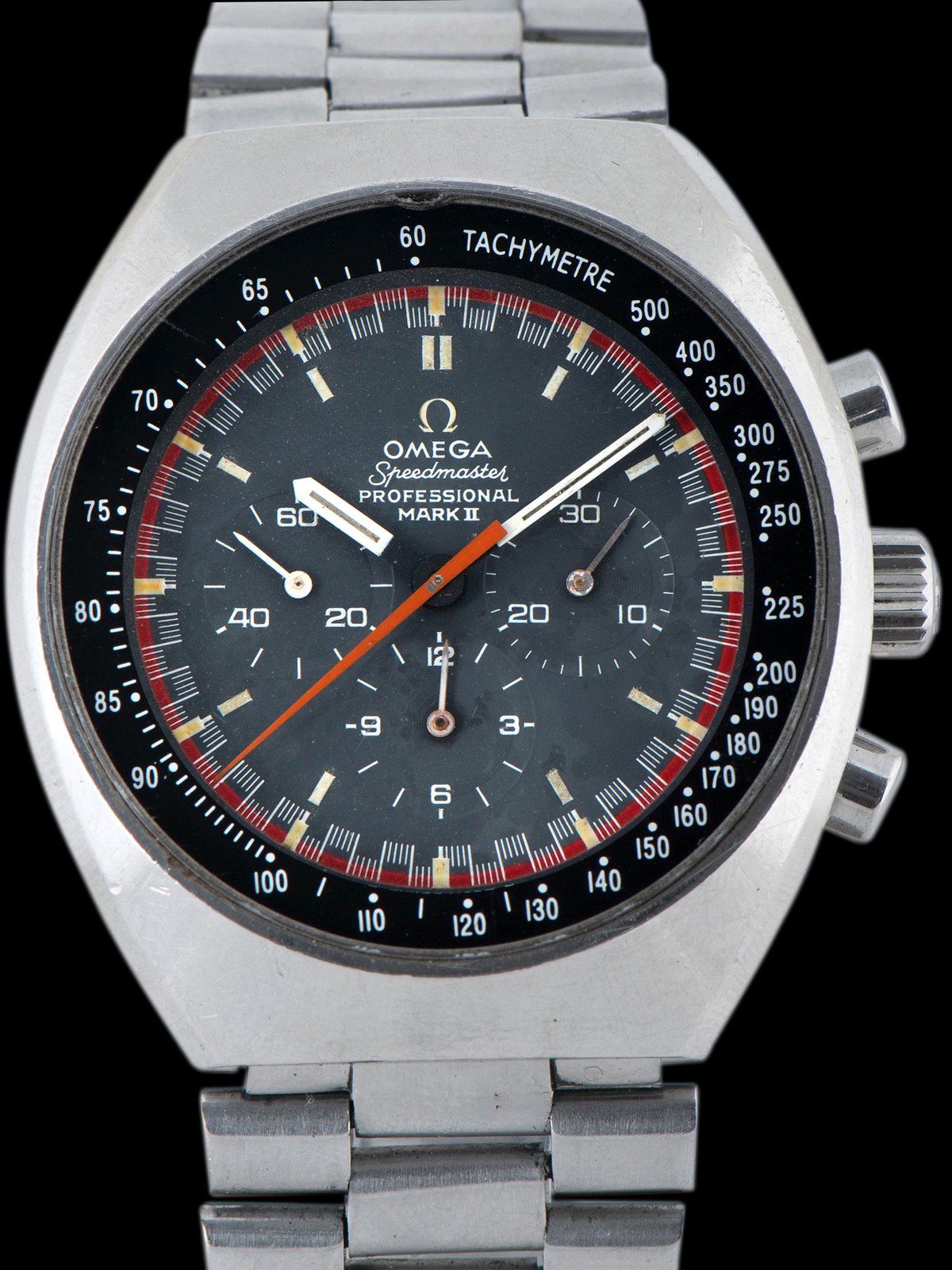
Omega Speedmaster Professional Mark II (Ref. 145.014) Racing Dial 'Cal. 861', 1973
- Maker / attribution
- Omega (maker)
- Date
- 1973
- Historical period
- Quartz Revolution (1969 – 1990)
- Country of origin
- Switzerland
- Object type
- Wristwatch
- Stock no.
- WOSMMKII70-MW
- Credit line
- Dealer listing, Craft & Tailored (WOSMMKII70-MW)
- Catalogue title (original)
- 1973 Omega Speedmaster Professional MARK II (Ref. 145.014) Racing Dial 'Cal. 861' (English)
View the source record (dealer listing) ↗ (opens another website in a new tab)Suggest a correction
Record summary
Catalogued by Craft & Tailored (dealer), Los Angeles (stock number WOSMMKII70-MW), this is a wristwatch by Omega, made in Switzerland, dated 1973. The Atlas places it in the Quartz Revolution period (1969 – 1990) of its Wristwatches collection. The record is illustrated with 6 photographs.
Assembled from the source record's structured fields. Dates and attributions are given as the source states them; where a field is missing the Atlas leaves it blank rather than estimating.
Catalogue description
Dealer description — Craft & Tailored
Fresh from the personal collection of style icon, automobile enthusiast, and Urban Outlaw himself, Magnus Walker, comes a 1973 Omega Speedmaster Professional MARK II in fantastic condition. With the immense success Omega saw from the Speedmaster Professional series, especially after its iconic trip to the moon, they decided the expand the Speedmaster model with the ever-evolving MARK series of chronographs. The MARK II debuted in 1969 with a bold, sunburst-finished tonneau-style case. The MARK III was introduced in 1971 and was the first Speedmaster to employ an automatic winding movement using the Lemania cal. 1340. The MARK IV was introduced in 1973 and melded the MARK II case style with the same Lemania-based movement of the MARK III. After a short hiatus, Omega created the MARK V which featured a very evolved aesthetic that many refer to as 'futuristic'. The Speedmaster MARK II came with the same Lemania-based movement as the original Speedmaster Professional "Moonwatch", reference 145.022. This watch contains Omega’s original caliber 861 movement and was in production from 1968 and lasted until 1996 when Omega introduced the Caliber 1861 movement. Unlike the Speedmaster Professional, the Omega Speedmaster MARK II has a barrel-shaped case that has polished chamfers and a brushed top and sides, giving it a different look from the standard Speedmaster Professional case worn by NASA Astronauts. The classic timing scale that the Speedmaster is known for is also different; it is under the mineral glass crystal and not located on the outside of the crystal as an external bezel, in essence, protecting the timing scale from scratches or disruption. Unlike modern timepieces with scratch-resistant sapphire crystals, pieces of this era were assembled with mineral glass crystals. Finally, as you may expect from a man with such auto-centric ties, this particular MARK II features a "racing dial", with red and white checkering on the outer edge of the dial. Considering the watch's connection to the automobile world, it's no wonder Magnus had one of these in his collection – but it's now ready for it's next wrist. This is a great opportunity to own an incredible watch with a very unique history. SPECS Stock # WOSMMKII70-MW Brand Omega Style Speedmaster Professional "MARK II" Model 145.014 Serial 32XXXXXX Size Men's Material Stainless Steel Dial Matte Grey "Racing" Millimeters 41 Bracelet Omega 1162 / 173 Stainless Steel Bracelet CASE & BRACELET The barrel-shaped case appears to have been polished in the past, showing honest signs of use while still displaying the original bevels and dimensions throughout. The mineral glass crystal is in good condition, showing no notable signs of wear except for a small chip at 12 o'clock. The Omega signed crown and pump pushers are original to the watch. The original factory engravings on the case back have faded mostly from view by now but are still visible in the right light. The watch comes supplied on an Omega 1171 / 173 bracelet that retains 20 links that show light stretch and will fit up to a 7 1/2-inch wrist. DIAL & HANDS The matte grey "exotic" racing dial is in wonderful vintage condition, showing some tonal spots from age but no notable damage. The tritium markers feature a soft tan coloration that is common for these dials and show light degradation under UV light inspection. The original tritium hands have aged to a dark grey patina and show some minor lume loss and cracking when inspected under UV light. The orange center chronograph hands a small chip in the paint at the center post and the minutes and hours sub-register hands also exhibit some fading and chipping to the paint as well. ACCESSORIES
Historical context
Quartz Revolution (1969 – 1990)
Seiko's Astron begins mass quartz timekeeping; traditional industries contract sharply.
Quartz and digital watches transformed the market after 1969. Swiss employment collapsed, Japanese and Hong Kong production soared, and the Swatch (1983) helped the Swiss industry recover; mechanical watches survived as luxury goods.
Read the period in the timelineMore wristwatches from this periodEarlier: Modern Mechanical Horology
Atlas type guide
Wristwatches
Bracelet watches were worn by women from the early nineteenth century — Breguet made one for Caroline Murat, Queen of Naples, in 1810–12 — but the wristwatch only became a man's instrument with military use and aviation in the early twentieth century. Between the World Wars it overtook the pocket watch; the 1920s and 1930s brought rectangular Art Deco cases, water-resistant cases and the first automatic winding systems.
After 1945 the wristwatch became a carrier of identity — dress watches, sports and dive watches, chronographs, calendars — produced by Swiss, American, Japanese, German, Soviet and Chinese industries. The quartz revolution after 1969 and the mechanical renaissance since the 1990s, including the rise of independent watchmakers, complete the story.
What to look for
- The reference number (between the lugs or inside the case back) and serial number, the starting point for dating.
- The calibre: its maker and number are often stamped under the dial or on the bridge.
- Originality of dial, hands and crown — refinished ('redial') dials are common.
- Case material marks: 18K/750, 14K/585, stainless steel, gold-filled, plated.
Dating clues
- Wire-lug cases: before c. 1925.
- Water-resistant screw-down cases: from 1926.
- Quartz movements: from 1969; sapphire crystals widespread after c. 1980.
General guidance written by the Atlas editors about this kind of object. It is not a statement about this particular piece; for that, rely on the source record above and on physical examination.
Related records

Instruments · 1950–1976
Omega Megaquartz 2400 marine chronometer, 1950–1976
Science Museum Group, London

Instruments · 1960–1979
Stopwatch / timer by Omega, 1960–1979
Science Museum Group, London

Instruments · 1960–1979
Stopwatch / timer by Omega, Switzerland, 1960–1979
Science Museum Group, London

Instruments · 1960–1979
Stopwatch by Omega, Swiss made, single-button type reading 0 - 60 seconds in fifths and 0 - 5 minutes in minutes on subsidiary dial, 1960-79.
Science Museum Group, London

Wristwatches · 1970
Wristwatch by Heno, Switzerland, 1970
Museum Rotterdam

Wristwatches · 1960–1986
'Tri-Compax' calendar chronograph wristwatch in gold case, by Universal, Geneva, Switzerland, 1960–1986.
Science Museum Group, London

Wristwatches · 1969–1970
Beta 21 Quartz wristwatch movement, made in Switzerland, 1970.
Science Museum Group, London

Wristwatches · c. 1969
Omega Speedmaster Moonwatch, ref. 145022-69st, c. 1969
Antiquorum auction archive, Geneva