
Wristwatches · Wristwatch
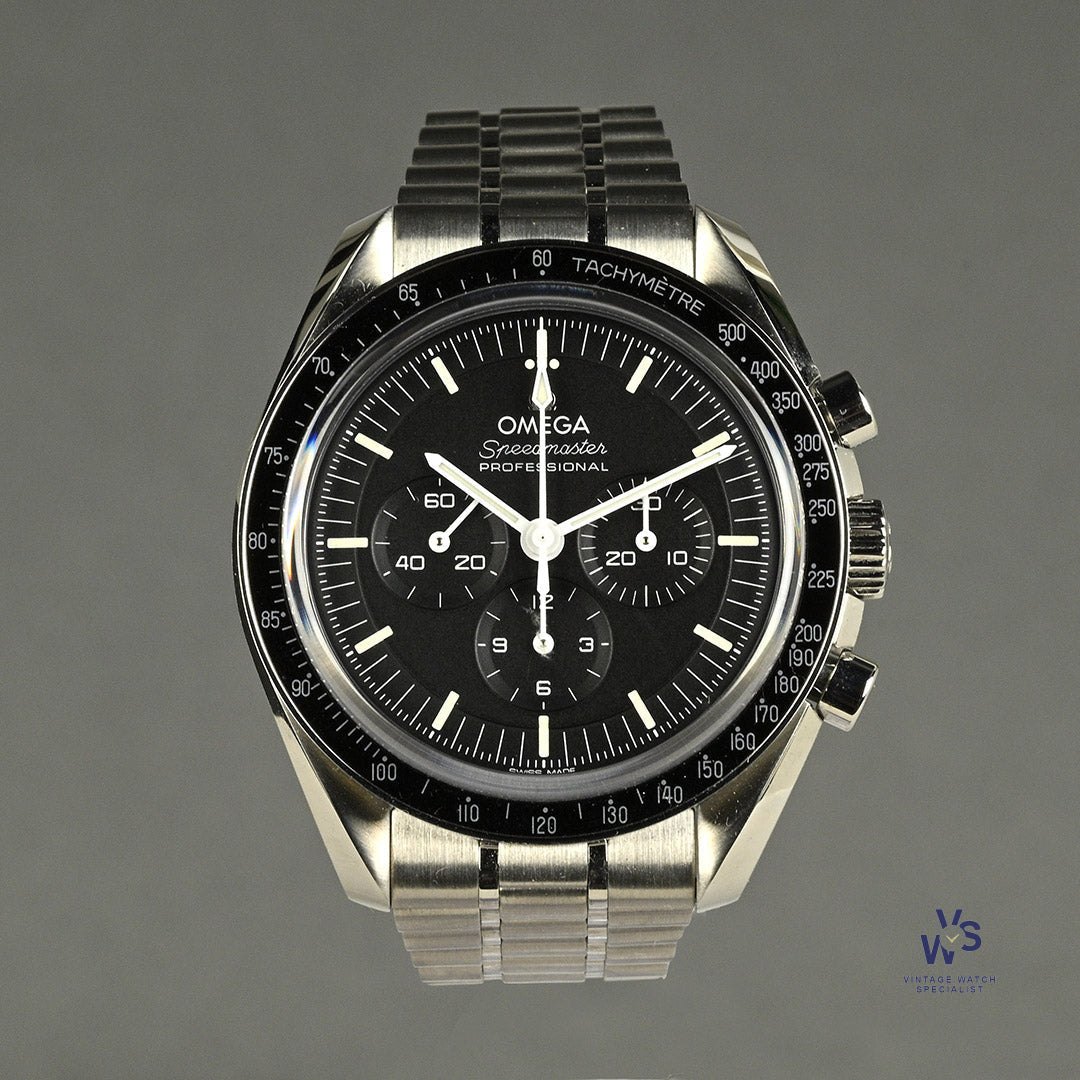
Omega Speedmaster Moonwatch Professional Co-Axial Master Chronometer, ref. 310.30.42.50.01.002, 2022
- Maker / attribution
- Omega (maker)
- Date
- 2022
- Historical period
- Contemporary Horology (2010 – Present)
- Country of origin
- Switzerland
- Object type
- Wristwatch
- Dimensions
- Case 42 mm
- Stock no.
- vws4448cs
- Credit line
- Dealer listing, Vintage Watch Specialist (vws4448cs)
- Catalogue title (original)
- Omega Speedmaster Moonwatch Professional Co-Axial Master Chronometer – Reference. 310.30.42.50.01.002 – 2022 (English)
View the source record (dealer listing) ↗ (opens another website in a new tab)Suggest a correction
Record summary
Catalogued by Vintage Watch Specialist (dealer), United Kingdom (stock number vws4448cs), this is a wristwatch by Omega, made in Switzerland, dated 2022. The Atlas places it in the Contemporary Horology period (2010 – Present) of its Wristwatches collection. Recorded dimensions: Case 42 mm. The record is illustrated with 6 photographs.
Assembled from the source record's structured fields. Dates and attributions are given as the source states them; where a field is missing the Atlas leaves it blank rather than estimating.
Catalogue description
Dealer description — Vintage Watch Specialist
There are few watches whose history is quite as recognisable as that of the Omega Speedmaster. First introduced in 1957, the Speedmaster began life as a precision chronograph, but its story took a remarkable turn during the 1960s when it became closely associated with NASA and manned spaceflight. Following rigorous testing, the Speedmaster was qualified by NASA for use on its missions in 1965 and subsequently accompanied astronauts during the Apollo programme. Its defining moment came in July 1969, when the Speedmaster became the first watch worn on the Moon during Apollo 11. It has been associated with lunar exploration ever since, earning the enduring “Moonwatch” name and becoming one of the most historically significant chronographs ever produced. The current generation manages the difficult trick of moving the Speedmaster forward without losing the character that made it famous. Its styling takes considerable inspiration from the fourth-generation Speedmaster of the space-race era, while the movement represents a significant technical evolution. At its heart is Omega’s calibre 3861, a manual-winding Co-Axial Master Chronometer movement that brings modern standards of precision, performance and magnetic resistance to the traditional Moonwatch format. What’s On Offer This is a 2022 Omega Speedmaster Moonwatch Professional, reference 310.30.42.50.01.002, with papers dated 13th May 2022. The 42mm stainless-steel case retains the unmistakable asymmetric Speedmaster profile, complemented by its black anodised aluminium tachymeter bezel. The black step dial is wonderfully familiar, with three recessed subsidiary dials, luminous hour markers and hands, an applied Omega logo and the classic Speedmaster Professional signature. This is the desirable sapphire version of the Moonwatch, with sapphire crystal protecting the dial and a sapphire exhibition caseback revealing the calibre 3861 beneath (Nicknamed the Sapphire Sandwich). The movement is arguably every bit as interesting to look at as the dial, with its intricate architecture and contrasting rhodium-plated and gold-toned components clearly visible through the back. The manually wound calibre 3861 is a 26-jewel Co-Axial Master Chronometer chronograph movement with a power reserve of approximately 50 hours. It is presented on its stainless-steel bracelet and comes complete with its Omega box and papers. A superb modern interpretation of perhaps the most famous chronograph ever made, combining the unmistakable appearance and manual-winding character of the Moonwatch with the added appeal of sapphire crystal and a beautifully exposed movement.
Historical context
Contemporary Horology (2010 – Present)
Silicon components, connected watches, optical-lattice research clocks and a thriving independent scene.
Smartwatches became the world's best-selling watches, while mechanical watchmaking focuses on craft, innovation (silicon components, new escapements) and independent makers.
Read the period in the timelineMore wristwatches from this periodEarlier: Mechanical Renaissance
Atlas type guide
Wristwatches
Bracelet watches were worn by women from the early nineteenth century — Breguet made one for Caroline Murat, Queen of Naples, in 1810–12 — but the wristwatch only became a man's instrument with military use and aviation in the early twentieth century. Between the World Wars it overtook the pocket watch; the 1920s and 1930s brought rectangular Art Deco cases, water-resistant cases and the first automatic winding systems.
After 1945 the wristwatch became a carrier of identity — dress watches, sports and dive watches, chronographs, calendars — produced by Swiss, American, Japanese, German, Soviet and Chinese industries. The quartz revolution after 1969 and the mechanical renaissance since the 1990s, including the rise of independent watchmakers, complete the story.
What to look for
- The reference number (between the lugs or inside the case back) and serial number, the starting point for dating.
- The calibre: its maker and number are often stamped under the dial or on the bridge.
- Originality of dial, hands and crown — refinished ('redial') dials are common.
- Case material marks: 18K/750, 14K/585, stainless steel, gold-filled, plated.
Dating clues
- Wire-lug cases: before c. 1925.
- Water-resistant screw-down cases: from 1926.
- Quartz movements: from 1969; sapphire crystals widespread after c. 1980.
General guidance written by the Atlas editors about this kind of object. It is not a statement about this particular piece; for that, rely on the source record above and on physical examination.
Related records

Instruments · 1950–1976
Omega Megaquartz 2400 marine chronometer, 1950–1976
Science Museum Group, London

Instruments · 1960–1979
Stopwatch / timer by Omega, 1960–1979
Science Museum Group, London

Instruments · 1960–1979
Stopwatch / timer by Omega, Switzerland, 1960–1979
Science Museum Group, London

Instruments · 1960–1979
Stopwatch by Omega, Swiss made, single-button type reading 0 - 60 seconds in fifths and 0 - 5 minutes in minutes on subsidiary dial, 1960-79.
Science Museum Group, London

Wristwatches · c. 2010s
Breguet Type XXI, ref. 3810, c. 2010s (Antiquorum Lot 381-24)
Antiquorum auction archive, Geneva

Wristwatches · c. 2010s
Breguet Type XXI, ref. 3810, c. 2010s (Antiquorum Lot 386-229)
Antiquorum auction archive, Geneva

Wristwatches · Sold in September 2010
Breitling Cosmonaute, ref. A 22322, Sold in September 2010
Antiquorum auction archive, Geneva

Wristwatches · c. 2010
Corum Bubble Chrono, ref. 396.150.20, c. 2010
Antiquorum auction archive, Geneva