
Wristwatches · Wristwatch
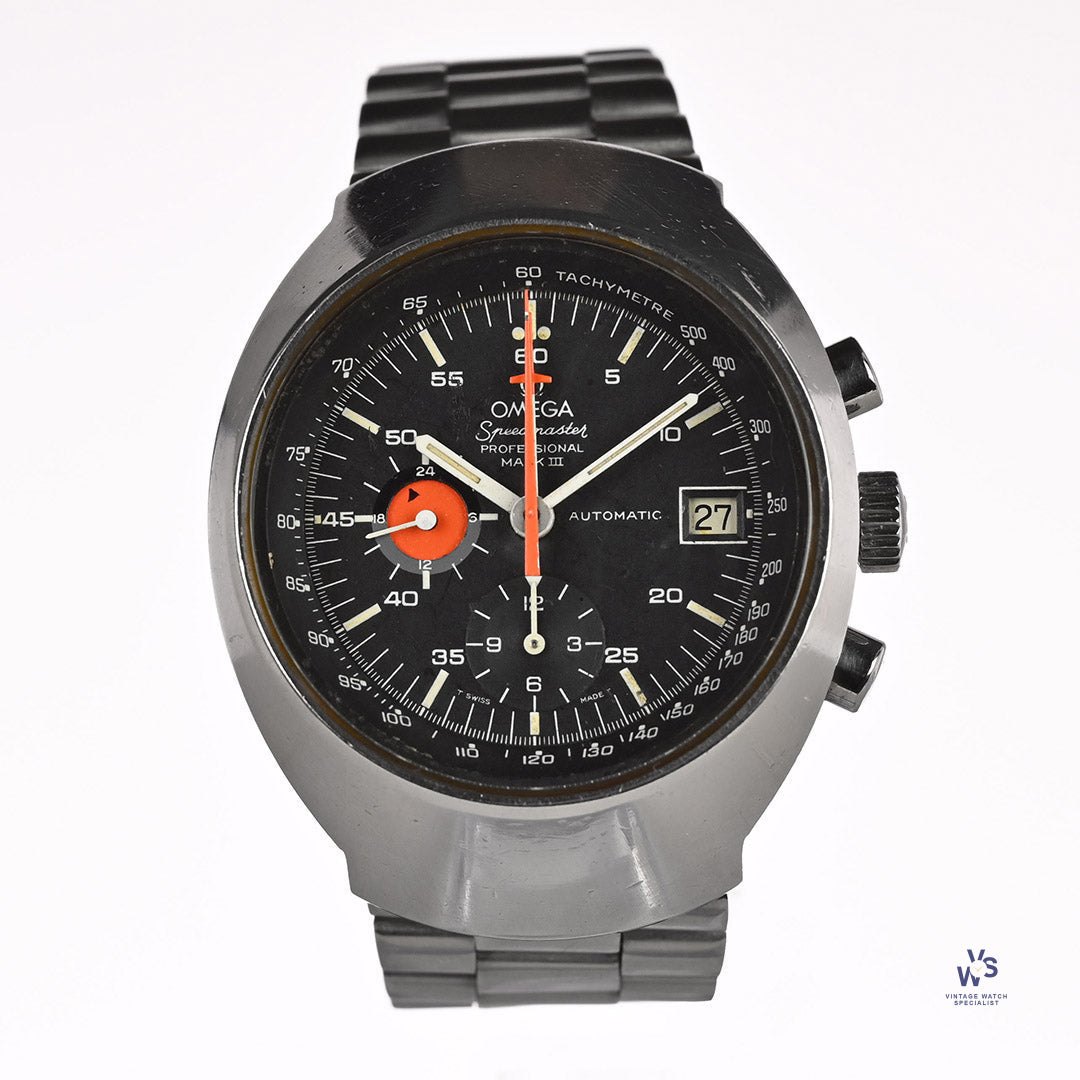
Omega Speedmaster Automatic, ref. 176.002, circa 1973
- Maker / attribution
- Omega (maker)
- Date
- c. 1973
- Historical period
- Quartz Revolution (1969 – 1990)
- Country of origin
- Switzerland
- Object type
- Wristwatch
- Dimensions
- Case 41 mm
- Stock no.
- vws3542
- Credit line
- Dealer listing, Vintage Watch Specialist (vws3542)
- Catalogue title (original)
- Omega Speedmaster Automatic - Model Ref: 176.002 - c.1973 (English)
View the source record (dealer listing) ↗ (opens another website in a new tab)Suggest a correction
Record summary
Catalogued by Vintage Watch Specialist (dealer), United Kingdom (stock number vws3542), this is a wristwatch by Omega, made in Switzerland, dated c. 1973. The Atlas places it in the Quartz Revolution period (1969 – 1990) of its Wristwatches collection. Recorded dimensions: Case 41 mm. The record is illustrated with 6 photographs.
Assembled from the source record's structured fields. Dates and attributions are given as the source states them; where a field is missing the Atlas leaves it blank rather than estimating.
Catalogue description
Dealer description — Vintage Watch Specialist
A Very Handsome Omega Speedmaster Model Ref: 176.002 in Superb Condition, c.1973 The Omega Speedmaster, introduced in 1957, quickly became a symbol of precision and resilience. Originally designed as a sporty, racing-inspired chronograph, its robust design and accuracy caught the attention of NASA. In 1965, after rigorous testing, the Speedmaster was officially certified for all manned space missions. Its legacy was cemented when it became the first watch worn on the moon during Apollo 11 in 1969, earning it the nickname "Moonwatch." Over the decades, the Speedmaster has evolved while maintaining its iconic design features, such as the tachymetric scale on the bezel for calculating speed. Various models have emerged, including those commemorating significant space milestones. The watch's connection to human space exploration has made it a favourite among watch collectors and enthusiasts alike. Today, the Speedmaster continues to be a testament to Omega's commitment to innovation, durability, and the spirit of adventure. What's on Offer This 1970s Omega Speedmaster 176.002 Mk3 is in superb preowned condition, introduced to the market in 1971, it was the first Speedmaster with an automatic movement. This is a meaty watch at 41mm wide and a crazy 17mm deep - it has a big presence on the wrist but is surprisingly comfortable. At its core lies the robust Caliber 1040 automatic movement, a testament to mechanical precision and reliability. The watch's aesthetic is characterized by its tonneau-shaped stainless steel case, providing a perfect blend of elegance and resilience. The black dial, marked by striking orange details, elevates readability while adding a touch of modern flair. Although this dial configuration with the orange sub-dial isn't one of the original designs manufactured by Omega and has been added at some point over time - we are unsure off the reason for this but it is what appealed to us as you will possibly never find another like this! The rest of the watch is completely original. Highly functional, it features a chronograph, date aperture and a 24-hour sub-dial—offering practicality for contemporary needs. The dial is encapsulated underneath a mineral crystal which is also in superb condition. The case back shows the Seamster Hippocampus, confusing right? Officially the Speedmaster was/is a subset of the Seamaster line. The watch is paired with its original Omega bracelet in steel which is also in very good condition. The watch shows minimal signs of wear but at nearly 50 years old, nothing we wouldn't expect! A great purchase and a watch we will be sad to let go.
Historical context
Quartz Revolution (1969 – 1990)
Seiko's Astron begins mass quartz timekeeping; traditional industries contract sharply.
Quartz and digital watches transformed the market after 1969. Swiss employment collapsed, Japanese and Hong Kong production soared, and the Swatch (1983) helped the Swiss industry recover; mechanical watches survived as luxury goods.
Read the period in the timelineMore wristwatches from this periodEarlier: Modern Mechanical Horology
Atlas type guide
Automatic (self-winding) watches
Self-winding watches use the wearer's motion to wind the mainspring. Abraham-Louis Perrelet and Breguet made 'perpétuelle' pocket watches with oscillating weights in the late eighteenth century, but the principle only became practical in the wristwatch. John Harwood patented a bumper automatic in 1923; Rolex's Perpetual rotor (1931) winding in one direction, and later bidirectional rotors (Eterna, Felsa Bidynator), established the modern form. Micro-rotors (Universal Genève, Buren) and peripheral rotors made automatic watches thinner.
What to look for
- A semicircular rotor turning 360° over the movement, or a 'bumper' weight that rebounds between springs.
- 'Automatic', 'Perpetual' or 'Self-winding' on the dial.
- A sealed screw-back case, since automatic watches are wound less often by the crown.
Dating clues
- Bumper automatics: 1923–c. 1955.
- Full rotors: from 1931 (Rolex); widespread after c. 1950.
- Micro-rotors: from 1954–1958.
General guidance written by the Atlas editors about this kind of object. It is not a statement about this particular piece; for that, rely on the source record above and on physical examination.
Related records

Instruments · 1950–1976
Omega Megaquartz 2400 marine chronometer, 1950–1976
Science Museum Group, London

Instruments · 1960–1979
Stopwatch / timer by Omega, 1960–1979
Science Museum Group, London

Instruments · 1960–1979
Stopwatch / timer by Omega, Switzerland, 1960–1979
Science Museum Group, London

Instruments · 1960–1979
Stopwatch by Omega, Swiss made, single-button type reading 0 - 60 seconds in fifths and 0 - 5 minutes in minutes on subsidiary dial, 1960-79.
Science Museum Group, London

Wristwatches · 1970
Wristwatch by Heno, Switzerland, 1970
Museum Rotterdam

Wristwatches · 1960–1986
'Tri-Compax' calendar chronograph wristwatch in gold case, by Universal, Geneva, Switzerland, 1960–1986.
Science Museum Group, London

Wristwatches · 1969–1970
Beta 21 Quartz wristwatch movement, made in Switzerland, 1970.
Science Museum Group, London

Wristwatches · c. 1969
Omega Speedmaster Moonwatch, ref. 145022-69st, c. 1969
Antiquorum auction archive, Geneva