
Wristwatches · Wristwatch
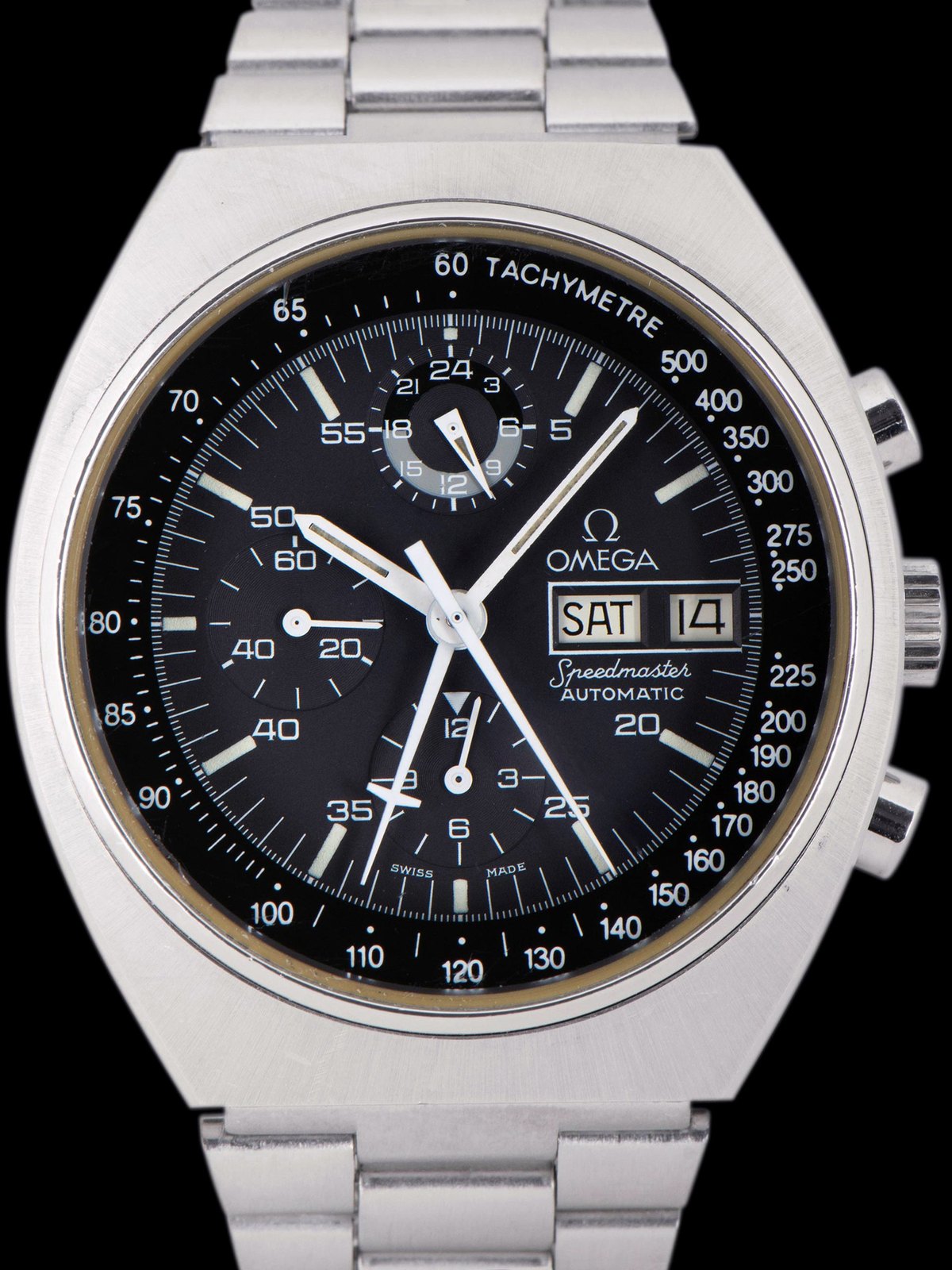
Omega Speedmaster Automatic (Ref. 176.0012) "Mark 4.5", 1985
- Maker / attribution
- Omega (maker)
- Date
- 1985
- Historical period
- Quartz Revolution (1969 – 1990)
- Country of origin
- Switzerland
- Object type
- Wristwatch
- Stock no.
- OSPMMK45
- Credit line
- Dealer listing, Craft & Tailored (OSPMMK45)
- Catalogue title (original)
- 1985 Omega Speedmaster Automatic (Ref. 176.0012) "Mark 4.5" (English)
View the source record (dealer listing) ↗ (opens another website in a new tab)Suggest a correction
Record summary
Catalogued by Craft & Tailored (dealer), Los Angeles (stock number OSPMMK45), this is a wristwatch by Omega, made in Switzerland, dated 1985. The Atlas places it in the Quartz Revolution period (1969 – 1990) of its Wristwatches collection. The record is illustrated with 6 photographs.
Assembled from the source record's structured fields. Dates and attributions are given as the source states them; where a field is missing the Atlas leaves it blank rather than estimating.
Catalogue description
Dealer description — Craft & Tailored
With the immense success Omega saw from the Speedmaster Professional series, especially after its iconic trip to the moon, they decided the expand the Speedmaster model with the ever-evolving Mark series of chronographs. The Mark II debuted in 1969 with a bold, sunburst-finished tonneau-style case. The Mark III was introduced in 1971 and was the first Speedmaster to employ an automatic winding movement using the Lemania cal. 1340. The Mark IV was introduced in 1973 and melded the Mark II case style with the same Lemania-based movement of the Mark III. After a short hiatus, Omega created the Mark V which featured a very evolved aesthetic that many refer to as 'futuristic'. So what is a Speedmaster Mark 4.5? The ref. 176.0012, also known as the"Mark 4.5", is the unofficial name of the Speedmaster Automatic that bridges the gap between the Mark IV and the Mark V. This model employs a very similar case to the Mark IV but employs the same movement as the Mark V, the Lemania cal. 5100. Interestingly the Mark 4.5 was manufactured for the longest period out of the actual models in the Mark Series, from 1974 to 1986. Stock # OSPMMK45 Brand Omega Style Speedmaster Automatic "Mark 4.5" Model 176.00012 Serial 45XXXXXX Size Men's Material Stainless Steel Dial Matte Black Millimeters 42x45 Bracelet Omega 1162 Bracelet W/ 172 End Pieces CASE & BRACELET The robust and large tonneau-style case is in wonderful condition with the impressive sunburst finish still intact and the broad bevel fully present as well, though the case does appear to have been gently polished in the past and shows light wear from use. The case retains its original pump pushers and Omega-signed crown. The original mineral glass crystal has some minor scratches and wear but they are very subtle and don't detract from the aesthetic of the watch. The case back remains very crisp with the Seamaster medallion remaining fully intact. The original Omega 1162/172 stainless steel bracelet retains 20 links that show expected stretch for the style and age of the bracelet and will fit up to a 7 1/2-inch wrist. DIAL & HANDS The original matte black dial is flawless, showing no age or damage whatsoever. The tritium lume plots feature a pale ivory color with no degradation present under UV light inspection. The original tritium hands have taken on a grey patina which is common for these models, and no degradation is present under UV light inspection. ACCESSORIES None. The watch is keeping time, but the service history is unknown. A movement service can be provided upon request.
Historical context
Quartz Revolution (1969 – 1990)
Seiko's Astron begins mass quartz timekeeping; traditional industries contract sharply.
Quartz and digital watches transformed the market after 1969. Swiss employment collapsed, Japanese and Hong Kong production soared, and the Swatch (1983) helped the Swiss industry recover; mechanical watches survived as luxury goods.
Read the period in the timelineMore wristwatches from this periodEarlier: Modern Mechanical Horology
Atlas type guide
Automatic (self-winding) watches
Self-winding watches use the wearer's motion to wind the mainspring. Abraham-Louis Perrelet and Breguet made 'perpétuelle' pocket watches with oscillating weights in the late eighteenth century, but the principle only became practical in the wristwatch. John Harwood patented a bumper automatic in 1923; Rolex's Perpetual rotor (1931) winding in one direction, and later bidirectional rotors (Eterna, Felsa Bidynator), established the modern form. Micro-rotors (Universal Genève, Buren) and peripheral rotors made automatic watches thinner.
What to look for
- A semicircular rotor turning 360° over the movement, or a 'bumper' weight that rebounds between springs.
- 'Automatic', 'Perpetual' or 'Self-winding' on the dial.
- A sealed screw-back case, since automatic watches are wound less often by the crown.
Dating clues
- Bumper automatics: 1923–c. 1955.
- Full rotors: from 1931 (Rolex); widespread after c. 1950.
- Micro-rotors: from 1954–1958.
General guidance written by the Atlas editors about this kind of object. It is not a statement about this particular piece; for that, rely on the source record above and on physical examination.
Related records

Instruments · 1950–1976
Omega Megaquartz 2400 marine chronometer, 1950–1976
Science Museum Group, London

Instruments · 1960–1979
Stopwatch / timer by Omega, 1960–1979
Science Museum Group, London

Instruments · 1960–1979
Stopwatch / timer by Omega, Switzerland, 1960–1979
Science Museum Group, London

Instruments · 1960–1979
Stopwatch by Omega, Swiss made, single-button type reading 0 - 60 seconds in fifths and 0 - 5 minutes in minutes on subsidiary dial, 1960-79.
Science Museum Group, London

Wristwatches · 1970
Wristwatch by Heno, Switzerland, 1970
Museum Rotterdam

Wristwatches · 1960–1986
'Tri-Compax' calendar chronograph wristwatch in gold case, by Universal, Geneva, Switzerland, 1960–1986.
Science Museum Group, London

Wristwatches · 1969–1970
Beta 21 Quartz wristwatch movement, made in Switzerland, 1970.
Science Museum Group, London

Wristwatches · c. 1969
Omega Speedmaster Moonwatch, ref. 145022-69st, c. 1969
Antiquorum auction archive, Geneva