
Wristwatches · Wristwatch
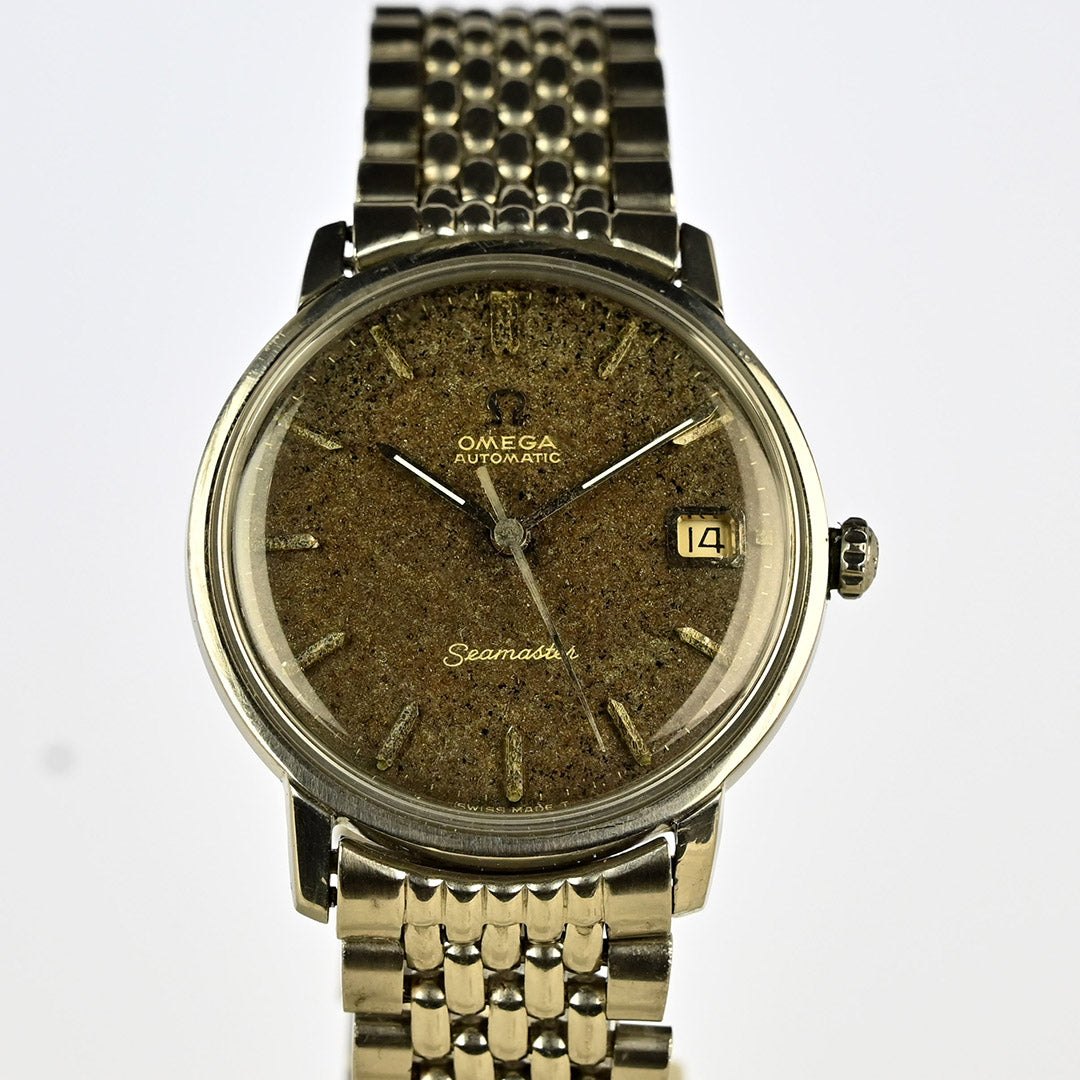
Omega Seamaster, ref. 166.001, 'Mink Granite' Dial, circa 1964
- Maker / attribution
- Omega (maker)
- Date
- c. 1964
- Historical period
- Modern Mechanical Horology (1945 – 1969)
- Country of origin
- Switzerland
- Object type
- Wristwatch
- Dimensions
- Case 34 mm
- Stock no.
- vws2081ps
- Credit line
- Dealer listing, Vintage Watch Specialist (vws2081ps)
- Catalogue title (original)
- Omega Seamaster - Model Ref: 166.001 - Beautiful 'Mink Granite' Dial - c.1964 (English)
View the source record (dealer listing) ↗ (opens another website in a new tab)Suggest a correction
Record summary
Catalogued by Vintage Watch Specialist (dealer), United Kingdom (stock number vws2081ps), this is a wristwatch by Omega, made in Switzerland, dated c. 1964. The Atlas places it in the Modern Mechanical Horology period (1945 – 1969) of its Wristwatches collection. Recorded dimensions: Case 34 mm. The record is illustrated with 6 photographs.
Assembled from the source record's structured fields. Dates and attributions are given as the source states them; where a field is missing the Atlas leaves it blank rather than estimating.
Catalogue description
Dealer description — Vintage Watch Specialist
An Omega Seamaster with Beautiful 'Mink Granite' Patina, Model Ref: 166.001, Issued in 1964, with Omega Beads of Rice Bracelet. In 1995, the OMEGA Seamaster achieved mainstream popularity when it joined the James Bond film franchise. It started with Pierce Brosnan’s Seamaster Diver 300M in GoldenEye and continued with Daniel Craig’s Seamaster 300 in SPECTRE . Today, the modern 007 is never without an OMEGA dive watch . However, the OMEGA Seamaster history started long before Bond’s. The Seamaster is the longest-running product line still produced by Omega. It was introduced in 1948 to celebrate Omegas 100th anniversary and was loosely based upon designs made for the British Royal Navy towards the end of World War II. The original Seamaster's key feature was an O-ring gasket used to provide its waterproof seal. Today it remains the oldest model in Omega’s current collection. What’s On Offer Have you ever seen a dial as individual as this? Nature has worked its magic on what would almost certainly have been a modest black dial, and transformed it into this textured 'mink granite' effect. The patina is that evenly dispersed across the dial, that it almost looks purposely done - this is a real one-off, an absolute work of art and we love it! The simple dial design boasts applied baton hour markers, slim pencil hands, a central seconds hand and a subtle date aperture at 3 o'clock. An applied Omega emblem and Seamaster signature complete the picture. This jewel-like dial is preserved underneath scratch-free plexi and encapsulated in a 34mm stainless steel case which sports the synonymous Seamaster hippocampus on the reverse. The watch is sold with its original Omega beads of rice bracelet, which wears beautifully on the wrist. You will simply never find another watch like this, it's as unique as you are! Running well and keeping good time, this watch has very recently undergone a full service by our revered watchmaker and comes to you in excellent condition. Additional information Made from Case: Stainless steel Dial: Tropical Crystal: Plexi Bracelet: Omega Beads of Rice Technical specifications Winding: Automatic Movement Type: Mechanical Caliber: 562 Jewels: 24j Waterproof: When new Power reserve: 50 hrs Purchase details Condition: Superb Model Reference: 166.001 Date of issue: 1964
Historical context
Modern Mechanical Horology (1945 – 1969)
Tool watches for divers, pilots and astronauts; electric watches anticipate the electronic age.
The classic era of the mechanical wristwatch: dive watches, chronographs for motor racing and space flight, GMT watches for jet travel, slim dress watches, automatic calendars, and the rise of Japanese manufacturers alongside Swiss, American, German and Soviet industries.
Read the period in the timelineMore wristwatches from this periodEarlier: Golden Age of Mechanical Watchmaking
Atlas type guide
Dive and water-resistant watches
Keeping water and dust out of a wristwatch was a long-standing challenge. Rolex's screw-down Oyster case (1926) and Omega's Marine (1932) were landmarks; in the early 1950s Blancpain's Fifty Fathoms and Rolex's Submariner defined the professional dive watch with rotating bezels for timing dives, luminous dials and high water resistance. The ISO 6425 standard (1982) later codified what a 'diver's watch' must do.
Dive watches became icons of post-war design and exploration, and their evolution — helium escape valves, ceramic bezels, saturation-diving depth ratings — records the history of underwater work.
What to look for
- Unidirectional or bidirectional rotating bezel with minute markings.
- Screw-down crown and case back; depth rating printed on the dial.
- Luminous hands and markers (radium before c. 1960, tritium c. 1960–1998, then Super-LumiNova).
- Reference numbers on the case between the lugs or inside the back.
Dating clues
- Screw-down Oyster cases: from 1926.
- Professional dive watches: from 1953.
- Tritium 'T' marks on dials: c. 1960–1998.
General guidance written by the Atlas editors about this kind of object. It is not a statement about this particular piece; for that, rely on the source record above and on physical examination.
Related records

Instruments · 1950–1976
Omega Megaquartz 2400 marine chronometer, 1950–1976
Science Museum Group, London

Instruments · 1960–1979
Stopwatch / timer by Omega, 1960–1979
Science Museum Group, London

Instruments · 1960–1979
Stopwatch / timer by Omega, Switzerland, 1960–1979
Science Museum Group, London

Instruments · 1960–1979
Stopwatch by Omega, Swiss made, single-button type reading 0 - 60 seconds in fifths and 0 - 5 minutes in minutes on subsidiary dial, 1960-79.
Science Museum Group, London

Wristwatches · 1945
Wristwatch by Eterna, 1945
Museum Rotterdam

Wristwatches · c. 1945
Breitling Premier, ref. 790, c. 1945
Antiquorum auction archive, Geneva

Wristwatches · c. 1945
Universal Genève Uni-Compax, ref. 22492, c. 1945
Antiquorum auction archive, Geneva

Wristwatches · c. 1950s
Baume & Mercier wristwatch, c. 1950s
Antiquorum auction archive, Geneva