
Pocket Watches · Diving watch
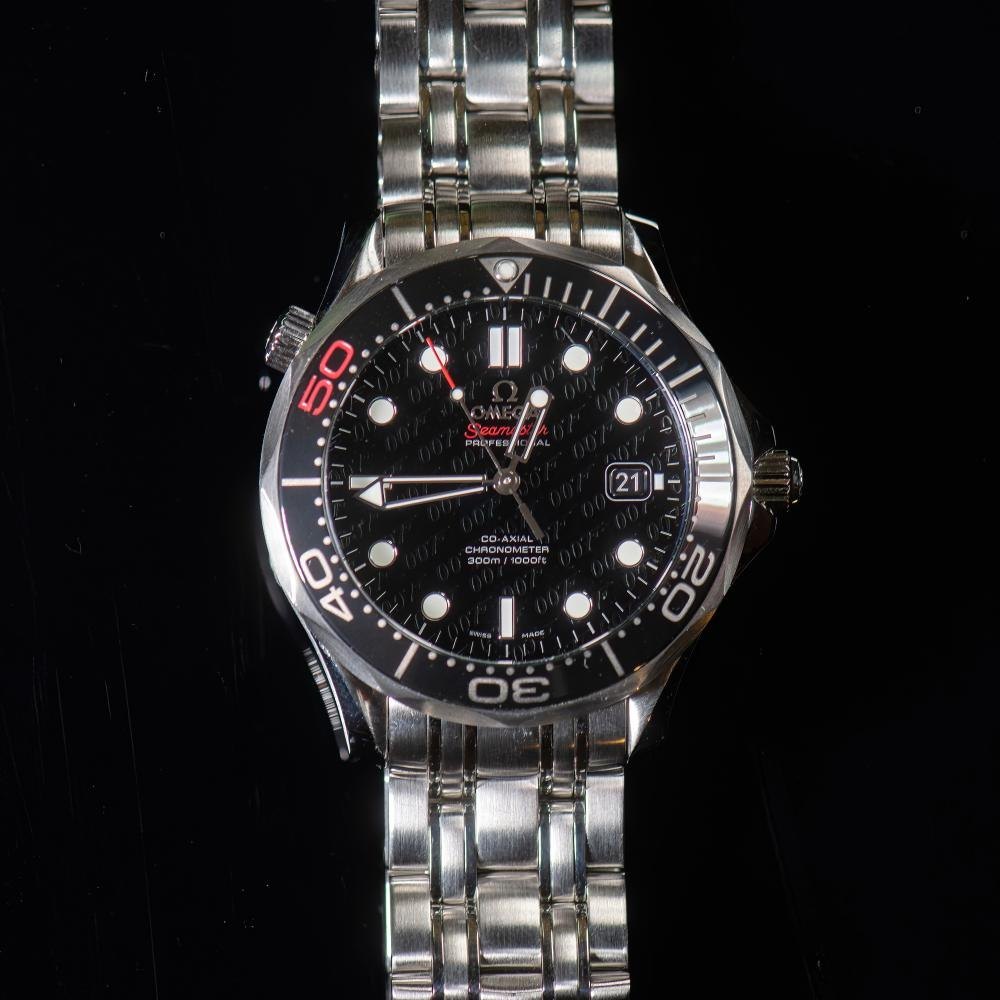
Omega Seamaster Professional Co-Axial Chronometer James Bond Limited Edition
- Maker / attribution
- Omega (source attribution)
- Date
- 2012
- Historical period
- Contemporary Horology (2010 – Present)
- Country of origin
- Switzerland
- Object type
- Diving watch
- Dimensions
- 41mm
- Auction house
- Elstob Auctioneers (via Invaluable)
- Lot
- 518
- Credit line
- Elstob Auctioneers (via Invaluable)
- Catalogue title (original)
- AN UNWORN LIMITED EDITION OMEGA JAMES BOND SEAMASTER WATCH (English)
View the source record (auction lot) ↗ (opens another website in a new tab)Suggest a correction
Record summary
Catalogued by Elstob Auctioneers (via Invaluable) (lot 518), this is a diving watch attributed to Omega, made in Switzerland, dated 2012. The Atlas places it in the Contemporary Horology period (2010 – Present) of its Pocket Watches collection. Recorded dimensions: 41mm. The record is illustrated with 1 photograph.
Assembled from the source record's structured fields. Dates and attributions are given as the source states them; where a field is missing the Atlas leaves it blank rather than estimating.
Catalogue description
Original object description
Bearing individual designation 04552/11007 from a limited edition of 11,007 units, this 41mm Omega Seamaster Professional Co-Axial Chronometer was released in 2012. The steel case is topped with a domed sapphire crystal, a black ceramic unidirectional timing bezel, and a manual helium release valve at the 10 o'clock position. The black dial is patterned with a diagonal field of '007' emblems, luminous dots, baton hour markers, and a date window located at 3 o'clock. On the reverse, the screw-down caseback is detailed with a gun-barrel rifling spiral surrounding a central transparent window displaying the automatic Omega calibre 2507 movement. Although catalogued as running at the time of cataloguing, its timekeeping accuracy was not verified. The watch is worn on a stainless steel bracelet featuring a folding deployant clasp with an integrated diver's wetsuit extension. Included with the watch are its original packaging and warranty cards, along with promotional items connecting the model to the film 'Skyfall', including two cinema showcards, an official Omega press kit, and Greg Williams's publication 'James Bond on Set'.
Inscriptions & marks
04552/11007
Historical context
Contemporary Horology (2010 – Present)
Silicon components, connected watches, optical-lattice research clocks and a thriving independent scene.
Pocket watches are now produced mainly as limited editions, unique pieces and heritage reissues, often showcasing traditional crafts such as enamel and engraving.
Read the period in the timelineMore pocket watches from this periodEarlier: Mechanical Renaissance
Atlas type guide
Pocket chronometers and precision watches
A pocket chronometer is a watch built to observatory standards, traditionally with a detent escapement like a marine chronometer. English makers such as John Arnold and Thomas Earnshaw made the first pocket chronometers in the 1780s. In the nineteenth century the term increasingly referred to any watch that had passed official rating trials at observatories in Kew, Neuchâtel, Geneva or Besançon, and the Swiss lever chronometer became dominant.
Tourbillon and karrusel watches belong to the same world of precision. Breguet patented the tourbillon in 1801 to average out positional errors; Bahne Bonniksen's karrusel (1892) was a cheaper English alternative. Rating certificates (bulletins de marche) that accompany such watches are historical documents in their own right.
What to look for
- Detent escapement (no pallets; a fine spring detent locks the escape wheel).
- Observatory certificates, competition results or 'Chronometer' marking on the dial.
- Tourbillon carriage visible through an aperture or on the movement.
- Fine finishing: jewelled holes in gold chatons, diamond endstones.
Dating clues
- English pocket chronometers: c. 1780–1900.
- Observatory trials at Neuchâtel from 1866, Geneva from 1873, Kew from 1884.
- Karrusels: 1892–c. 1915.
General guidance written by the Atlas editors about this kind of object. It is not a statement about this particular piece; for that, rely on the source record above and on physical examination.
Read next:Spring detent (chronometer) escapementTourbillonDetached lever escapement
Related records

Instruments · 1950–1976
Omega Megaquartz 2400 marine chronometer, 1950–1976
Science Museum Group, London

Instruments · 1960–1979
Stopwatch / timer by Omega, 1960–1979
Science Museum Group, London

Instruments · 1960–1979
Stopwatch / timer by Omega, Switzerland, 1960–1979
Science Museum Group, London

Instruments · 1960–1979
Stopwatch by Omega, Swiss made, single-button type reading 0 - 60 seconds in fifths and 0 - 5 minutes in minutes on subsidiary dial, 1960-79.
Science Museum Group, London
Pocket Watches · 13.11.2026
Pocket watch by Borel Fils & Cie, Switzerland, 13.11.2026
Museokeskus Vapriikki
Pocket Watches · 2016
F.P. Journe Octa UTC Boutique Edition, 2016
S.Song Watches (dealer), Seattle
Pocket Watches · 2016
2016 Rolex Submariner Date Ref. 116610LN
Craft & Tailored
Pocket Watches · 2019
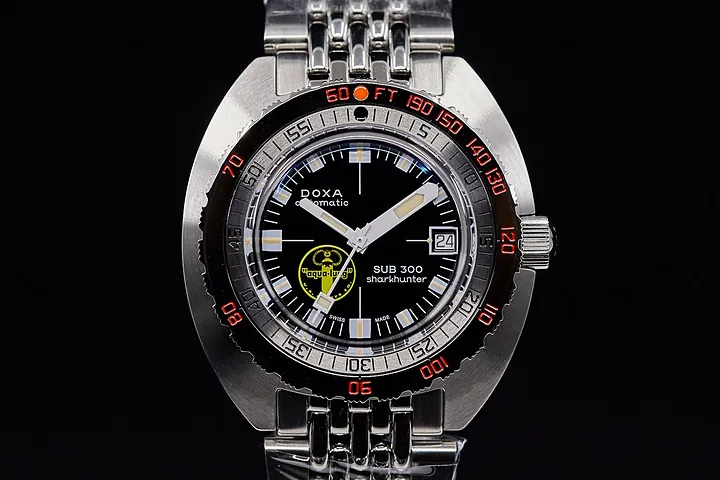
DOXA Sub 300 Sharkhunter 'Blacklung' Reissue
Analog/Shift