
Wristwatches · Wristwatch
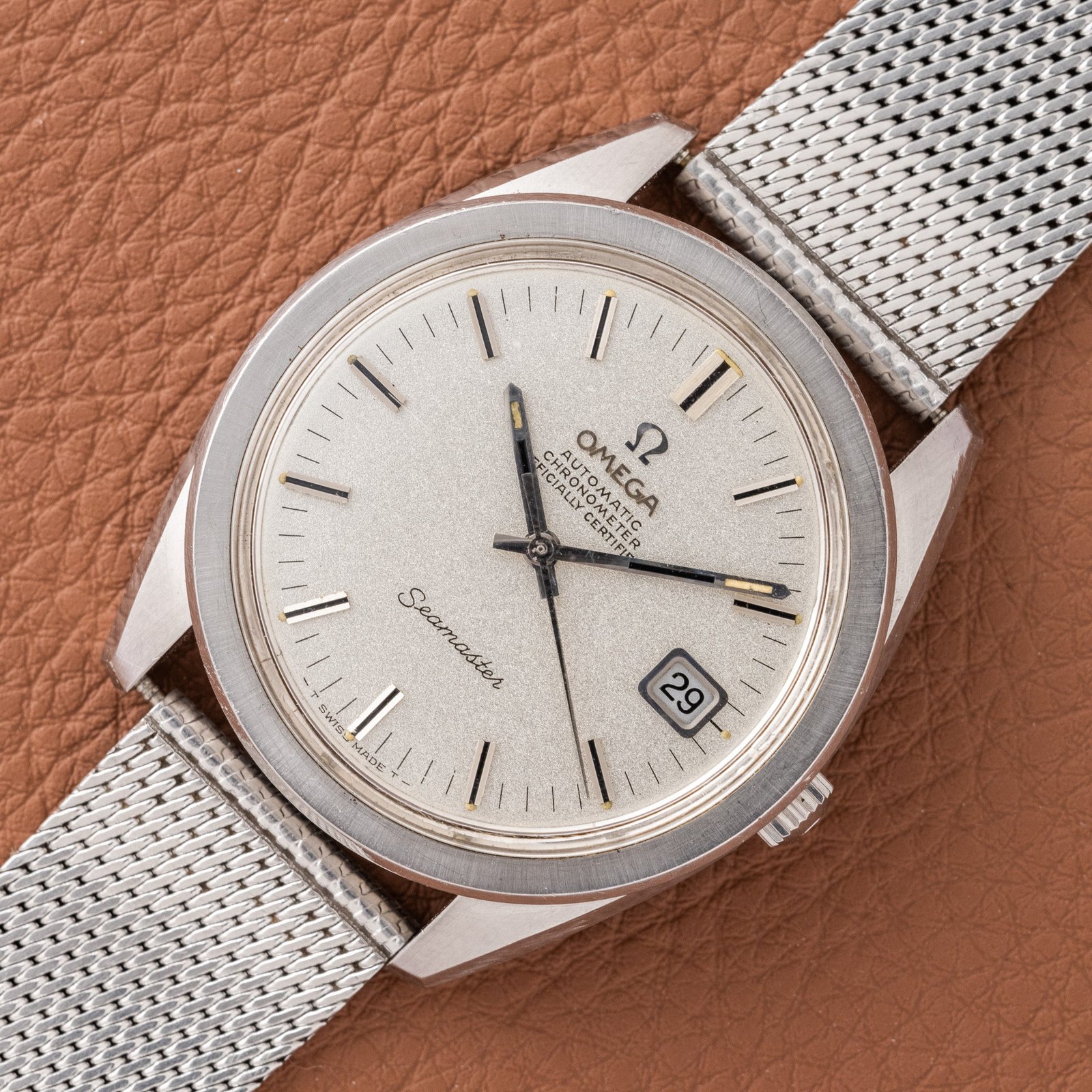
Omega Seamaster Jumbo Sparkle Dial (Ref. 168.022), 1970s
- Maker / attribution
- Omega (maker)
- Date
- 1970s
- Historical period
- Quartz Revolution (1969 – 1990)
- Country of origin
- Switzerland
- Object type
- Wristwatch
- Dimensions
- Case 36 mm
- Stock no.
- Product 8306024710327
- Credit line
- Dealer listing, Huntington Company (product 8306024710327)
- Catalogue title (original)
- 1970s Omega Seamaster Jumbo Sparkle Dial (Ref. 168.022) (English)
View the source record (dealer listing) ↗ (opens another website in a new tab)Suggest a correction
Record summary
Catalogued by Huntington Company (dealer) (stock number Product 8306024710327), this is a wristwatch by Omega, made in Switzerland, dated 1970s. The Atlas places it in the Quartz Revolution period (1969 – 1990) of its Wristwatches collection. Recorded dimensions: Case 36 mm. The record is illustrated with 6 photographs.
Assembled from the source record's structured fields. Dates and attributions are given as the source states them; where a field is missing the Atlas leaves it blank rather than estimating.
Catalogue description
Dealer description — Huntington Company
Timeless and Attainable Start your vintage journey with confidence. History & Significance The 168.022 represents the chronometer-rated side of the Seamaster line during the late 1960s and early 1970s. This reference uses the cal. 564, one of Omega’s most respected automatic chronometer movements of the era, known for its reliability and quick-set date. The case design reflects transitional Omega styling in this period, combining sharper edges with a slightly tonneau profile. This example stands out for its clean silver 'sparkle' dial, applied indices, and its original Omega mesh bracelet, which was a premium accessory option at the time. The piece carries the classic Seahorse caseback medallion and retains its signed crown, making it a strong, correct example of a chronometer-grade Seamaster. Writer’s Thoughts The flat brushed case sides and slim profile make it an easy daily wear. The mesh bracelet gives it a distinctive vintage character while keeping the weight balanced on the wrist. The 36mm case is a more uncommon size for the era, making this a great contender for many looking to add a Seamaster to their collection. Our Promise Every watch is thoroughly vetted, carefully described with complete transparency, and guaranteed authentic. This Omega is offered in original condition, representing an uncommon and stylish take on one of Omega’s most iconic model families. Specifications Brand: Omega Model: Seamaster Chronometer ref. 168.022 Year: circa 1970s Case Material: Stainless steel Case Size: 36mm Dial: Silver 'frosted' finish Crystal: Acrylic Movement: Automatic Strap: Omega mesh bracelet Buckle/Clasp: Omega-signed locking clasp Contents: Watch only Condition Case: Strong case with sharp edges and consistent brushing. Light wear consistent with age. Bezel: Clean bezel with minor wear. Crystal: Light surface wear visible under reflection. Dial: Silver dial in clean condition with evenly aged lume plots on the indices. Hands: Correct hands with matching aged lume. Strap: Omega stainless steel mesh bracelet in good condition. Buckle/Clasp: Omega-signed clasp with light wear.
Historical context
Quartz Revolution (1969 – 1990)
Seiko's Astron begins mass quartz timekeeping; traditional industries contract sharply.
Quartz and digital watches transformed the market after 1969. Swiss employment collapsed, Japanese and Hong Kong production soared, and the Swatch (1983) helped the Swiss industry recover; mechanical watches survived as luxury goods.
Read the period in the timelineMore wristwatches from this periodEarlier: Modern Mechanical Horology
Atlas type guide
Dive and water-resistant watches
Keeping water and dust out of a wristwatch was a long-standing challenge. Rolex's screw-down Oyster case (1926) and Omega's Marine (1932) were landmarks; in the early 1950s Blancpain's Fifty Fathoms and Rolex's Submariner defined the professional dive watch with rotating bezels for timing dives, luminous dials and high water resistance. The ISO 6425 standard (1982) later codified what a 'diver's watch' must do.
Dive watches became icons of post-war design and exploration, and their evolution — helium escape valves, ceramic bezels, saturation-diving depth ratings — records the history of underwater work.
What to look for
- Unidirectional or bidirectional rotating bezel with minute markings.
- Screw-down crown and case back; depth rating printed on the dial.
- Luminous hands and markers (radium before c. 1960, tritium c. 1960–1998, then Super-LumiNova).
- Reference numbers on the case between the lugs or inside the back.
Dating clues
- Screw-down Oyster cases: from 1926.
- Professional dive watches: from 1953.
- Tritium 'T' marks on dials: c. 1960–1998.
General guidance written by the Atlas editors about this kind of object. It is not a statement about this particular piece; for that, rely on the source record above and on physical examination.
Related records

Instruments · 1950–1976
Omega Megaquartz 2400 marine chronometer, 1950–1976
Science Museum Group, London

Instruments · 1960–1979
Stopwatch / timer by Omega, 1960–1979
Science Museum Group, London

Instruments · 1960–1979
Stopwatch / timer by Omega, Switzerland, 1960–1979
Science Museum Group, London

Instruments · 1960–1979
Stopwatch by Omega, Swiss made, single-button type reading 0 - 60 seconds in fifths and 0 - 5 minutes in minutes on subsidiary dial, 1960-79.
Science Museum Group, London

Wristwatches · 1970
Wristwatch by Heno, Switzerland, 1970
Museum Rotterdam

Wristwatches · 1960–1986
'Tri-Compax' calendar chronograph wristwatch in gold case, by Universal, Geneva, Switzerland, 1960–1986.
Science Museum Group, London

Wristwatches · 1969–1970
Beta 21 Quartz wristwatch movement, made in Switzerland, 1970.
Science Museum Group, London

Wristwatches · c. 1969
Omega Speedmaster Moonwatch, ref. 145022-69st, c. 1969
Antiquorum auction archive, Geneva