
Wristwatches · Wristwatch
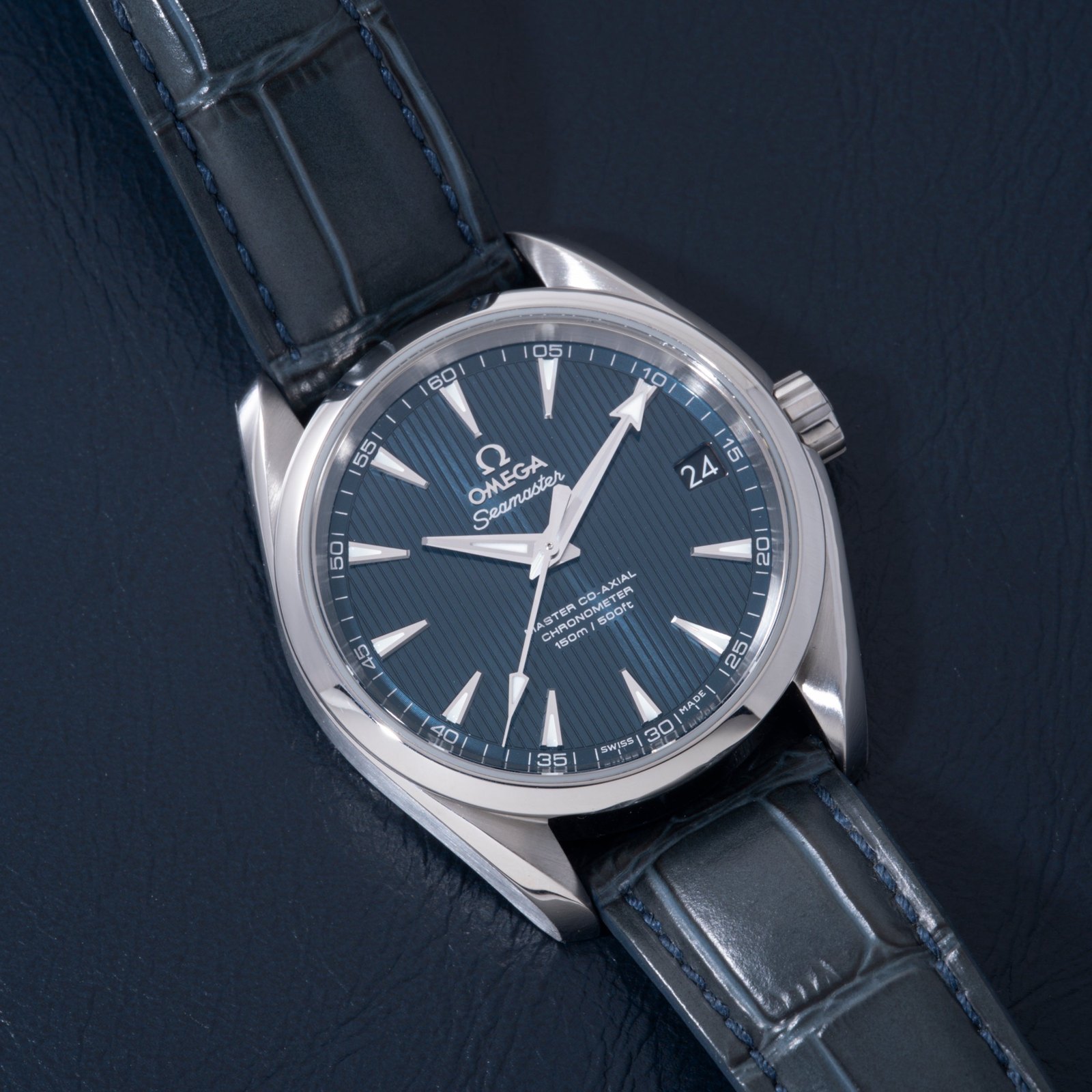
Omega Seamaster Aqua Terra, 2010s
- Maker / attribution
- Omega (maker)
- Date
- 2010s
- Historical period
- Contemporary Horology (2010 – Present)
- Country of origin
- Switzerland
- Object type
- Wristwatch
- Dimensions
- Case 38.5 mm
- Stock no.
- 409960411
- Credit line
- Dealer listing, Analog/Shift (409960411)
- Catalogue title (original)
- Omega Seamaster Aqua Terra (English)
View the source record (dealer listing) ↗ (opens another website in a new tab)Suggest a correction
Record summary
Catalogued by Analog/Shift (dealer), New York (stock number 409960411), this is a wristwatch by Omega, made in Switzerland, dated 2010s. The Atlas places it in the Contemporary Horology period (2010 – Present) of its Wristwatches collection. Recorded dimensions: Case 38.5 mm. The record is illustrated with 6 photographs.
Assembled from the source record's structured fields. Dates and attributions are given as the source states them; where a field is missing the Atlas leaves it blank rather than estimating.
Catalogue description
Dealer description — Analog/Shift
The Omega Seamaster Aqua Terra has always occupied an appealing middle ground. Introduced in 2002, it brought the Seamaster’s maritime heritage into a cleaner, more versatile package: robust enough to earn its place within the famous dive-watch family, yet refined enough to work far beyond the water. This example from the 2010s pairs a 38.5mm stainless steel case with one of the Aqua Terra’s signature designs: a rich blue dial featuring Omega’s vertically striped “Teak Concept” pattern, inspired by the wooden decks of luxury sailing yachts. Applied faceted hour markers and matching hands give the dial a crisp, architectural quality, while the date aperture at 3 o’clock adds everyday practicality. A scratch-resistant sapphire crystal protects the dial, while the blue alligator leather strap gives the watch a slightly dressier character than its bracelet-equipped counterparts. Inside is Omega’s Co-Axial Calibre 8500, a self-winding, chronometer-certified movement developed around the brand’s Co-Axial escapement. Visible through the sapphire exhibition caseback, the movement offers a 60-hour power reserve and features Omega’s distinctive arabesque Geneva-wave decoration. Water resistance to 150 meters reinforces the idea behind the Aqua Terra itself: elegance without fragility.
Historical context
Contemporary Horology (2010 – Present)
Silicon components, connected watches, optical-lattice research clocks and a thriving independent scene.
Smartwatches became the world's best-selling watches, while mechanical watchmaking focuses on craft, innovation (silicon components, new escapements) and independent makers.
Read the period in the timelineMore wristwatches from this periodEarlier: Mechanical Renaissance
Atlas type guide
Dive and water-resistant watches
Keeping water and dust out of a wristwatch was a long-standing challenge. Rolex's screw-down Oyster case (1926) and Omega's Marine (1932) were landmarks; in the early 1950s Blancpain's Fifty Fathoms and Rolex's Submariner defined the professional dive watch with rotating bezels for timing dives, luminous dials and high water resistance. The ISO 6425 standard (1982) later codified what a 'diver's watch' must do.
Dive watches became icons of post-war design and exploration, and their evolution — helium escape valves, ceramic bezels, saturation-diving depth ratings — records the history of underwater work.
What to look for
- Unidirectional or bidirectional rotating bezel with minute markings.
- Screw-down crown and case back; depth rating printed on the dial.
- Luminous hands and markers (radium before c. 1960, tritium c. 1960–1998, then Super-LumiNova).
- Reference numbers on the case between the lugs or inside the back.
Dating clues
- Screw-down Oyster cases: from 1926.
- Professional dive watches: from 1953.
- Tritium 'T' marks on dials: c. 1960–1998.
General guidance written by the Atlas editors about this kind of object. It is not a statement about this particular piece; for that, rely on the source record above and on physical examination.
Related records

Instruments · 1950–1976
Omega Megaquartz 2400 marine chronometer, 1950–1976
Science Museum Group, London

Instruments · 1960–1979
Stopwatch / timer by Omega, 1960–1979
Science Museum Group, London

Instruments · 1960–1979
Stopwatch / timer by Omega, Switzerland, 1960–1979
Science Museum Group, London

Instruments · 1960–1979
Stopwatch by Omega, Swiss made, single-button type reading 0 - 60 seconds in fifths and 0 - 5 minutes in minutes on subsidiary dial, 1960-79.
Science Museum Group, London

Wristwatches · c. 2010s
Breguet Type XXI, ref. 3810, c. 2010s (Antiquorum Lot 381-24)
Antiquorum auction archive, Geneva

Wristwatches · c. 2010s
Breguet Type XXI, ref. 3810, c. 2010s (Antiquorum Lot 386-229)
Antiquorum auction archive, Geneva

Wristwatches · Sold in September 2010
Breitling Cosmonaute, ref. A 22322, Sold in September 2010
Antiquorum auction archive, Geneva

Wristwatches · c. 2010
Corum Bubble Chrono, ref. 396.150.20, c. 2010
Antiquorum auction archive, Geneva