
Wristwatches · Wristwatch
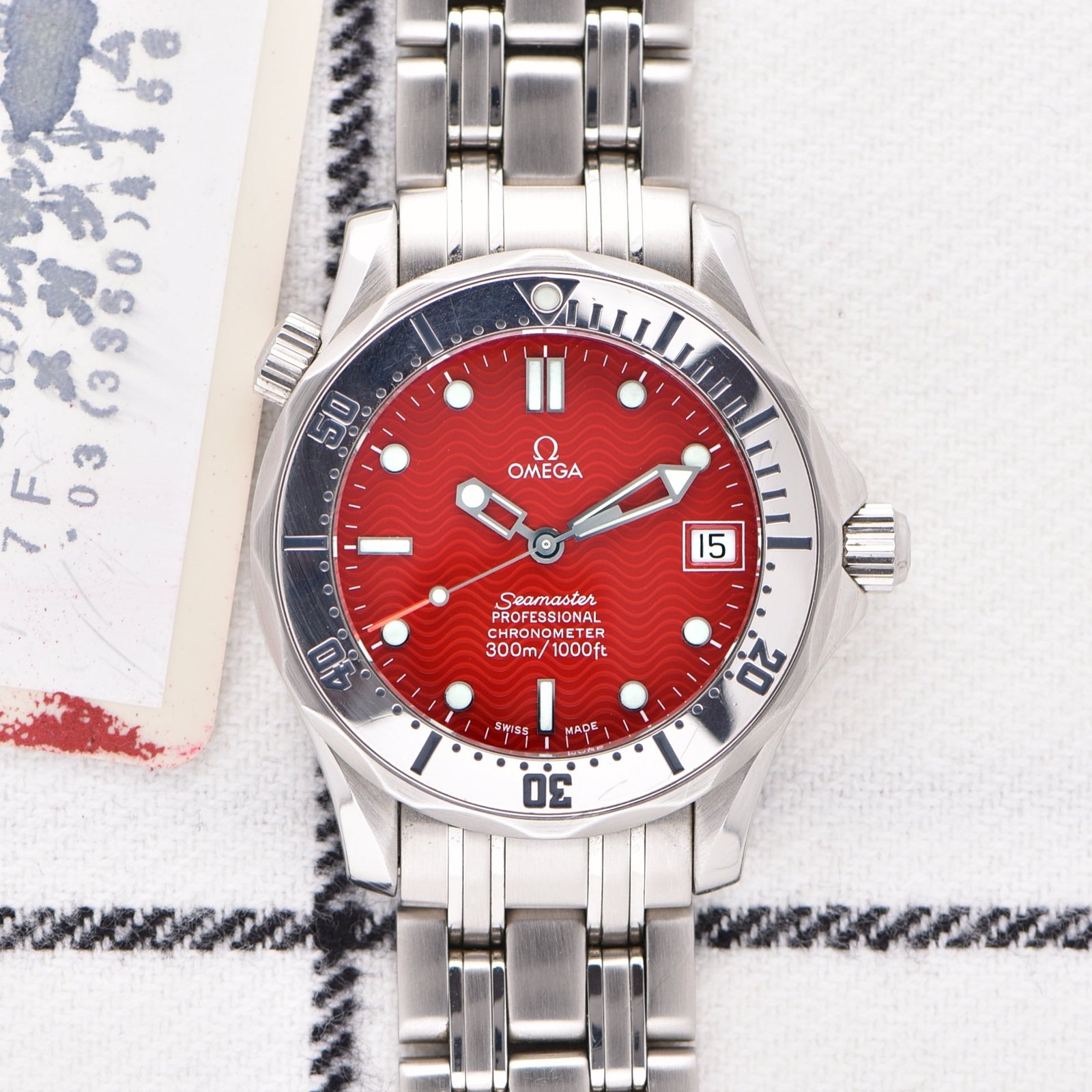
Omega Seamaster 300M Red Marui Edition, 1999
- Maker / attribution
- Omega (maker)
- Date
- 1999
- Historical period
- Mechanical Renaissance (1990 – 2010)
- Country of origin
- Switzerland
- Object type
- Wristwatch
- Dimensions
- Case 36 mm
- Stock no.
- Product 7403776278711
- Credit line
- Dealer listing, Huntington Company (product 7403776278711)
- Catalogue title (original)
- 1999 Omega Seamaster 300M Red Marui Edition - Box & Papers (English)
View the source record (dealer listing) ↗ (opens another website in a new tab)Suggest a correction
Record summary
Catalogued by Huntington Company (dealer) (stock number Product 7403776278711), this is a wristwatch by Omega, made in Switzerland, dated 1999. The Atlas places it in the Mechanical Renaissance period (1990 – 2010) of its Wristwatches collection. Recorded dimensions: Case 36 mm. The record is illustrated with 6 photographs.
Assembled from the source record's structured fields. Dates and attributions are given as the source states them; where a field is missing the Atlas leaves it blank rather than estimating.
Catalogue description
Dealer description — Huntington Company
2552.61 Specifications Year: 1999 Model: Seamaster 300M Case Diameter: 36mm Lug to Lug: 40mm Case: Stainless Steel Condition: No significant wear as seen Dial: Red Movement: Automatic Condition One of the cleanest red dial Seamasters we've seen. As you can see the dial is perfect with perfect lume. The case and bracelet are unpolished and in amazing condition. There is no paint loss in the bezel markers. The watch comes as a complete set with the box, booklets, and certificate. The Story The Omega Seamaster, a popular watch, has a long history dating back to 1948. It was first introduced in 1948 as a tribute to Omega's 100th anniversary and became the brand's best seller. The Seamaster was modeled after waterproof wristwatches worn by the British military during World War II. Its O-ring gasket improved its water-resistance, making it resistant to temperatures up to 60 meters. In 1957, Omega introduced the Seamaster 300, designed for underwater use, but only capable of diving to 200 meters. Oceanographer Jacques Cousteau's team wore the watch during their Conshelf II experiments in the Red Sea. By the mid-1990s, the Seamaster had fallen out of popularity, but it was selected as the James Bond watch. Pierce Brosnan wore an Omega Seamaster 300 in the film Golden Eye in 1995, and Daniel Craig wore an Omega Seamaster 300 and Planet Ocean in Casino Royale, Quantum of Solace, and Skyfall. In 2015, Omega released the special edition Seamaster 300 Spectre, harking back to the original Bond Seamaster. For this Marui edition, its a limited edition Seamaster exclusively done for Marui, a retailer in Japan. The company operates a chain of department stores in Tokyo as well as other major Japanese cities. The more common Marui edition is the Panda Speedmaster Reduced you may or may not have seen. From our research, it looks like the red Seamaster was done in more limited numbers but the specific quantity is unknown. The Brand Omega, a Swiss watchmaker founded in 1848, has a rich history of innovation and precision. The company's vision was carried on by its sons Louis-Paul and César, who pioneered full watch production under the brand's roof. In 1894, the company unveiled the world's first mass-produced, interchangeable watch movement, the Omega Calibre, which streamlined production and propelled the brand to international fame. As the 20th century began, Omega watches became at the forefront of timekeeping technology and revolutionized sports watches with their precision. The Olympic Games provided an ideal stage for Omega to demonstrate its exceptional timekeeping abilities. In 1932, Omega began its role as Official Olympic Timekeeper, starting an enduring partnership spanning over 80 years. With each Games, Omega introduced groundbreaking timekeeping innovations, such as the first photo finish camera at the 1948 London Olympics. Omega's contributions to spaceflight began in 1962 when the Omega Speedmaster became the first watch worn in space on Mercury-Atlas 6. Its defining moment came in 1969 with the Apollo 11 moon landing, where Buzz Aldrin stepped onto the moon wearing his trusty Omega Speedmaster Moonwatch. The company played an indispensable role in NASA's pioneering '60s space missions, including the Apollo 13 mission, where the Speedmaster timed the engine burn, ensuring the crew's safe descent to Earth. Omega's cultural impact extends into pop culture through a long-running cinematic partnership with James Bond Movies. Since 1995's GoldenEye, James Bond has sported Omega watches on the silver screen, wearing the Seamaster Diver 300M and the rugged Omega Seamaster Planet Ocean. Omega remains dedicated to exploring new technological frontiers today, with innovations like the battery-free Pictograms model, wearable tech collaborations, and energy-harnessing movements driving progress and cementing its place in history.
Historical context
Mechanical Renaissance (1990 – 2010)
Mechanical watches return as cultural objects; independent watchmaking flourishes.
Mechanical watches returned as cultural and luxury objects. Complications, tourbillons and new materials proliferated; independent watchmakers such as George Daniels, F.P. Journe and Philippe Dufour revived artisanal watchmaking; collecting vintage watches became a major field.
Read the period in the timelineMore wristwatches from this periodEarlier: Quartz Revolution
Atlas type guide
Dive and water-resistant watches
Keeping water and dust out of a wristwatch was a long-standing challenge. Rolex's screw-down Oyster case (1926) and Omega's Marine (1932) were landmarks; in the early 1950s Blancpain's Fifty Fathoms and Rolex's Submariner defined the professional dive watch with rotating bezels for timing dives, luminous dials and high water resistance. The ISO 6425 standard (1982) later codified what a 'diver's watch' must do.
Dive watches became icons of post-war design and exploration, and their evolution — helium escape valves, ceramic bezels, saturation-diving depth ratings — records the history of underwater work.
What to look for
- Unidirectional or bidirectional rotating bezel with minute markings.
- Screw-down crown and case back; depth rating printed on the dial.
- Luminous hands and markers (radium before c. 1960, tritium c. 1960–1998, then Super-LumiNova).
- Reference numbers on the case between the lugs or inside the back.
Dating clues
- Screw-down Oyster cases: from 1926.
- Professional dive watches: from 1953.
- Tritium 'T' marks on dials: c. 1960–1998.
General guidance written by the Atlas editors about this kind of object. It is not a statement about this particular piece; for that, rely on the source record above and on physical examination.
Related records

Instruments · 1950–1976
Omega Megaquartz 2400 marine chronometer, 1950–1976
Science Museum Group, London

Instruments · 1960–1979
Stopwatch / timer by Omega, 1960–1979
Science Museum Group, London

Instruments · 1960–1979
Stopwatch / timer by Omega, Switzerland, 1960–1979
Science Museum Group, London

Instruments · 1960–1979
Stopwatch by Omega, Swiss made, single-button type reading 0 - 60 seconds in fifths and 0 - 5 minutes in minutes on subsidiary dial, 1960-79.
Science Museum Group, London

Wristwatches · 2008
Wristwatch by Breitling?, 2008
Museum Rotterdam

Wristwatches · c. 1990s
Audemars Piguet Bamboo, c. 1990s
Antiquorum auction archive, Geneva

Wristwatches · c. 1990
Audemars Piguet Huitieme Perpetual Calendar, ref. 25696PT, c. 1990
Antiquorum auction archive, Geneva

Wristwatches · c. 1990
Breitling Chronomat, ref. b13050.1, c. 1990
Antiquorum auction archive, Geneva