
Wristwatches · Wristwatch
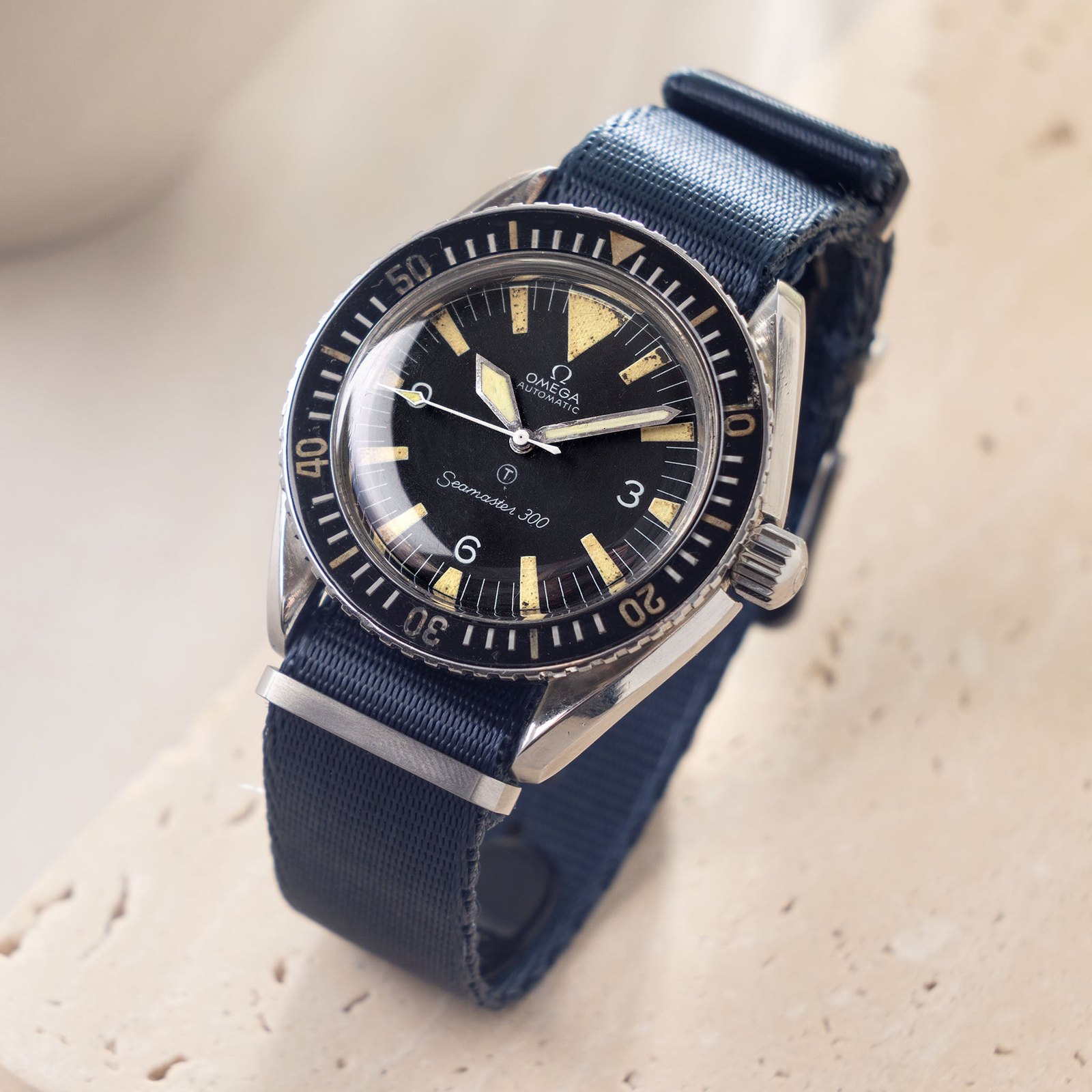
Omega Seamaster 300 British Royal Navy issued ref. 165.024 Mill Spec Circle-T Dial, 1968
- Maker / attribution
- Omega (maker)
- Date
- 1968
- Historical period
- Modern Mechanical Horology (1945 – 1969)
- Country of origin
- England
- Object type
- Wristwatch
- Dimensions
- Case 42 mm
- Stock no.
- W-3465
- Credit line
- Dealer listing, Bulang & Sons (W-3465)
- Catalogue title (original)
- Omega Seamaster 300 British Royal Navy issued ref. 165.024 Mill Spec Circle-T Dial (English)
View the source record (dealer listing) ↗ (opens another website in a new tab)Suggest a correction
Record summary
Catalogued by Bulang & Sons (dealer), Copenhagen (stock number W-3465), this is a wristwatch by Omega, made in England, dated 1968. The Atlas places it in the Modern Mechanical Horology period (1945 – 1969) of its Wristwatches collection. Recorded dimensions: Case 42 mm. The record is illustrated with 6 photographs.
Assembled from the source record's structured fields. Dates and attributions are given as the source states them; where a field is missing the Atlas leaves it blank rather than estimating.
Catalogue description
Dealer description — Bulang & Sons
The Omega Seamaster 300 has a storied military heritage, most notably with the British Royal Navy, which commissioned a special version in 1967. This military issue was a modified Seamaster 300 featuring fixed lugs for a one-piece strap, an encircled “T” to denote tritium lume, and a large triangular marker at 12 o’clock for improved readability. These military watches, delivered between 1967 and 1971, were engraved with service identifiers such as “0552” for the Royal Navy or “W10” for the Army. The “Big Triangle” dial, paired with the broad sword hands, offers exceptional legibility and now displays a beautiful yellow patina on the lume. The use of tritium on the hands and indices is confirmed by the circled “T” on the dial — a hallmark reserved for true military dive watches. The bezel remains in excellent condition, showing no major defects or cracks. This exceptional tool watch is fitted with one of our Bulang and Sons single-pass nylon straps. Over the years, the case lost its original fixed bars — likely after its military service — perhaps to allow for the fitting of a metal bracelet. The caseback bears the military code “0552/923-7xxx A/347/70,” confirming delivery to the Royal Navy in 1970. Inside beats the automatic, red-gilded Omega Caliber 552 movement, which has been fully serviced by our watchmaker. Ready for its next mission, this Omega Seamaster 300 is a true military classic — as collectible as it is wearable. Built for men who don’t flinch at 50 metres under the Sea level and issued to those who actually earned the right to wear it — the Omega “Big Triangle” Seamaster isn’t just a handsome face, it’s proper military kit . Service-issued, battle-ready, and tough as they come. Don’t stall — a Royal Navy Seamaster doesn’t wait for stragglers. ⚓ Specifications: Omega Seamaster 300 165.024 British Royal Navy issued 42mm steel case wit twisted lugs and Case-back engraved “0552/923-7xxx A/347/70,” per MOD Specifications Arabic 12-6-9 layout, Circle-T dial Sword hands Calibre 552 automatic movement Bulang and sons single pass nylon strap Movement Serial 293xxxxx dating to 1968 Fully serviced by our watchmaker
Historical context
Modern Mechanical Horology (1945 – 1969)
Tool watches for divers, pilots and astronauts; electric watches anticipate the electronic age.
The classic era of the mechanical wristwatch: dive watches, chronographs for motor racing and space flight, GMT watches for jet travel, slim dress watches, automatic calendars, and the rise of Japanese manufacturers alongside Swiss, American, German and Soviet industries.
Read the period in the timelineMore wristwatches from this periodEarlier: Golden Age of Mechanical Watchmaking
Atlas type guide
Dive and water-resistant watches
Keeping water and dust out of a wristwatch was a long-standing challenge. Rolex's screw-down Oyster case (1926) and Omega's Marine (1932) were landmarks; in the early 1950s Blancpain's Fifty Fathoms and Rolex's Submariner defined the professional dive watch with rotating bezels for timing dives, luminous dials and high water resistance. The ISO 6425 standard (1982) later codified what a 'diver's watch' must do.
Dive watches became icons of post-war design and exploration, and their evolution — helium escape valves, ceramic bezels, saturation-diving depth ratings — records the history of underwater work.
What to look for
- Unidirectional or bidirectional rotating bezel with minute markings.
- Screw-down crown and case back; depth rating printed on the dial.
- Luminous hands and markers (radium before c. 1960, tritium c. 1960–1998, then Super-LumiNova).
- Reference numbers on the case between the lugs or inside the back.
Dating clues
- Screw-down Oyster cases: from 1926.
- Professional dive watches: from 1953.
- Tritium 'T' marks on dials: c. 1960–1998.
General guidance written by the Atlas editors about this kind of object. It is not a statement about this particular piece; for that, rely on the source record above and on physical examination.
Related records

Instruments · 1950–1976
Omega Megaquartz 2400 marine chronometer, 1950–1976
Science Museum Group, London

Instruments · 1960–1979
Stopwatch / timer by Omega, 1960–1979
Science Museum Group, London

Instruments · 1960–1979
Stopwatch / timer by Omega, Switzerland, 1960–1979
Science Museum Group, London

Instruments · 1960–1979
Stopwatch by Omega, Swiss made, single-button type reading 0 - 60 seconds in fifths and 0 - 5 minutes in minutes on subsidiary dial, 1960-79.
Science Museum Group, London
Wristwatches · 1953
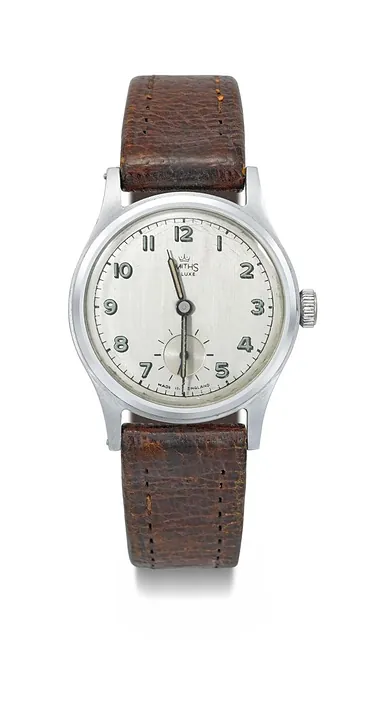
Wristwatch by Smiths English Clocks Limited, England, 1953
Science Museum Group, London
Wristwatches · 1959
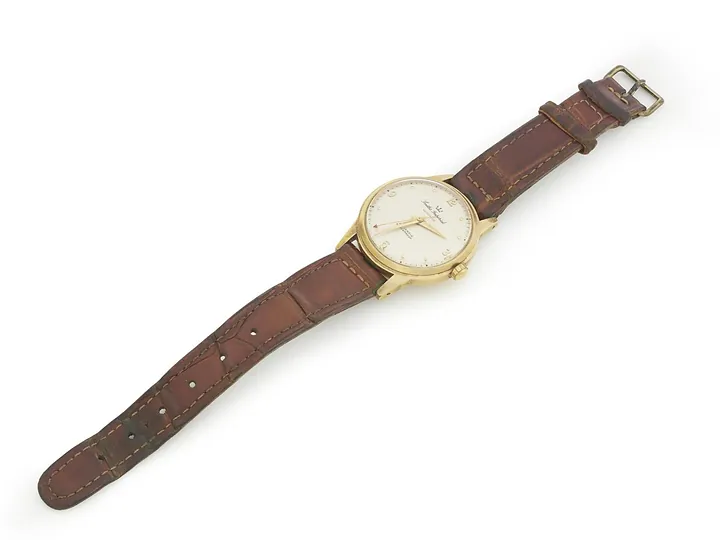
Wristwatch by Smiths Clocks & Watches Ltd, England, 1959
Science Museum Group, London
Wristwatches · 1958
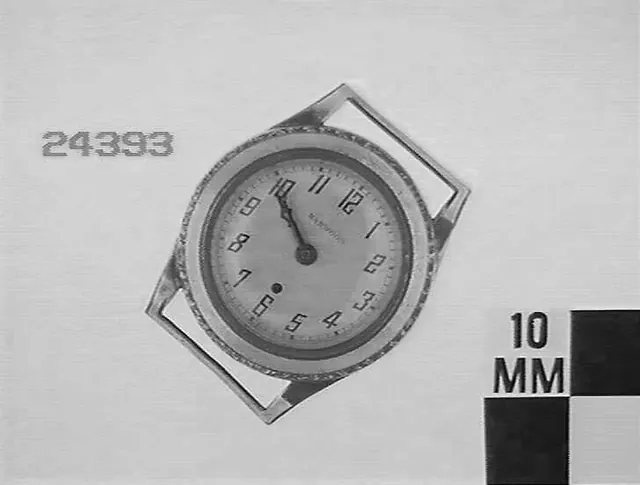
Wrist Watch - Harwood, England, 1958
Museums Victoria, Melbourne
Wristwatches · c. 1957
Wrist Watch - Timex, Great Britain, c. 1957
Museums Victoria, Melbourne