
Wristwatches · Wristwatch
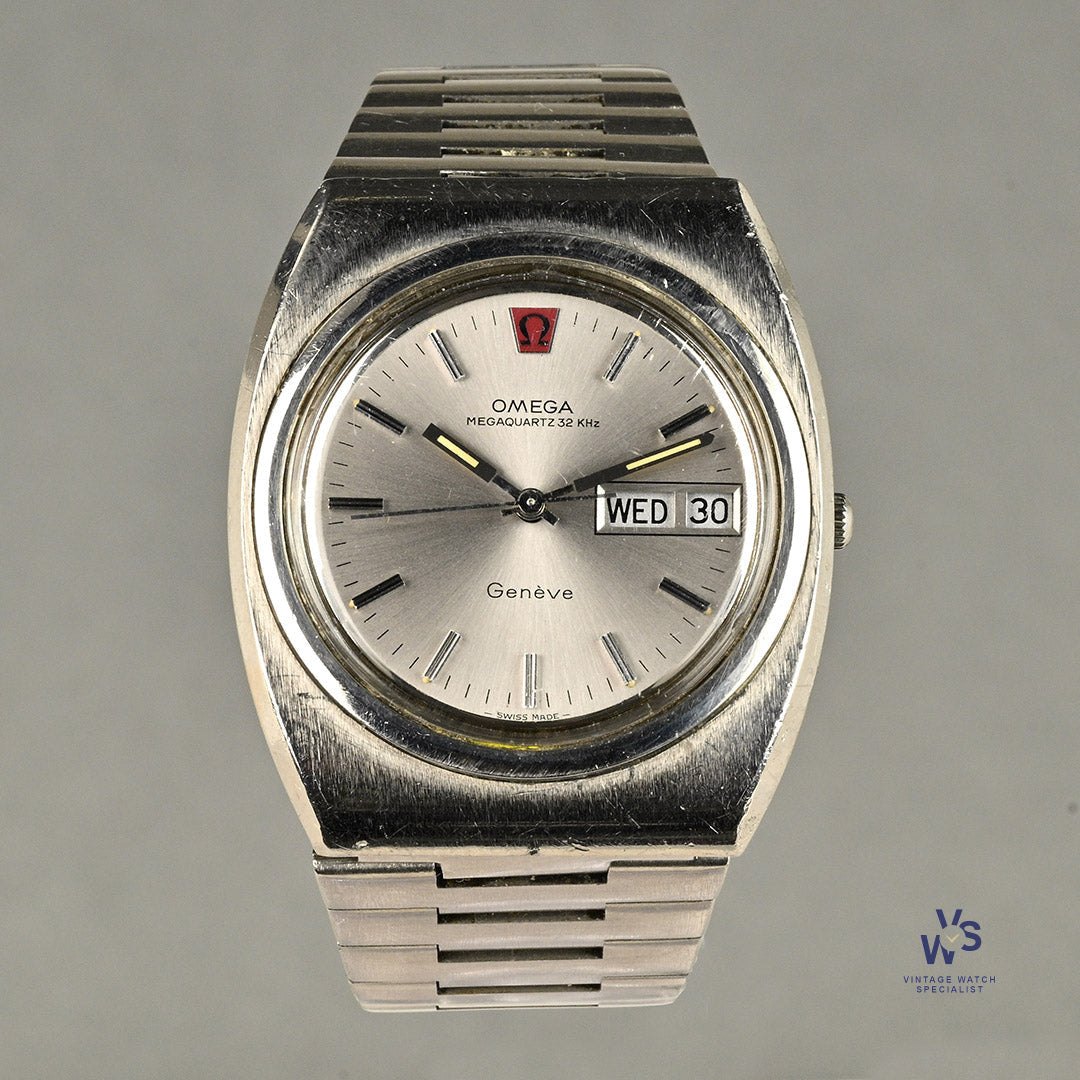
Omega Genève Megaquartz 32 KHz Day-Date, circa 1973
- Maker / attribution
- Omega (maker)
- Date
- c. 1973
- Historical period
- Quartz Revolution (1969 – 1990)
- Country of origin
- Switzerland
- Object type
- Wristwatch
- Dimensions
- Case 39 mm
- Stock no.
- vws4405cs
- Credit line
- Dealer listing, Vintage Watch Specialist (vws4405cs)
- Catalogue title (original)
- Omega Genève Megaquartz 32 KHz Day-Date c.1973 (English)
View the source record (dealer listing) ↗ (opens another website in a new tab)Suggest a correction
Record summary
Catalogued by Vintage Watch Specialist (dealer), United Kingdom (stock number vws4405cs), this is a wristwatch by Omega, made in Switzerland, dated c. 1973. The Atlas places it in the Quartz Revolution period (1969 – 1990) of its Wristwatches collection. Recorded dimensions: Case 39 mm. The record is illustrated with 6 photographs.
Assembled from the source record's structured fields. Dates and attributions are given as the source states them; where a field is missing the Atlas leaves it blank rather than estimating.
Catalogue description
Dealer description — Vintage Watch Specialist
The early 1970s marked one of the most significant periods of change in watchmaking history. Quartz technology was beginning to challenge the dominance of traditional mechanical movements, and Switzerland's established manufacturers were investing heavily in electronic timekeeping. Omega was at the forefront of this development, introducing a succession of innovative quartz watches that combined impressive accuracy with the distinctive design language of the decade. Among these was the Omega Megaquartz 32 KHz, a collection of electronic watches developed around a quartz oscillator operating at 32,768 Hz. This frequency would become an industry standard, providing a reliable foundation for accurate electronic timekeeping. Omega's Megaquartz watches represented an important step in making quartz technology more accessible. While earlier electronic watches had been expensive and technically complex, the Megaquartz range offered the advantages of quartz accuracy in practical, everyday wristwatches. The Genève models were particularly characteristic of the period, featuring bold case designs, integrated bracelets and clean, contemporary dials. Their styling reflected the changing tastes of the 1970s, when watch manufacturers increasingly experimented with larger cases and more architectural forms. Today, these early Omega quartz watches occupy an interesting position in the brand's history, representing a period of considerable technological innovation and a fascinating alternative to the mechanical watches for which Omega is perhaps better known. What’s on Offer Here we have a wonderfully characteristic Omega Genève Megaquartz 32 KHz Day-Date, Reference 196.0030, dating from circa 1973, complete with its stainless-steel bracelet. The watch is a superb example of early 1970s Omega design, combining a substantial stainless-steel case with a beautifully understated silver sunburst dial. The dial features a fine radial brushed finish that catches the light particularly well, complemented by applied baton hour markers and slender black hands with luminous inserts. The distinctive red Omega emblem at 12 o'clock provides a welcome splash of colour against the otherwise restrained silver finish. Beneath the Omega signature sits the Megaquartz 32 KHz designation, while the Genève name appears above 6 o'clock. At 3 o'clock is the practical day-date display, framed by a polished surround and offering one of the most useful complications for an everyday watch. The watch retains its original Omega-marked crystal and an engraved crown - fine details appreciated by those in the know. The stainless-steel case measures approximately 39mm across and 44mm lug-to-lug, giving the watch a substantial presence on the wrist. Its broad, angular shoulders and integrated bracelet arrangement are unmistakably 1970s in appearance. The case displays the expected marks of wear accumulated over more than five decades, particularly across the brushed and polished surfaces. These are entirely in keeping with its age and contribute to its honest vintage character. Fitted to the watch is its Omega stainless-steel bracelet, Reference 1237/223, with the Omega emblem clearly visible on the folding clasp. The bracelet complements the case beautifully and completes the distinctive integrated appearance. Power comes from the Omega Calibre 1310, an early quartz movement developed during the company's pioneering period of electronic watchmaking. The movement incorporates a day-date display and provides the accuracy and convenience that helped establish quartz technology during the 1970s. Condition Details: Crystal: Very Good Dial: Excellent Bezel: Very Good Case: Fair Bracelet: Very Good Movement: Serviced Overall: Very Good
Historical context
Quartz Revolution (1969 – 1990)
Seiko's Astron begins mass quartz timekeeping; traditional industries contract sharply.
Quartz and digital watches transformed the market after 1969. Swiss employment collapsed, Japanese and Hong Kong production soared, and the Swatch (1983) helped the Swiss industry recover; mechanical watches survived as luxury goods.
Read the period in the timelineMore wristwatches from this periodEarlier: Modern Mechanical Horology
Atlas type guide
Quartz, digital and electronic watches
Electronic watches arrived in three steps. The Hamilton Electric 500 (1957) was the first battery-powered wristwatch, still with a balance; Bulova's Accutron (1960) used a tuning fork. On 25 December 1969 Seiko released the Astron 35SQ, the first quartz wristwatch, closely followed by the Swiss Beta 21 group. In 1972 Hamilton's Pulsar introduced the LED digital watch, and LCD displays soon made digital watches cheap.
The 'Quartz Crisis' that followed devastated the Swiss mechanical industry, which lost two-thirds of its workforce between 1970 and 1984 before recovering with the Swatch (1983) and the luxury mechanical revival. Solar, radio-controlled, kinetic and connected smartwatches continue the electronic line.
What to look for
- Battery hatch in the case back and calibre markings with 'Quartz' or a crystal frequency.
- Display technology: LED (red, push-button) versus LCD (always-on).
- Tuning-fork hum and a smoothly sweeping seconds hand on Accutrons.
- Model and reference numbers, often printed on the back.
Dating clues
- Electric balance watches: from 1957.
- Tuning-fork watches: 1960–c. 1977.
- Quartz analogue: from December 1969; LED digital: 1972–c. 1978; LCD from 1973.
General guidance written by the Atlas editors about this kind of object. It is not a statement about this particular piece; for that, rely on the source record above and on physical examination.
Read next:Seiko calibre 35A (Astron)
Related records

Instruments · 1950–1976
Omega Megaquartz 2400 marine chronometer, 1950–1976
Science Museum Group, London

Instruments · 1960–1979
Stopwatch / timer by Omega, 1960–1979
Science Museum Group, London

Instruments · 1960–1979
Stopwatch / timer by Omega, Switzerland, 1960–1979
Science Museum Group, London

Instruments · 1960–1979
Stopwatch by Omega, Swiss made, single-button type reading 0 - 60 seconds in fifths and 0 - 5 minutes in minutes on subsidiary dial, 1960-79.
Science Museum Group, London

Wristwatches · 1970
Wristwatch by Heno, Switzerland, 1970
Museum Rotterdam

Wristwatches · 1960–1986
'Tri-Compax' calendar chronograph wristwatch in gold case, by Universal, Geneva, Switzerland, 1960–1986.
Science Museum Group, London

Wristwatches · 1969–1970
Beta 21 Quartz wristwatch movement, made in Switzerland, 1970.
Science Museum Group, London

Wristwatches · c. 1969
Omega Speedmaster Moonwatch, ref. 145022-69st, c. 1969
Antiquorum auction archive, Geneva