
Wristwatches · Wristwatch
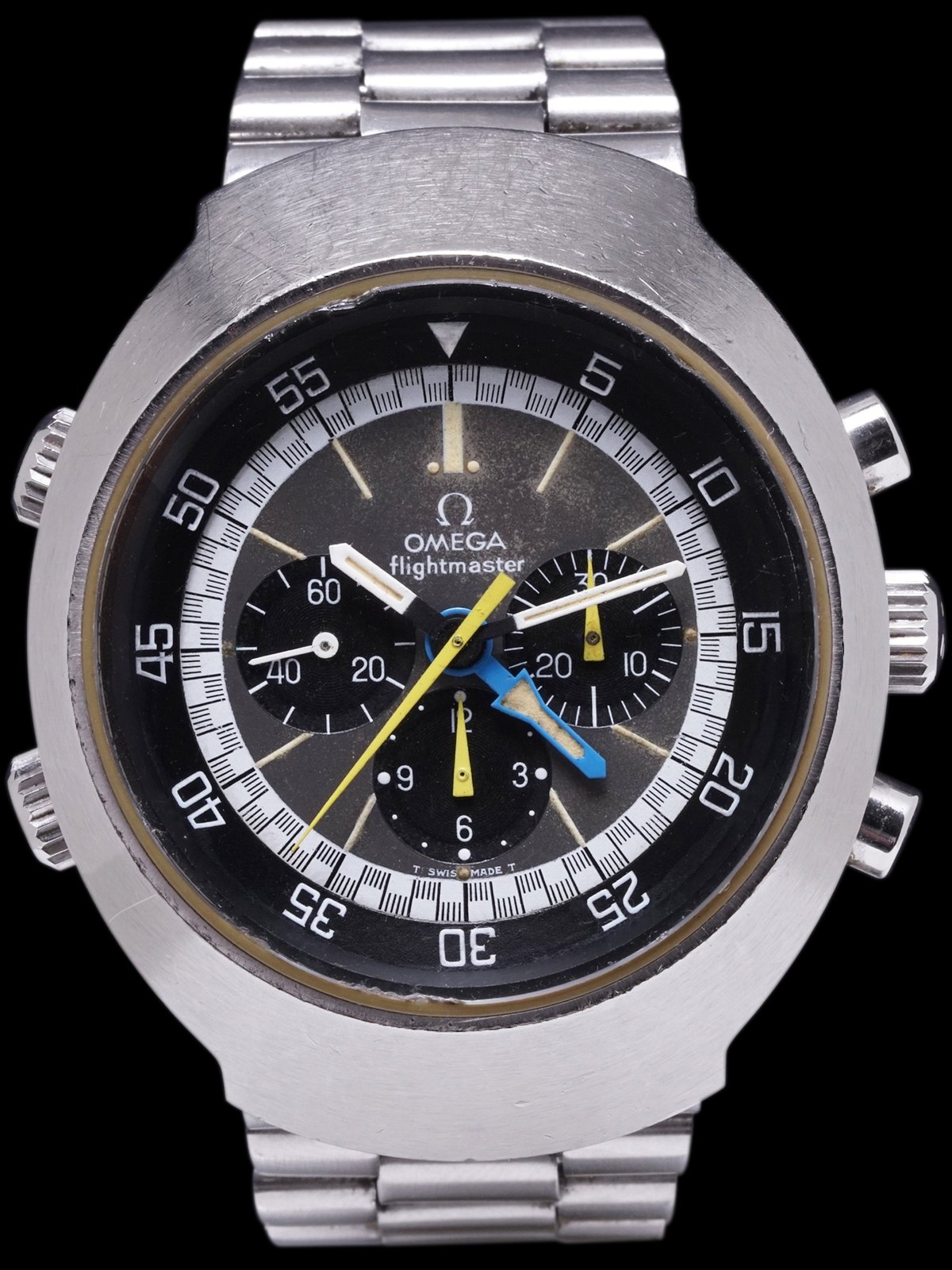
Omega Flightmaster (Ref. 145.036) Cal. 911, 1972
- Maker / attribution
- Omega (maker)
- Date
- 1972
- Historical period
- Quartz Revolution (1969 – 1990)
- Country of origin
- Switzerland
- Object type
- Wristwatch
- Dimensions
- Case 43 mm
- Stock no.
- OMFM145036-2
- Credit line
- Dealer listing, Craft & Tailored (OMFM145036-2)
- Catalogue title (original)
- 1972 Omega Flightmaster (Ref. 145.036) Cal. 911 (English)
View the source record (dealer listing) ↗ (opens another website in a new tab)Suggest a correction
Record summary
Catalogued by Craft & Tailored (dealer), Los Angeles (stock number OMFM145036-2), this is a wristwatch by Omega, made in Switzerland, dated 1972. The Atlas places it in the Quartz Revolution period (1969 – 1990) of its Wristwatches collection. Recorded dimensions: Case 43 mm. The record is illustrated with 6 photographs.
Assembled from the source record's structured fields. Dates and attributions are given as the source states them; where a field is missing the Atlas leaves it blank rather than estimating.
Catalogue description
Dealer description — Craft & Tailored
Tool chronographs dominated the late 1960's and early 1970's, a trend for which Omega is due credit for. During this time Omega created several different chronographs, all with different applications, one of which was the Flightmaster. The Flightmaster series of chronographs are a variant of the Omega Speedmaster line produced and sold towards "Pilots" from 1969 to 1977. The Flightmaster possesses a distinctly oversized 43mm case that includes 3 crowns, 2 pushers, and 7 hands. (Yes you read that right!) The Flightmaster is a technical powerhouse that includes the typical chronograph function paired with an independent blue 12-hour GMT hand, which allows the tracking of a second timezone without the need for military time. And not to mention an inner rotating timing ring similar to that of a supercompressor. The Omega Flightmaster was designed with pure functionality in mind specifically for commercial pilots and frequent travelers, a matter of fact Omega engraved a Douglass DC-8 into the caseback. The Flightmaster series consisted of two distinct versions, each with several dial variants within each version. In addition to the two main versions, there is a rare and limited and solid gold version of one model that is rarely seen. The first Flightmaster variant, reference 145.013, features the Omega cal. 910 movement which is a highly modified version of Omega's famous Lemania based cal. 861 movement. The most noticeable element of the ref. 145.013 is the 9 o'clock sub-dial which is a 24-hour indicator that is half green to indicate day vs. night. Shortly after this, Omega modified their cal. 910 movement and created the cal. 911 and changed the reference to 145.036, Omega's second iteration of the Flightmaster. The Omega cal. 911 movement replaced the 9 o'clock AM/PM sub-dial complication, with a more traditional running seconds sub-dial. In a quote from Stuart Tentoni via chronomaddox "The Flightmaster has a somewhat undeserved reputation as being a "Monster-sized" watch. Yes, if you look at the Flightmaster's exterior dimensions it is a large watch. However, similar to the Fender Stratocaster, the Flightmaster's shape and taper actually fits and blends in with the back of the wrist well and wears better than many smaller watches", which perfectly sums up the way the Flightmaster reference range wears while on the wrist. The Flightmaster is oversized, but extremely functional and also ergonomic. This specific 1972 Omega Flightmaster (Ref. 145.036) (2nd version) features a high visibility and eye-catching grey dial with yellow accents that has taken on a subtle and attractive patina. The case remains completely unpolished and retains its original bracelet, all in all making for a unique and comfortable wearing experience that has an awesome vintage aesthetic. Stock # OMFM145036-2 Brand Omega Style Flightmaster Model 145.036 Serial 35XXXXXX Size Men's Material Stainless Steel Dial Matte Grey Millimeters 43mm Bracelet Omega 1162 Oval-Link Bracelet W/ 172 End Pieces CASE & BRACELET The unique tonneau case is in excellent unpolished condition, displaying its original factory finishing with light signs of use throughout. The case retains all of its original crowns and pushers. The original mineral glass crystal shows normal wear for its age. The case back retains its original factory "Flightmaster" engraving, though it is faint from wear. The original Omega 1162 oval-link bracelet with 172 end pieces is in excellent condition, retaining 21 links with light stretch from use. DIAL & HANDS The grey main dial is in remarkable original condition with a wonderful golden speckled patina that has formed around the lump lots and the upper portion of the dial. The inner rotating bezel is in excellent condition. The black and white "roulette" style minute track shows no signs of discoloration or aging. The black sub-dials are in exceptional condition, remaining clean and deep black in coloration. The tritium lume markers have achieved a charming yellow coloration and exhibit no degradation under U.V. light inspection. All of the hands are original to the watch, including the sub-dial hands. The white hour and minute hands and the blue independent hour hand match the lume plots perfectly, under U.V. light inspection the minute and blue hour hand show very light cracking in the lume and remain stable, the white hour hand shows no imperfections. ACCESSORIES
Historical context
Quartz Revolution (1969 – 1990)
Seiko's Astron begins mass quartz timekeeping; traditional industries contract sharply.
Quartz and digital watches transformed the market after 1969. Swiss employment collapsed, Japanese and Hong Kong production soared, and the Swatch (1983) helped the Swiss industry recover; mechanical watches survived as luxury goods.
Read the period in the timelineMore wristwatches from this periodEarlier: Modern Mechanical Horology
Atlas type guide
Wristwatches
Bracelet watches were worn by women from the early nineteenth century — Breguet made one for Caroline Murat, Queen of Naples, in 1810–12 — but the wristwatch only became a man's instrument with military use and aviation in the early twentieth century. Between the World Wars it overtook the pocket watch; the 1920s and 1930s brought rectangular Art Deco cases, water-resistant cases and the first automatic winding systems.
After 1945 the wristwatch became a carrier of identity — dress watches, sports and dive watches, chronographs, calendars — produced by Swiss, American, Japanese, German, Soviet and Chinese industries. The quartz revolution after 1969 and the mechanical renaissance since the 1990s, including the rise of independent watchmakers, complete the story.
What to look for
- The reference number (between the lugs or inside the case back) and serial number, the starting point for dating.
- The calibre: its maker and number are often stamped under the dial or on the bridge.
- Originality of dial, hands and crown — refinished ('redial') dials are common.
- Case material marks: 18K/750, 14K/585, stainless steel, gold-filled, plated.
Dating clues
- Wire-lug cases: before c. 1925.
- Water-resistant screw-down cases: from 1926.
- Quartz movements: from 1969; sapphire crystals widespread after c. 1980.
General guidance written by the Atlas editors about this kind of object. It is not a statement about this particular piece; for that, rely on the source record above and on physical examination.
Related records

Instruments · 1950–1976
Omega Megaquartz 2400 marine chronometer, 1950–1976
Science Museum Group, London

Instruments · 1960–1979
Stopwatch / timer by Omega, 1960–1979
Science Museum Group, London

Instruments · 1960–1979
Stopwatch / timer by Omega, Switzerland, 1960–1979
Science Museum Group, London

Instruments · 1960–1979
Stopwatch by Omega, Swiss made, single-button type reading 0 - 60 seconds in fifths and 0 - 5 minutes in minutes on subsidiary dial, 1960-79.
Science Museum Group, London

Wristwatches · 1970
Wristwatch by Heno, Switzerland, 1970
Museum Rotterdam

Wristwatches · 1960–1986
'Tri-Compax' calendar chronograph wristwatch in gold case, by Universal, Geneva, Switzerland, 1960–1986.
Science Museum Group, London

Wristwatches · 1969–1970
Beta 21 Quartz wristwatch movement, made in Switzerland, 1970.
Science Museum Group, London

Wristwatches · c. 1969
Omega Speedmaster Moonwatch, ref. 145022-69st, c. 1969
Antiquorum auction archive, Geneva