
Wristwatches · Wristwatch
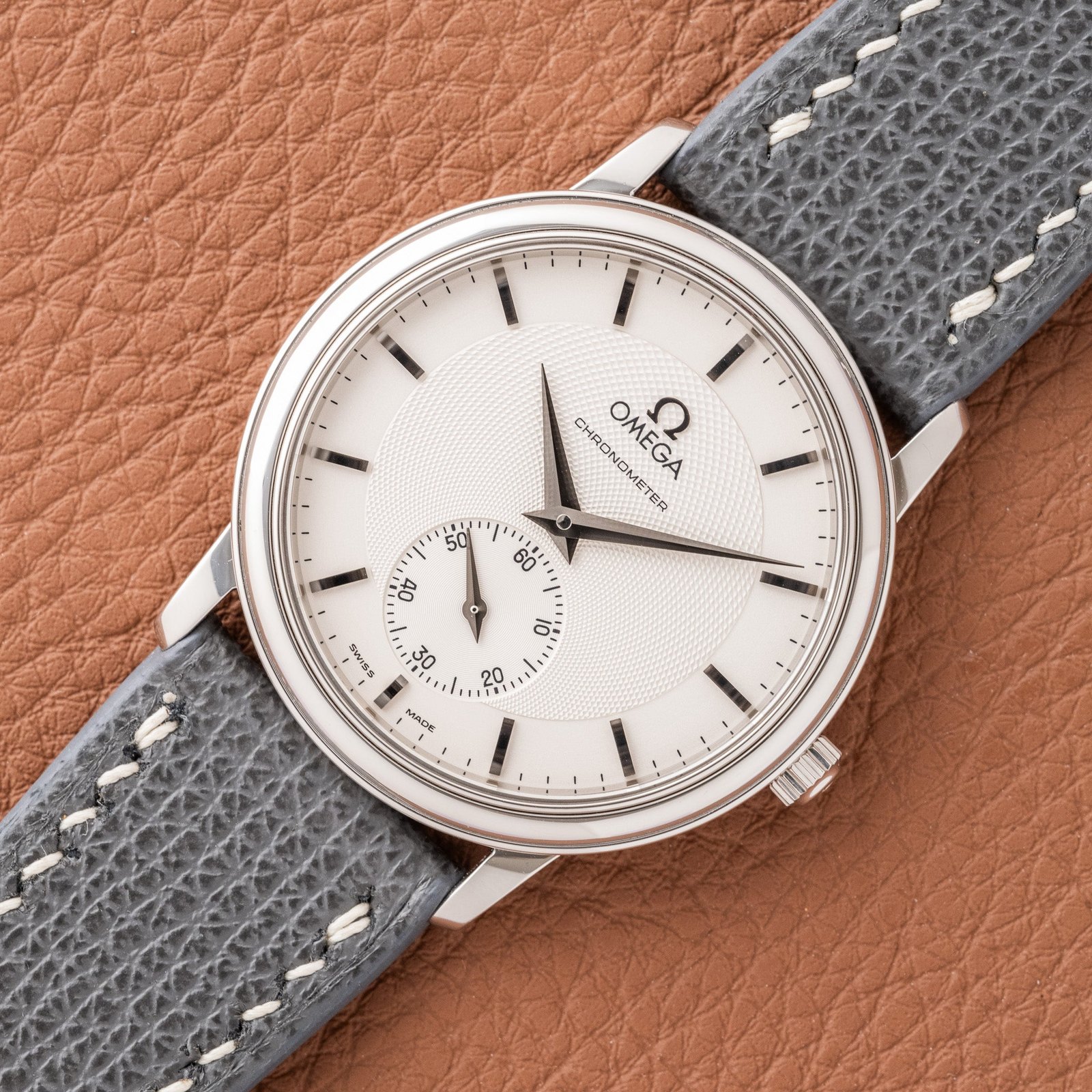
Omega De Ville Prestige Platinum Case (Ref. 127.0150), 1997
- Maker / attribution
- Omega (maker)
- Date
- 1997
- Historical period
- Mechanical Renaissance (1990 – 2010)
- Country of origin
- Switzerland
- Object type
- Wristwatch
- Materials / technique
- platinum
- Dimensions
- Case 34 mm
- Stock no.
- Product 8322943516855
- Credit line
- Dealer listing, Huntington Company (product 8322943516855)
- Catalogue title (original)
- 1997 Omega De Ville Prestige Platinum Case (Ref. 127.0150) (English)
Editor's note
The dealer's brand field named another maker; the dealer's own listing title identifies the watch as Omega.View the source record (dealer listing) ↗ (opens another website in a new tab)Suggest a correction
Record summary
Catalogued by Huntington Company (dealer) (stock number Product 8322943516855), this is a wristwatch by Omega, made in Switzerland, dated 1997. The Atlas places it in the Mechanical Renaissance period (1990 – 2010) of its Wristwatches collection. Materials and techniques recorded by the source: platinum. Recorded dimensions: Case 34 mm. The record is illustrated with 6 photographs.
Assembled from the source record's structured fields. Dates and attributions are given as the source states them; where a field is missing the Atlas leaves it blank rather than estimating.
Catalogue description
Dealer description — Huntington Company
History and Significance Platinum Omega wristwatches are among the rarest expressions of the brand’s output, and reference 127.0150 sits firmly in that category. Produced in extremely limited numbers, this reference features a platinum case manufactured in Italy, a detail that further narrows its already small production pool. Even by modern standards, Omega rarely works in platinum, reserving the material for very low-volume and highly specialized pieces. This watch dates to 1997 and reflects Omega’s continued commitment to traditional watchmaking at a time when precious metal production was increasingly uncommon. The chronometer-rated automatic movement reinforces Omega’s long-standing emphasis on precision, while the clean, balanced dial layout keeps the focus on legibility and proportion rather than ornamentation. Platinum Omegas remain dramatically underrepresented in the broader market. At any given time, only a small handful are available worldwide, making this reference a quiet but serious outlier within Omega’s catalog. Writer’s Thoughts This is a watch for someone who values substance over recognition. On the wrist, it wears understated, but the weight and feel of the platinum case immediately distinguish it from steel or white gold. The 34mm case size is well judged and timeless, and the overall presentation feels purposeful and restrained. For collectors drawn to rarity, material significance, and Omega’s chronometer lineage, this is a meaningful piece. Our Promise Every watch we offer is carefully inspected and evaluated for authenticity and originality. We stand behind each piece we sell and disclose all known details and condition observations as accurately as possible. Specifications Brand: Omega Model: Chronometer Reference: ref. 127.0150 Year: 1997 Case Material: Platinum Case Size: 34mm Dial: Silver Guilloche dial with applied markers Crystal: Sapphire Movement: Automatic chronometer Strap: Grey leather strap Buckle/Clasp: Steel pin buckle Contents: Watch only Condition Case: Platinum case shows light surface wear consistent with careful use. The case remains unpolished with strong proportions and defined edges. Bezel: Smooth bezel shows minor handling marks with no major dents or distortions. Crystal: Sapphire crystal is clean with no visible chips or cracks. Dial: Clean with crisp printing and a well-preserved guilloche finish. Hands: Original hands show light patina consistent with age and no corrosion. Strap: Leather strap is in good condition with minimal wear. Buckle/Clasp: Pin buckle shows light cosmetic wear and functions properly.
Historical context
Mechanical Renaissance (1990 – 2010)
Mechanical watches return as cultural objects; independent watchmaking flourishes.
Mechanical watches returned as cultural and luxury objects. Complications, tourbillons and new materials proliferated; independent watchmakers such as George Daniels, F.P. Journe and Philippe Dufour revived artisanal watchmaking; collecting vintage watches became a major field.
Read the period in the timelineMore wristwatches from this periodEarlier: Quartz Revolution
Atlas type guide
Wristwatches
Bracelet watches were worn by women from the early nineteenth century — Breguet made one for Caroline Murat, Queen of Naples, in 1810–12 — but the wristwatch only became a man's instrument with military use and aviation in the early twentieth century. Between the World Wars it overtook the pocket watch; the 1920s and 1930s brought rectangular Art Deco cases, water-resistant cases and the first automatic winding systems.
After 1945 the wristwatch became a carrier of identity — dress watches, sports and dive watches, chronographs, calendars — produced by Swiss, American, Japanese, German, Soviet and Chinese industries. The quartz revolution after 1969 and the mechanical renaissance since the 1990s, including the rise of independent watchmakers, complete the story.
What to look for
- The reference number (between the lugs or inside the case back) and serial number, the starting point for dating.
- The calibre: its maker and number are often stamped under the dial or on the bridge.
- Originality of dial, hands and crown — refinished ('redial') dials are common.
- Case material marks: 18K/750, 14K/585, stainless steel, gold-filled, plated.
Dating clues
- Wire-lug cases: before c. 1925.
- Water-resistant screw-down cases: from 1926.
- Quartz movements: from 1969; sapphire crystals widespread after c. 1980.
General guidance written by the Atlas editors about this kind of object. It is not a statement about this particular piece; for that, rely on the source record above and on physical examination.
Related records

Instruments · 1950–1976
Omega Megaquartz 2400 marine chronometer, 1950–1976
Science Museum Group, London

Instruments · 1960–1979
Stopwatch / timer by Omega, 1960–1979
Science Museum Group, London

Instruments · 1960–1979
Stopwatch / timer by Omega, Switzerland, 1960–1979
Science Museum Group, London

Instruments · 1960–1979
Stopwatch by Omega, Swiss made, single-button type reading 0 - 60 seconds in fifths and 0 - 5 minutes in minutes on subsidiary dial, 1960-79.
Science Museum Group, London

Wristwatches · 2008
Wristwatch by Breitling?, 2008
Museum Rotterdam

Wristwatches · c. 1990s
Audemars Piguet Bamboo, c. 1990s
Antiquorum auction archive, Geneva

Wristwatches · c. 1990
Audemars Piguet Huitieme Perpetual Calendar, ref. 25696PT, c. 1990
Antiquorum auction archive, Geneva

Wristwatches · c. 1990
Breitling Chronomat, ref. b13050.1, c. 1990
Antiquorum auction archive, Geneva