
Wristwatches · Triple calendar wristwatch with moon phase
Omega Cosmic Ref. 2486-2 Wristwatch
- Maker / attribution
- Omega (source attribution)
- Date
- c. 1947
- Historical period
- Modern Mechanical Horology (1945 – 1969)
- Country of origin
- Switzerland
- Object type
- Triple calendar wristwatch with moon phase
- Dimensions
- 37mm
- Holding institution
- Bonhams, via Invaluable
- Accession / object no.
- omega-cosmic-ref-2486-2-wristwatch-8c58b9aaea
- Credit line
- Bonhams, via Invaluable
- Catalogue title (original)
- Omega Cosmic Ref: 2486-2 gold plated triple calendar wristwatch with moon phase (English)
View the source record ↗ (opens another website in a new tab)Suggest a correction
Record summary
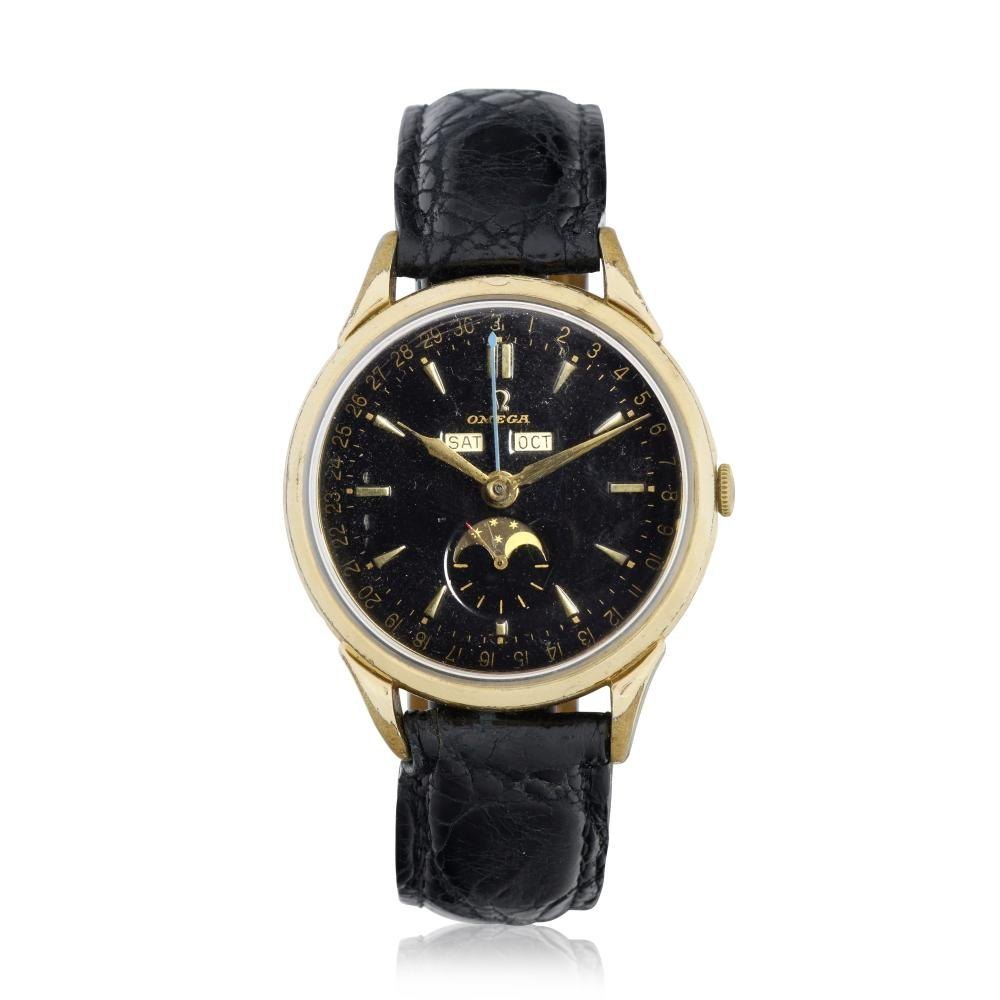
Held and catalogued by Bonhams, via Invaluable (object number omega-cosmic-ref-2486-2-wristwatch-8c58b9aaea), this is a triple calendar wristwatch with moon phase attributed to Omega, made in Switzerland, dated c. 1947. The Atlas places it in the Modern Mechanical Horology period (1945 – 1969) of its Wristwatches collection. Recorded dimensions: 37mm. The record is illustrated with 1 photograph.
Assembled from the source record's structured fields. Dates and attributions are given as the source states them; where a field is missing the Atlas leaves it blank rather than estimating.
Catalogue description
Original object description
Catalogued to approximately 1947, this Omega Cosmic calendar wristwatch bears reference 2486-2. The 37 mm circular gold-plated case features a personalized inscription on its snap-on back and is pierced along the flanks at 2, 4, and 8 o'clock with three recessed pushers to adjust the calendar indicators. Surrounding outer tracks for the minutes and date, the black dial is detailed with gilt dart indices, gilt dagger hands, and an auxiliary blue date pointer. Month and day apertures are set below 12 o'clock, complemented by a 6 o'clock register that unites running seconds with an astronomical moon-phase display. The timepiece is driven by a 17-jewel, hand-wound Omega Caliber 27 DLPC movement stamped with serial number 11207601. Omega signatures are present on the movement, dial, and case. While this specific evaluated example is presented on an aftermarket black leather strap with a gilt buckle, execution specifics may differ among individual reference 2486-2 watches.
Inscriptions & marks
11207601
Historical context
Modern Mechanical Horology (1945 – 1969)
Tool watches for divers, pilots and astronauts; electric watches anticipate the electronic age.
The classic era of the mechanical wristwatch: dive watches, chronographs for motor racing and space flight, GMT watches for jet travel, slim dress watches, automatic calendars, and the rise of Japanese manufacturers alongside Swiss, American, German and Soviet industries.
Read the period in the timelineMore wristwatches from this periodEarlier: Golden Age of Mechanical Watchmaking
Atlas type guide
Calendar, moon-phase and perpetual calendar watches
Calendar complications range from a simple date to the perpetual calendar, which automatically allows for months of different lengths and leap years until 2100. Pocket watches with perpetual calendars were made in the eighteenth and nineteenth centuries; Patek Philippe made the first perpetual calendar wristwatch in 1925, and series production followed in 1941. The annual calendar (Patek Philippe, 1996) needs correction only once a year.
Moon-phase displays use a disc with two moons and 59 teeth advanced daily, approximating the 29.5-day lunation; more precise trains reduce the error to one day in over a century.
What to look for
- Apertures or subsidiary dials for day, date, month and leap year.
- Moon disc under a 'bosom' shaped aperture.
- Recessed correctors on the case band for setting the calendar.
Dating clues
- Triple-date wristwatches: popular c. 1940–1955.
- Perpetual calendar wristwatches: from 1925 (unique) and 1941 (series).
General guidance written by the Atlas editors about this kind of object. It is not a statement about this particular piece; for that, rely on the source record above and on physical examination.
Related records

Instruments · 1950–1976
Omega Megaquartz 2400 marine chronometer, 1950–1976
Science Museum Group, London

Instruments · 1960–1979
Stopwatch / timer by Omega, 1960–1979
Science Museum Group, London

Instruments · 1960–1979
Stopwatch / timer by Omega, Switzerland, 1960–1979
Science Museum Group, London

Instruments · 1960–1979
Stopwatch by Omega, Swiss made, single-button type reading 0 - 60 seconds in fifths and 0 - 5 minutes in minutes on subsidiary dial, 1960-79.
Science Museum Group, London

Wristwatches · 1945
Wristwatch by Eterna, 1945
Museum Rotterdam

Wristwatches · c. 1945
Breitling Premier, ref. 790, c. 1945
Antiquorum auction archive, Geneva

Wristwatches · c. 1945
Universal Genève Uni-Compax, ref. 22492, c. 1945
Antiquorum auction archive, Geneva

Wristwatches · c. 1950s
Baume & Mercier wristwatch, c. 1950s
Antiquorum auction archive, Geneva