
Wristwatches · Wristwatch
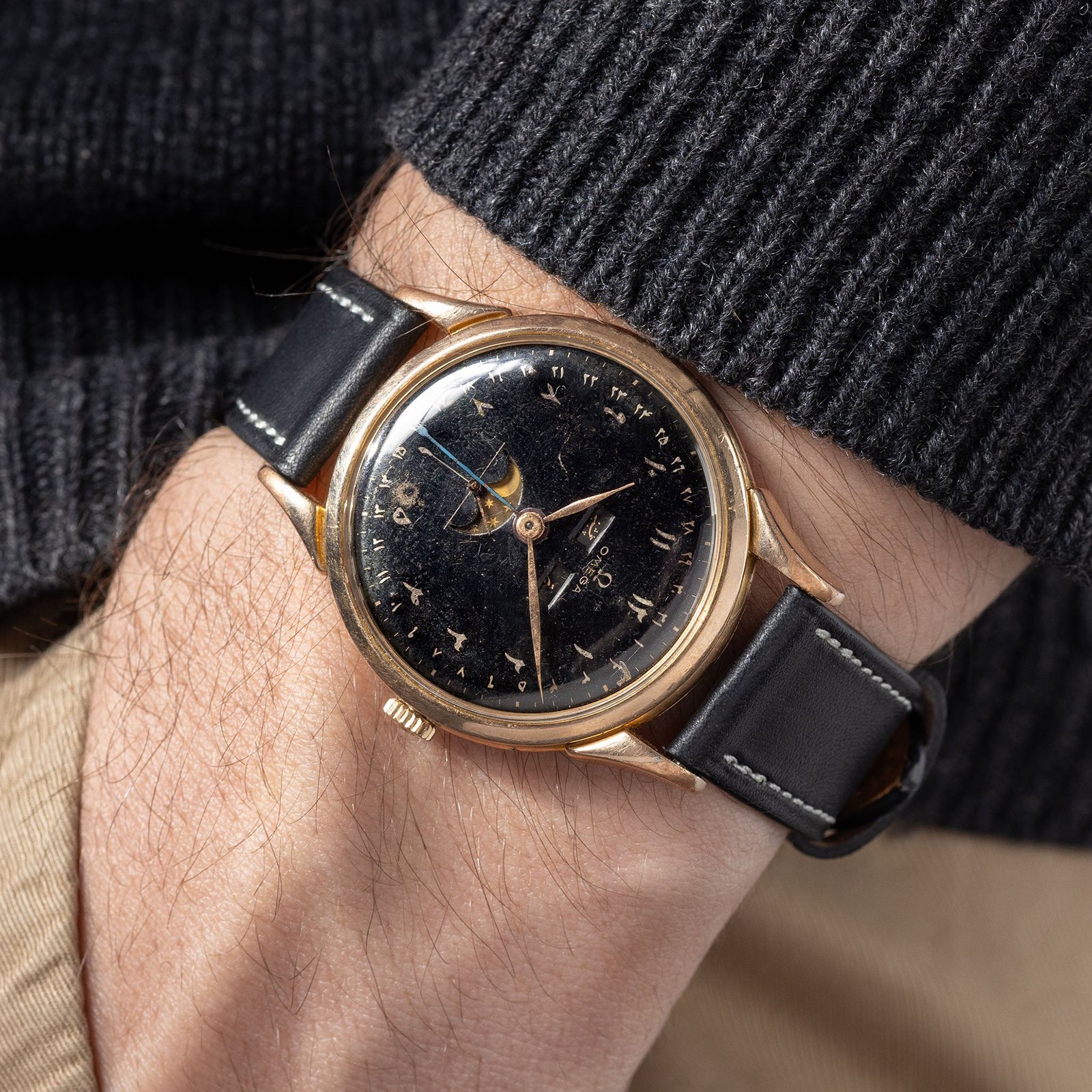
Omega Cosmic 2486-2 Jumbo Black Farsi Numerals Dial Pink Gold Plated, late 1940s
- Maker / attribution
- Omega (maker)
- Date
- late 1940s
- Historical period
- Golden Age of Mechanical Watchmaking (1900 – 1945)
- Country of origin
- Switzerland
- Object type
- Wristwatch
- Materials / technique
- gold
- Dimensions
- Case 35 mm
- Stock no.
- W-3604
- Credit line
- Dealer listing, Bulang & Sons (W-3604)
- Catalogue title (original)
- Omega Cosmic 2486-2 Jumbo Black Farsi Numerals Dial Pink Gold Plated (English)
View the source record (dealer listing) ↗ (opens another website in a new tab)Suggest a correction
Record summary
Catalogued by Bulang & Sons (dealer), Copenhagen (stock number W-3604), this is a wristwatch by Omega, made in Switzerland, dated late 1940s. The Atlas places it in the Golden Age of Mechanical Watchmaking period (1900 – 1945) of its Wristwatches collection. Materials and techniques recorded by the source: gold. Recorded dimensions: Case 35 mm. The record is illustrated with 6 photographs.
Assembled from the source record's structured fields. Dates and attributions are given as the source states them; where a field is missing the Atlas leaves it blank rather than estimating.
Catalogue description
Dealer description — Bulang & Sons
The Omega Cosmic Ref. 2486 represents one of the brand’s most intriguing yet quietly underappreciated achievements of the mid-20th century. Featuring a full calendar complication, it once stood among the most sophisticated offerings in Omega’s lineup, reflecting the technical ambition of the era. Calendar-equipped Cosmics often fly under the radar, frequently overshadowed by more complex perpetual calendar models. Yet their charm lies precisely in this balance of practicality, elegance, and mechanical interest. This particular example elevates the reference even further, distinguished by an exceptionally rare dial configuration with day and month displays rendered in Farsi (Persian)—a detail seldom encountered and highly desirable among seasoned collectors. Compact in concept yet rich in character, this watch offers the appeal of a calendar complication without the ostentation often associated with larger, more imposing counterparts. A refined and culturally significant piece, it stands as a fascinating alternative to the more celebrated calendar watches of its time. Farsi-dial Omega Cosmics are a recognized category among collectors, yet they were not bespoke commissions. Instead, they originated from a very limited production run intended for the Middle Eastern market. A closer look at the dial reveals an important distinction: rather than the Eastern Arabic numerals commonly seen today, the script is true Farsi, identifiable by the heart-shaped numeral five. Most of these watches were originally delivered to Iran. It is widely believed that the majority were sold in Tehran, then a rapidly modernizing, oil-wealthy capital under the rule of Mohammad Reza Pahlavi. The Omega Cosmic calendar was produced in five round-case references, offered in both 35mm (Refs. 2606, 2471, and 2473) and larger 37mm formats (Refs. 2485 and 2486). Farsi-signed dials are most frequently encountered in the 2606 and 2486 references. The present example features a “jumbo” 37.5mm pink gold-plated case—an era-specific detail that highlights Omega’s broad material offerings at the time, which ranged from stainless steel to gold-plated and solid gold constructions. The pink gold-plated case is in lovely condition and features a snap-back case back, side correctors for the moon phase and calendar functions, elegant lugs, and a thin bezel, allowing the dial to appear even larger on the wrist. The black dial shows some honest age, yet remains highly attractive and sympathetic for a watch dating to the late 1940s. It features the aforementioned Farsi numerals, with matching Farsi calendar displays visible through the dial apertures. Additional details include leaf-shaped hands, a blued hand for the date indication, a small running seconds at six o’clock, and a beautifully rendered moonphase in the same area. We have paired this Omega with a fine Bulang & Sons leather strap. The watch is powered by the manually wound Cal. 381, based on a Lemania ébauche, and has been fully serviced by our watchmaker. Own a rare Omega Cosmic—یک گنجینه of mid-century craftsmanship, let’s talk about this ”Farsi “ ! (یک گنجینه = “a treasure”) Specifications: Omega Cosmic Triple Calendar reference 2486-2 37.5 mm “Jumbo” pink gold-plated case with snap back case back Movement t no 1120xxxx dating to the late 1940’s Super rare Black dial with Farsi numerals Day and month windows, date chapter ring and phase of moon sub dial Manual wind Omega calibre 381 movement Comes on a Bulang and Sons strap Fully serviced by our watchmaker
Historical context
Golden Age of Mechanical Watchmaking (1900 – 1945)
The wristwatch displaces the pocket watch; waterproof cases, self-winding and grand complications.
The wristwatch overtook the pocket watch. Military use in the First World War, aviation, water-resistant cases (1926), automatic winding (1923–31), rectangular Art Deco designs and early chronographs and calendars defined the period.
Read the period in the timelineMore wristwatches from this periodEarlier: Industrial Revolution
Atlas type guide
Wristwatches
Bracelet watches were worn by women from the early nineteenth century — Breguet made one for Caroline Murat, Queen of Naples, in 1810–12 — but the wristwatch only became a man's instrument with military use and aviation in the early twentieth century. Between the World Wars it overtook the pocket watch; the 1920s and 1930s brought rectangular Art Deco cases, water-resistant cases and the first automatic winding systems.
After 1945 the wristwatch became a carrier of identity — dress watches, sports and dive watches, chronographs, calendars — produced by Swiss, American, Japanese, German, Soviet and Chinese industries. The quartz revolution after 1969 and the mechanical renaissance since the 1990s, including the rise of independent watchmakers, complete the story.
What to look for
- The reference number (between the lugs or inside the case back) and serial number, the starting point for dating.
- The calibre: its maker and number are often stamped under the dial or on the bridge.
- Originality of dial, hands and crown — refinished ('redial') dials are common.
- Case material marks: 18K/750, 14K/585, stainless steel, gold-filled, plated.
Dating clues
- Wire-lug cases: before c. 1925.
- Water-resistant screw-down cases: from 1926.
- Quartz movements: from 1969; sapphire crystals widespread after c. 1980.
General guidance written by the Atlas editors about this kind of object. It is not a statement about this particular piece; for that, rely on the source record above and on physical examination.
Related records

Instruments · 1950–1976
Omega Megaquartz 2400 marine chronometer, 1950–1976
Science Museum Group, London

Instruments · 1960–1979
Stopwatch / timer by Omega, 1960–1979
Science Museum Group, London

Instruments · 1960–1979
Stopwatch / timer by Omega, Switzerland, 1960–1979
Science Museum Group, London

Instruments · 1960–1979
Stopwatch by Omega, Swiss made, single-button type reading 0 - 60 seconds in fifths and 0 - 5 minutes in minutes on subsidiary dial, 1960-79.
Science Museum Group, London

Wristwatches · 1931
Rolex 'Oyster Perpetual' rotor self-winding wrist-watch, lever escapement, in steel case with glass in back, Montres Rolex SA, Geneva, Switzerland, 1931
Science Museum Group, London

Wristwatches · 1900–1999
Wristwatch by Certina, Switzerland, 1900–1999
Nordic Museum Foundation

Wristwatches · 1900–1999
Wristwatch by Omega, Västerås, 1900–1999
Nordic Museum Foundation

Wristwatches · 1900–1999
Wristwatch by Universal, Switzerland, 1900–1999
Nordic Museum Foundation