
Wristwatches · Wristwatch
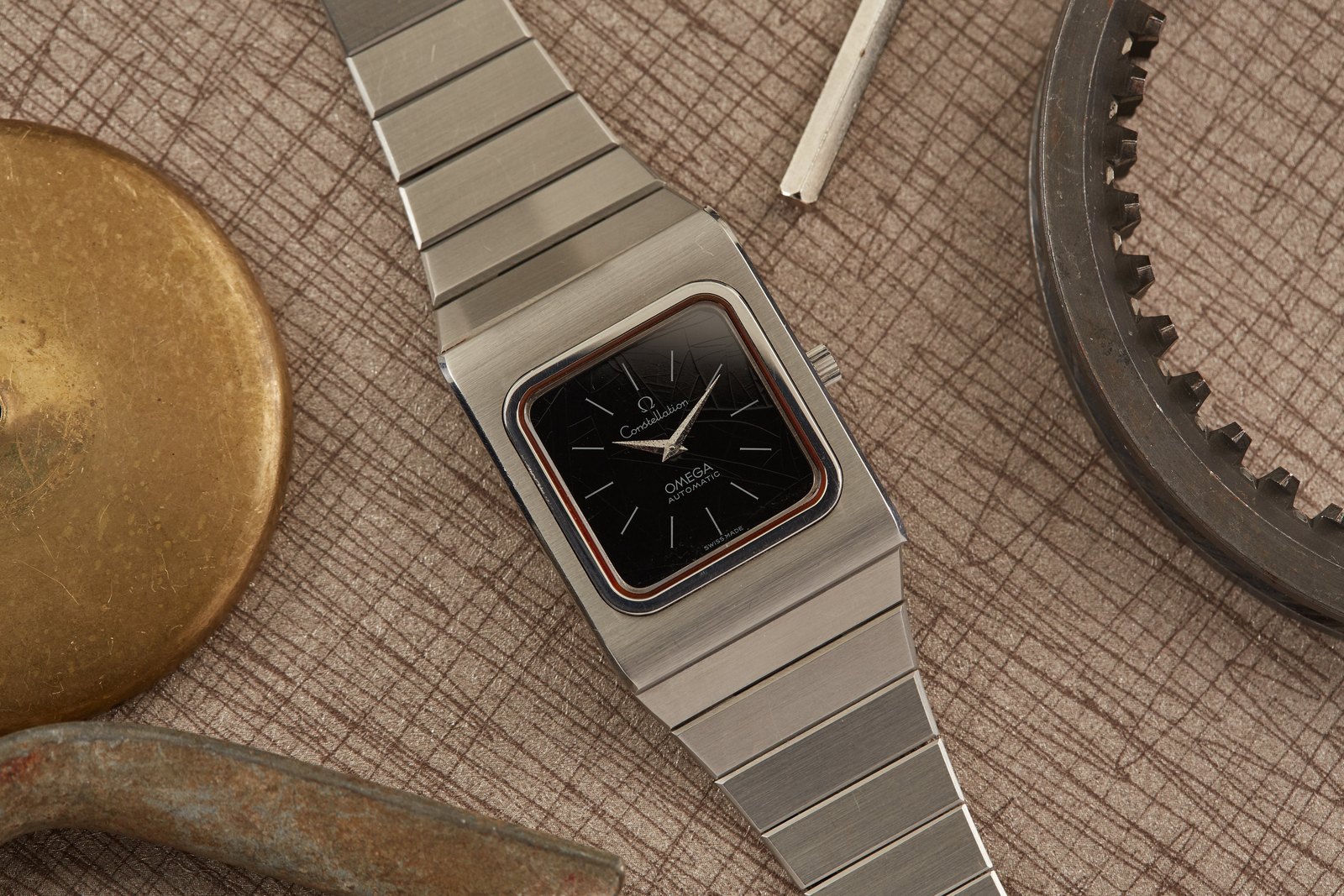
Omega Constellation Automatic Ultra-Thin, late 1970s
- Maker / attribution
- Omega (maker)
- Date
- late 1970s
- Historical period
- Quartz Revolution (1969 – 1990)
- Country of origin
- Switzerland
- Object type
- Wristwatch
- Stock no.
- Product 4165697863767
- Credit line
- Dealer listing, Analog/Shift (product 4165697863767)
- Catalogue title (original)
- Omega Constellation Automatic Ultra-Thin (English)
View the source record (dealer listing) ↗ (opens another website in a new tab)Suggest a correction
Record summary
Catalogued by Analog/Shift (dealer), New York (stock number Product 4165697863767), this is a wristwatch by Omega, made in Switzerland, dated late 1970s. The Atlas places it in the Quartz Revolution period (1969 – 1990) of its Wristwatches collection. The record is illustrated with 6 photographs.
Assembled from the source record's structured fields. Dates and attributions are given as the source states them; where a field is missing the Atlas leaves it blank rather than estimating.
Catalogue description
Dealer description — Analog/Shift
Why We Love It This beautiful 1970s Omega comes from the personal collection of our Founder. The Constellation was once Omega’s flagship model. A contemporary to the original Speedmaster, Seamaster SM300, Railmaster and DeVille lines, the Connie was a popular choice during its day and age, known for their award-winning precision movements. Over the years Omega produced many different Constellation models, with a wide variation in case shape and dial design. This particular model, a Reference 355.0814, dates to the late 1970s and is proof that Omega was clued in to the popular design language of the time. Featuring an eye-catching rectangular case with an integrated steel bracelet, this watch is truly a conversation starter. Looking closer, you'll notice factory bevels along the case edges and its lovely tapered bracelet, as well as a framing bezel with a high polish finish. Its clear that this Constellation drew its inspiration from the Gerald Genta masterpieces of the era. Looking closely at the dial, you'll be absorbed by its rich black glossiness, and when you play with it in the light you'll notice a crazed 'spidering' effect. This is an unusual occurrence for an Omega from this era and gives off a 'shattered window' texture that many collectors strongly desire. Our founder bought this rare model from the grandson of the original owner, who bought it new in India in 1978. Complete with papers, this funky piece is only marginally thicker than a first series Royal Oak, comes with an Observatory-certified automatic movement, integrated bracelet, outstanding dial, and a whole lot of bragging rights. Our Founder's only request? Give it a loving home! The Story The Constellation line was launched by Omega in 1952, after a limited production of a watch commemorating their centennial in 1948 that was aptly named the Century. While the Century was never intended for retail production, it received such wide acclaim for both its sumptuous case design and it's chronometer-level accuracy that Omega decided to launch a new line. Beginning with their self-winding movement, Omega built a watch that matched their ideal for what a modern (at the time) watch should be. Omega adorned the newly-minted Constellation line with a likeness of the Cupola of the Geneva Observatory. This observatory was one of several in Europe that put watches through a rigorous testing process with accuracy standards much more stringent than those of the Control Officiel Suisse des Chronometres, or COSC. These tests, lasting between 30 and 50 days, were broken down into eight categories of overall accuracy. Watches that passed the rigorous scrutiny were dubbed Observatory Chronometers and were awarded a special Bulletin de Marche from the Observatory that tested it. The cupola is a reminder of the watch's superior engineering, the eight stars a nod to Omega's acing of every category of the observatory accuracy tests in 1931. For a closer look at the history of the Constellation line, have a look at the Omega Museum Online, HERE .
Historical context
Quartz Revolution (1969 – 1990)
Seiko's Astron begins mass quartz timekeeping; traditional industries contract sharply.
Quartz and digital watches transformed the market after 1969. Swiss employment collapsed, Japanese and Hong Kong production soared, and the Swatch (1983) helped the Swiss industry recover; mechanical watches survived as luxury goods.
Read the period in the timelineMore wristwatches from this periodEarlier: Modern Mechanical Horology
Atlas type guide
Automatic (self-winding) watches
Self-winding watches use the wearer's motion to wind the mainspring. Abraham-Louis Perrelet and Breguet made 'perpétuelle' pocket watches with oscillating weights in the late eighteenth century, but the principle only became practical in the wristwatch. John Harwood patented a bumper automatic in 1923; Rolex's Perpetual rotor (1931) winding in one direction, and later bidirectional rotors (Eterna, Felsa Bidynator), established the modern form. Micro-rotors (Universal Genève, Buren) and peripheral rotors made automatic watches thinner.
What to look for
- A semicircular rotor turning 360° over the movement, or a 'bumper' weight that rebounds between springs.
- 'Automatic', 'Perpetual' or 'Self-winding' on the dial.
- A sealed screw-back case, since automatic watches are wound less often by the crown.
Dating clues
- Bumper automatics: 1923–c. 1955.
- Full rotors: from 1931 (Rolex); widespread after c. 1950.
- Micro-rotors: from 1954–1958.
General guidance written by the Atlas editors about this kind of object. It is not a statement about this particular piece; for that, rely on the source record above and on physical examination.
Related records

Instruments · 1950–1976
Omega Megaquartz 2400 marine chronometer, 1950–1976
Science Museum Group, London

Instruments · 1960–1979
Stopwatch / timer by Omega, 1960–1979
Science Museum Group, London

Instruments · 1960–1979
Stopwatch / timer by Omega, Switzerland, 1960–1979
Science Museum Group, London

Instruments · 1960–1979
Stopwatch by Omega, Swiss made, single-button type reading 0 - 60 seconds in fifths and 0 - 5 minutes in minutes on subsidiary dial, 1960-79.
Science Museum Group, London

Wristwatches · 1970
Wristwatch by Heno, Switzerland, 1970
Museum Rotterdam

Wristwatches · 1960–1986
'Tri-Compax' calendar chronograph wristwatch in gold case, by Universal, Geneva, Switzerland, 1960–1986.
Science Museum Group, London

Wristwatches · 1969–1970
Beta 21 Quartz wristwatch movement, made in Switzerland, 1970.
Science Museum Group, London

Wristwatches · c. 1969
Omega Speedmaster Moonwatch, ref. 145022-69st, c. 1969
Antiquorum auction archive, Geneva