
Wristwatches · Wristwatch
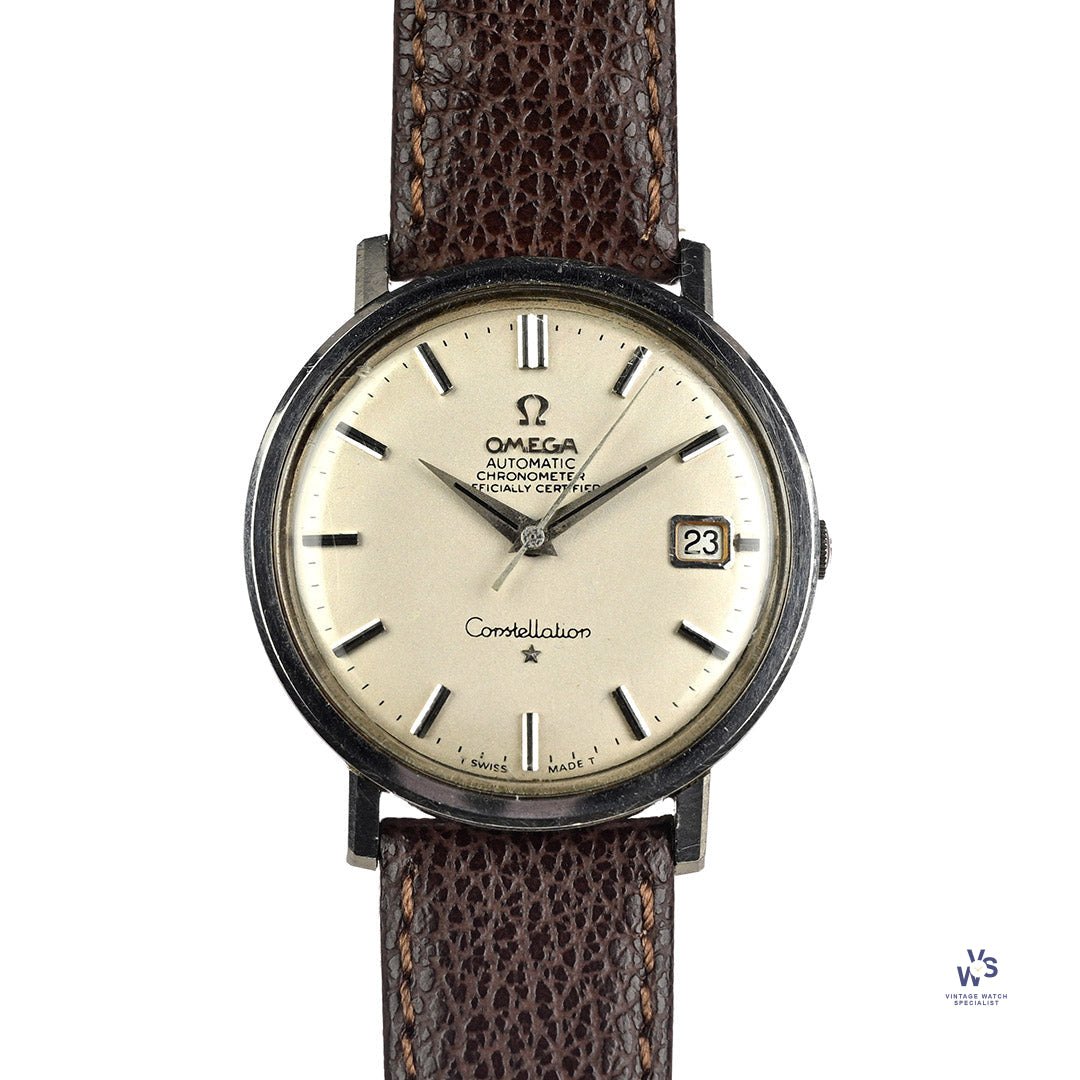
Omega Constellation Automatic Date, ref. ST168.004, circa 1962
- Maker / attribution
- Omega (maker)
- Date
- c. 1962
- Historical period
- Modern Mechanical Horology (1945 – 1969)
- Country of origin
- Switzerland
- Object type
- Wristwatch
- Dimensions
- Case 35 mm
- Stock no.
- vws3598cs
- Credit line
- Dealer listing, Vintage Watch Specialist (vws3598cs)
- Catalogue title (original)
- Omega Constellation Automatic Date - Model Ref: ST168.004 - c.1962 (English)
View the source record (dealer listing) ↗ (opens another website in a new tab)Suggest a correction
Record summary
Catalogued by Vintage Watch Specialist (dealer), United Kingdom (stock number vws3598cs), this is a wristwatch by Omega, made in Switzerland, dated c. 1962. The Atlas places it in the Modern Mechanical Horology period (1945 – 1969) of its Wristwatches collection. Recorded dimensions: Case 35 mm. The record is illustrated with 6 photographs.
Assembled from the source record's structured fields. Dates and attributions are given as the source states them; where a field is missing the Atlas leaves it blank rather than estimating.
Catalogue description
Dealer description — Vintage Watch Specialist
A Beautiful Vintage Omega Constellation with an Attractive Silver Dial Boasting Stylish Furniture and a Subtle Date Aperture, c.1962 Omega Automatic Constellation Date Steel Model Reference: ST168.004 Calibre: 561 24 Jewels Adjusted 5 positions and Temperatures Movement Number: 23810785 on Omega pin buckle. The Omega Constellation Collection, introduced in 1952, signifies a cornerstone in horological excellence. Named to evoke the celestial precision of its timekeeping, the collection was initially celebrated for its pioneering design and chronometric performance. The original models featured a distinctive "pie-pan" dial, named for its unique shape, which added depth and dimension, and became a hallmark of sophistication. In the 1980s, the Constellation line underwent a significant transformation with the introduction of the "Manhattan" series. This series showcased the now-iconic "Griffes" or claws, which elegantly held the sapphire crystal, innovating both function and style. The collection expanded with a plethora of models featuring luxurious materials such as gold and stainless steel, adorned with diamonds. Throughout its evolution, the Omega Constellation has maintained its position as a symbol of precision and elegance, continuously integrating cutting-edge technology while respecting its illustrious heritage. Today, it remains an emblem of timeless luxury and accuracy. What's on Offer You cannot go wrong with vintage Omega, and the Constellation is possibly my favourite range, of which this watch is a beautiful example. A simple and chic design, the silver dial features onyx-filled baton hour markers and corresponding Dauphine hands, accompanied by a central seconds needle. There is a subtly framed date aperture at 3 o'clock and an applied Omega signature at 12. The dial is completed by the synonymous star of the Constellation range, which follows through to the caseback, where you will see the observatory emblem and 8 stars. Encapsulated underneath a shatterproof acrylic crystal, the dial is encased in polished stainless steel with a very slim bezel, allowing the watch to appear larger than its 35mm when on the wrist. A 1960s piece, this watch has been well taken care of and shows minimal signs of previous wear, but its service history is unknown (please see caveat below). A great buy - we love it!
Historical context
Modern Mechanical Horology (1945 – 1969)
Tool watches for divers, pilots and astronauts; electric watches anticipate the electronic age.
The classic era of the mechanical wristwatch: dive watches, chronographs for motor racing and space flight, GMT watches for jet travel, slim dress watches, automatic calendars, and the rise of Japanese manufacturers alongside Swiss, American, German and Soviet industries.
Read the period in the timelineMore wristwatches from this periodEarlier: Golden Age of Mechanical Watchmaking
Atlas type guide
Automatic (self-winding) watches
Self-winding watches use the wearer's motion to wind the mainspring. Abraham-Louis Perrelet and Breguet made 'perpétuelle' pocket watches with oscillating weights in the late eighteenth century, but the principle only became practical in the wristwatch. John Harwood patented a bumper automatic in 1923; Rolex's Perpetual rotor (1931) winding in one direction, and later bidirectional rotors (Eterna, Felsa Bidynator), established the modern form. Micro-rotors (Universal Genève, Buren) and peripheral rotors made automatic watches thinner.
What to look for
- A semicircular rotor turning 360° over the movement, or a 'bumper' weight that rebounds between springs.
- 'Automatic', 'Perpetual' or 'Self-winding' on the dial.
- A sealed screw-back case, since automatic watches are wound less often by the crown.
Dating clues
- Bumper automatics: 1923–c. 1955.
- Full rotors: from 1931 (Rolex); widespread after c. 1950.
- Micro-rotors: from 1954–1958.
General guidance written by the Atlas editors about this kind of object. It is not a statement about this particular piece; for that, rely on the source record above and on physical examination.
Related records

Instruments · 1950–1976
Omega Megaquartz 2400 marine chronometer, 1950–1976
Science Museum Group, London

Instruments · 1960–1979
Stopwatch / timer by Omega, 1960–1979
Science Museum Group, London

Instruments · 1960–1979
Stopwatch / timer by Omega, Switzerland, 1960–1979
Science Museum Group, London

Instruments · 1960–1979
Stopwatch by Omega, Swiss made, single-button type reading 0 - 60 seconds in fifths and 0 - 5 minutes in minutes on subsidiary dial, 1960-79.
Science Museum Group, London

Wristwatches · 1945
Wristwatch by Eterna, 1945
Museum Rotterdam

Wristwatches · c. 1945
Breitling Premier, ref. 790, c. 1945
Antiquorum auction archive, Geneva

Wristwatches · c. 1945
Universal Genève Uni-Compax, ref. 22492, c. 1945
Antiquorum auction archive, Geneva

Wristwatches · c. 1950s
Baume & Mercier wristwatch, c. 1950s
Antiquorum auction archive, Geneva