
Wristwatches · Wristwatch
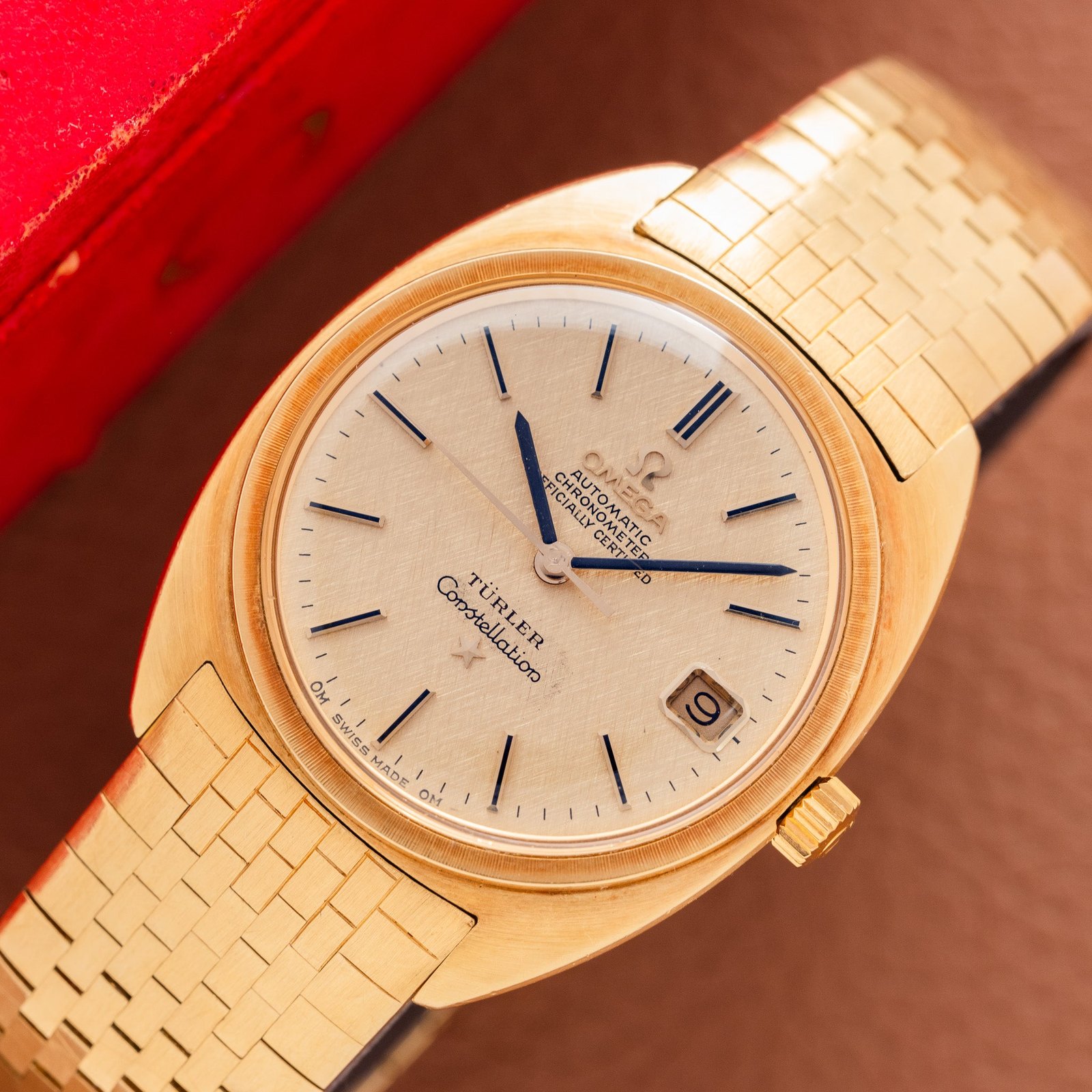
Omega Constellation 18k Brick Or Massif Linen Dial (Ref. 168.009), 1968
- Maker / attribution
- Omega (maker)
- Date
- 1968
- Historical period
- Modern Mechanical Horology (1945 – 1969)
- Country of origin
- Switzerland
- Object type
- Wristwatch
- Dimensions
- Case 35 mm
- Stock no.
- Product 8195739877559
- Credit line
- Dealer listing, Huntington Company (product 8195739877559)
- Catalogue title (original)
- 1968 Omega Constellation 18k Brick Or Massif Linen Dial (Ref. 168.009) (English)
View the source record (dealer listing) ↗ (opens another website in a new tab)Suggest a correction
Record summary
Catalogued by Huntington Company (dealer) (stock number Product 8195739877559), this is a wristwatch by Omega, made in Switzerland, dated 1968. The Atlas places it in the Modern Mechanical Horology period (1945 – 1969) of its Wristwatches collection. Recorded dimensions: Case 35 mm. The record is illustrated with 6 photographs.
Assembled from the source record's structured fields. Dates and attributions are given as the source states them; where a field is missing the Atlas leaves it blank rather than estimating.
Catalogue description
Dealer description — Huntington Company
Worth The Read This is not your ordinary C-shaped Connie. This example is a true Or Massif, every bit of this is solid gold and the OM s igned dial confirms that. This solid 18k yellow gold example features a rare brick bracelet and linen dial, both also in solid gold. The watch comes with its original box and service receipt. The Constellation - The Constellation collection, founded in 1948, is a collection of watches that began with the Centenary, a watch designed by René Banwart. The watch was made in limited numbers, with 6,000 made in 1952. The Constellation was named after the emblem on the caseback, which showed an observatory with eight stars above it. The watch was known for its distinctive faceted convex dial, known as a "pie-pan dial." The collection evolved over the 1960s, with models featuring simpler dial designs and a wider variety of case shapes. The Constellation also pioneered quartz watch technology, with the first commercially available quartz watch, the Astron, released in 1969. Today the line is still just as diverse, with mechanical chronometers and Master Chronometers. The collection includes a wide range of case materials and combinations, representing the latest chapter in the history of one of the longest-lived and most important wristwatch collections in the history of wristwatches. Specifications Reference: 168.009 Model: Constellation Movement: Automatic Caliber 564 serviced and documented. Contents: Original Box Case: The 35mm case looks great with its original, untouched brushed finish. The reference 168.009 features a fluted/coin-edged bezel also in solid gold. Dial: The linen Constellation dial is perfection. A beautiful solid gold linen dial underneath the original Omega signed acrylic. Strap & Buckle: The original brick bracelet is in perfect condition. It fits a 7.2-inch wrist, not including the factory spring-activated extension in the clasp.
Historical context
Modern Mechanical Horology (1945 – 1969)
Tool watches for divers, pilots and astronauts; electric watches anticipate the electronic age.
The classic era of the mechanical wristwatch: dive watches, chronographs for motor racing and space flight, GMT watches for jet travel, slim dress watches, automatic calendars, and the rise of Japanese manufacturers alongside Swiss, American, German and Soviet industries.
Read the period in the timelineMore wristwatches from this periodEarlier: Golden Age of Mechanical Watchmaking
Atlas type guide
Wristwatches
Bracelet watches were worn by women from the early nineteenth century — Breguet made one for Caroline Murat, Queen of Naples, in 1810–12 — but the wristwatch only became a man's instrument with military use and aviation in the early twentieth century. Between the World Wars it overtook the pocket watch; the 1920s and 1930s brought rectangular Art Deco cases, water-resistant cases and the first automatic winding systems.
After 1945 the wristwatch became a carrier of identity — dress watches, sports and dive watches, chronographs, calendars — produced by Swiss, American, Japanese, German, Soviet and Chinese industries. The quartz revolution after 1969 and the mechanical renaissance since the 1990s, including the rise of independent watchmakers, complete the story.
What to look for
- The reference number (between the lugs or inside the case back) and serial number, the starting point for dating.
- The calibre: its maker and number are often stamped under the dial or on the bridge.
- Originality of dial, hands and crown — refinished ('redial') dials are common.
- Case material marks: 18K/750, 14K/585, stainless steel, gold-filled, plated.
Dating clues
- Wire-lug cases: before c. 1925.
- Water-resistant screw-down cases: from 1926.
- Quartz movements: from 1969; sapphire crystals widespread after c. 1980.
General guidance written by the Atlas editors about this kind of object. It is not a statement about this particular piece; for that, rely on the source record above and on physical examination.
Related records

Instruments · 1950–1976
Omega Megaquartz 2400 marine chronometer, 1950–1976
Science Museum Group, London

Instruments · 1960–1979
Stopwatch / timer by Omega, 1960–1979
Science Museum Group, London

Instruments · 1960–1979
Stopwatch / timer by Omega, Switzerland, 1960–1979
Science Museum Group, London

Instruments · 1960–1979
Stopwatch by Omega, Swiss made, single-button type reading 0 - 60 seconds in fifths and 0 - 5 minutes in minutes on subsidiary dial, 1960-79.
Science Museum Group, London

Wristwatches · 1945
Wristwatch by Eterna, 1945
Museum Rotterdam

Wristwatches · c. 1945
Breitling Premier, ref. 790, c. 1945
Antiquorum auction archive, Geneva

Wristwatches · c. 1945
Universal Genève Uni-Compax, ref. 22492, c. 1945
Antiquorum auction archive, Geneva

Wristwatches · c. 1950s
Baume & Mercier wristwatch, c. 1950s
Antiquorum auction archive, Geneva