
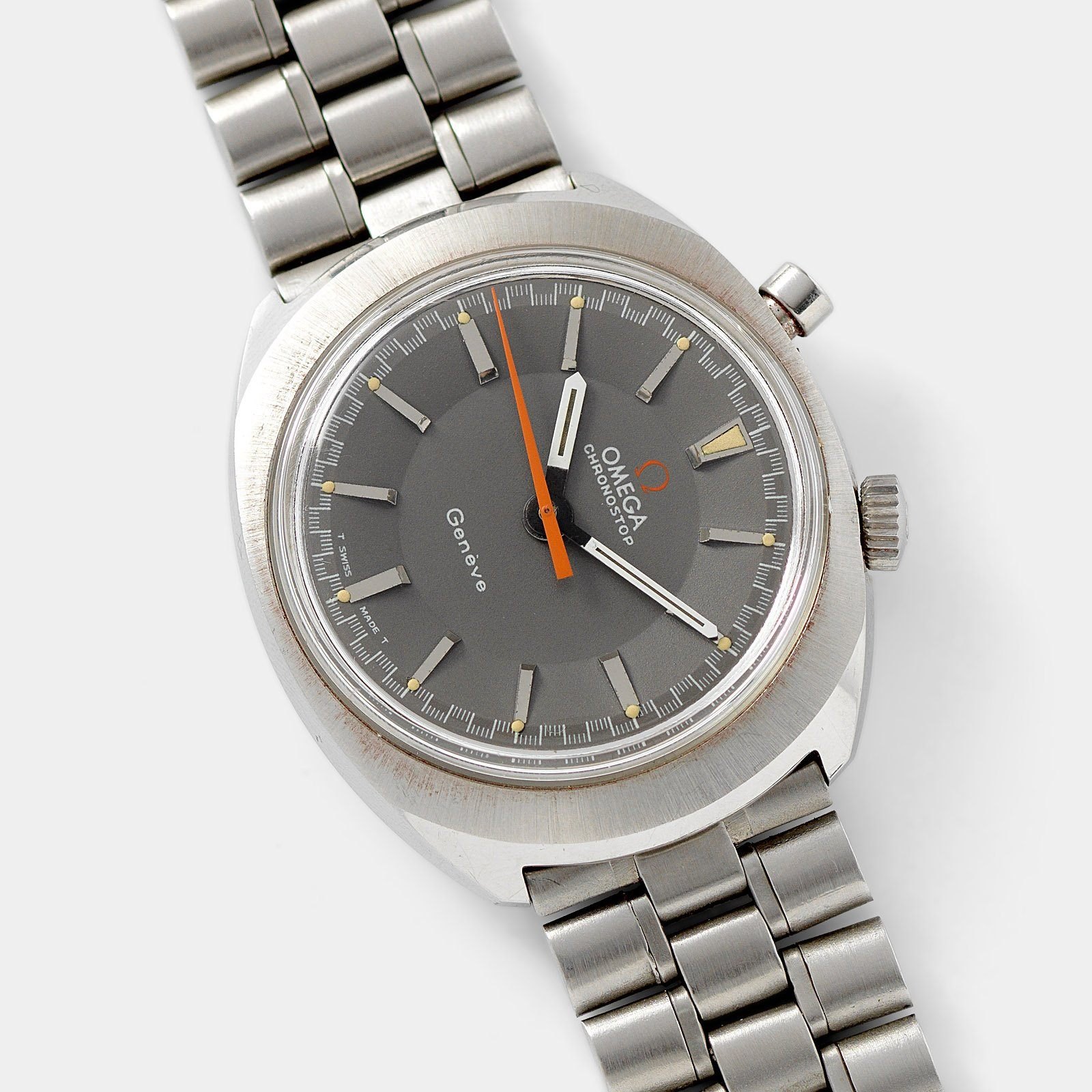
Instruments · Stopwatch
Omega Chronostop Driver’s Watch Reference 145.010, 1960s
- Maker / attribution
- Omega (maker)
- Date
- 1960s
- Historical period
- Modern Mechanical Horology (1945 – 1969)
- Country of origin
- Switzerland
- Object type
- Stopwatch
- Dimensions
- Case 41 mm
- Stock no.
- W-890
- Credit line
- Dealer listing, Bulang & Sons (W-890)
- Catalogue title (original)
- Omega Chronostop Driver’s Watch Reference 145.010 (English)
View the source record (dealer listing) ↗ (opens another website in a new tab)Suggest a correction
Record summary
Catalogued by Bulang & Sons (dealer), Copenhagen (stock number W-890), this is a stopwatch by Omega, made in Switzerland, dated 1960s. The Atlas places it in the Modern Mechanical Horology period (1945 – 1969) of its Instruments collection. Recorded dimensions: Case 41 mm. The record is illustrated with 6 photographs.
Assembled from the source record's structured fields. Dates and attributions are given as the source states them; where a field is missing the Atlas leaves it blank rather than estimating.
Catalogue description
Dealer description — Bulang & Sons
Turn it 90 degrees… This is a very cool driver’s chrono with funky orange stopwatch and and single pusher cushion-shaped case. What marks this watch out as a driver’s watch is the fact that the dial is turned by 90 degrees, thus allowing the time to be read at a glance whilst holding the steering wheel. Further more, period Omega ads show the watch being worn on the inside of the wrist for even easier viewing! The cushion shaped case is in super-mint condition, with the purple lacquer still in place on the caseback ! The grey dial is in stunning original condition too and we love the funky orange hand – it really pops on the watch! The Chronostop comes on its original Omega steel bracelet, reference 1118, with a clasp stamped ‘11’ and reference 123 endlinks. The watch has been fully serviced by our watchmaker. Specifications - Reference 145.010 - Dates to 1960s - 35 x 41mm steel case - Cal 865 movement - Movement serial 1661xxxx - Single pusher chronograph - Omega 1118 steel bracelet with ref 123 endlinks - Fully serviced by our watchmaker - Includes a handmade single leather watch pouch
Historical context
Modern Mechanical Horology (1945 – 1969)
Tool watches for divers, pilots and astronauts; electric watches anticipate the electronic age.
Electronic instruments, quartz frequency standards and the first atomic clocks transformed precision timing in laboratories and broadcasting.
Read the period in the timelineMore instruments from this periodEarlier: Golden Age of Mechanical Watchmaking
Atlas type guide
Timers, stopwatches, chronoscopes and time recorders
Instruments for measuring short intervals or recording when something happened form a large and practical branch of horology. Sports stopwatches and split-seconds timers, laboratory chronoscopes (such as Hipp's, which measured thousandths of a second for psychology and ballistics experiments), metronomes for music, watchmen's clocks that recorded patrol rounds, and the time recorders that clocked factory workers in and out all derive from clock and watch technology.
These objects matter historically because they show timekeeping leaving the observatory and the drawing room and entering industry, science and sport. Many were mass-produced, and their dials, scales and patents chart the rise of electrification and industrial management.
What to look for
- Scales graduated in fifths, tenths or hundredths of a second, or decimal minutes for industrial use.
- Start, stop and reset push-pieces; a second hand that can be stopped independently (split seconds).
- Recording devices: paper discs or tapes, printing mechanisms, keys or punches.
- Patent numbers and dates on the dial or case, which give a terminus post quem.
Dating clues
- Hipp chronoscopes were made from the 1840s into the twentieth century.
- Employee time recorders spread from the 1890s (Bundy, IBM, International Time Recording Co.).
- Quartz and electronic timers replaced mechanical stopwatches in sport from the 1970s.
General guidance written by the Atlas editors about this kind of object. It is not a statement about this particular piece; for that, rely on the source record above and on physical examination.
Read next:Flyback chronograph
Related records

Instruments · 1950–1976
Omega Megaquartz 2400 marine chronometer, 1950–1976
Science Museum Group, London

Instruments · 1960–1979
Stopwatch / timer by Omega, 1960–1979
Science Museum Group, London

Instruments · 1960–1979
Stopwatch / timer by Omega, Switzerland, 1960–1979
Science Museum Group, London

Instruments · 1960–1979
Stopwatch by Omega, Swiss made, single-button type reading 0 - 60 seconds in fifths and 0 - 5 minutes in minutes on subsidiary dial, 1960-79.
Science Museum Group, London
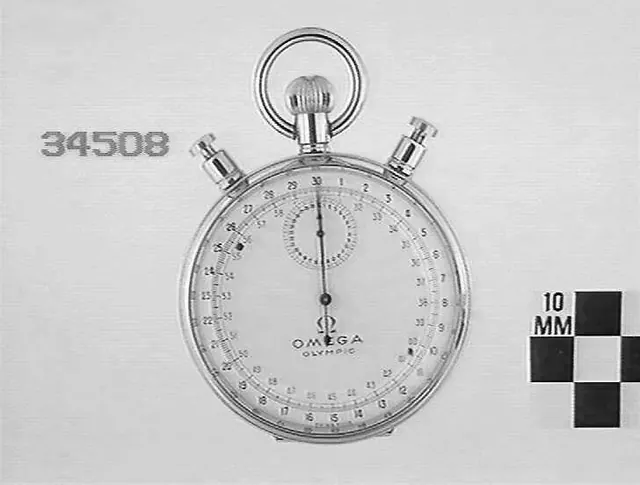
Instruments · c. 1955
Stop Watch - Omega, Switzerland, c. 1955
Museums Victoria, Melbourne
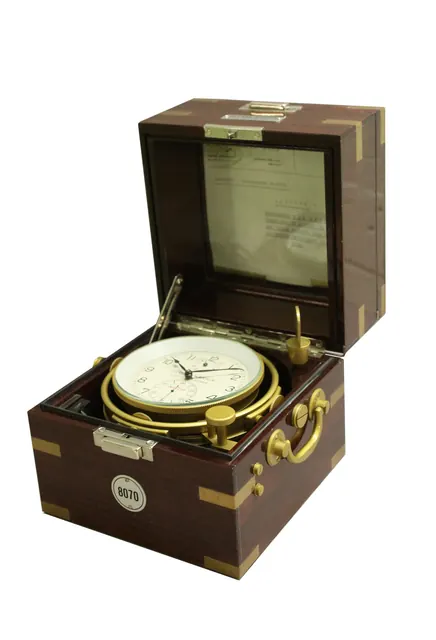
Instruments · 1954–1957
Marine chronometer by Ulysse Nardin, Switzerland, 1954–1957
Tiedemuseo Liekki
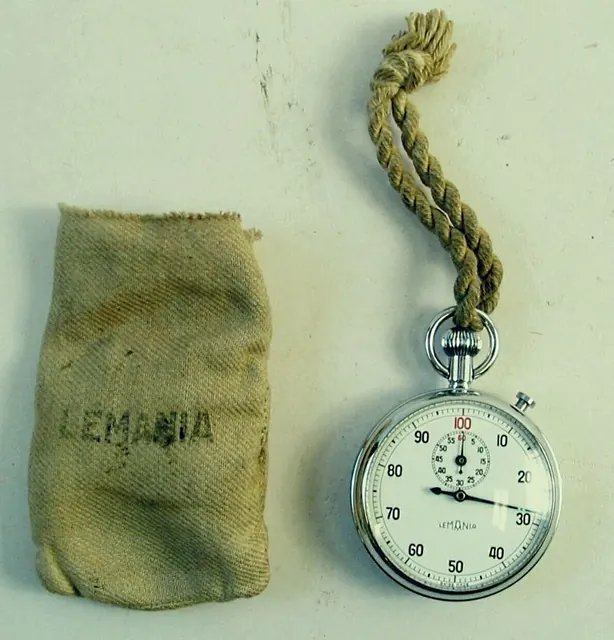
Instruments · 1950–1970
Stopwatch by Lemania, Switzerland, 1950–1970
Museokeskus Vapriikki
Instruments · 1960s
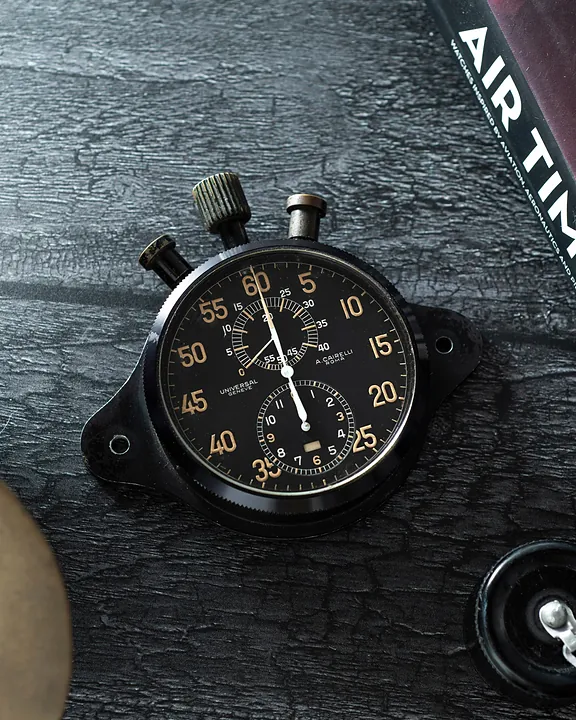
Universal Genève HC-1 Bomb Timer by A. Cairelli Roma, 1960s
Analog/Shift (dealer), New York