
Instruments · Stopwatch
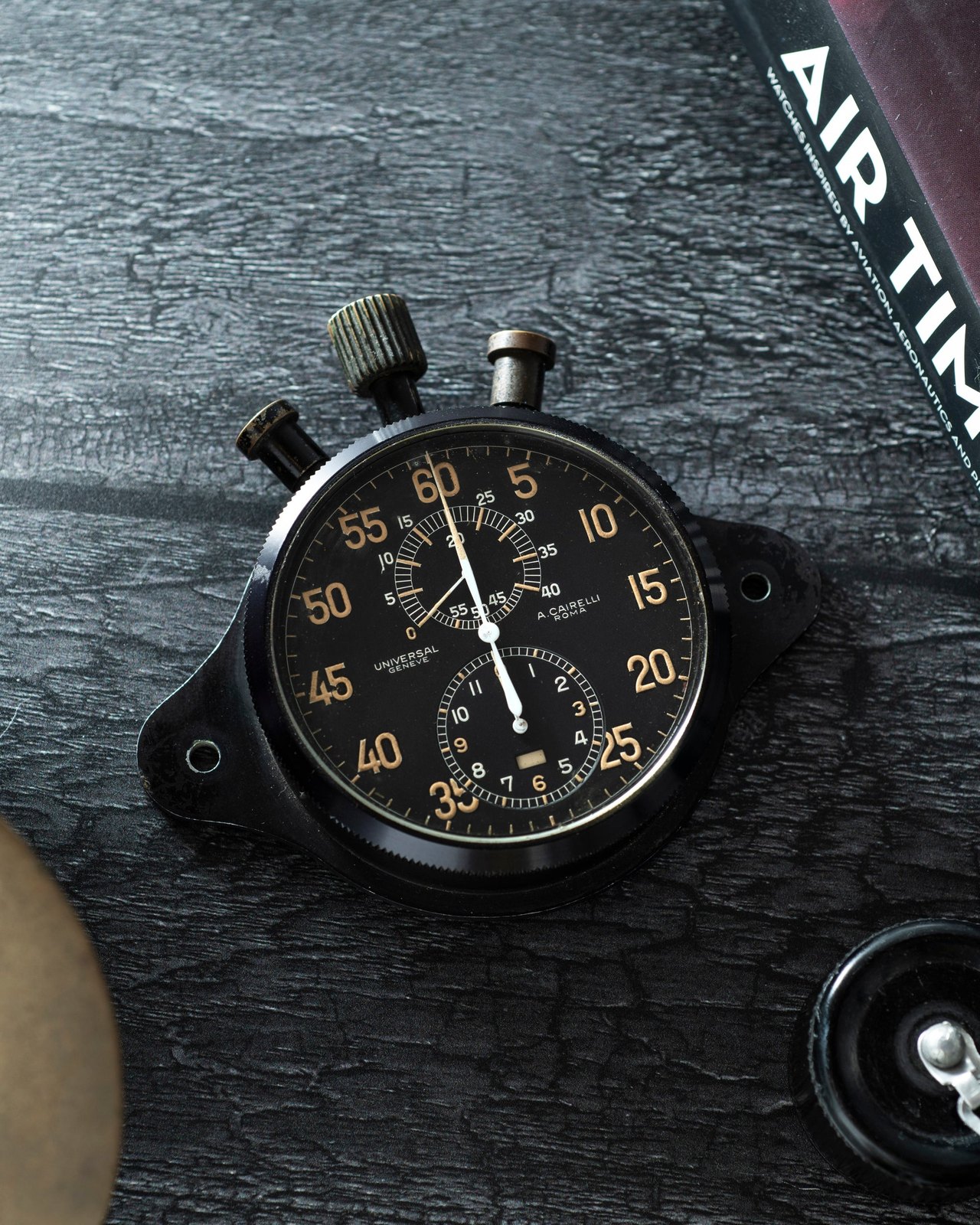
Universal Genève HC-1 Bomb Timer by A. Cairelli Roma, 1960s
- Maker / attribution
- Universal Genève (maker)
- Date
- 1960s
- Historical period
- Modern Mechanical Horology (1945 – 1969)
- Country of origin
- Switzerland
- Object type
- Stopwatch
- Dimensions
- Case 65 mm
- Stock no.
- 39131182
- Credit line
- Dealer listing, Analog/Shift (39131182)
- Catalogue title (original)
- Universal Genève HC-1 Bomb Timer by A. Cairelli Roma (English)
Editor's note
The dealer's brand field named another maker; the dealer's own listing title identifies the watch as Universal Genève.View the source record (dealer listing) ↗ (opens another website in a new tab)Suggest a correction
Record summary
Catalogued by Analog/Shift (dealer), New York (stock number 39131182), this is a stopwatch by Universal Genève, made in Switzerland, dated 1960s. The Atlas places it in the Modern Mechanical Horology period (1945 – 1969) of its Instruments collection. Recorded dimensions: Case 65 mm. The record is illustrated with 6 photographs.
Assembled from the source record's structured fields. Dates and attributions are given as the source states them; where a field is missing the Atlas leaves it blank rather than estimating.
Catalogue description
Dealer description — Analog/Shift
Sure, Analog:Shift is a business built around the love of wristwatches. But it’s our love for timepieces, timekeeping, and artifacts from history in general that are the common themes present in the items we procure. And that includes a love of clocks in general: pocket watches, travel clocks, and more. After all, in the couple hundred years before the First World War, personal timekeeping was all about the pocket watch, and before that, it was larger clocks that were front and center, horologically. We still believe a good clock deserves a place in any watch lover’s collection. Offered here is a Universal Genève HC-1 dash instrument that dates to the 1960s and was produced for A. Cairelli of Roma, Universal's agency in Italy, who also modified and supplied timepieces to the Italian government for military contracts. Any double signed Universal Genève/A. Cairelli dial is highly coveted among collectors. This particular timepiece was designed to be installed on board the Fiat G.91, a fighter-bomber-reconnaissance aircraft for the Italian Air Force. This military-grade instrument features a Bakelite case measuring approximately 65mm, a large winding crown at 12 o’clock framed by a pair of pump pushers, a luminous matte black dial with Arabic numerals and a pair of recessed subsidiary registers displaying a 60-minute and 12-hour counters and a curious tri-colore display window at 6 o'clock operated by pushing the crown, likely used by bomber crews to denote payload drop intervals. Internally, this UG dashboard clock uses a manual winding Calibre 296 movement which has just been fully overhauled. This is a phenomenal example of a rare and highly collectable military-grade timing instrument from Universal Genève!
Historical context
Modern Mechanical Horology (1945 – 1969)
Tool watches for divers, pilots and astronauts; electric watches anticipate the electronic age.
Electronic instruments, quartz frequency standards and the first atomic clocks transformed precision timing in laboratories and broadcasting.
Read the period in the timelineMore instruments from this periodEarlier: Golden Age of Mechanical Watchmaking
Atlas type guide
Timers, stopwatches, chronoscopes and time recorders
Instruments for measuring short intervals or recording when something happened form a large and practical branch of horology. Sports stopwatches and split-seconds timers, laboratory chronoscopes (such as Hipp's, which measured thousandths of a second for psychology and ballistics experiments), metronomes for music, watchmen's clocks that recorded patrol rounds, and the time recorders that clocked factory workers in and out all derive from clock and watch technology.
These objects matter historically because they show timekeeping leaving the observatory and the drawing room and entering industry, science and sport. Many were mass-produced, and their dials, scales and patents chart the rise of electrification and industrial management.
What to look for
- Scales graduated in fifths, tenths or hundredths of a second, or decimal minutes for industrial use.
- Start, stop and reset push-pieces; a second hand that can be stopped independently (split seconds).
- Recording devices: paper discs or tapes, printing mechanisms, keys or punches.
- Patent numbers and dates on the dial or case, which give a terminus post quem.
Dating clues
- Hipp chronoscopes were made from the 1840s into the twentieth century.
- Employee time recorders spread from the 1890s (Bundy, IBM, International Time Recording Co.).
- Quartz and electronic timers replaced mechanical stopwatches in sport from the 1970s.
General guidance written by the Atlas editors about this kind of object. It is not a statement about this particular piece; for that, rely on the source record above and on physical examination.
Read next:Flyback chronograph
Related records
Clocks · c. 1960-1970s
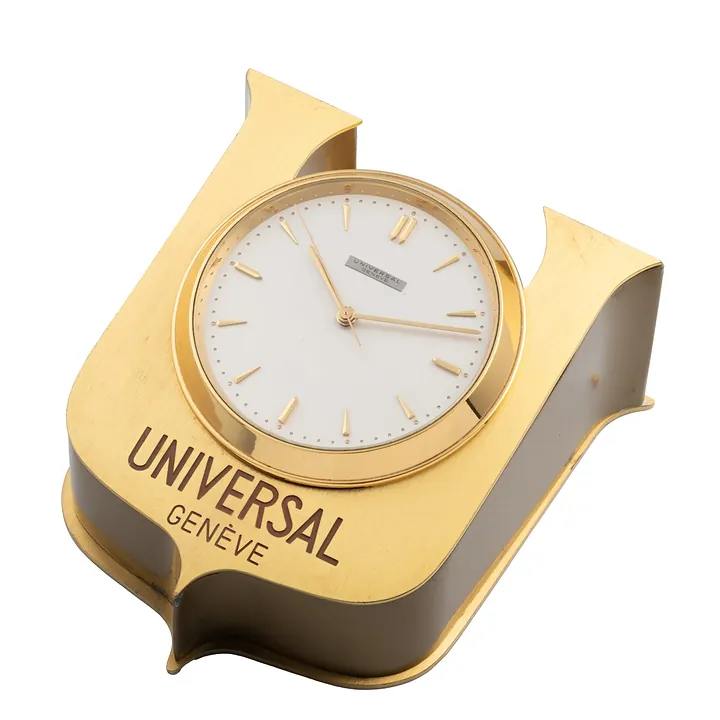
Universal Genève clock, ref. 999.116.01, c. 1960-1970s
Antiquorum auction archive, Geneva
Pocket Watches · c. 1950s
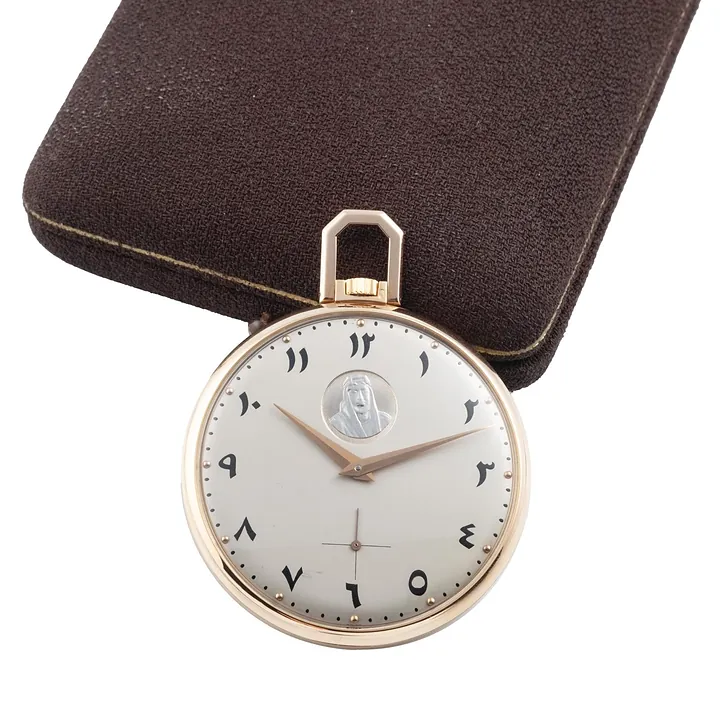
Universal Genève pocket watch, ref. 11746 3/ 11746 1, c. 1950s
Antiquorum auction archive, Geneva
Wristwatches · c. 1941
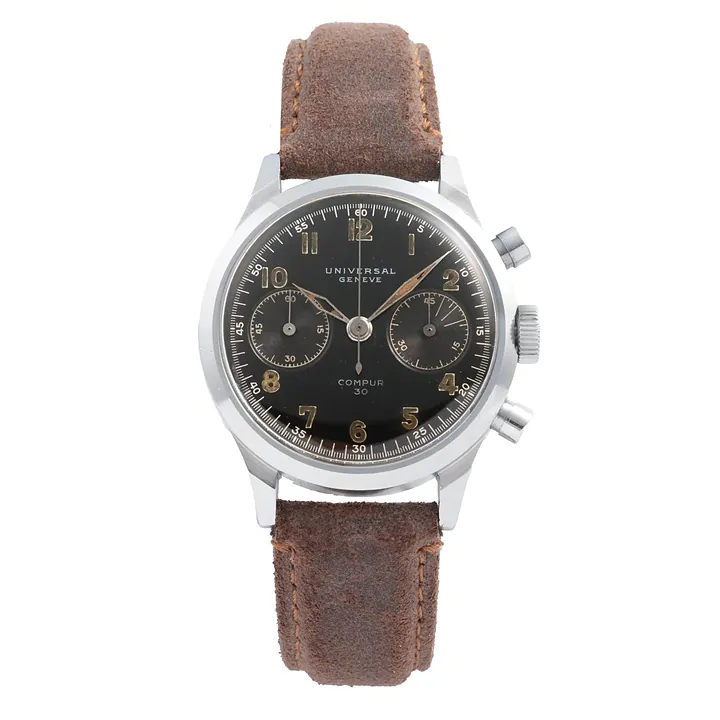
Universal Genève Compur 30, ref. 22409, c. 1941
Antiquorum auction archive, Geneva

Wristwatches · c. 1945
Universal Genève Uni-Compax, ref. 22492, c. 1945
Antiquorum auction archive, Geneva

Instruments · 1950–1976
Omega Megaquartz 2400 marine chronometer, 1950–1976
Science Museum Group, London
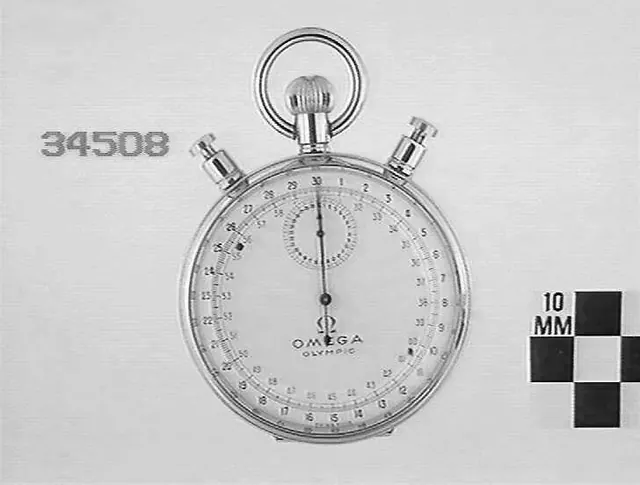
Instruments · c. 1955
Stop Watch - Omega, Switzerland, c. 1955
Museums Victoria, Melbourne
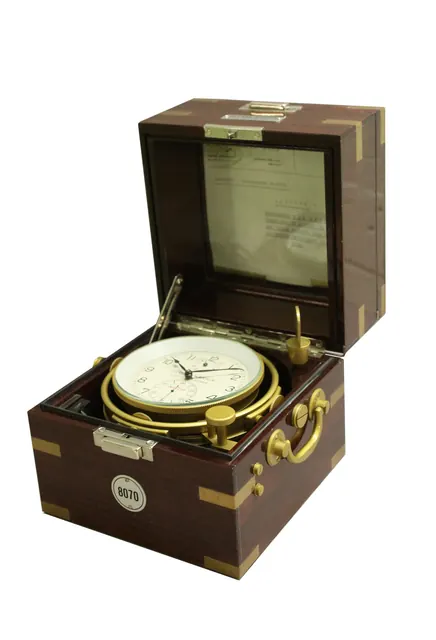
Instruments · 1954–1957
Marine chronometer by Ulysse Nardin, Switzerland, 1954–1957
Tiedemuseo Liekki
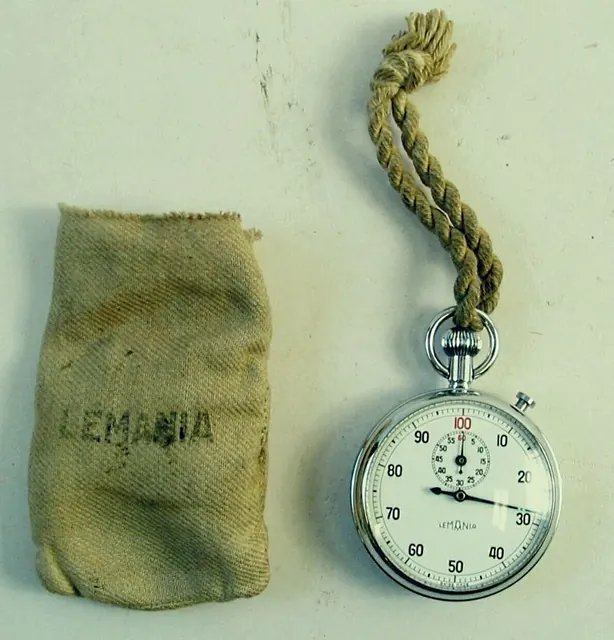
Instruments · 1950–1970
Stopwatch by Lemania, Switzerland, 1950–1970
Museokeskus Vapriikki