
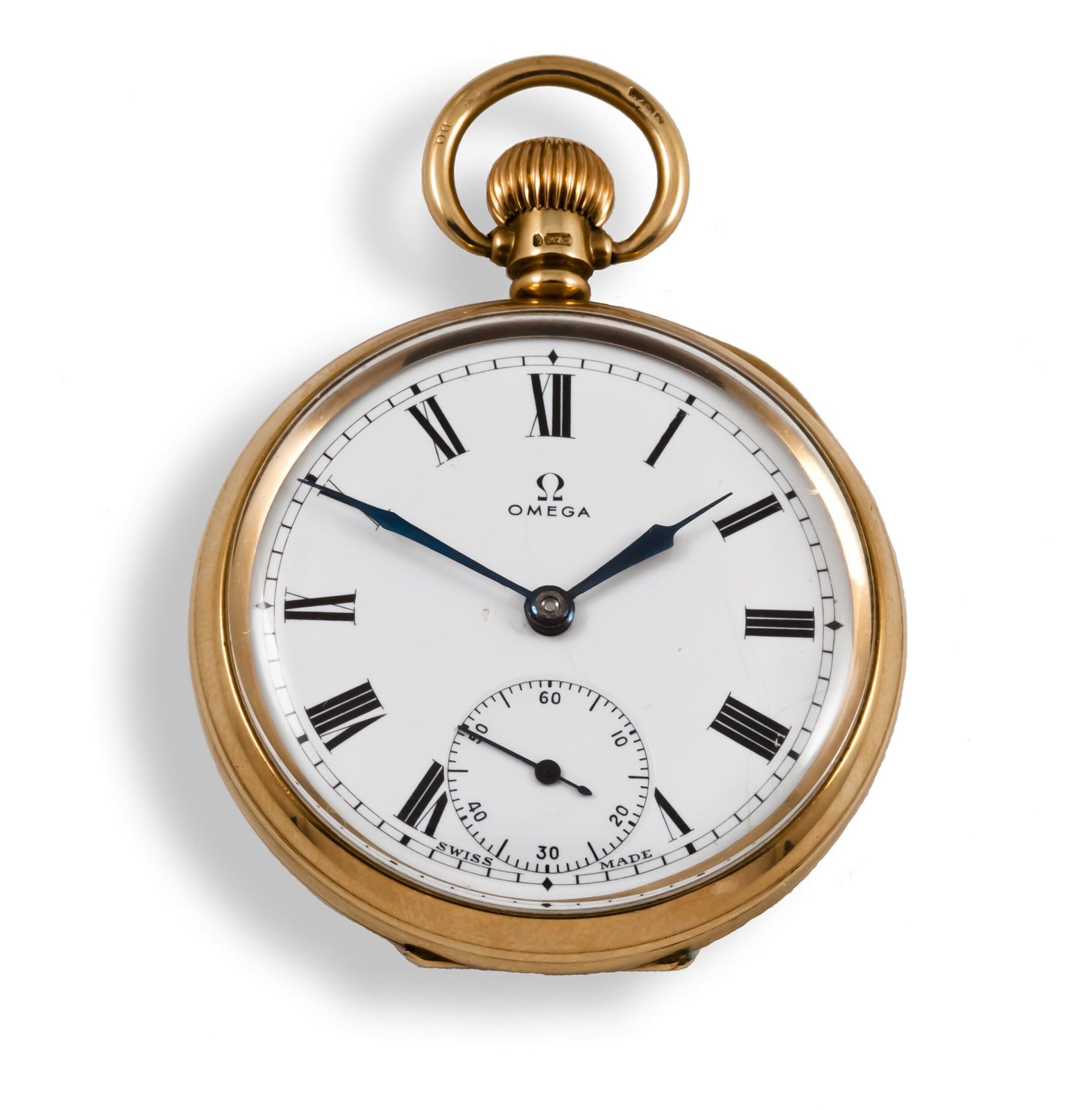
Pocket Watches · Pocket watch
Omega. 9k Gold Case. 1939
- Maker / attribution
- Omega (maker)
- Date
- 20th century
- Historical period
- Golden Age of Mechanical Watchmaking (1900 – 1945)
- Country of origin
- Switzerland
- Object type
- Pocket watch
- Materials / technique
- gold
- Dealer
- WatchMuseum.org shop
- Stock no.
- Product 279
- Credit line
- Dealer listing, WatchMuseum.org shop (product 279)
- Catalogue title (original)
- Omega. 9k Gold Case. 1939 (English)
View the source record (dealer listing) ↗ (opens another website in a new tab)Suggest a correction
Record summary
Catalogued by WatchMuseum.org shop (stock number Product 279), this is a pocket watch by Omega, made in Switzerland, dated 20th century. The Atlas places it in the Golden Age of Mechanical Watchmaking period (1900 – 1945) of its Pocket Watches collection. Materials and techniques recorded by the source: gold. The record is illustrated with 6 photographs.
Assembled from the source record's structured fields. Dates and attributions are given as the source states them; where a field is missing the Atlas leaves it blank rather than estimating.
Catalogue description
Dealer description — WatchMuseum.org shop
Omega, a name synonymous with precision and timeless elegance, traces its origins back to 1848 when Louis Brandt established the company in La Chaux-de-Fonds, Switzerland. Initially, Brandt crafted watches using parts made by independent artisans, a common practice among European watchmakers of the era. The business saw significant advancements under the stewardship of Brandt’s sons, Louis-Paul and Cesar, who relocated it to Bienne in 1879. By 1894, they had revolutionized the industry with machinery that allowed for the production of watches with interchangeable parts, leading to the creation of the renowned Labrador line and the iconic Caliber 19. This innovation laid the groundwork for the official establishment of Omega SA in 1903. Following the untimely deaths of Louis-Paul and Cesar, the company was left in the capable hands of four young leaders, including the 23-year-old Paul-Emile Brandt. Under their guidance, Omega continued to thrive, eventually merging with Tissot and becoming one of Switzerland’s premier watch manufacturers. The 1939 Omega 9k Gold Case watch stands as a testament to this rich heritage, embodying the brand’s commitment to quality and craftsmanship. The company that was to become Omega was founded in 1848 By Louis Brandt in La Chaux de Fonds, Switzerland. He was a businessman and produced a range of watches, the parts of which were made by “outworkers” as with almost all European watch makers at that time. Louis’ two sons, Louis-Paul and Cesar moved the business to Bien (Bienne) in 1879 and developed machinery that enabled the production of watches with interchangeable parts by 1894. They produced several brands of cylinder watch, making all the parts in house and one of the first lines of high quality lever watches produced were called Labrador. This relatively new technology sparked the roll out of the Omega company, and the famous Caliber 19, but it was not until 1903 that Omega SA became the official name for the company. From around 1897 all Omega watches were made with interchangeable parts as most Swiss Watch making companies modernised and introduced the mass production methods that were the idea of Aaron Lufkin Dennison in the US and first implemented by him and Edward Howard in 1853 in what was to become the American Waltham Watch Co.. Both the sons died in 1903 leaving one of Switzerland’s biggest watch companies (with an annual production of nearly a quarter of a million watches), in the hands of four young people, the oldest of whom was Paul-Emile Brandt at 23. They worked hard to firstly amalgamate Tissot into the company to form the holding company SSHI and then to promote the brands by both product placing and ensuring that prominent organisations and famous people wore Omega watches. The British Royal Flying Corps used Omegas for timekeeping from 1917 as did the US Army from 1918. NASA chose Omega and it was the first watch to be worn on the Moon in 1969. Buzz Aldrin, George Clooney, John F Kennedy, Mao Zedong, Elvis Presley and Prince William were all wearers of Omega watches. A major bit of product placing was achieved when the Omega company persuaded James Bond to replace his Rolex Submariner with the Omega Seamaster in Goldeneye in 1995 and 007 has used an Omega ever since. OMEGA. 9k GOLD CASE. 1939. OVERALL CONDITION: The watch is working well and in near perfect condition. SIZE OVERALL: 46.6mm (excluding bow and crown) SIZE MOVEMENT: 39.8mm. US size 12. MANUFACTURED IN: Switzerland YEAR OF MANUFACTURE: 1939 JEWELS: 15 MOVEMENT TYPE: Three quarter plate. MOVEMENT CONDITION: Good. Stripped and ultra sound cleaned within the last 12 months. MOVEMENT ACCURACY: +/- 5 minutes in 24 hours RUN TIME: 24 hours approx. on one full wind. ESCAPEMENT: Lever DIAL: Roman numerals. Good condition, but with some very small marks near the centre. CRYSTAL: Replacement Mineral glass Crystal WIND: Crown wind SET: Crown set CASE: Dennison 9k solid Gold case. 0.375. Hallmarked for Birmingham 1939 CONDITION: Very good. KNOWN DEFECTS: No obvious faults. STOCK No: 483 There may be other faults of which I am not aware. Old mechanical watches may have wear to component parts and may stop working for no obvious reason.
Historical context
Golden Age of Mechanical Watchmaking (1900 – 1945)
The wristwatch displaces the pocket watch; waterproof cases, self-winding and grand complications.
The pocket watch reached technical maturity and then began to give way to the wristwatch after the First World War. Complicated watches for collectors such as Henry Graves Jr. and James Ward Packard, railroad watches, and slim Art Deco dress watches are characteristic.
Read the period in the timelineMore pocket watches from this periodEarlier: Industrial Revolution
Atlas type guide
Pocket watches
The pocket watch was the dominant personal timekeeper from the late seventeenth century until the First World War. Its development tracks the history of the escapement: verge watches with fusees until the late eighteenth century; Thomas Mudge's lever escapement (c. 1755) and the cylinder escapement popularised by George Graham and later by Swiss makers; and the Swiss and English lever watches of the nineteenth century. Lépine's bar-bridge calibre and keyless winding made watches thinner and easier to use.
Industrialisation transformed the trade: American factories such as Waltham (from 1850) and Elgin produced interchangeable parts by machine, and Swiss makers responded with their own mechanisation after the 1876 Philadelphia Exhibition. By 1900 a reliable watch was affordable to millions; the finest makers continued to produce complications and precision watches.
What to look for
- The escapement: verge (crown wheel), cylinder, duplex, English or Swiss lever.
- Key winding (a square arbor in dial or back) or keyless crown winding.
- Signatures and serial numbers on the movement, dial and inside case back.
- Hallmarks, case maker's marks and gold or silver standards stamped in the case.
- Dial material: enamel, silver, gold, later printed metal.
Dating clues
- Verge watches dominate before c. 1800; cylinder watches c. 1770–1900; lever watches after c. 1820.
- Keyless winding: increasingly common after c. 1860.
- Manufacturer serial number lists exist for Waltham, Elgin, Longines, Omega, Patek Philippe and others.
General guidance written by the Atlas editors about this kind of object. It is not a statement about this particular piece; for that, rely on the source record above and on physical examination.
Read next:Verge escapementDetached lever escapementFuseeIdentification Centre
Related records

Instruments · 1950–1976
Omega Megaquartz 2400 marine chronometer, 1950–1976
Science Museum Group, London

Instruments · 1960–1979
Stopwatch / timer by Omega, 1960–1979
Science Museum Group, London

Instruments · 1960–1979
Stopwatch / timer by Omega, Switzerland, 1960–1979
Science Museum Group, London

Instruments · 1960–1979
Stopwatch by Omega, Swiss made, single-button type reading 0 - 60 seconds in fifths and 0 - 5 minutes in minutes on subsidiary dial, 1960-79.
Science Museum Group, London

Pocket Watches · c. 1900
Patek Philippe Chronometro Gondolo, c. 1900
Antiquorum auction archive, Geneva
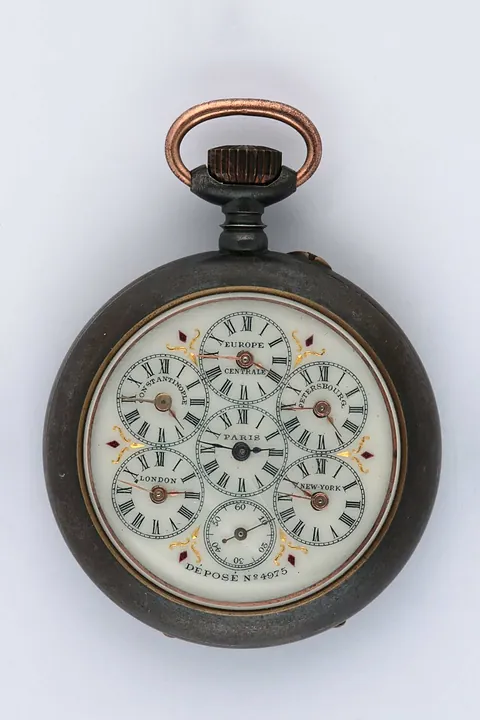
Pocket Watches · c. 1900
Pocket watch by A. Sandoz-Boucherin, Switzerland, c. 1900
German Clock Museum
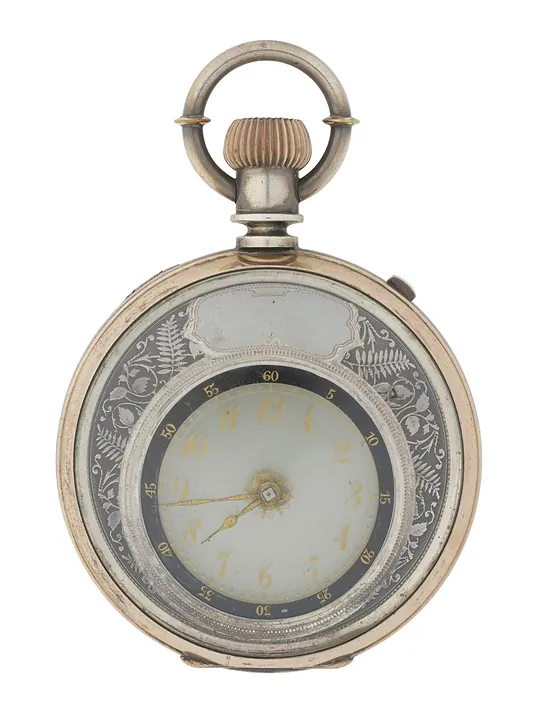
Pocket Watches · 1900
Pocket watch by Armand Schwob & Frère, Switzerland, 1900
Science Museum Group, London
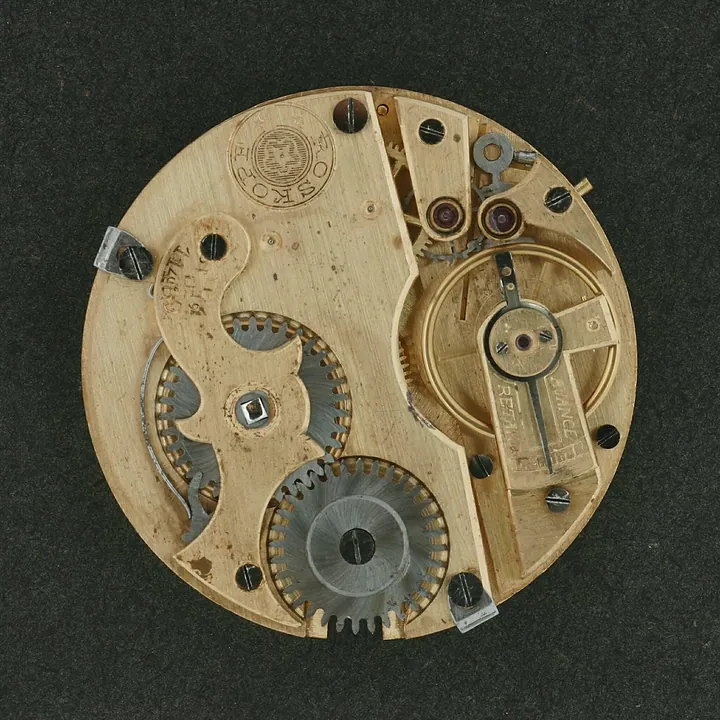
Pocket Watches · c. 1900
Pocket watch by Vve. Chs. Léon Schmid und Cie, Switzerland, c. 1900
German Clock Museum