
Wristwatches · Wristwatch
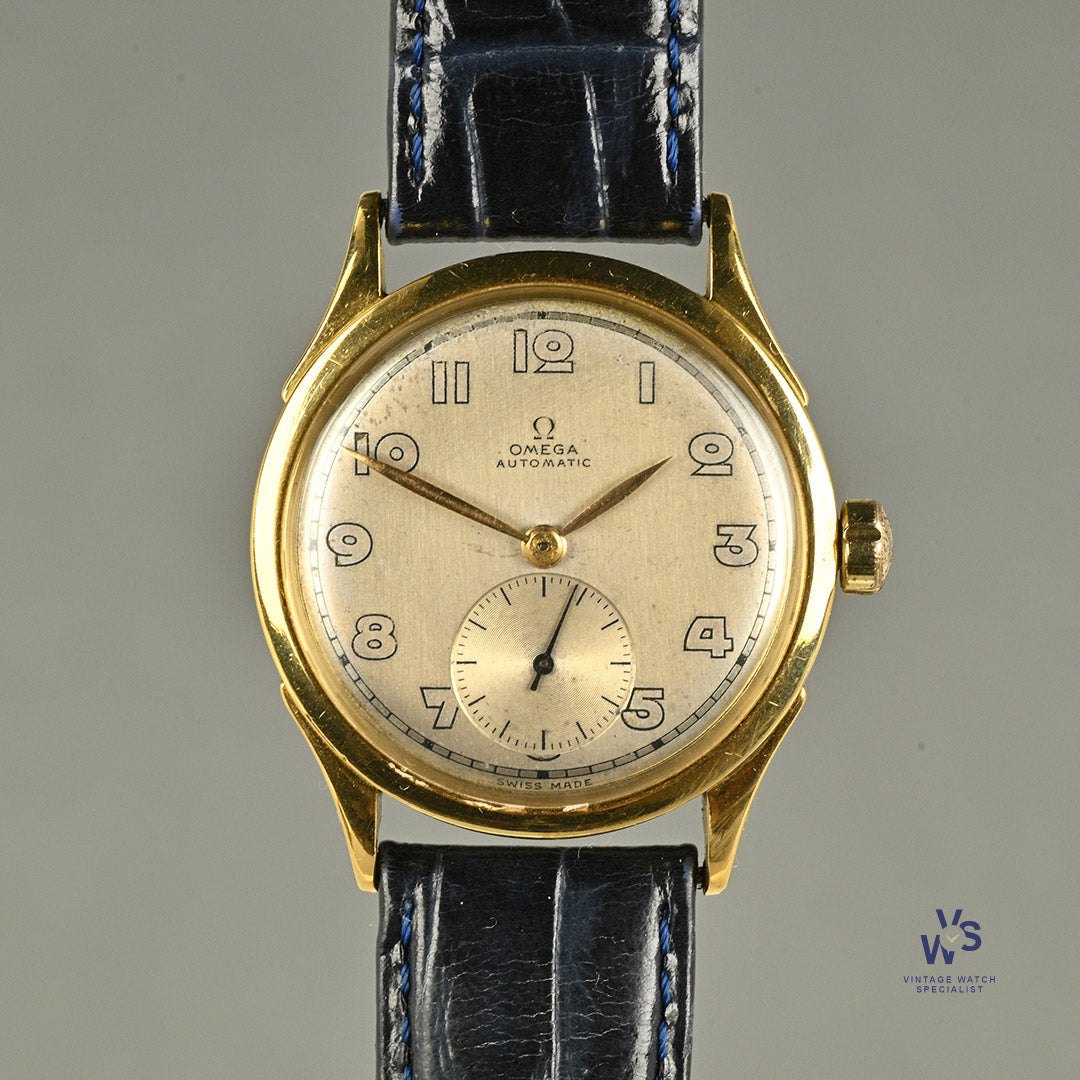
Omega 18k Gold Automatic Bumper Dress Watch, Art Deco-Influenced Dial, Calibre 28.10 RA, circa 1944–1947
- Maker / attribution
- Omega (maker)
- Date
- c. 1944–1947
- Historical period
- Modern Mechanical Horology (1945 – 1969)
- Country of origin
- Switzerland
- Object type
- Wristwatch
- Materials / technique
- gold
- Dimensions
- Case 32.5 mm
- Stock no.
- vws4366cs
- Credit line
- Dealer listing, Vintage Watch Specialist (vws4366cs)
- Catalogue title (original)
- Omega - 18k Gold Automatic Bumper Dress Watch - Art Deco-Influenced Dial - Calibre 28.10 RA - c.1944–1947 (English)
View the source record (dealer listing) ↗ (opens another website in a new tab)Suggest a correction
Record summary
Catalogued by Vintage Watch Specialist (dealer), United Kingdom (stock number vws4366cs), this is a wristwatch by Omega, made in Switzerland, dated c. 1944–1947. The Atlas places it in the Modern Mechanical Horology period (1945 – 1969) of its Wristwatches collection. Materials and techniques recorded by the source: gold. Recorded dimensions: Case 32.5 mm. The record is illustrated with 6 photographs.
Assembled from the source record's structured fields. Dates and attributions are given as the source states them; where a field is missing the Atlas leaves it blank rather than estimating.
Catalogue description
Dealer description — Vintage Watch Specialist
A superb 1940s Omega in solid 18k gold, with an Art Deco-influenced outlined numeral dial, unusual underlined zeros, slim leaf-style hands and the fascinating Calibre 28.10 RA bumper automatic movement. Omega was among the important Swiss manufacturers developing automatic wristwatches during the 1940s, when self-winding technology was still evolving rapidly. Its early bumper movements used an oscillating weight travelling through a restricted arc rather than the continuously rotating rotor familiar today. The 28.10 family belongs to this fascinating period of Omega production, combining innovative automatic winding with the elegant cases and distinctive dial designs that characterised the company's mid-century dress watches. What's on Offer We are delighted to offer this particularly handsome Omega automatic dress watch, dating from approximately 1944–1947 and combining an 18k gold case with Omega's 17-jewel Calibre 28.10 RA bumper automatic movement. Measuring 32.5mm across, the solid gold case is beautifully proportioned, with a slim bezel allowing the dial to occupy much of the available space. Particularly attractive are the long, finely shaped lugs, which sweep gently away from the case and give the watch an elegant profile when viewed from the side. At 39.5mm lug-to-lug, they also lend the watch greater presence than its period-correct case diameter might initially suggest. The beautifully constructed 18k gold case was made by Favre & Perret SA of La Chaux-de-Fonds , identified by its Swiss case-maker number 115. A respected specialist in precious-metal watch cases, Favre & Perret supplied finely made cases to some of Switzerland’s leading watch manufacturers. The gold crown is Omega signed, a lovely detail that complements the case and reinforces the quality of the overall presentation. The cream dial is arguably the star of the watch. Its distinctive outlined Arabic numerals display a strong Art Deco influence, with unusually geometric forms that give the dial considerable individuality. Look particularly closely at 2 and 10 and you'll find one of its most charming details: the zero is underlined, an unusual typographical flourish that immediately distinguishes the dial. A finely printed outer minute track surrounds the display, while the Omega name and Automatic designation are positioned neatly beneath 12 o'clock. The time is indicated by a pair of slim, gold leaf-style hands, beautifully suited to the restrained elegance of the watch. At 6 o'clock sits a recessed subsidiary seconds dial - its placement provides excellent balance to the dial and is another quintessentially 1940s detail. The dial itself has developed gentle spotting, marks and tonal variation over the decades. Rather than detracting from the watch, these signs of age give it the character expected of an original vintage example approaching 80 years old. Inside is Omega's Calibre 28.10 RA, a 17-jewel mechanical automatic movement employing the early bumper winding system. Instead of completing a full rotation, its oscillating weight moves backwards and forwards through a limited arc, meeting sprung buffers at either end. It represents a fascinating stage in the development of the automatic wristwatch before full-rotor winding systems became the industry norm. Finished with a dark leather strap with blue stitching, this is a wonderfully characterful early automatic Omega, bringing together a solid 18k gold case, unusual Art Deco-influenced dial and an important example of the company's early bumper movement technology.
Historical context
Modern Mechanical Horology (1945 – 1969)
Tool watches for divers, pilots and astronauts; electric watches anticipate the electronic age.
The classic era of the mechanical wristwatch: dive watches, chronographs for motor racing and space flight, GMT watches for jet travel, slim dress watches, automatic calendars, and the rise of Japanese manufacturers alongside Swiss, American, German and Soviet industries.
Read the period in the timelineMore wristwatches from this periodEarlier: Golden Age of Mechanical Watchmaking
Atlas type guide
Automatic (self-winding) watches
Self-winding watches use the wearer's motion to wind the mainspring. Abraham-Louis Perrelet and Breguet made 'perpétuelle' pocket watches with oscillating weights in the late eighteenth century, but the principle only became practical in the wristwatch. John Harwood patented a bumper automatic in 1923; Rolex's Perpetual rotor (1931) winding in one direction, and later bidirectional rotors (Eterna, Felsa Bidynator), established the modern form. Micro-rotors (Universal Genève, Buren) and peripheral rotors made automatic watches thinner.
What to look for
- A semicircular rotor turning 360° over the movement, or a 'bumper' weight that rebounds between springs.
- 'Automatic', 'Perpetual' or 'Self-winding' on the dial.
- A sealed screw-back case, since automatic watches are wound less often by the crown.
Dating clues
- Bumper automatics: 1923–c. 1955.
- Full rotors: from 1931 (Rolex); widespread after c. 1950.
- Micro-rotors: from 1954–1958.
General guidance written by the Atlas editors about this kind of object. It is not a statement about this particular piece; for that, rely on the source record above and on physical examination.
Related records

Instruments · 1950–1976
Omega Megaquartz 2400 marine chronometer, 1950–1976
Science Museum Group, London

Instruments · 1960–1979
Stopwatch / timer by Omega, 1960–1979
Science Museum Group, London

Instruments · 1960–1979
Stopwatch / timer by Omega, Switzerland, 1960–1979
Science Museum Group, London

Instruments · 1960–1979
Stopwatch by Omega, Swiss made, single-button type reading 0 - 60 seconds in fifths and 0 - 5 minutes in minutes on subsidiary dial, 1960-79.
Science Museum Group, London

Wristwatches · 1945
Wristwatch by Eterna, 1945
Museum Rotterdam

Wristwatches · c. 1945
Breitling Premier, ref. 790, c. 1945
Antiquorum auction archive, Geneva

Wristwatches · c. 1945
Universal Genève Uni-Compax, ref. 22492, c. 1945
Antiquorum auction archive, Geneva

Wristwatches · c. 1950s
Baume & Mercier wristwatch, c. 1950s
Antiquorum auction archive, Geneva