
Wristwatches · Wristwatch
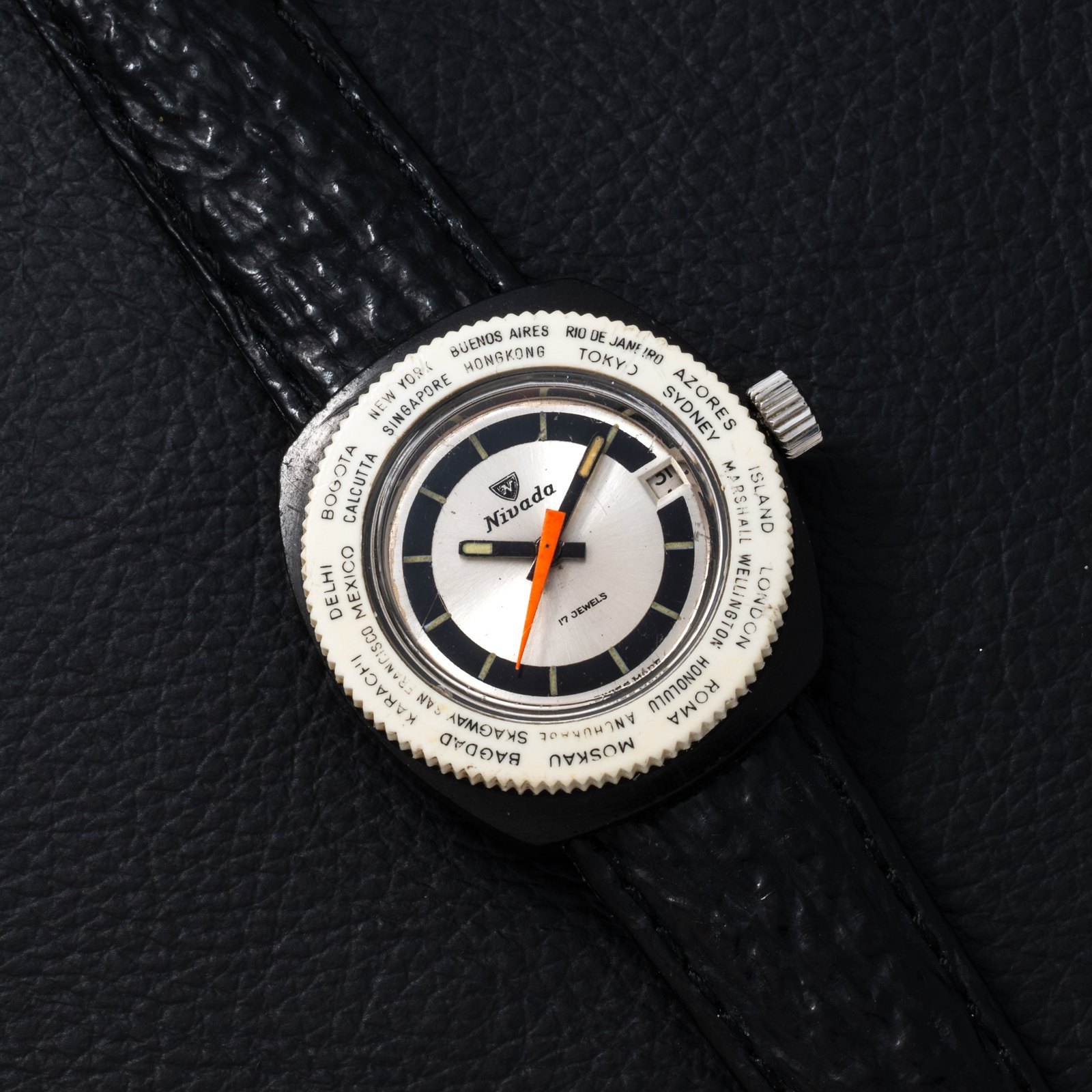
Nivada Fiber Star World Time 'Mini', 1970s
- Maker / attribution
- Nivada Grenchen (maker)
- Date
- 1970s
- Historical period
- Quartz Revolution (1969 – 1990)
- Country of origin
- Unrecorded in source
- Object type
- Wristwatch
- Stock no.
- 40992995
- Credit line
- Dealer listing, Analog/Shift (40992995)
- Catalogue title (original)
- Nivada Fiber Star World Time 'Mini' (English)
View the source record (dealer listing) ↗ (opens another website in a new tab)Suggest a correction
Record summary
Catalogued by Analog/Shift (dealer), New York (stock number 40992995), this is a wristwatch by Nivada Grenchen, dated 1970s. The Atlas places it in the Quartz Revolution period (1969 – 1990) of its Wristwatches collection. The record is illustrated with 6 photographs.
Assembled from the source record's structured fields. Dates and attributions are given as the source states them; where a field is missing the Atlas leaves it blank rather than estimating.
Catalogue description
Dealer description — Analog/Shift
In the 1970s, travel meant something glamorous. Jumbo jets. Paper tickets. Departure boards clicking mechanically from city to city. And on the wrist? Something that could keep up. Enter the Nivada Fiber Star World Time. While Nivada is often celebrated for its Chronomaster and Depthmaster tool watches, the Fiber Star occupies a more obscure — and arguably more interesting — corner of the catalog. This example, dating to the 1970s, leans fully into the era’s design language with its distinctive TV-style cushion case, executed in lightweight fiberglass. It’s substantial on the wrist, yet unexpectedly comfortable — a forward-thinking material choice that feels entirely period-correct. The silver sunburst dial provides a clean stage for bold functionality. A bright orange sweeping seconds hand adds a punch of color, while a framed date window at 3 o’clock keeps things practical. Surrounding it all is the white rotating world time bezel, printed with major global cities — New York, London, Tokyo — allowing the wearer to track multiple time zones with a simple adjustment. Analog travel tech at its finest. Inside beats a 17-jewel manual-winding movement, reliable and straightforward — no fuss, just function. Less common than its dive-ready siblings, the Fiber Star is a sleeper hit for collectors who appreciate Nivada’s experimental side. Jet-set charm. Seventies swagger. Passport not required!
Historical context
Quartz Revolution (1969 – 1990)
Seiko's Astron begins mass quartz timekeeping; traditional industries contract sharply.
Quartz and digital watches transformed the market after 1969. Swiss employment collapsed, Japanese and Hong Kong production soared, and the Swatch (1983) helped the Swiss industry recover; mechanical watches survived as luxury goods.
Read the period in the timelineMore wristwatches from this periodEarlier: Modern Mechanical Horology
Atlas type guide
Military, pilot and travel watches
The wristwatch owes much of its adoption by men to warfare and aviation. Wristlets — small pocket watches soldered with lugs and worn on a strap — were used in colonial campaigns and became standard equipment in the First World War, with protective grilles over the crystal ('shrapnel guards'). Louis Cartier's Santos (1904), designed for the aviator Alberto Santos-Dumont, is often cited as an early purpose-made pilot's watch.
In the Second World War governments specified watches in detail: the German B-Uhr observation watches, the American A-11, and the British 'W.W.W.' (the 'Dirty Dozen' set of 1945). After the war, jet travel brought GMT and world-time watches, which show two or more time zones at once — Louis Cottier's world-time mechanism and the Rolex GMT-Master (1955) are examples.
What to look for
- Military markings on the case back: broad arrow, issue numbers, 'W.W.W.', 'A.T.P.'
- High-legibility black dials with luminous Arabic numerals; oversized crowns for gloved hands.
- 24-hour hands and rotating 24-hour bezels or city rings on GMT/world-time watches.
- Wire lugs on early wristlets converted from pocket watches.
Dating clues
- Wire-lug wristlets: c. 1900–1925.
- Military specifications of the Second World War: 1939–1945.
- GMT and world-time wristwatches: mainly after 1950.
General guidance written by the Atlas editors about this kind of object. It is not a statement about this particular piece; for that, rely on the source record above and on physical examination.
Related records
Wristwatches · c. 1960s
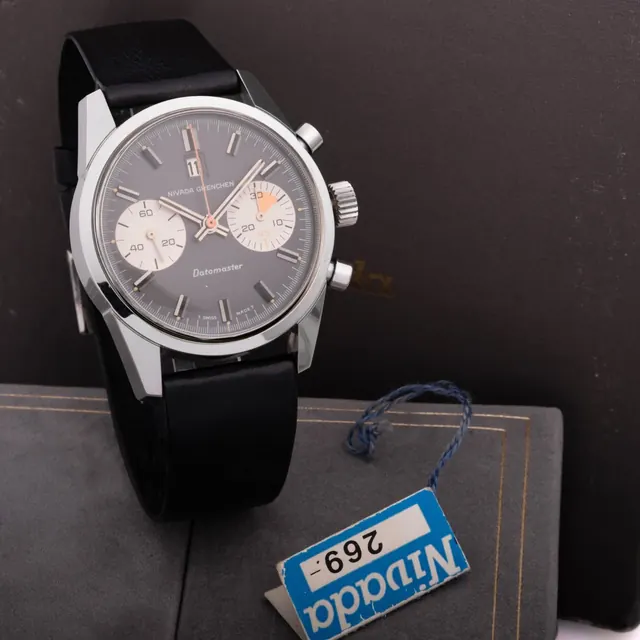
Nivada Grenchen wristwatch, ref. 87003, Datomaster, circa 1960's
Antiquorum auction archive, Geneva
Wristwatches · 1970s
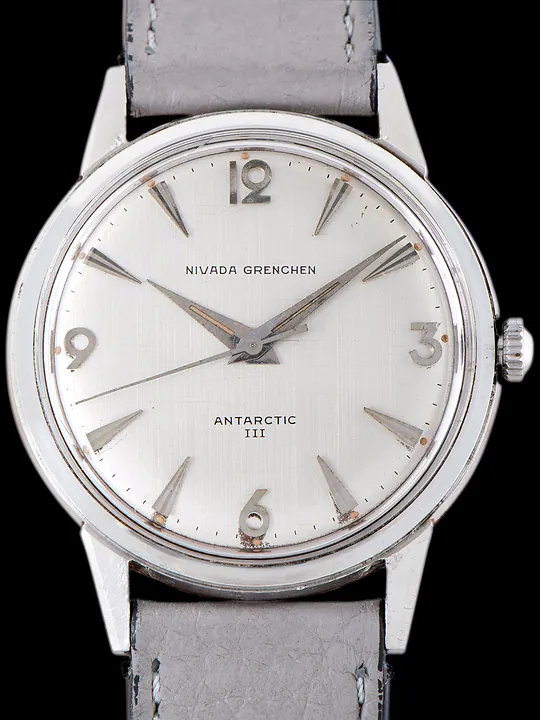
Nivada Grenchen Antarctic III "Linen" Dial, 1970s
Craft & Tailored (dealer), Los Angeles
Wristwatches · 1970s
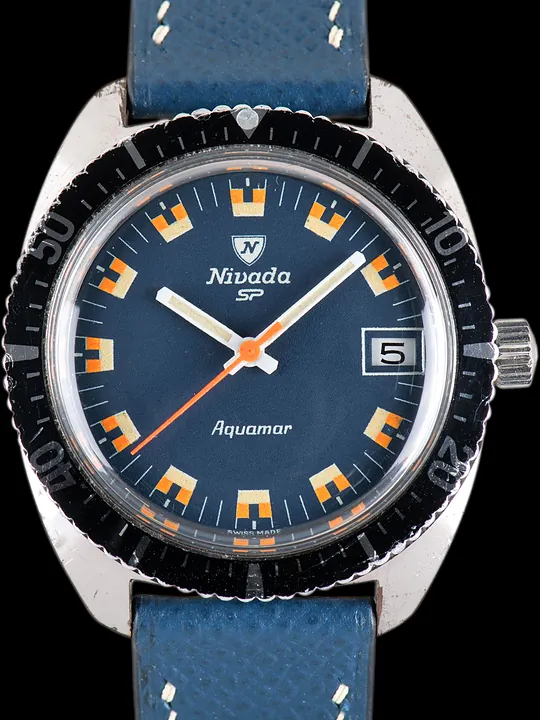
Nivada Aquamar (Ref. 4517) Matte Blue Dial, 1970s
Craft & Tailored (dealer), Los Angeles
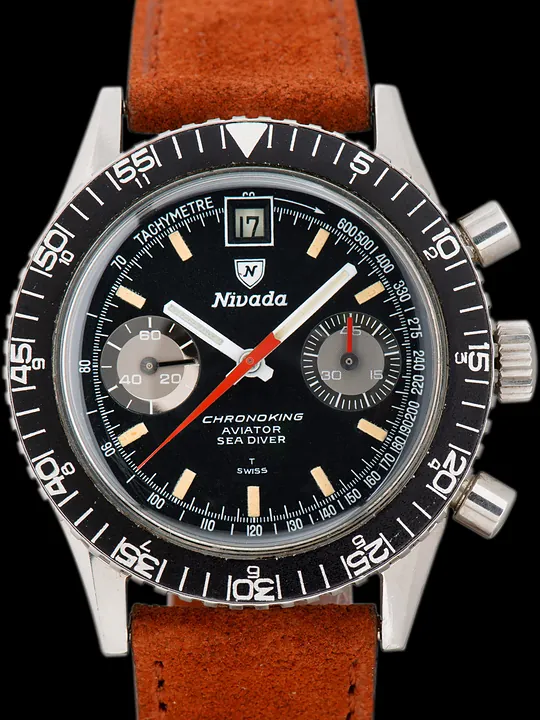
Wristwatches · 1970s
Nivada Grenchen Chronoking Aviator Sea Diver (Ref. 87033), 1970s
Craft & Tailored (dealer), Los Angeles

Wristwatches · 1970
Wristwatch by Heno, Switzerland, 1970
Museum Rotterdam
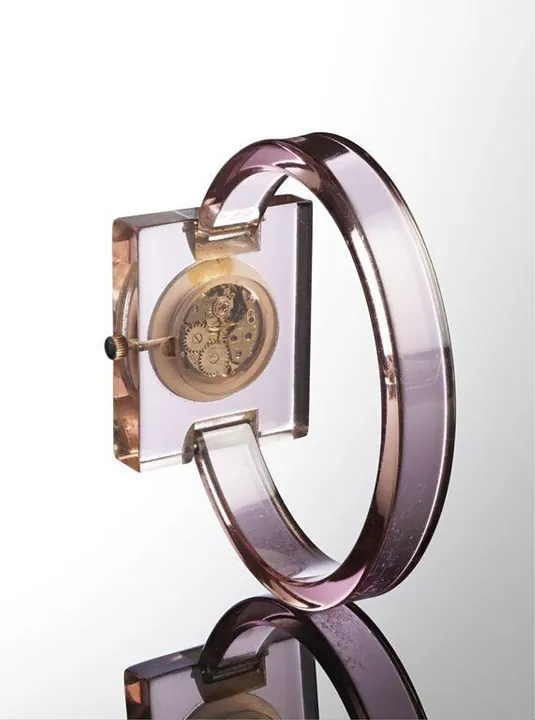
Wristwatches · 1970s
Wristwatch, plastic, by Gucci; Italy, 1970s.
Victoria and Albert Museum, London
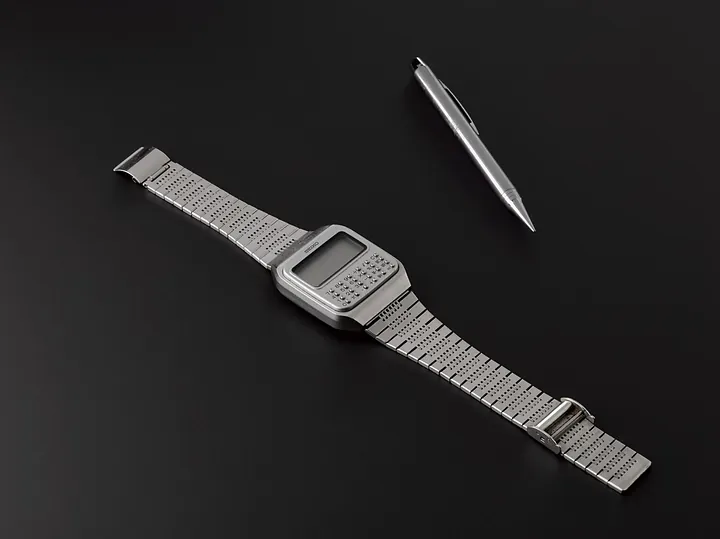
Wristwatches · 1978
Calculator wristwatch by Suwa Seikosha Co. Limited, Japan, 1978
Science Museum Group, London
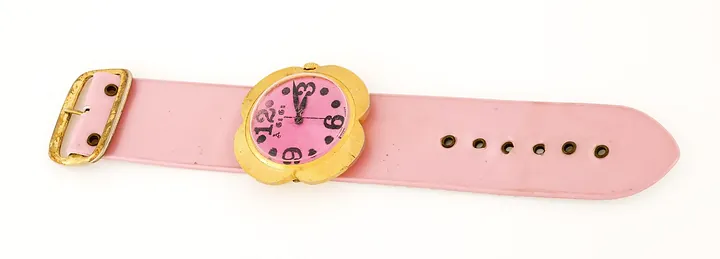
Wristwatches · 1980
Wristwatch, 1980 (no. 71413)
Museum Rotterdam