
Wristwatches · Wristwatch
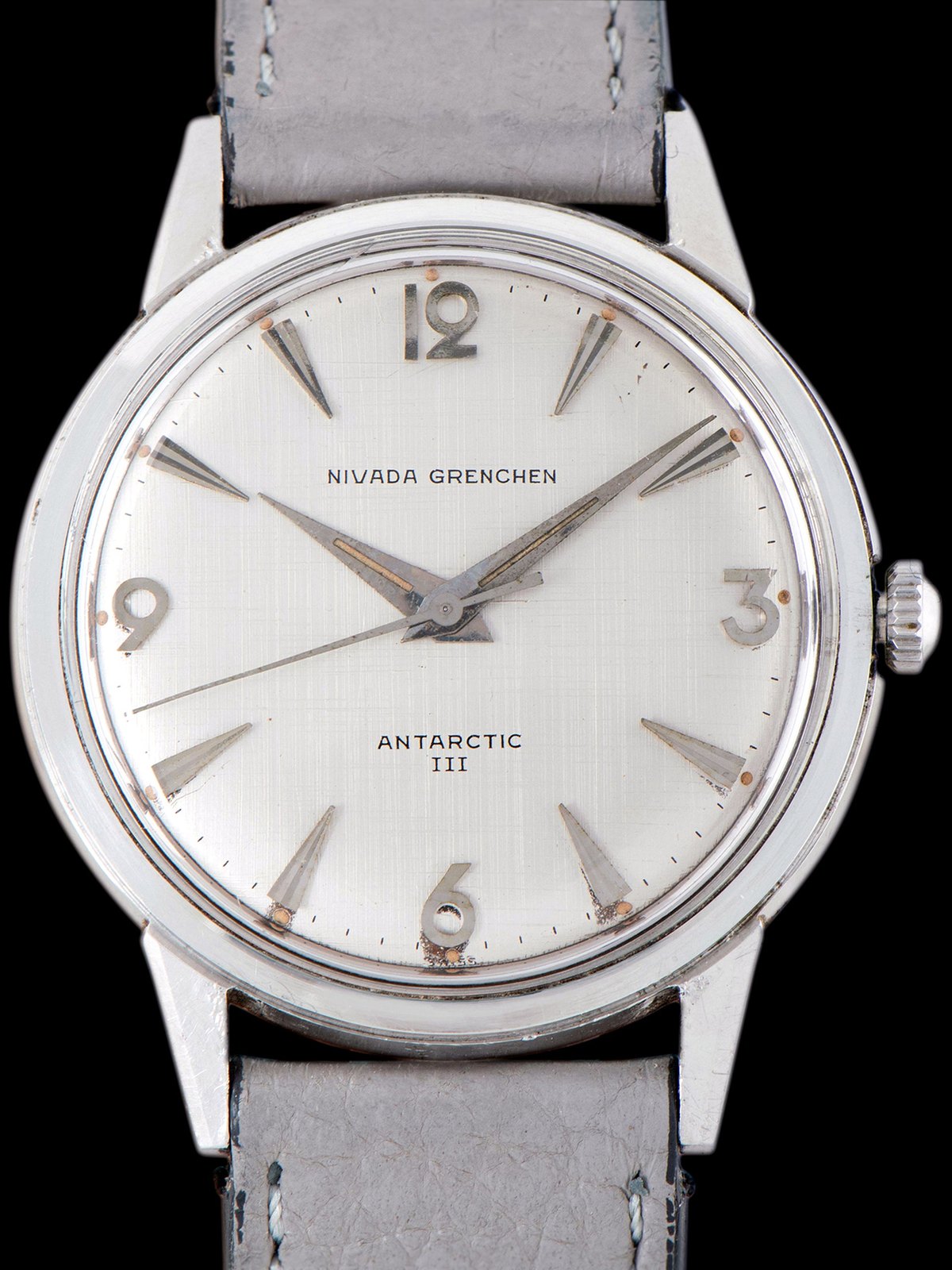
Nivada Grenchen Antarctic III "Linen" Dial, 1970s
- Maker / attribution
- Nivada Grenchen (maker)
- Date
- 1970s
- Historical period
- Quartz Revolution (1969 – 1990)
- Country of origin
- Unrecorded in source
- Object type
- Wristwatch
- Stock no.
- NVDAGANTIII
- Credit line
- Dealer listing, Craft & Tailored (NVDAGANTIII)
- Catalogue title (original)
- 1970s Nivada Grenchen Antarctic III "Linen" Dial (English)
View the source record (dealer listing) ↗ (opens another website in a new tab)Suggest a correction
Record summary
Catalogued by Craft & Tailored (dealer), Los Angeles (stock number NVDAGANTIII), this is a wristwatch by Nivada Grenchen, dated 1970s. The Atlas places it in the Quartz Revolution period (1969 – 1990) of its Wristwatches collection. The record is illustrated with 6 photographs.
Assembled from the source record's structured fields. Dates and attributions are given as the source states them; where a field is missing the Atlas leaves it blank rather than estimating.
Catalogue description
Dealer description — Craft & Tailored
Nivada Grenchen's roots reach all the way back to 1879, when the Nivada family opened up a watchmaking workshop. The watch brand itself, however, was officially founded in 1926 in Grenchen, Switzerland – and was actually one of the first brands to manufacture automatic watches. Nivada is also responsible for the creation of a handful of wristwatch innovations, including creating waterproof and “rustless” watches that would stand up to the rigors of the outdoor adventures for which they were created. In the early 1950s, a global organization called the International Council of Scientific Unions was created. This organization aimed to unite scientists and physicists from around the globe in an effort to democratize and share scientific findings. One of the places that attracted a lot of interest was Antarctica, as it was still largely unexplored and played home to many unique phenomena. The scientists that would embark on the expedition to explore it would need stout, element-resistant tools and equipment to help them in their experiments. That, of course, included watches. So, Nivada set out to design a new watch line to rise to the occasion, based on their best-selling Aquamatic watches, with three key tenets guiding its creation: the watches had to be waterproof, self-winding, and anti-magnetic. They then named the line Antarctic, for obvious reasons, and went even further by creating rugged ads showing it off as "the watch that went to the Antarctic," not too unlike the famous rock-climbing ads done for the Rolex Explorer—a watch that was a kindred spirit both in aesthetic and intention. This particular model is part of what is colloquially known as the Roman Numeral series—hence the "III" appended to the Antarctic name on the dial. The Antarctic III models were a slightly more formal option compared to some of the other variants, with a larger dial, thin bezel and lugs, as well as its distinctive linen dial. While it's mostly restrained and classic in design, the giant, eye-catching rounded deco numerals certainly add a classy midcentury feel. This watch shows off all the classic hallmarks in stunning fashion, showing very little wear on the case or the dial. It's a timeless watch with a unique history that could be dressed up or down and worn just about anywhere. Even the Antarctic. SPECS Stock # NVDAGANTIII Brand Nivada Grenchen Style Antarctic III Model N/A Serial N/A Size Men's Material Stainless Steel Dial Silver "Linen" Millimeters 35.5 Strap 2pc Handmade Leather Strap CASE & BRACELET The excellent stainless steel case remains in very strong overall condition, showing only light signs of honest use with no notable evidence of previous polishing present. The case retains its original unsigned crown. The UFO-esque case back exhibits minimal wear and retains its original engravings still in legible condition. The watch comes supplied on a two-piece handmade leather strap. DIAL & HANDS The original silver linen dial is in exceptional condition, exhibiting only light age and no damage. The dial features art deco-style Arabic numerals at 3, 6, 9, and 12 o'clock with matching "icicle" markers at the remaining hours, all of which are clean and in fantastic condition. The tritium lume plots have achieved a lovely dark cream patina and exhibit nominal degradation in the 3 and 9 o'clock plots with the rest of the plots remaining fully present when inspected under UV light. The original hands show light oxidation and the inlaid tritium lume that matches the dial perfectly. ACCESSORIES None. The watch is keeping time but previous service history is unknown.
Historical context
Quartz Revolution (1969 – 1990)
Seiko's Astron begins mass quartz timekeeping; traditional industries contract sharply.
Quartz and digital watches transformed the market after 1969. Swiss employment collapsed, Japanese and Hong Kong production soared, and the Swatch (1983) helped the Swiss industry recover; mechanical watches survived as luxury goods.
Read the period in the timelineMore wristwatches from this periodEarlier: Modern Mechanical Horology
Atlas type guide
Wristwatches
Bracelet watches were worn by women from the early nineteenth century — Breguet made one for Caroline Murat, Queen of Naples, in 1810–12 — but the wristwatch only became a man's instrument with military use and aviation in the early twentieth century. Between the World Wars it overtook the pocket watch; the 1920s and 1930s brought rectangular Art Deco cases, water-resistant cases and the first automatic winding systems.
After 1945 the wristwatch became a carrier of identity — dress watches, sports and dive watches, chronographs, calendars — produced by Swiss, American, Japanese, German, Soviet and Chinese industries. The quartz revolution after 1969 and the mechanical renaissance since the 1990s, including the rise of independent watchmakers, complete the story.
What to look for
- The reference number (between the lugs or inside the case back) and serial number, the starting point for dating.
- The calibre: its maker and number are often stamped under the dial or on the bridge.
- Originality of dial, hands and crown — refinished ('redial') dials are common.
- Case material marks: 18K/750, 14K/585, stainless steel, gold-filled, plated.
Dating clues
- Wire-lug cases: before c. 1925.
- Water-resistant screw-down cases: from 1926.
- Quartz movements: from 1969; sapphire crystals widespread after c. 1980.
General guidance written by the Atlas editors about this kind of object. It is not a statement about this particular piece; for that, rely on the source record above and on physical examination.
Related records
Wristwatches · c. 1960s
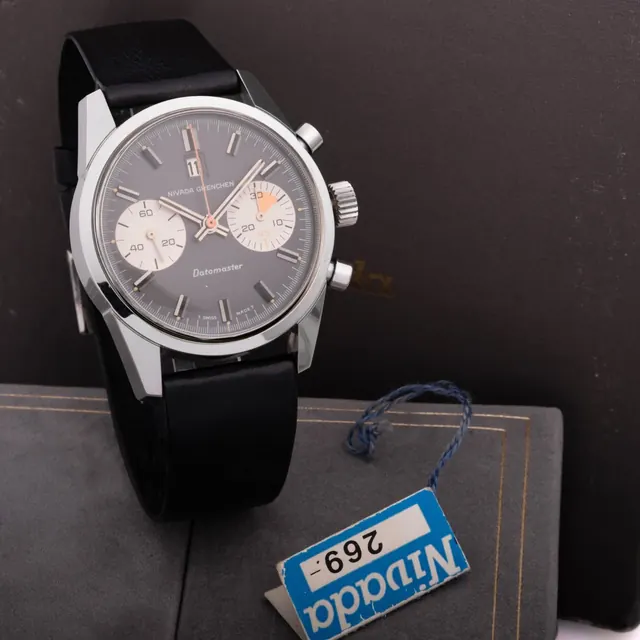
Nivada Grenchen wristwatch, ref. 87003, Datomaster, circa 1960's
Antiquorum auction archive, Geneva
Wristwatches · 1970s
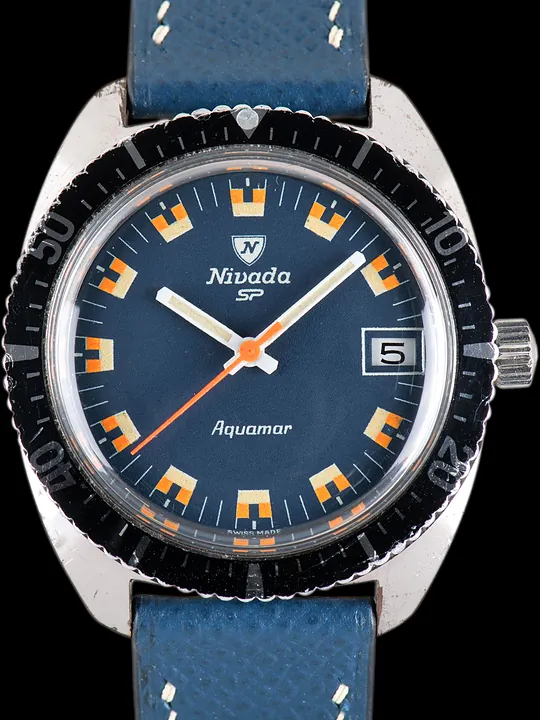
Nivada Aquamar (Ref. 4517) Matte Blue Dial, 1970s
Craft & Tailored (dealer), Los Angeles
Wristwatches · 1970s
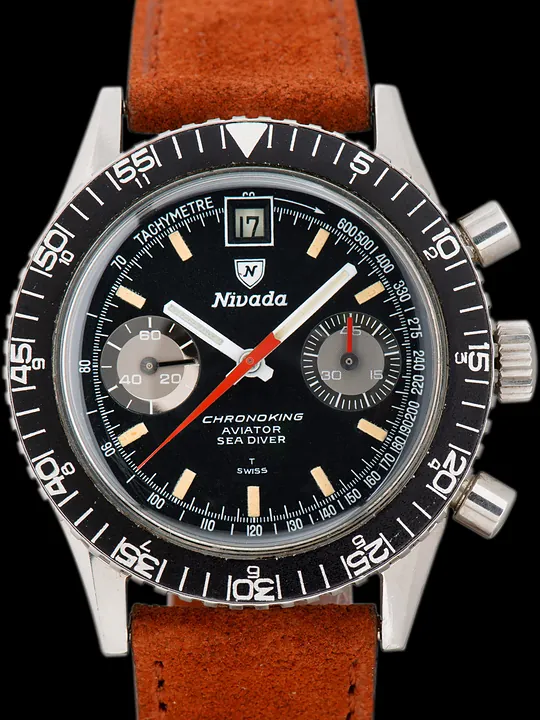
Nivada Grenchen Chronoking Aviator Sea Diver (Ref. 87033), 1970s
Craft & Tailored (dealer), Los Angeles
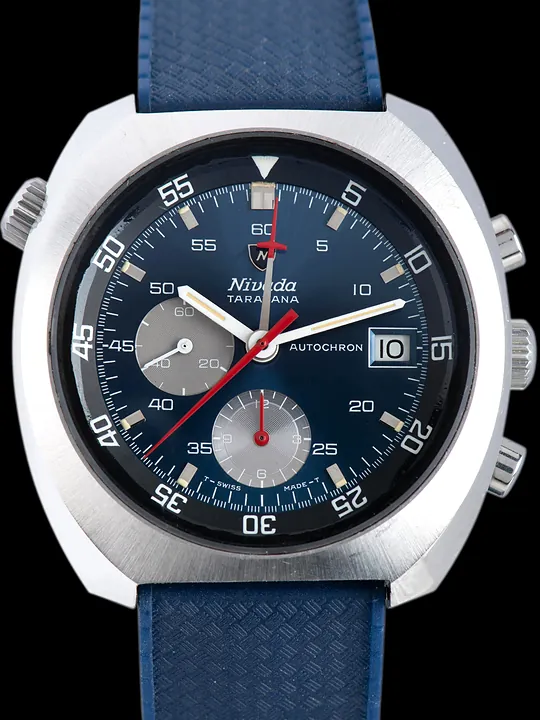
Wristwatches · 1970s
Nivada Taravana Autochron (Ref. 87024), 1970s
Craft & Tailored (dealer), Los Angeles

Wristwatches · 1970
Wristwatch by Heno, Switzerland, 1970
Museum Rotterdam
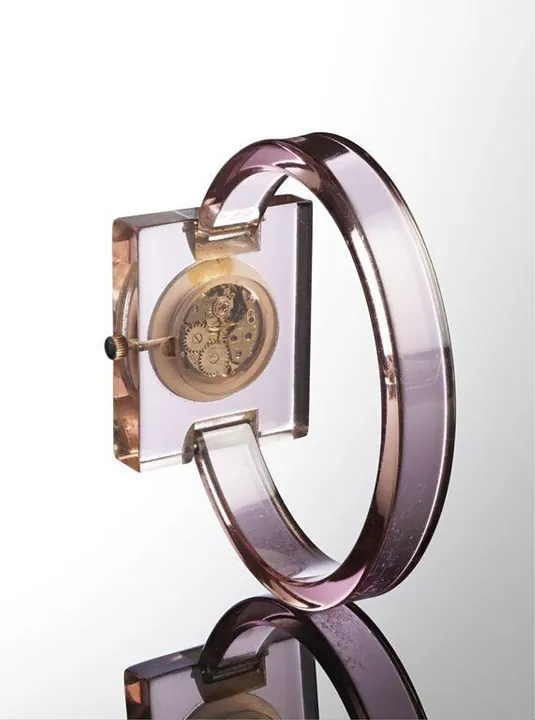
Wristwatches · 1970s
Wristwatch, plastic, by Gucci; Italy, 1970s.
Victoria and Albert Museum, London
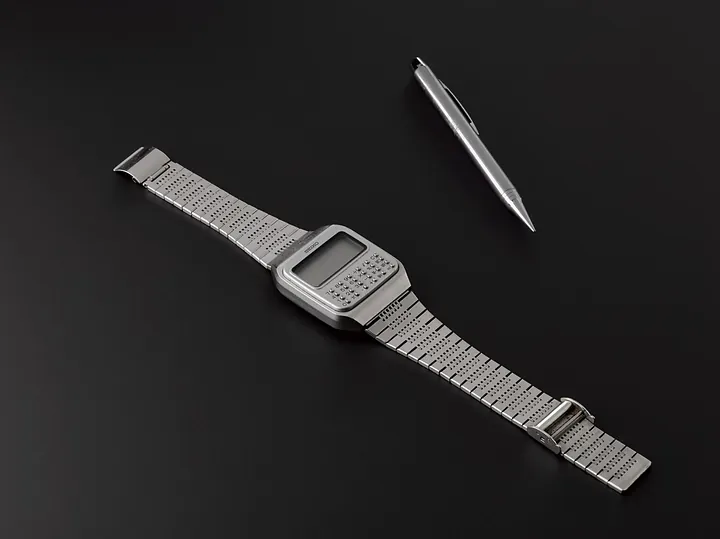
Wristwatches · 1978
Calculator wristwatch by Suwa Seikosha Co. Limited, Japan, 1978
Science Museum Group, London
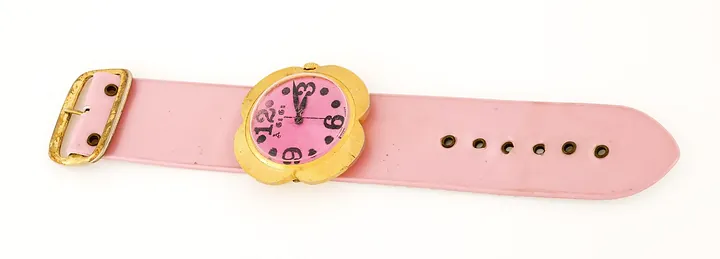
Wristwatches · 1980
Wristwatch, 1980 (no. 71413)
Museum Rotterdam