
Clocks · Clock
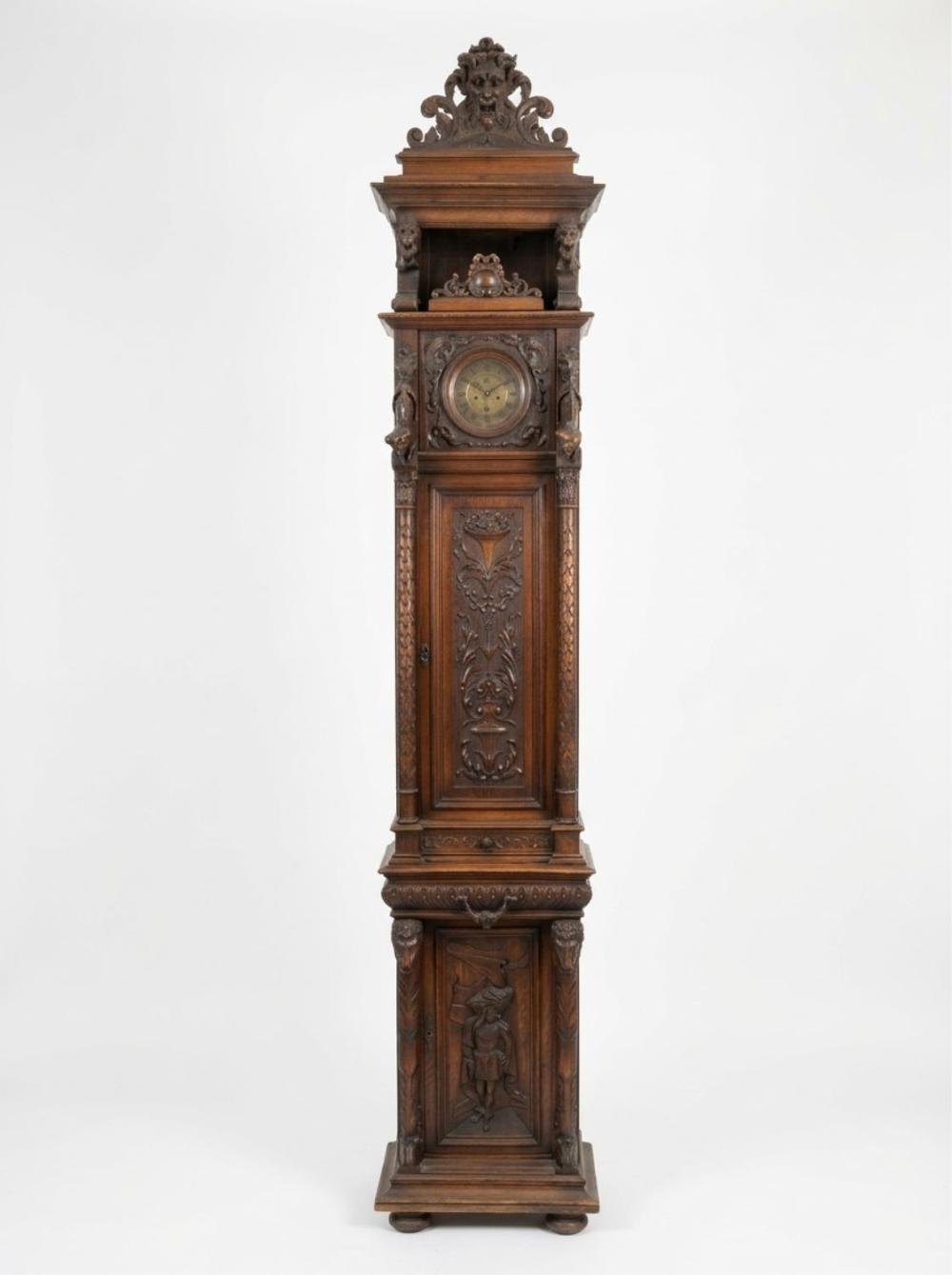
Monumental 19th C. Munich Carved Walnut Tall Clock
- Maker / attribution
- Unrecorded in source
- Date
- late 19th century
- Historical period
- Industrial Revolution (1850 – 1900)
- Country of origin
- Germany
- Object type
- Clock
- Materials / technique
- walnut, brass, iron
- Dimensions
- 115" H x 16" W x 22" D (9'7" x 16" x 22") Dial Inscr
- Auction house
- Invaluable auction listings
- Lot
- Lot D3BA562937
- Credit line
- Auction lot record: lot 86, Important California Estates Auction, California Auctioneers (2026), via Invaluable
- Catalogue title (original)
- Monumental 19th C. Munich Carved Walnut Tall Clock (English)
View the source record (auction lot) ↗ (opens another website in a new tab)Suggest a correction
Record summary
Catalogued by Invaluable auction listings (lot Lot D3BA562937), this is a clock, made in Germany, dated late 19th century. The Atlas places it in the Industrial Revolution period (1850 – 1900) of its Clocks collection. Materials and techniques recorded by the source: walnut, brass, iron. Recorded dimensions: 115" H x 16" W x 22" D (9'7" x 16" x 22") Dial Inscr. The record is illustrated with 4 photographs.
Assembled from the source record's structured fields. Dates and attributions are given as the source states them; where a field is missing the Atlas leaves it blank rather than estimating.
Catalogue description
Lot description — California Auctioneers
Towering tall case clock stands 9'7" (115 inches) tall, showcasing a deeply stained walnut case heavily adorned with architectural elements and dramatic, high-relief allegorical carvings. The upper pediment features a massive, masterfully rendered green man or faun mascaron face with an open mouth and stylized horns, framed by sweeping acanthus scrolls. Below the upper tier molding, two snarling, open-mouthed lion-gargoyle figures project forward on brackets over a lower architectural shelf centering an inset Queen Anne shell cartouche. The hood houses a circular brass dial and is supported by flanking brackets carved as guardian lion figures. The dial face features a silvered chapter ring with bold Roman numerals alternating with engraved fleur-de-lis motifs, signed across the lower register by the maker "J. Fueter / München". The gilded brass center ring and outer minute ring display an engraved foliate vine pattern enclosing two winding arbors and scrolling openwork iron hands. The trunk houses a long panel door with a relief-carved cornucopia vase blooming with thick clusters of grapes, leaves, and trailing flora, beautifully framed by bold, cross-hatched diamond pattern corner columns topped with Corinthian capitals. Perched at the upper front corners of the waist are two fully dimensional, sculpted gargoyle-like creature figures leaning outward. Inside the case, the multi-train mechanical movement is paired with an engraved silvered pendulum disc showing an extensive foliate scroll layout, suspended alongside dual cylindrical brass weights displaying relief-stamped scrolling acanthus panels. The lower plinth door panel features a detailed pictorial scene depicting a high-relief carved German Landsknecht or Renaissance soldier in traditional slashed-sleeve attire, adjusting his plumed cap within a brick architectural alcove. This lower door is flanked by full-length, high-relief columns carved as full-bodied standing rams, showcasing the theatrical, multi-layered design language of late 19th-century German cabinetry. Dimensions: 115" H x 16" W x 22" D (9'7" x 16" x 22") Dial Inscription: Signed "J. Fueter / München" across the lower silvered chapter ring.
Historical context
Industrial Revolution (1850 – 1900)
American interchangeable-parts manufacture; railroad time standards; Swiss and German factory systems.
Factory production transformed the clock into an everyday object. American makers (Seth Thomas, Ansonia, Waterbury) and German factories (Junghans, Gustav Becker, Lenzkirch) sold millions of shelf, wall and alarm clocks worldwide; France produced standardised Paris movements and carriage clocks; electric time distribution began.
Read the period in the timelineMore clocks from this periodEarlier: Precision & Scientific Horology
Atlas type guide
Longcase (tall-case or grandfather) clocks
The longcase clock was born from two seventeenth-century innovations: Christiaan Huygens's pendulum (1656–57) and the anchor escapement (c. 1670). A long seconds pendulum, nearly a metre long, swings with a small arc, and enclosing it together with the driving weights in a tall wooden case protected the mechanism and created a new piece of furniture. London makers such as Ahasuerus Fromanteel, Thomas Tompion and Joseph Knibb set the pattern.
By the eighteenth century longcase clocks were made throughout Britain, the Netherlands, Scandinavia (the Swedish Mora clock), France (the Comtoise from the Franche-Comté), Germany and colonial America. Eight-day movements with two weights became standard in better clocks; thirty-hour clocks with one weight and a rope or chain were cheaper alternatives.
What to look for
- Winding holes in the dial: two (eight-day, going and striking) or none (thirty-hour, pulled up by a chain).
- Brass dials with applied chapter rings (earlier) versus painted iron 'white' dials (after c. 1770 in Britain).
- Moon-phase arches, date apertures, seconds dials and maker's name on the dial.
- Case woods and style: ebonised, walnut marquetry, lacquer, oak or mahogany; regional styles from London, Lancashire, Scotland or America.
- Whether the movement and dial match the case — 'marriages' are common.
Dating clues
- Square brass dials suggest c. 1670–1720; arched brass dials c. 1715–1790.
- Painted (white) dials were made by Birmingham dial-makers from about 1772.
- Comtoise clocks with repoussé pendulums are mostly nineteenth century.
General guidance written by the Atlas editors about this kind of object. It is not a statement about this particular piece; for that, rely on the source record above and on physical examination.
Read next:Anchor (recoil) escapementDeadbeat escapementAnchor escapement
Related records
Clocks · c. 1850
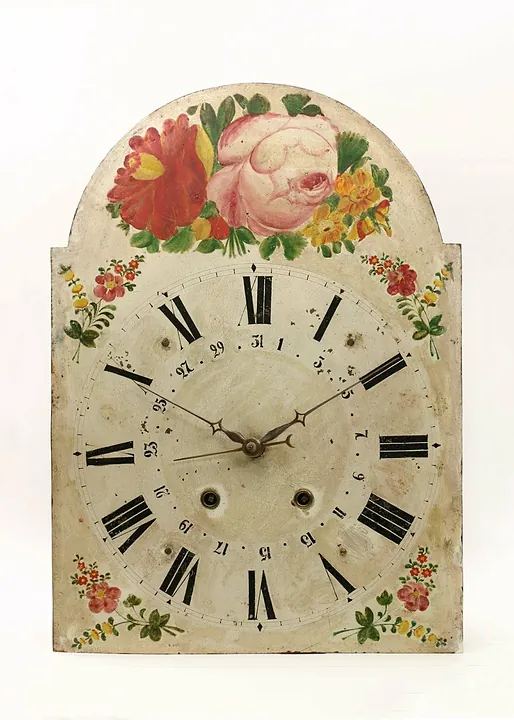
Cuckoo / black forest clock, Germany, c. 1850
German Clock Museum
Clocks · 1850
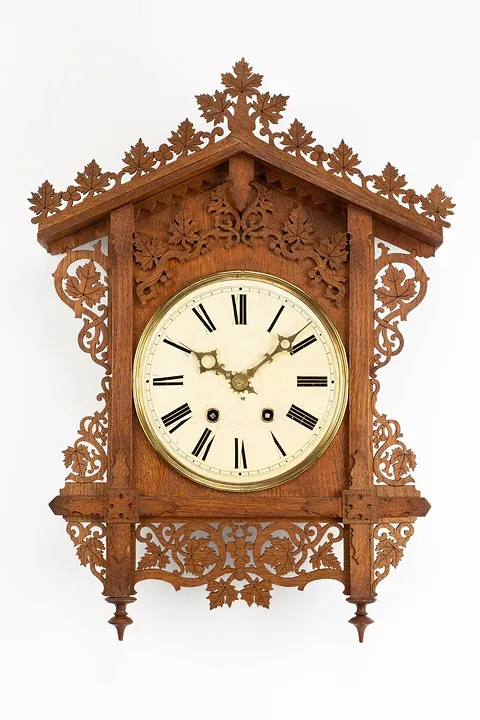
Wall clock by Glatz und Co. Kreuzer, Germany, 1850
German Clock Museum
Clocks · 1858
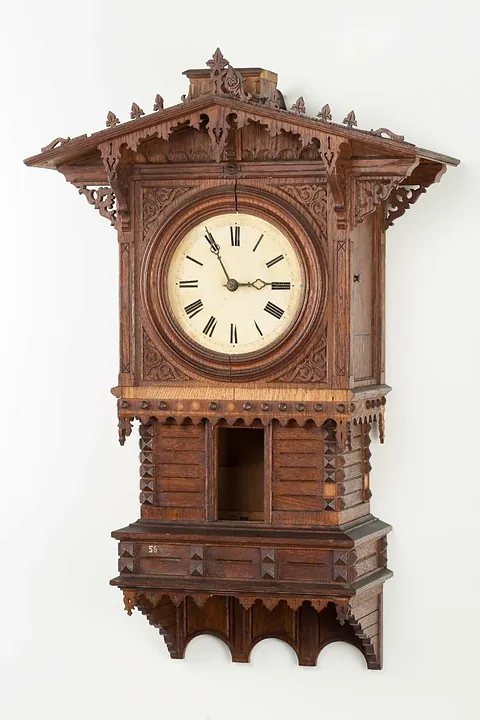
Clock by Jacob Bäuerle, Germany, 1858
German Clock Museum
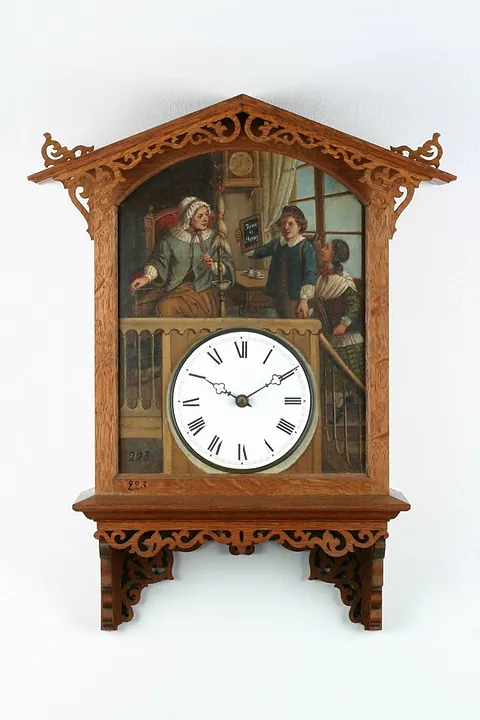
Clocks · 1860
Clock by August Tritschler, Germany, 1860
German Clock Museum
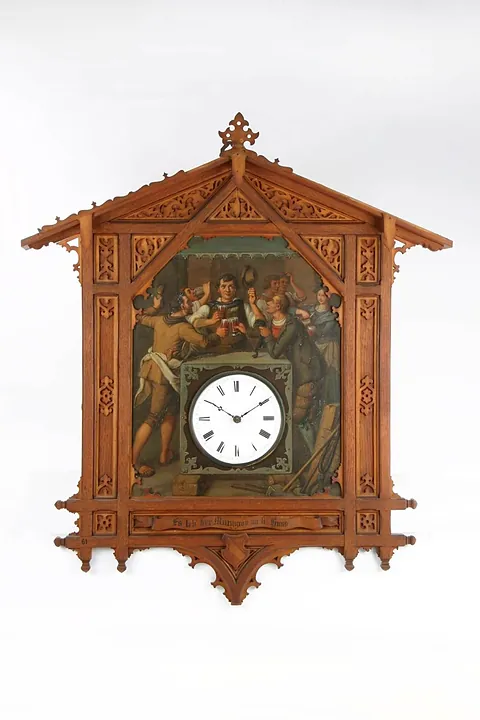
Clocks · 1860
Clock by Großherzoglich Badische Uhrmacherschule, Germany, 1860
German Clock Museum
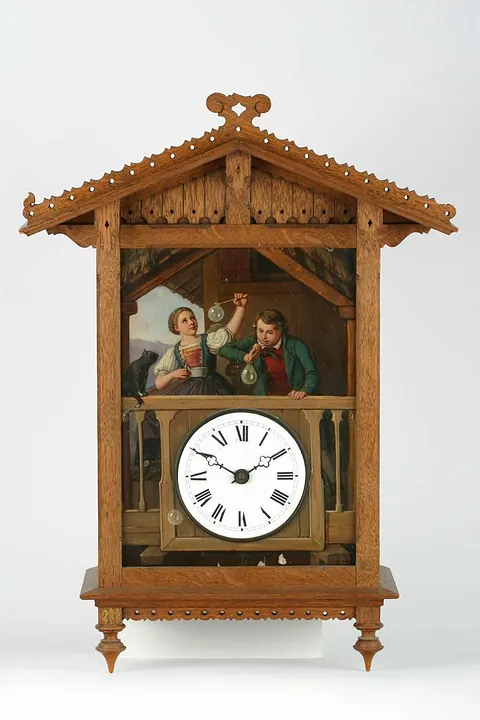
Clocks · c. 1860
Clock by Heinrich Frank, Germany, c. 1860
German Clock Museum
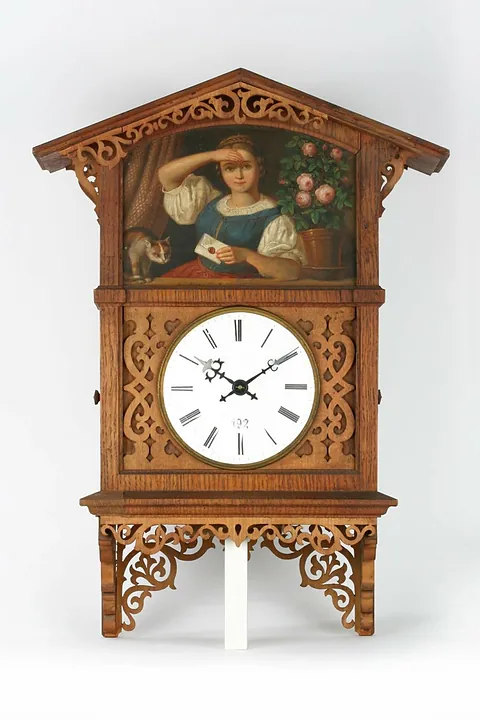
Clocks · c. 1860
Clock by M. Schuhmacher, Germany, c. 1860
German Clock Museum

Clocks · c. 1860
Clock by Martens und Cie., Germany, c. 1860 (no. 57930)
German Clock Museum