
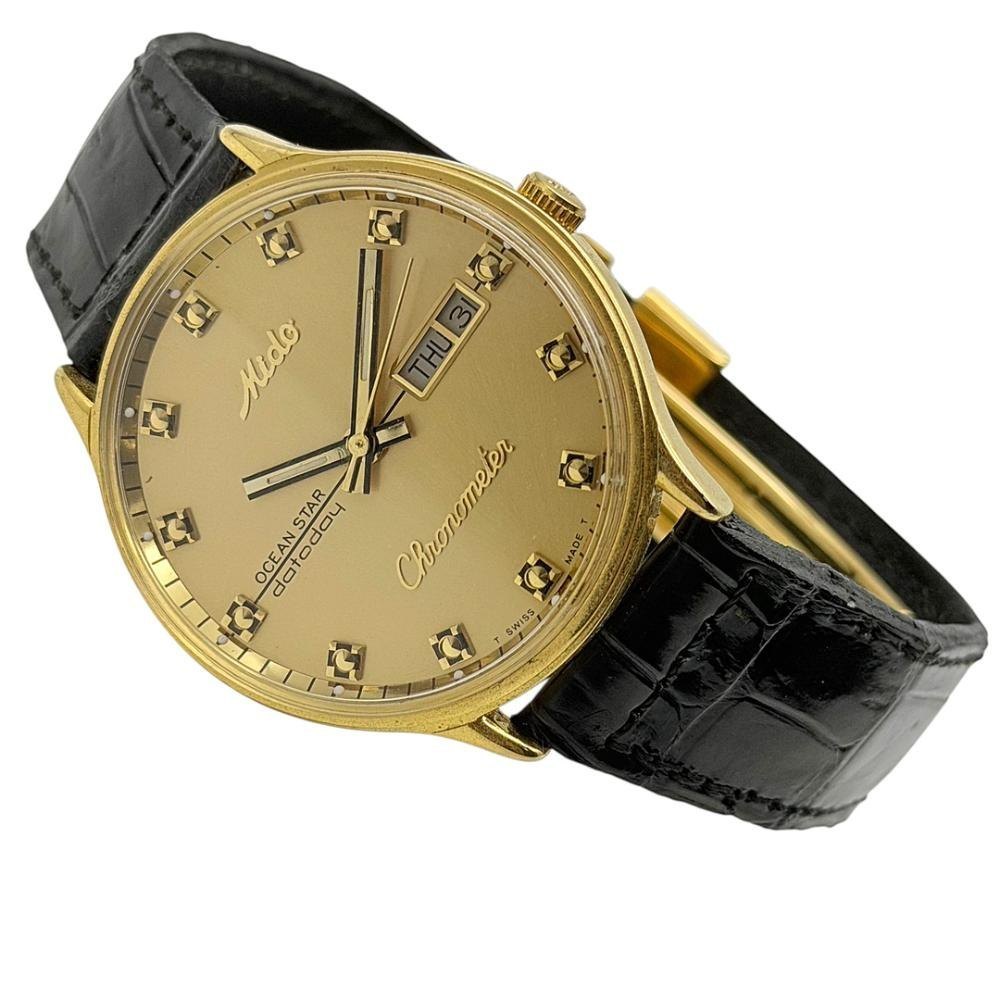
Wristwatches · Day-date automatic wristwatch
Mido Commander Ocean Star Datoday Chronometer Wristwatch
- Maker / attribution
- Mido (source attribution)
- Date
- 1970s/1980s
- Historical period
- Quartz Revolution (1969 – 1990)
- Country of origin
- Unrecorded in source
- Object type
- Day-date automatic wristwatch
- Materials / technique
- Gold-plated
- Dimensions
- 36 mm
- Holding institution
- Auction house “Kunst- und Auktionshaus Quedlinburg”, via Invaluable
- Accession / object no.
- mido-commander-ocean-star-datoday-chronometer-wristwatch-35b8099086
- Credit line
- Auction house “Kunst- und Auktionshaus Quedlinburg”, via Invaluable
- Catalogue title (original)
- Mido Commander Ocean Star Datoday Chronometer gentleman's wristwatch, reference 8439 (English)
View the source record ↗ (opens another website in a new tab)Suggest a correction
Record summary
Held and catalogued by Auction house “Kunst- und Auktionshaus Quedlinburg”, via Invaluable (object number mido-commander-ocean-star-datoday-chronometer-wristwatch-35b8099086), this is a day-date automatic wristwatch attributed to Mido, dated 1970s/1980s. The Atlas places it in the Quartz Revolution period (1969 – 1990) of its Wristwatches collection. Materials and techniques recorded by the source: Gold-plated. Recorded dimensions: 36 mm. The record is illustrated with 1 photograph.
Assembled from the source record's structured fields. Dates and attributions are given as the source states them; where a field is missing the Atlas leaves it blank rather than estimating.
Catalogue description
Original object description
Produced during the 1970s or 1980s, this Mido Commander Ocean Star Datoday Chronometer wristwatch carries reference 8439 and movement/case serial 9988138. The gold-plated case spans 36 mm across by 11.4 mm in thickness, incorporating a fluted gold-toned winding crown, a stainless steel case back, and the maker's proprietary Ocean Star sealing system. On the gold-toned dial, applied text indicates the brand and the word 'Chronometer', designating its certified 25-jewel self-winding movement, while 'OCEAN STAR datoday' appears in print. Time and date indications comprise square indices with black borders and luminous dots, black-edged luminous baton hands, a central seconds hand in gold tone, and a framed day-date display at the 3 o'clock position. The timepiece is fitted to a 23 cm black reptile-pattern leather band with a gold-tone folding clasp, according to details drawn from auction records.
Inscriptions & marks
9988138
Historical context
Quartz Revolution (1969 – 1990)
Seiko's Astron begins mass quartz timekeeping; traditional industries contract sharply.
Quartz and digital watches transformed the market after 1969. Swiss employment collapsed, Japanese and Hong Kong production soared, and the Swatch (1983) helped the Swiss industry recover; mechanical watches survived as luxury goods.
Read the period in the timelineMore wristwatches from this periodEarlier: Modern Mechanical Horology
Atlas type guide
Calendar, moon-phase and perpetual calendar watches
Calendar complications range from a simple date to the perpetual calendar, which automatically allows for months of different lengths and leap years until 2100. Pocket watches with perpetual calendars were made in the eighteenth and nineteenth centuries; Patek Philippe made the first perpetual calendar wristwatch in 1925, and series production followed in 1941. The annual calendar (Patek Philippe, 1996) needs correction only once a year.
Moon-phase displays use a disc with two moons and 59 teeth advanced daily, approximating the 29.5-day lunation; more precise trains reduce the error to one day in over a century.
What to look for
- Apertures or subsidiary dials for day, date, month and leap year.
- Moon disc under a 'bosom' shaped aperture.
- Recessed correctors on the case band for setting the calendar.
Dating clues
- Triple-date wristwatches: popular c. 1940–1955.
- Perpetual calendar wristwatches: from 1925 (unique) and 1941 (series).
General guidance written by the Atlas editors about this kind of object. It is not a statement about this particular piece; for that, rely on the source record above and on physical examination.
Related records
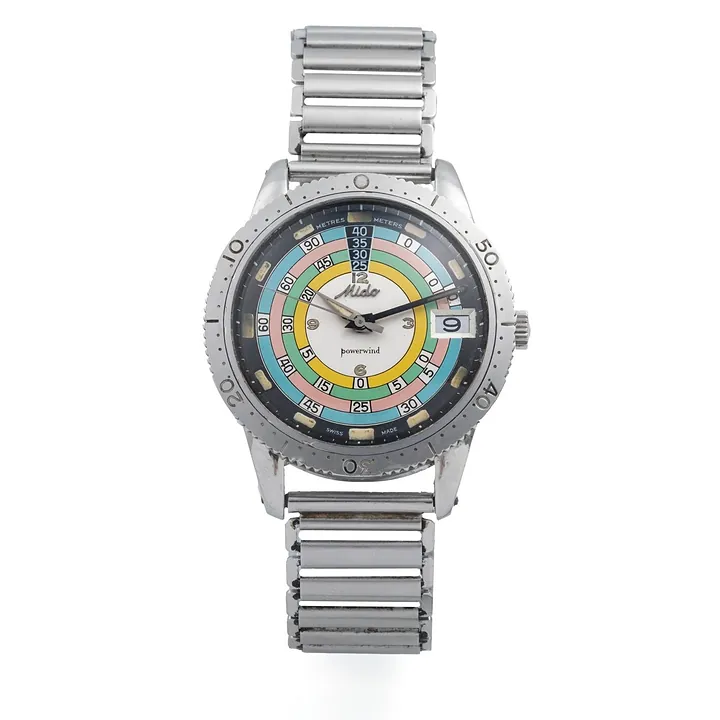
Wristwatches · c. 1962
Mido Powerwind Rainbow, ref. 5907, c. 1962
Antiquorum auction archive, Geneva
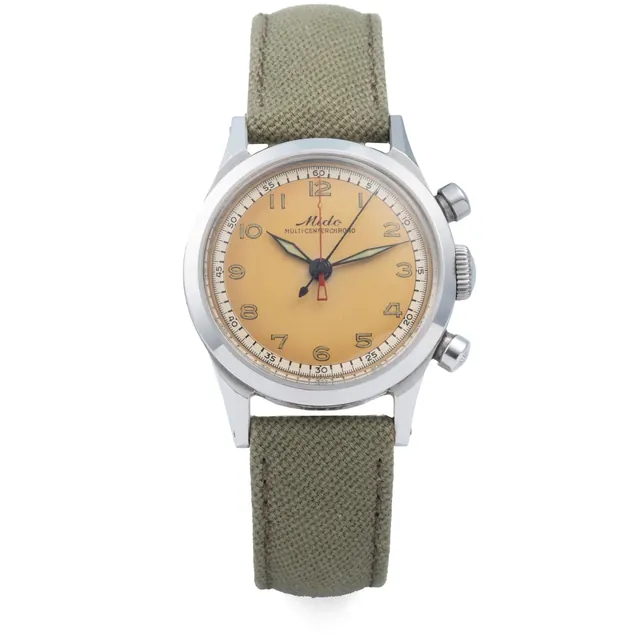
Wristwatches · c. 1940s
Mido wristwatch, Multi-Centerchrono Taubert/Borgel Case, circa 1940's
Antiquorum auction archive, Geneva
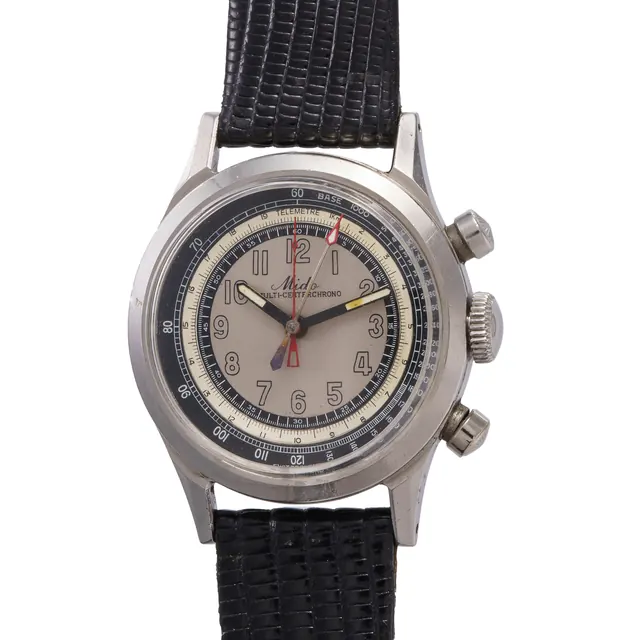
Wristwatches · c. 1940-1950s
Mido wristwatch, Multi-Centerchrono, circa 1940-1950s
Antiquorum auction archive, Geneva
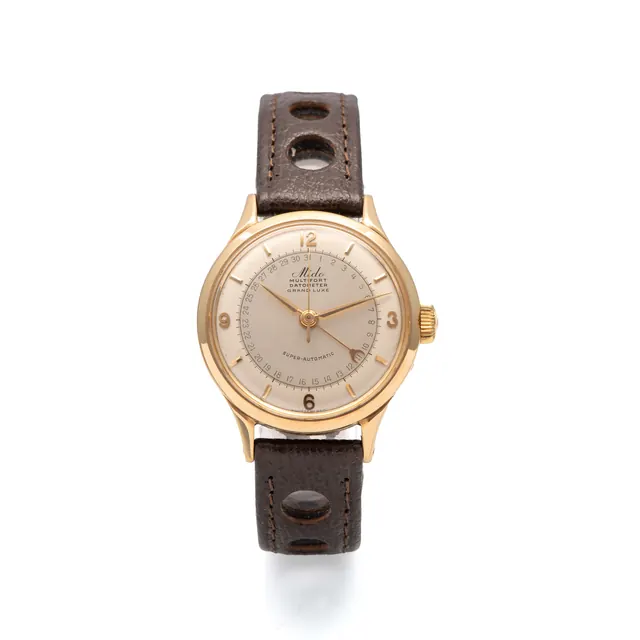
Wristwatches · c. 1950s
Mido wristwatch, Multifort Datometer Grand Luxe Waterproof, circa 1950's
Antiquorum auction archive, Geneva

Wristwatches · 1970
Wristwatch by Heno, Switzerland, 1970
Museum Rotterdam
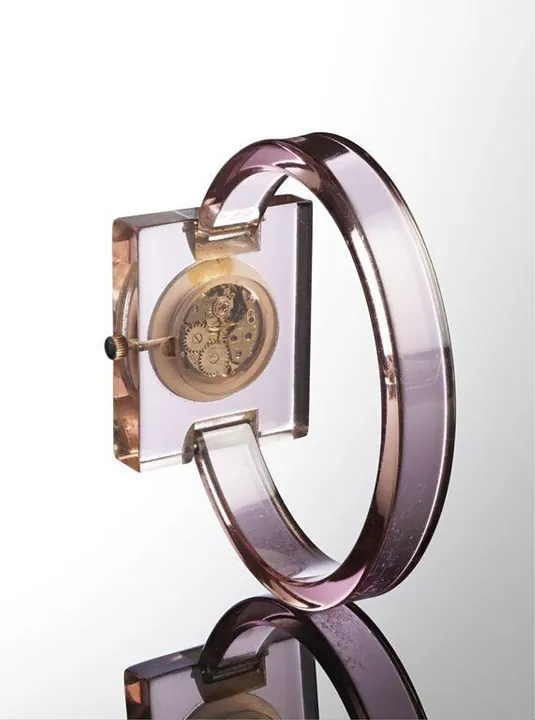
Wristwatches · 1970s
Wristwatch, plastic, by Gucci; Italy, 1970s.
Victoria and Albert Museum, London
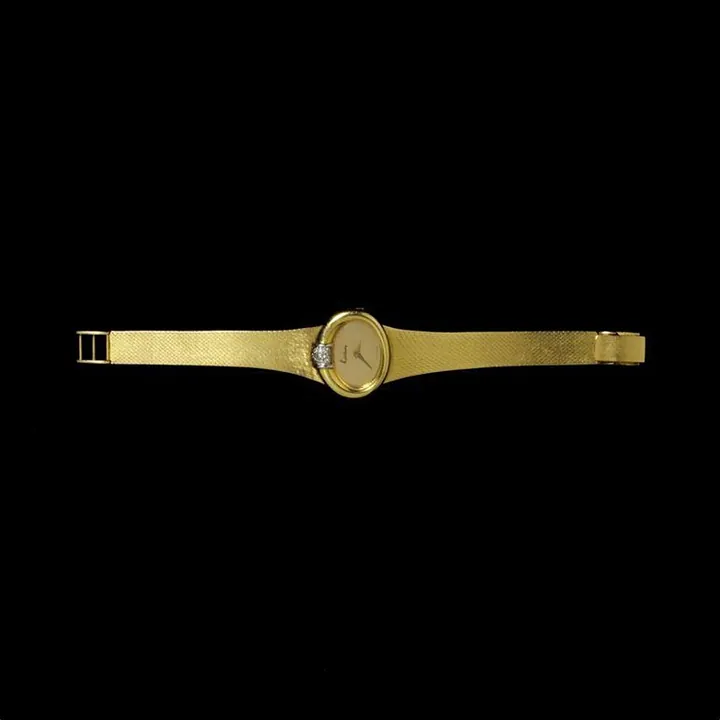
Wristwatches · 1973
Woman's watch, gold with diamonds set in platinum. Made for Kutchinsky, London by Chopard et Cie. Switzerland, 1973
Victoria and Albert Museum, London
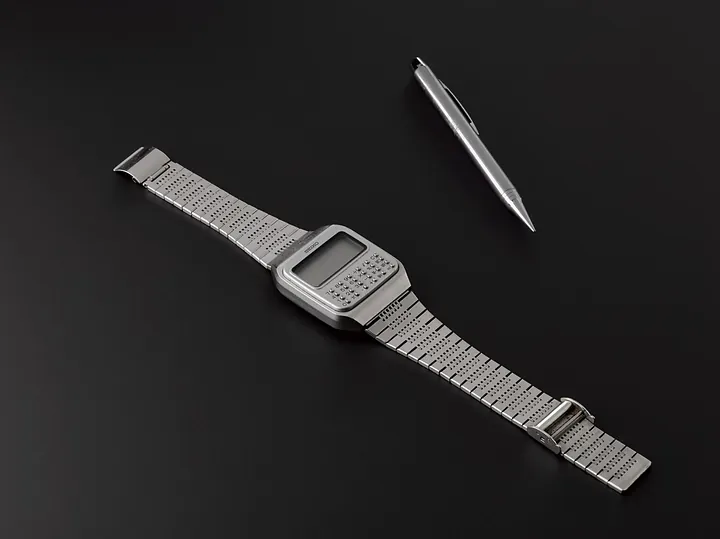
Wristwatches · 1978
Calculator wristwatch by Suwa Seikosha Co. Limited, Japan, 1978
Science Museum Group, London