
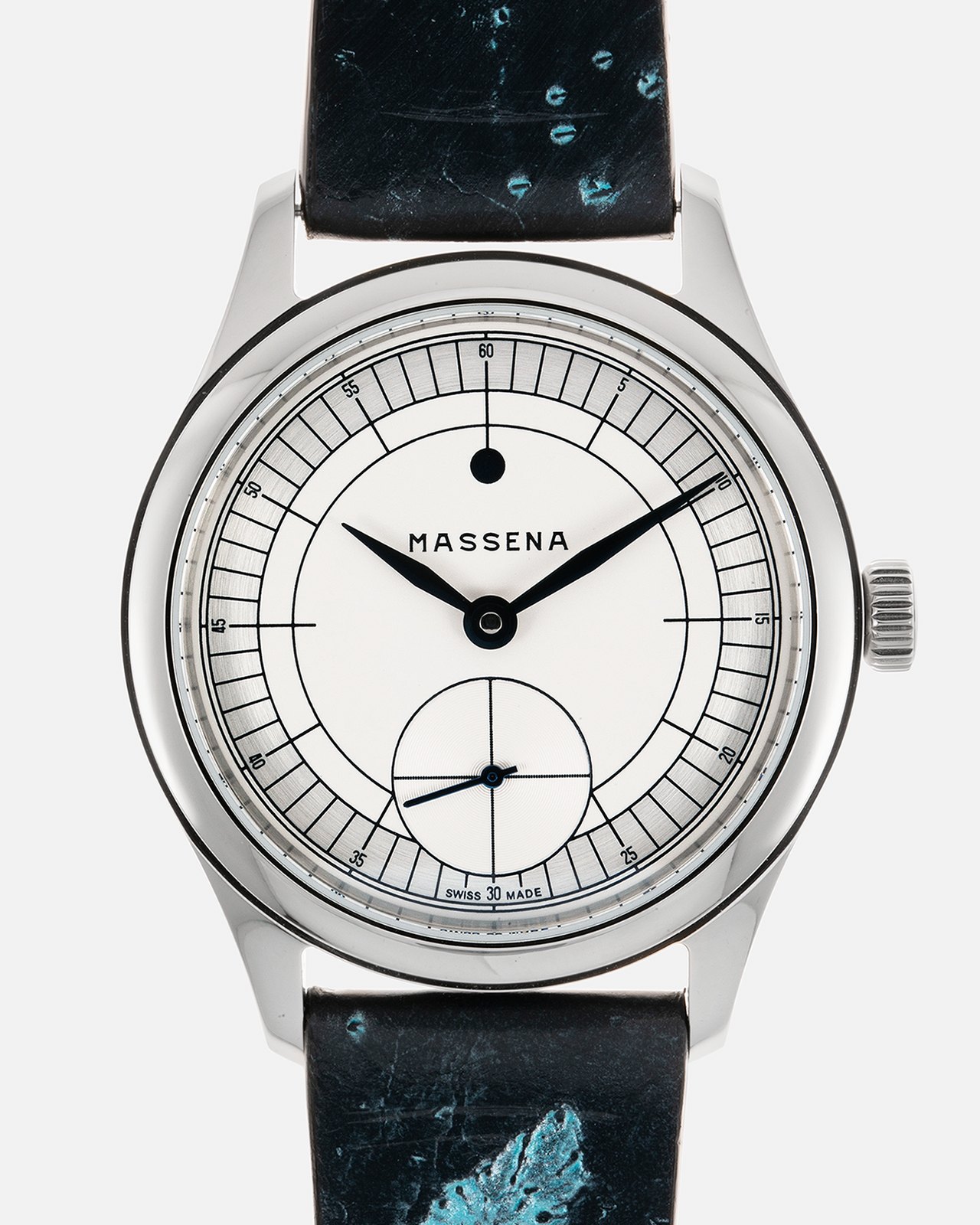
Wristwatches · Wristwatch
Massena Lab Raúl Pagès Margraph, 2023
- Maker / attribution
- Massena LAB (maker)
- Date
- 2023
- Historical period
- Contemporary Horology (2010 – Present)
- Country of origin
- Unrecorded in source
- Object type
- Wristwatch
- Dimensions
- Case 38.5 mm
- Stock no.
- Product 6923662950487
- Credit line
- Dealer listing, S.Song Watches (product 6923662950487)
- Catalogue title (original)
- Massena Lab Raúl Pagès Margraph (English)
View the source record (dealer listing) ↗ (opens another website in a new tab)Suggest a correction
Record summary
Catalogued by S.Song Watches (dealer), Seattle (stock number Product 6923662950487), this is a wristwatch by Massena LAB, dated 2023. The Atlas places it in the Contemporary Horology period (2010 – Present) of its Wristwatches collection. Recorded dimensions: Case 38.5 mm. The record is illustrated with 6 photographs.
Assembled from the source record's structured fields. Dates and attributions are given as the source states them; where a field is missing the Atlas leaves it blank rather than estimating.
Catalogue description
Dealer description — S.Song Watches
Founded in 2018 by horological veteran William Massena, Massena LAB emerged with a vision to collaborate with established brands to produce limited series of watches. As avid enthusiasts of all things related to independent watchmaking in general, the announcement of Raúl Pagès' involvement – renowned for his acclaimed works like the Régulateur à Détente RP1 watch and remarkable automatons such as the White Gold Turtle – partnering with Massena LAB for this particular endeavour instantly ignited our excitement and we had a strong intuition that something truly exceptional was in the making. Ladies and gentlemen, offered here today is the Magraph, a collaborative release between Massena LAB and Raúl Pagès. This unveiling holds particular significance as it marks the debut of a Massena LAB timepiece featuring its very own proprietary movement – the Cal. M660, which was designed and developed under the watchful technical supervision of Raúl Pagès. Encased within a modestly-sized 38.5mm x 10mm stainless steel, Calatrava-style case, the Magraph features a stepped bezel, clean lines, and surfaces adorned with satin-brush finishing. This case design evokes the elegance of watches from the 1940s and 1950s, with its clean lines and aesthetic. The two-tone dial design, on the other hand, finds its roots in Bauhaus art and architecture from the 1930s, embracing the purity and elegance of simple geometric forms over intricate or ornamental embellishments. Interestingly, William Massena also alluded to the dial's resemblance to a pièce unique variant of the Patek Philippe Ref. 96, commissioned in 1935 by a prominent luxury retailer in Berlin named 'Magraf'. As a whole, the Magraph presents an understated aesthetic, its dial structured in a sector-like layout, featuring a subtle off-white hue with a rhodium-plated outermost sector ring adorned by circular motifs. Additionally, the dial features a striking contrast through the inclusion of thermal-blued hands, elegantly offsetting the pure and pristine appearance of the dial. This design also integrates a radially grooved small-seconds sub-dial positioned at 6 o'clock, beautifully harmonizing with the overall dial layout. At the heart of the Magraph lies the exclusive Cal. M660 by Raúl Pagès. This hand-wound movement boasts a 60-hour power reserve, accompanied by meticulously hand-chamfered anglage on the plates and bridges, as well as classic Côtes de Genève finishing throughout. Nestled beneath the balance wheel, you’ll find a unique tortoise-shaped ( La tortue ) poinçon Pagès , a signature hallmark of Raúl Pagès, encircled by delicate decorative perlage throughout. Absolutely impressive.
Historical context
Contemporary Horology (2010 – Present)
Silicon components, connected watches, optical-lattice research clocks and a thriving independent scene.
Smartwatches became the world's best-selling watches, while mechanical watchmaking focuses on craft, innovation (silicon components, new escapements) and independent makers.
Read the period in the timelineMore wristwatches from this periodEarlier: Mechanical Renaissance
Atlas type guide
Wristwatches
Bracelet watches were worn by women from the early nineteenth century — Breguet made one for Caroline Murat, Queen of Naples, in 1810–12 — but the wristwatch only became a man's instrument with military use and aviation in the early twentieth century. Between the World Wars it overtook the pocket watch; the 1920s and 1930s brought rectangular Art Deco cases, water-resistant cases and the first automatic winding systems.
After 1945 the wristwatch became a carrier of identity — dress watches, sports and dive watches, chronographs, calendars — produced by Swiss, American, Japanese, German, Soviet and Chinese industries. The quartz revolution after 1969 and the mechanical renaissance since the 1990s, including the rise of independent watchmakers, complete the story.
What to look for
- The reference number (between the lugs or inside the case back) and serial number, the starting point for dating.
- The calibre: its maker and number are often stamped under the dial or on the bridge.
- Originality of dial, hands and crown — refinished ('redial') dials are common.
- Case material marks: 18K/750, 14K/585, stainless steel, gold-filled, plated.
Dating clues
- Wire-lug cases: before c. 1925.
- Water-resistant screw-down cases: from 1926.
- Quartz movements: from 1969; sapphire crystals widespread after c. 1980.
General guidance written by the Atlas editors about this kind of object. It is not a statement about this particular piece; for that, rely on the source record above and on physical examination.
Related records
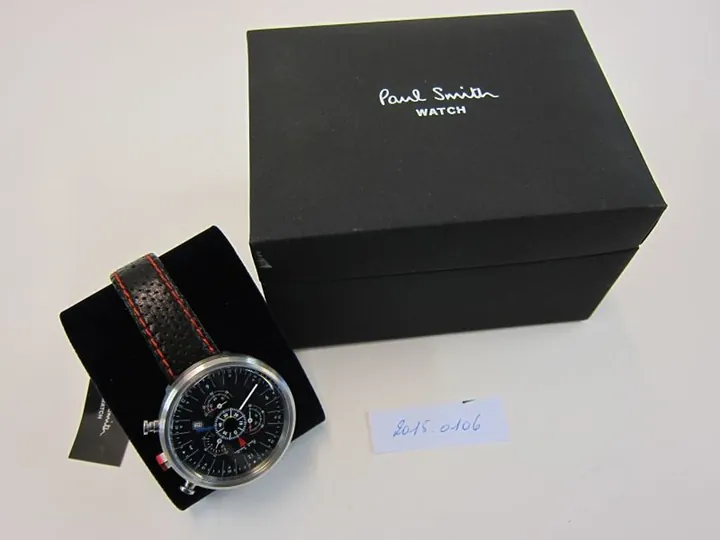
Wristwatches · 2010
Wristwatch, 2010
Modemuseum Hasselt
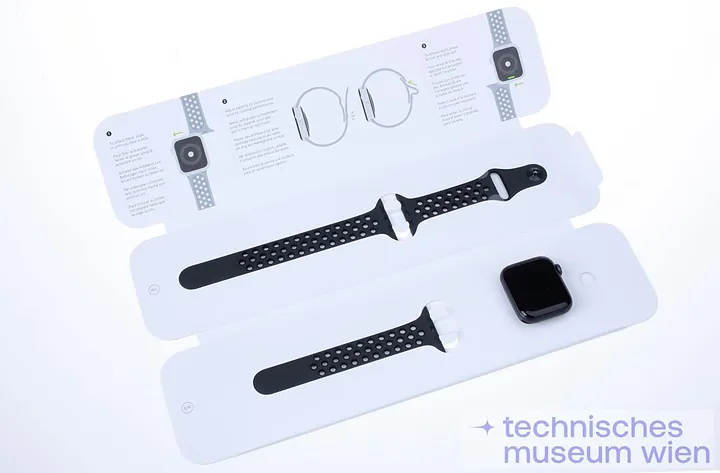
Wristwatches · 2018 (Series 4 released in September 2018; '1977' in the source is the model number A1977)
Apple Watch Series 4 (GPS, 40 mm, model A1977), 2018
Vienna Museum of Science and Technology
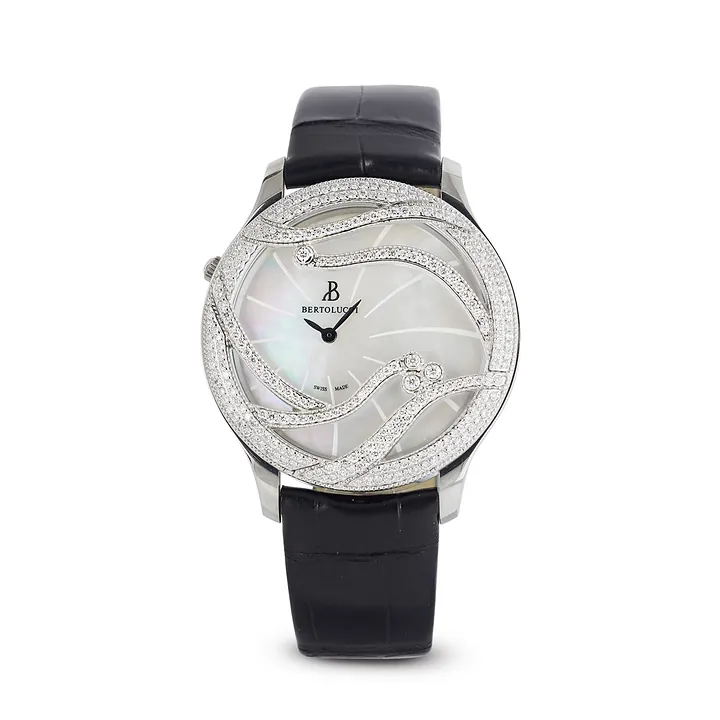
Wristwatches · c. 2010s
Bertolucci Stria III, ref. 11513.50.45.B88.6C1.501, c. 2010s
Antiquorum auction archive, Geneva
Wristwatches · c. 2010s
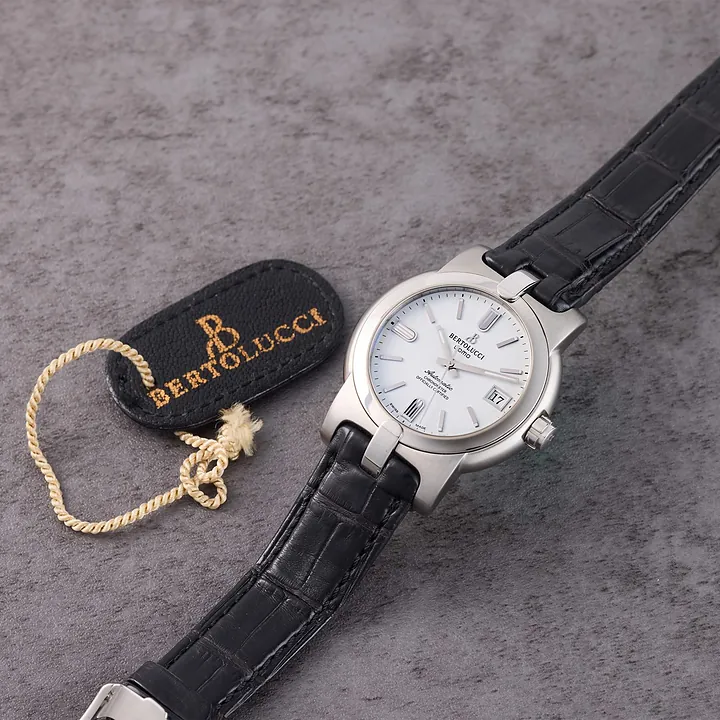
Bertolucci Uoma, ref. 824.51.41.10B, c. 2010s
Antiquorum auction archive, Geneva

Wristwatches · c. 2010s
Breguet Type XXI, ref. 3810, c. 2010s (Antiquorum Lot 381-24)
Antiquorum auction archive, Geneva

Wristwatches · c. 2010s
Breguet Type XXI, ref. 3810, c. 2010s (Antiquorum Lot 386-229)
Antiquorum auction archive, Geneva

Wristwatches · Sold in September 2010
Breitling Cosmonaute, ref. A 22322, Sold in September 2010
Antiquorum auction archive, Geneva
Wristwatches · c. 2010s
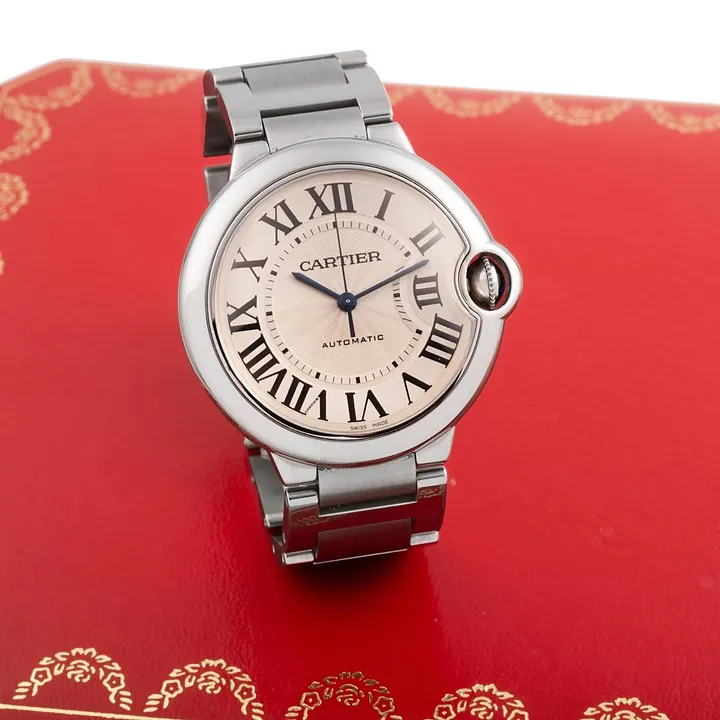
Cartier Ballon Bleu, ref. 3284, c. 2010s
Antiquorum auction archive, Geneva