
Clocks · Mantel clock
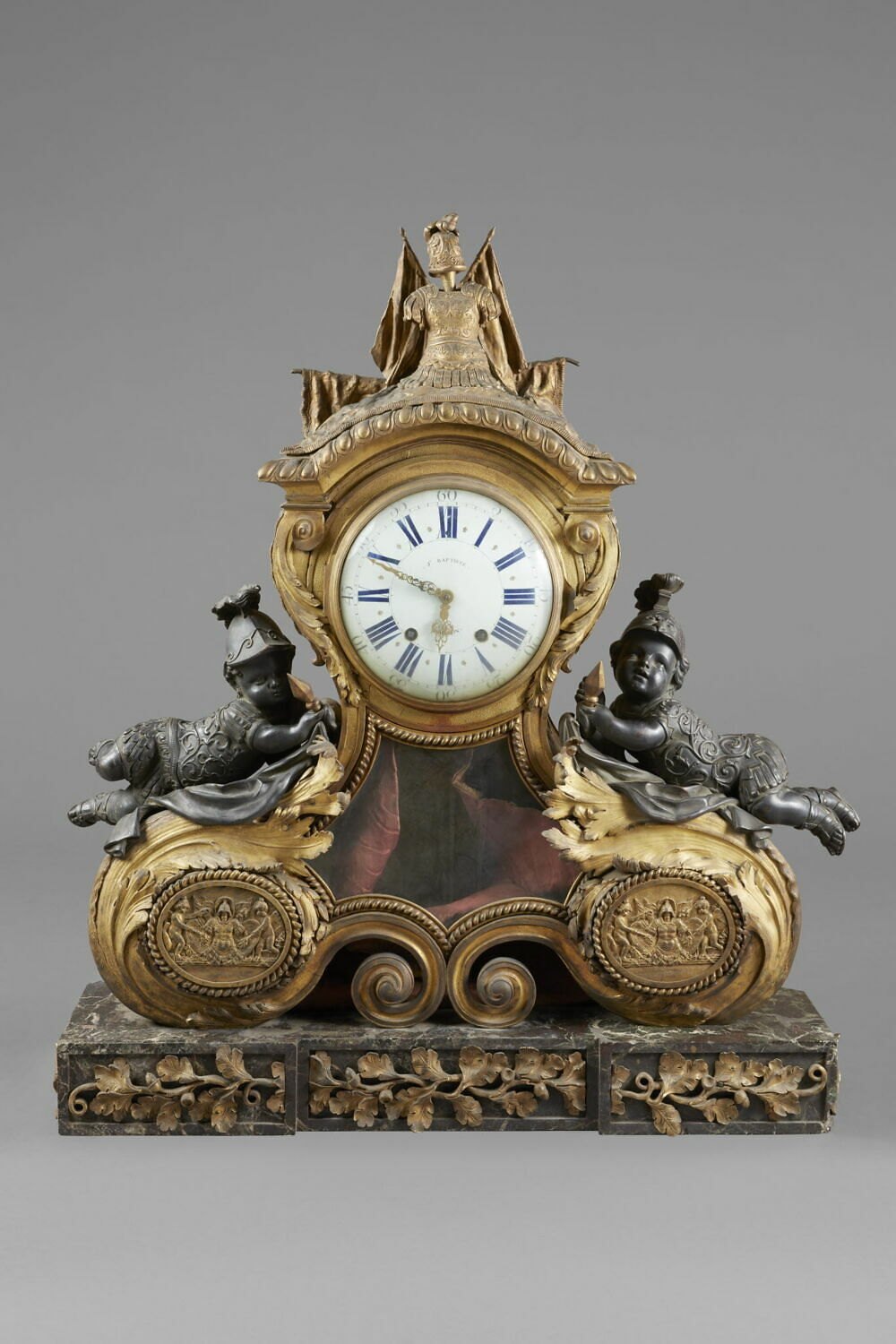
Mantel clock by Jean-Baptiste Baillon, France, 1840–1860
- Maker / attribution
- Jean-Baptiste Baillon (Horloger)
- Date
- 1840–1860
- Historical period
- Industrial Revolution (1850 – 1900)
- Country of origin
- France
- Place
- Paris, France
- Object type
- Mantel clock
- Materials / technique
- bronze, marble
- Dimensions
- height 103 cm; width 88 cm; depth 24 cm
- Holding institution
- Musée du Louvre, Paris
- Accession / object no.
- OAR 377 A
- Credit line
- Musée du Louvre
- Catalogue title (original)
- Grande pendule (French)
View the source record ↗ (opens another website in a new tab)Suggest a correction
Record summary
Held and catalogued by Musée du Louvre, Paris (object number OAR 377 A), this is a mantel clock by Jean-Baptiste Baillon, made in Paris, France, dated 1840–1860. The Atlas places it in the Industrial Revolution period (1850 – 1900) of its Clocks collection. Materials and techniques recorded by the source: bronze, marble. Recorded dimensions: height 103 cm; width 88 cm; depth 24 cm. The record is illustrated with 6 photographs.
Assembled from the source record's structured fields. Dates and attributions are given as the source states them; where a field is missing the Atlas leaves it blank rather than estimating.
Catalogue description
Catalogue description — Musée du Louvre (French)
grande pendule rehaussée de bronze noir et doré ; le cadran circulaire signé J.-B. Baillon est flanqué de deux amours de bronze noir casqués et armés d'une pique ; base de marbre blanc ; huit pieds en toupies de bronze doré ; balancier en forme de soleil.
Shown in the original language of the source catalogue. An editor-reviewed English translation has not yet been published; we do not publish machine translations as authoritative text.
Dating and period as catalogued (French)
Epoque / période : Second Empire (1852-1870) (Occident->époque contemporaine) · · Date de création/fabrication : 1840 - 1860 et 1750 - 1800 (cadran) (signature)
Shown in the original language of the source catalogue. An editor-reviewed English translation has not yet been published; we do not publish machine translations as authoritative text.
Materials and techniques as catalogued (French)
Matériau : bronze · Technique : fonte = coulé fondu = fondu (techniques métal) · Technique : doré = dorure (techniques métal) · Technique : patiné = patine (techniques métal) (noire) · Matériau : marbre
Shown in the original language of the source catalogue. An editor-reviewed English translation has not yet been published; we do not publish machine translations as authoritative text.
Inscriptions & marks
Etiquette : ; sur le verre arrière : « MNL N elle Sie OAR 377A » ; deux étiquettes volantes « OAR 377A » ; Signature : ; sur le cadran : "J.B. BAILLON" et sur le mouvement : "J Bte Baillon Paris / n° 3271"
Provenance
la grande pendule Napoléon III (cadran signé J[ean] B[aptiste] Baillon) a pu être identifiée comme provenant de Saint Florian en croisant plusieurs sources. Dans la liste de préparation aux commissions de choix des oeuvres de la récupération artistique (dite liste de l'OBIP), on lit : « N° d'ordre : 6 ; N° allemand : ss n° ; Provenance : 1er convoi de Linz ; Epoque : Napoléon III ; Sujet : Cartel, ornements guerriers et amours ; Matière : Bronze doré ; Observation : [néant] ». L'indication dans cette liste du convoi de provenance (premier convoi en provenance de Linz) constitue une base de recherche appréciable. Dans les documents relatifs aux oeuvres revenues de Saint Florian par le premier convoi en provenance de Linz, trois documents où l'OAR 377 A est cité sont intéressants : - Calepin de déballage du premier convoi en provenance de Linz : « Caisse HR 11 - Gde pendule baroque pour cheminée - bronze doré enfant casque » ; - Saint Florian, liste complète des objets acquis par le Rundfunk (campagne d'achat 1944) : "N° d'inventaire allemand : 15 ; Nature des objets : 1 grande pendule baroque ; Provenance : Chesnier Duschene 83 rue de la Convention ; Renfermé dans caisse HR N° : 11 » ; - Saint Florian, inventaire des caisses rapatriées contenant les objets acquis par le RUNDFUNK (campagne d'achat 1944) : « Numéro des caisses : 11 ; Objets contenus : 1 grande pendule baroque pour cheminée ; N° d'inventaire d'origine : 15" . Bien que la liste OBIP n'indique pas le numéro de cett
Historical context
Industrial Revolution (1850 – 1900)
American interchangeable-parts manufacture; railroad time standards; Swiss and German factory systems.
Factory production transformed the clock into an everyday object. American makers (Seth Thomas, Ansonia, Waterbury) and German factories (Junghans, Gustav Becker, Lenzkirch) sold millions of shelf, wall and alarm clocks worldwide; France produced standardised Paris movements and carriage clocks; electric time distribution began.
Read the period in the timelineMore clocks from this periodEarlier: Precision & Scientific Horology
Atlas type guide
Mantel and French pendule clocks
The mantel clock — the French pendule de cheminée — is as much decorative art as timekeeper. From the late seventeenth century Parisian clockmakers worked with cabinet-makers, bronze founders and gilders (ciseleurs-doreurs) to create cases in Boulle marquetry, gilt bronze and marble, while the movements were often supplied by specialist makers. Clocks of the Louis XIV, Louis XV and Louis XVI periods, and Empire clocks with allegorical figures, set fashions copied across Europe.
The nineteenth century industrialised the type. The 'Paris movement', a standardised round movement with silk-thread or Brocot suspension and count-wheel striking, was made in huge numbers by firms such as Japy and Vincenti, and fitted into cases of every style and material.
What to look for
- Round 'Paris' movements with makers' stamps (e.g. Japy Frères, Vincenti, S. Marti) and medal marks from exhibitions.
- Suspension type: silk thread (earlier) or Brocot adjustable suspension (after c. 1840).
- Visible Brocot escapement on the dial in later clocks.
- Fire-gilt (mercury) gilding on bronzes versus later electro-gilding.
- Signed dials naming a retailer rather than the movement maker.
Dating clues
- Silk-suspension Paris movements: c. 1800–1850.
- Brocot suspension and visible escapements: after c. 1840.
- Exhibition medal stamps on movements give dates after the medal year.
General guidance written by the Atlas editors about this kind of object. It is not a statement about this particular piece; for that, rely on the source record above and on physical examination.
Read next:Anchor (recoil) escapement
Related records
Pocket Watches · 1749–1750
Watch by Jean-Baptiste Baillon, France, 1749–1750
Musée du Louvre, Paris
Pocket Watches · 1770–1800
Watch by Jean-Baptiste Baillon, France, 1770–1800
Musée du Louvre, Paris
Pocket Watches · 1725–1750
Watch by Jean-Baptiste Baillon, France, 1725–1750
Musée du Louvre, Paris
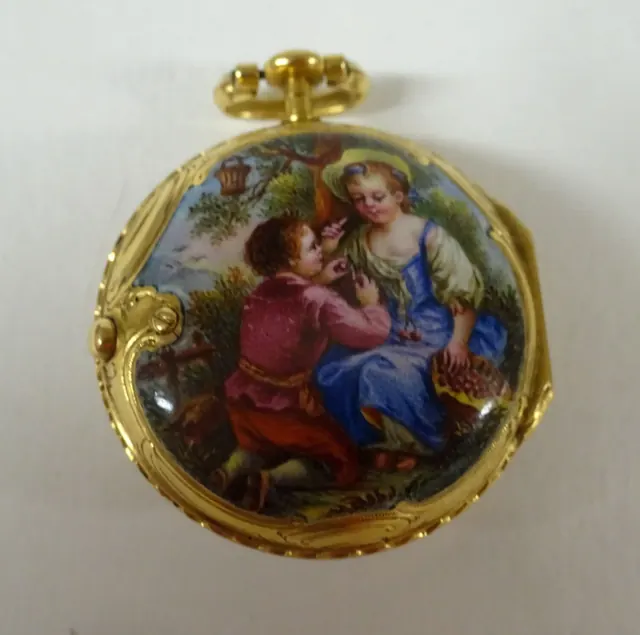
Pocket Watches · 1740–1760
Watch by Jean-Baptiste Baillon, France, 1740–1760
Musée du Louvre, Paris
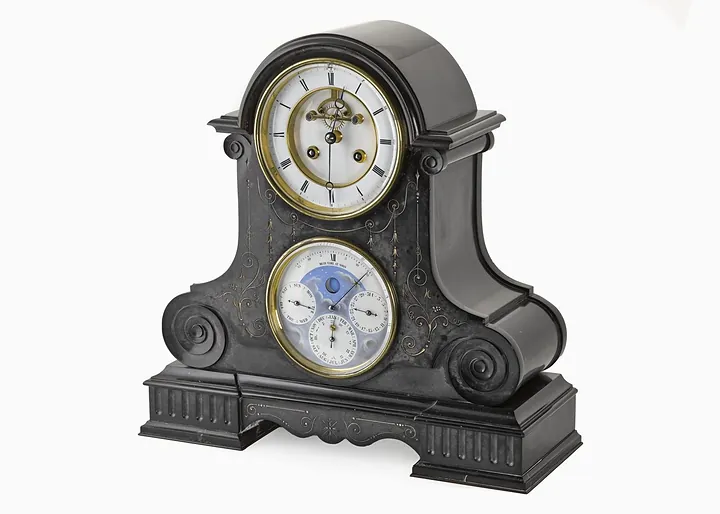
Clocks · 1840–1878
Mantel clock by A. Brocot, France, 1840–1878
Science Museum Group, London
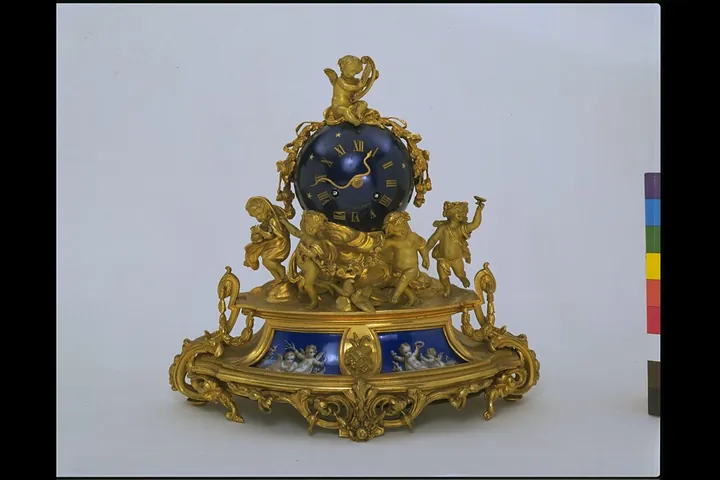
Clocks · c. 1855
Ormolu and enamel clock, Paris, ca.1855, made by Lévy Frères.
Victoria and Albert Museum, London
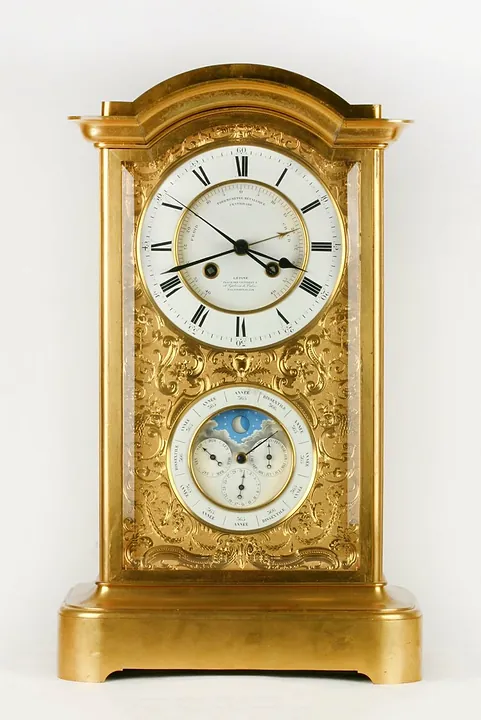
Clocks · c. 1850
Table clock, France, c. 1850
German Clock Museum
Clocks · c. 1850
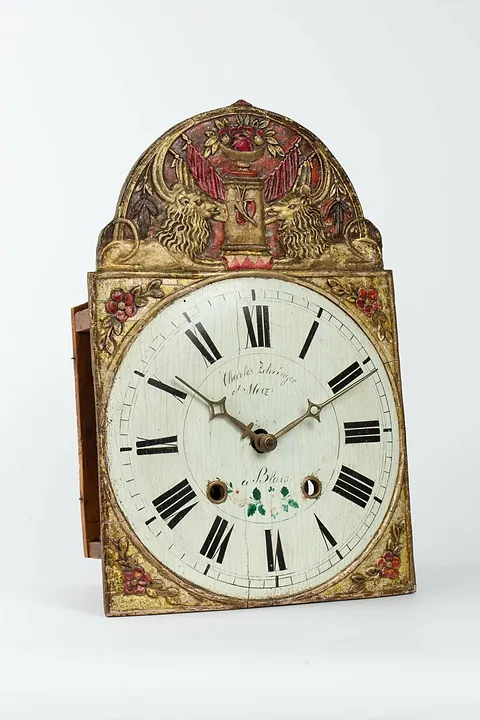
Wall clock by Charles et Merz Zehringer, France, c. 1850
German Clock Museum