
Wristwatches · Wristwatch
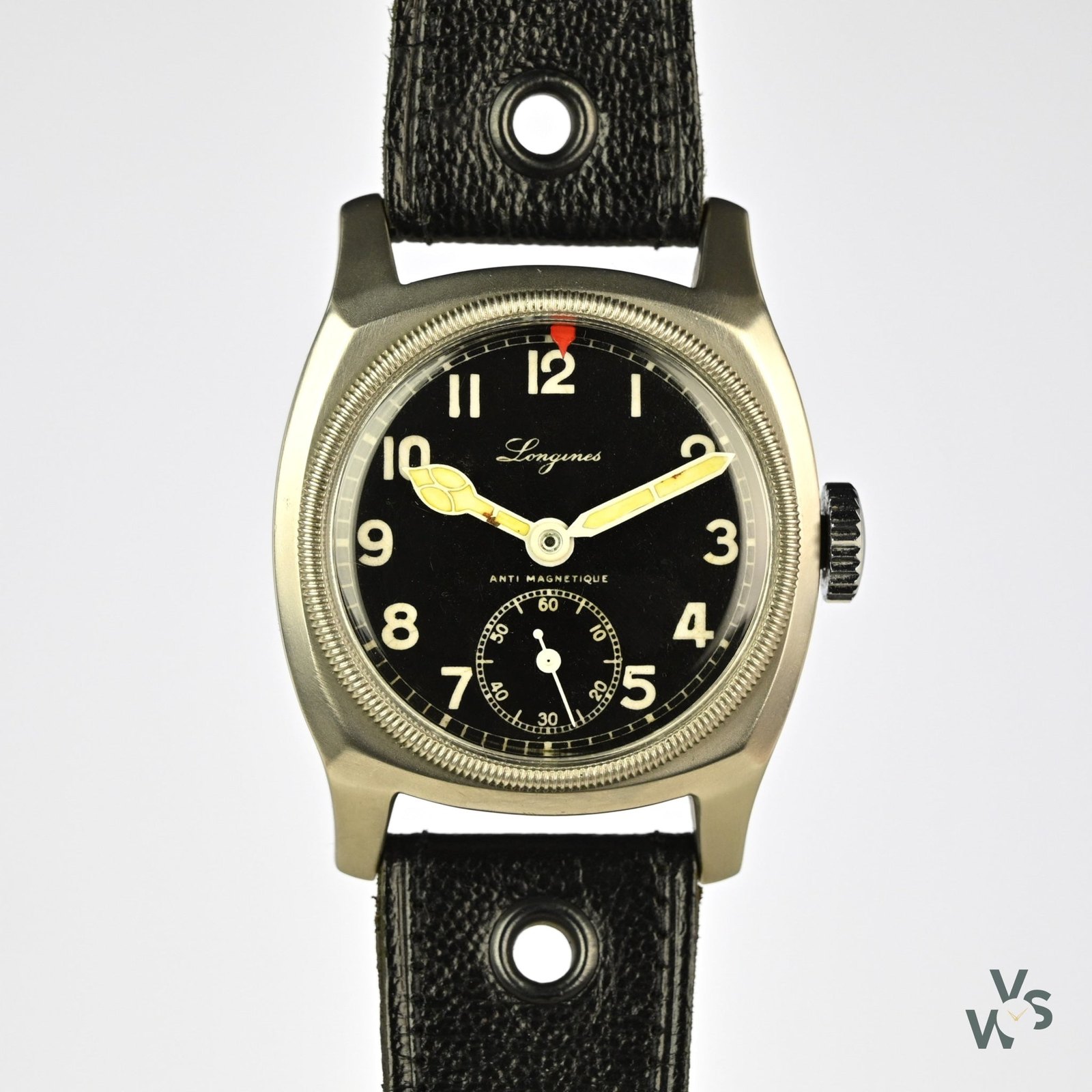
Longines Majetek Czechoslovakian Air Force Pilots Watch, Military Issued, circa 1937
- Maker / attribution
- Longines (maker)
- Date
- c. 1937
- Historical period
- Golden Age of Mechanical Watchmaking (1900 – 1945)
- Country of origin
- Czech Republic
- Object type
- Wristwatch
- Dimensions
- Case 40 mm
- Stock no.
- vws1817cs
- Credit line
- Dealer listing, Vintage Watch Specialist (vws1817cs)
- Catalogue title (original)
- Longines - Majetek Czechoslovakian Air Force Pilots Watch - Military Issued c.1937 ***SOLD*** (English)
View the source record (dealer listing) ↗ (opens another website in a new tab)Suggest a correction
Record summary
Catalogued by Vintage Watch Specialist (dealer), United Kingdom (stock number vws1817cs), this is a wristwatch by Longines, made in Czech Republic, dated c. 1937. The Atlas places it in the Golden Age of Mechanical Watchmaking period (1900 – 1945) of its Wristwatches collection. Recorded dimensions: Case 40 mm. The record is illustrated with 6 photographs.
Assembled from the source record's structured fields. Dates and attributions are given as the source states them; where a field is missing the Atlas leaves it blank rather than estimating.
Catalogue description
Dealer description — Vintage Watch Specialist
We Are Sorry But This Watch Is Now Sold - If However You Are Looking To Buy Or Sell Something Similar Then Please Email Sales@Vintagewatchspecialist.Com Or Whatsapp/Call +44 7831 454658. Thanks A Longines Majetek Czech Pilots Watch Which Was Originally Invoiced in 1937 to Kohn, The Longines Agent in Prague. A Substantial Watch with Handsome Proportions and a Military History. Compagnie des Montres Longines, Francillon S.A., or simply Longines, is a Swiss luxury watchmaker based in Saint-Imier, Switzerland. Founded by Auguste Agassiz in 1832, the company has been a subsidiary of the Swiss Swatch Group and its predecessors since 1983. Its winged hourglass logo, which was registered in 1889, is the oldest unchanged yet still an active registered trademark. What’s On Offer This large pilot’s wristwatch was issued to the Czech Military during World War II and equipped with a rotating fluted bezel to indicate elapsed time. The black dial with its luminous Arabic numerals, triangle-shaped indicator, and cathedral hands filled with luminescent radium was easily readable during the night. Longines manufactured this model from 1935 to 1948 for the Czechoslovakian Air Force and some pieces for the general public. The pilot’s watch movement is housed in a cushion-shaped steel case (40mm), is highly antimagnetic, shock-proof, and equipped with an unbreakable crystal. After applying for an extract of archive from Longines, their comments are as below; " It is fitted with a Longines manually wound mechanical movement, caliber 15.94 and was invoiced on 27 May 1937 to the company Kohn, which was at that time our agent in Prague." "Based on the pictures received, we can deduct that some transformations have probably been done after the watch has left the company." We can possibly take from this, that the watch was subsequently marked with "Majetek Vojenské Správy 2053" and issued to the Czech Air Force by the importers Kohn. Given the mint condition of the bezel hands and dial, we wonder if they were replaced at some point! However, the entire watch is in really nice condition with a blemish-free black dial, sharp Arabic numerals, and Cathedral hands with buttery yellow lume. This watch enjoys substantial proportions that wear very well on the wrist and would make a great everyday wearer. Additional information Made from Case: Stainless Steel Dial: Black Crystal: Plexiglass Bracelet: Black Leather Technical specifications Winding: Manual Movement Type: Mechanical Caliber: 15.94 Jewels: 15j Waterproof: N/A Power reserve: 37hrs Purchase details Condition: Excellent Model Reference: Majetek Date of issue: c.1937 Guarantee: 12 Months by VWS Dimensions Width (without crown): 40mm Lug width: 22mm Lug height: (lug to lug) 51mm Wrist size: Adjustable
Historical context
Golden Age of Mechanical Watchmaking (1900 – 1945)
The wristwatch displaces the pocket watch; waterproof cases, self-winding and grand complications.
The wristwatch overtook the pocket watch. Military use in the First World War, aviation, water-resistant cases (1926), automatic winding (1923–31), rectangular Art Deco designs and early chronographs and calendars defined the period.
Read the period in the timelineMore wristwatches from this periodEarlier: Industrial Revolution
Atlas type guide
Military, pilot and travel watches
The wristwatch owes much of its adoption by men to warfare and aviation. Wristlets — small pocket watches soldered with lugs and worn on a strap — were used in colonial campaigns and became standard equipment in the First World War, with protective grilles over the crystal ('shrapnel guards'). Louis Cartier's Santos (1904), designed for the aviator Alberto Santos-Dumont, is often cited as an early purpose-made pilot's watch.
In the Second World War governments specified watches in detail: the German B-Uhr observation watches, the American A-11, and the British 'W.W.W.' (the 'Dirty Dozen' set of 1945). After the war, jet travel brought GMT and world-time watches, which show two or more time zones at once — Louis Cottier's world-time mechanism and the Rolex GMT-Master (1955) are examples.
What to look for
- Military markings on the case back: broad arrow, issue numbers, 'W.W.W.', 'A.T.P.'
- High-legibility black dials with luminous Arabic numerals; oversized crowns for gloved hands.
- 24-hour hands and rotating 24-hour bezels or city rings on GMT/world-time watches.
- Wire lugs on early wristlets converted from pocket watches.
Dating clues
- Wire-lug wristlets: c. 1900–1925.
- Military specifications of the Second World War: 1939–1945.
- GMT and world-time wristwatches: mainly after 1950.
General guidance written by the Atlas editors about this kind of object. It is not a statement about this particular piece; for that, rely on the source record above and on physical examination.
Related records
Instruments · c. 1940
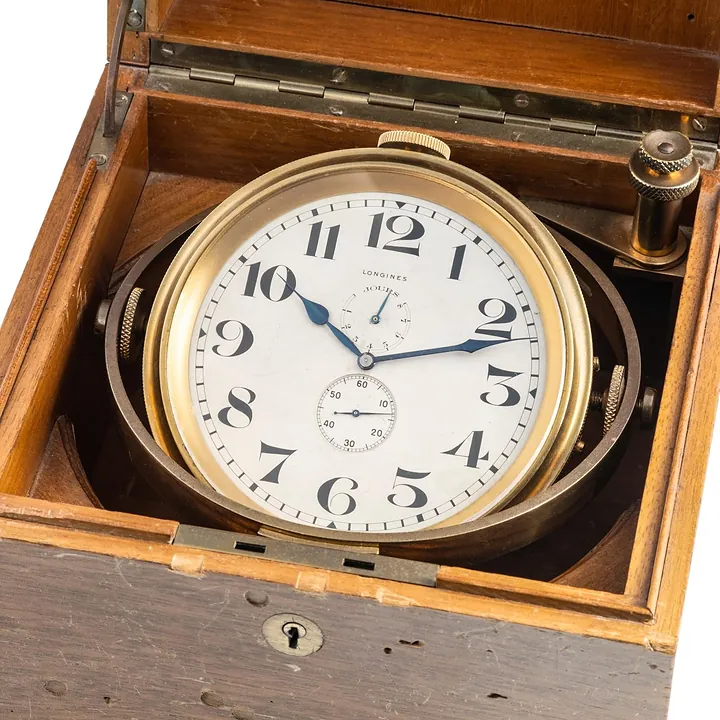
Longines marine chronometer, c. 1940
Antiquorum auction archive, Geneva
Pocket Watches · c. 1910-1920s
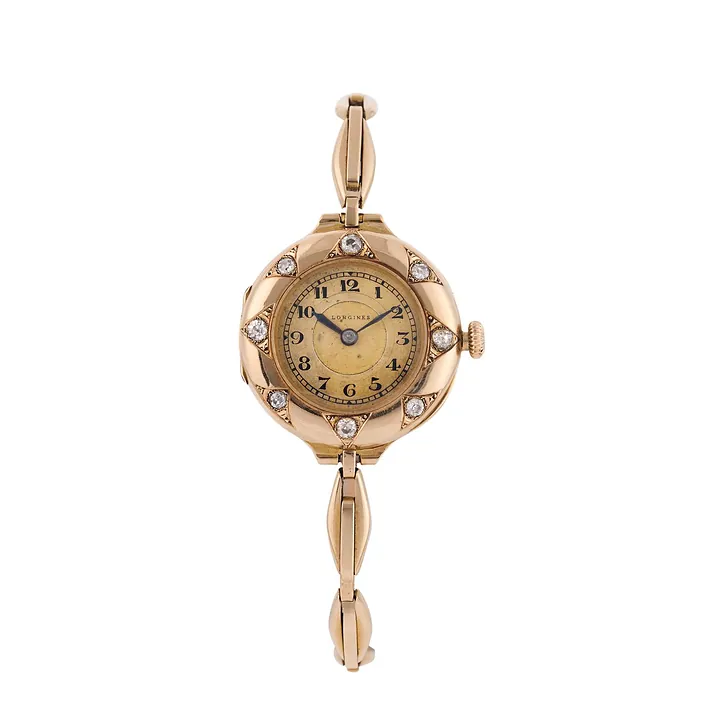
Longines watch, c. 1910-1920s
Antiquorum auction archive, Geneva
Pocket Watches · c. 1915
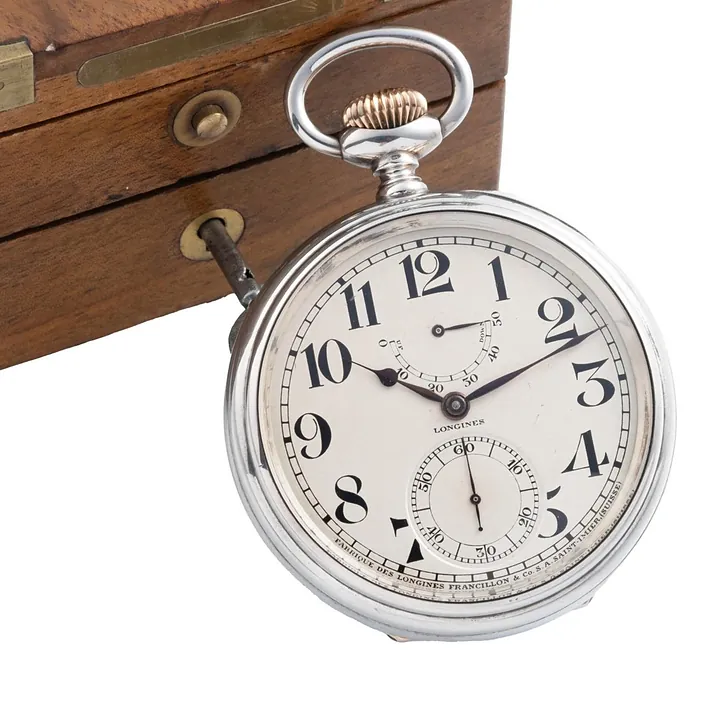
Longines ''torpedo-Boat Watch'', c. 1915
Antiquorum auction archive, Geneva
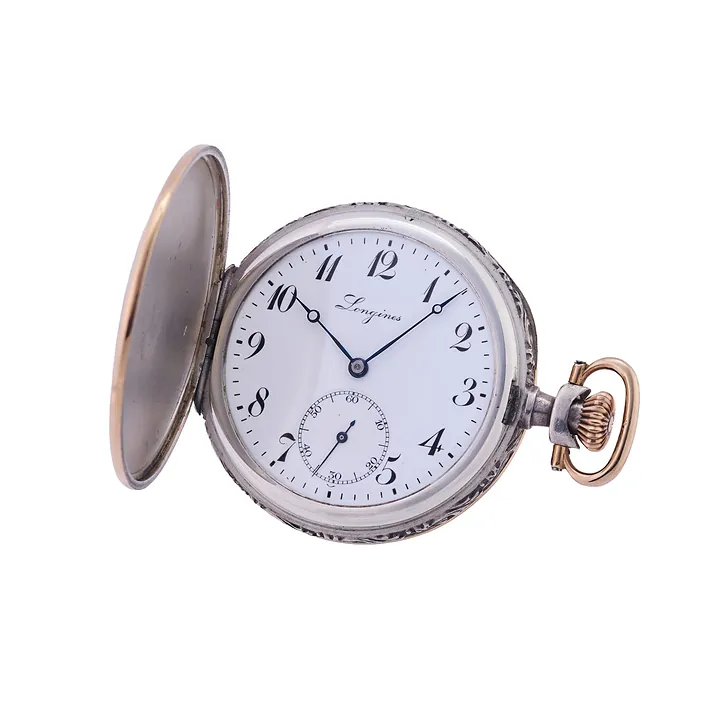
Pocket Watches · c. 1920s
Longines pocket watch, c. 1920s (Antiquorum Lot 389-59)
Antiquorum auction archive, Geneva
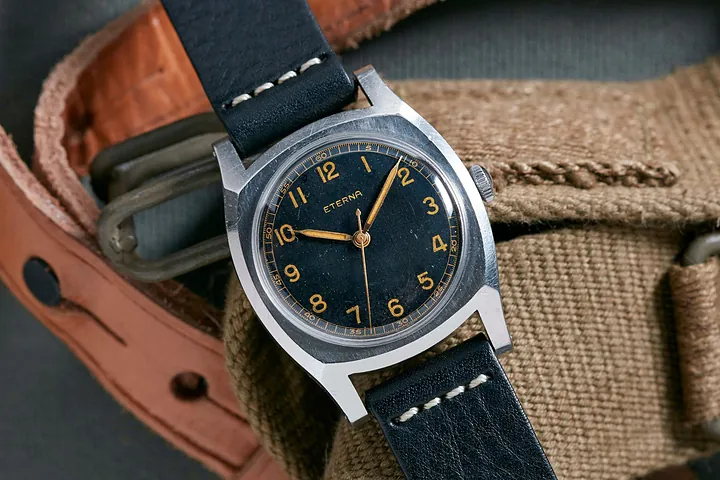
Wristwatches · early 1940s
Eterna Majetek Czech Military, early 1940s
Analog/Shift (dealer), New York
Wristwatches · 1900–1999
Wristwatch by Mercury, 1900–1999
Modemuseum Hasselt
Wristwatches · 1900–1999
Wristwatch by Nutrix, 1900–1999
Modemuseum Hasselt

Wristwatches · 1920
Wristwatch, 1920
Modemuseum Hasselt