
Wristwatches · Wristwatch
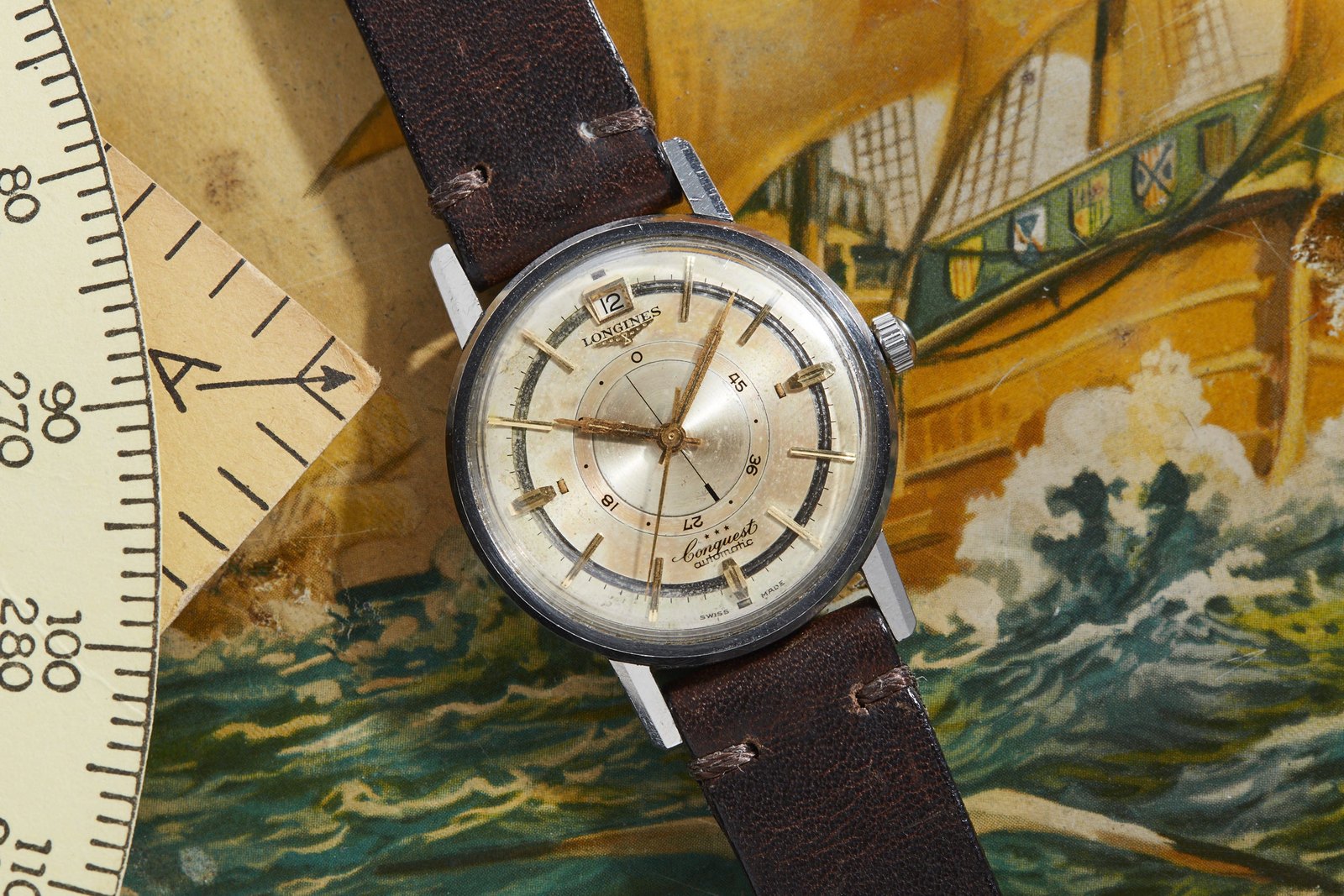
Longines Conquest Power Reserve Date, 1948
- Maker / attribution
- Longines (maker)
- Date
- 1948
- Historical period
- Modern Mechanical Horology (1945 – 1969)
- Country of origin
- Switzerland
- Object type
- Wristwatch
- Stock no.
- Product 9542523137
- Credit line
- Dealer listing, Analog/Shift (product 9542523137)
- Catalogue title (original)
- Longines Conquest Power Reserve Date (English)
View the source record (dealer listing) ↗ (opens another website in a new tab)Suggest a correction
Record summary
Catalogued by Analog/Shift (dealer), New York (stock number Product 9542523137), this is a wristwatch by Longines, made in Switzerland, dated 1948. The Atlas places it in the Modern Mechanical Horology period (1945 – 1969) of its Wristwatches collection. The record is illustrated with 6 photographs.
Assembled from the source record's structured fields. Dates and attributions are given as the source states them; where a field is missing the Atlas leaves it blank rather than estimating.
Catalogue description
Dealer description — Analog/Shift
When asked whether Omega would start placing automatic movements in their watches, then-CEO Paul-Emile Brandt remarked, “If our clients are too lazy to wind their watch everyday, then we should stop producing watches!” Of course, before John Harwood filed his patent for an automatic wristwatch movement in 1920s, clients had no other choice. Watches needed to be wound by hand. And these watches, powered by tightly-coiled springs, had to be wound once a day or they would lose power, and thus, precision. In the Age of Sail, when sailors relied on marine chronometers to determine their bearings, the importance of keeping a watch fully-wound was paramount. An imprecise reckoning led to a ship sailing miles off course—and the result was often fatal. So watchmakers devised a mechanism to measure and display the remaining power in these chronometers: a power reserve indicator. Antoine-Louis Breguet developed a pocket watch with a power reserve indicator in the 19th century, and as the Age of Sail gave way to the Age of Steam, railroad chronometers began to display them. It was another hundred years or more before power reserve indicators first began appearing on wristwatches. The first was created, fittingly enough, by Breguet in the 1930s, though it never saw mass-production. As automatic or self-winding movements began to appear, the power reserve indicator saw new life. Though consumers no longer needed to hand-wind their watches, a power reserve indicator served as a gentle reminder that automatic watches sometimes need to be wound if they’ve been sitting idle. In the 1940s, Jaeger-LeCoultre became the first manufacture to include power reserve indicators in serialized watches, starting with the aptly-named Powermatic. This watch, which was produced from 1948 to 1959, saw prominence on the wrist of James Dean, who was wearing one in the car crash that took his life. In fact, the Powermatic is still being produced by JLC today under the name Reserve de Marche. Though perhaps now best known for its association with horse racing, Longines has been a staple of the Swiss watchmaking industry since the mid 19th century, and has gained a reputation for the masterfulness of its design—and its creative use of complications, the power reserve being one of them. This watch, Reference 9032, is part of the Conquest line. Launched in 1954, the Conquest line represented a “stepping-stone to progress” for Longines, which had been a well-known and well-respected name in Swiss watchmaking since the mid-19th century. During World War II, Longines found itself producing wristwatches for the British Ministry of Defense—the acclaimed “Greenlander” of Dirty Dozen fame. After the war, the manufacture from the “long meadows” sought to stretch its creative and technical muscles, and the Conquest was one way to achieve that. The 1950s were a time when many manufactures, free from the military contracts that had restricted production, began to experiment and implement new horological innovations. The watches that Longines released following the war reflected the sturdy construction of the Greenlander, but utilized the manufacture’s early automatic wristwatch movements, the Calibre 22A, first released in 1946. The Conquest—like the Omega Seamaster, another benchmark of post-war horology design—was Longines’ way of blazing forward to unexplored frontiers while still keeping one foot firmly in the past. The Reference 9032 is notable for its sturdy steel case (with a circular medallion in the center of the case back in trademark green), with beefy chamfered lugs, a feature often found on Seamasters of the period. But the Conquest’s crowning glory is the dial, which displays a circular power reserve indicator on a disc in the center. As the power runs down, the disc rotates back to zero. The dial of this Conquest is an exercise in variance. Though the applied gold hour markers and the date at 12 o’clock catch the eye, the gaze is draw around, ever around, along the chapter ring and that visually-arresting power reserve indicator. With watches like this one, it’s no secret why vintage Longines continues to be desirable.
Historical context
Modern Mechanical Horology (1945 – 1969)
Tool watches for divers, pilots and astronauts; electric watches anticipate the electronic age.
The classic era of the mechanical wristwatch: dive watches, chronographs for motor racing and space flight, GMT watches for jet travel, slim dress watches, automatic calendars, and the rise of Japanese manufacturers alongside Swiss, American, German and Soviet industries.
Read the period in the timelineMore wristwatches from this periodEarlier: Golden Age of Mechanical Watchmaking
Atlas type guide
Wristwatches
Bracelet watches were worn by women from the early nineteenth century — Breguet made one for Caroline Murat, Queen of Naples, in 1810–12 — but the wristwatch only became a man's instrument with military use and aviation in the early twentieth century. Between the World Wars it overtook the pocket watch; the 1920s and 1930s brought rectangular Art Deco cases, water-resistant cases and the first automatic winding systems.
After 1945 the wristwatch became a carrier of identity — dress watches, sports and dive watches, chronographs, calendars — produced by Swiss, American, Japanese, German, Soviet and Chinese industries. The quartz revolution after 1969 and the mechanical renaissance since the 1990s, including the rise of independent watchmakers, complete the story.
What to look for
- The reference number (between the lugs or inside the case back) and serial number, the starting point for dating.
- The calibre: its maker and number are often stamped under the dial or on the bridge.
- Originality of dial, hands and crown — refinished ('redial') dials are common.
- Case material marks: 18K/750, 14K/585, stainless steel, gold-filled, plated.
Dating clues
- Wire-lug cases: before c. 1925.
- Water-resistant screw-down cases: from 1926.
- Quartz movements: from 1969; sapphire crystals widespread after c. 1980.
General guidance written by the Atlas editors about this kind of object. It is not a statement about this particular piece; for that, rely on the source record above and on physical examination.
Related records
Instruments · c. 1940
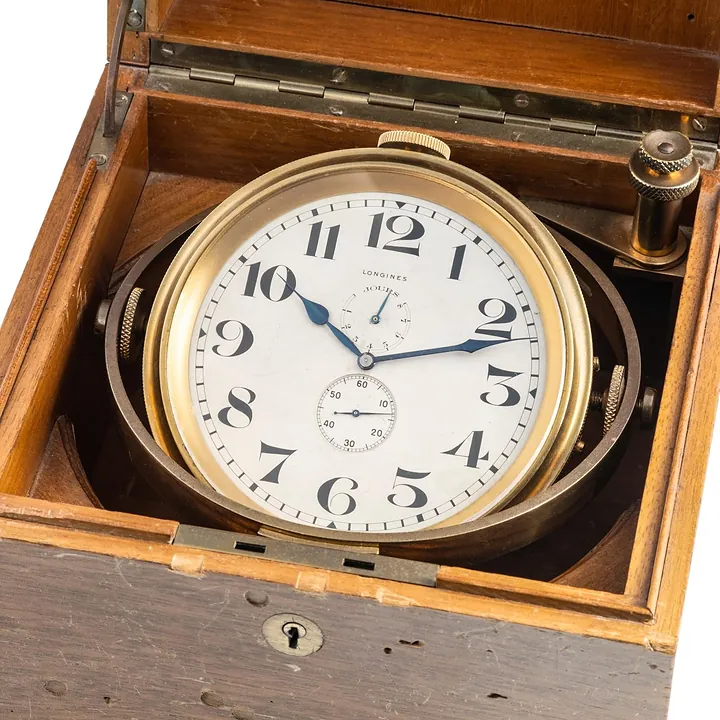
Longines marine chronometer, c. 1940
Antiquorum auction archive, Geneva
Pocket Watches · c. 1910-1920s
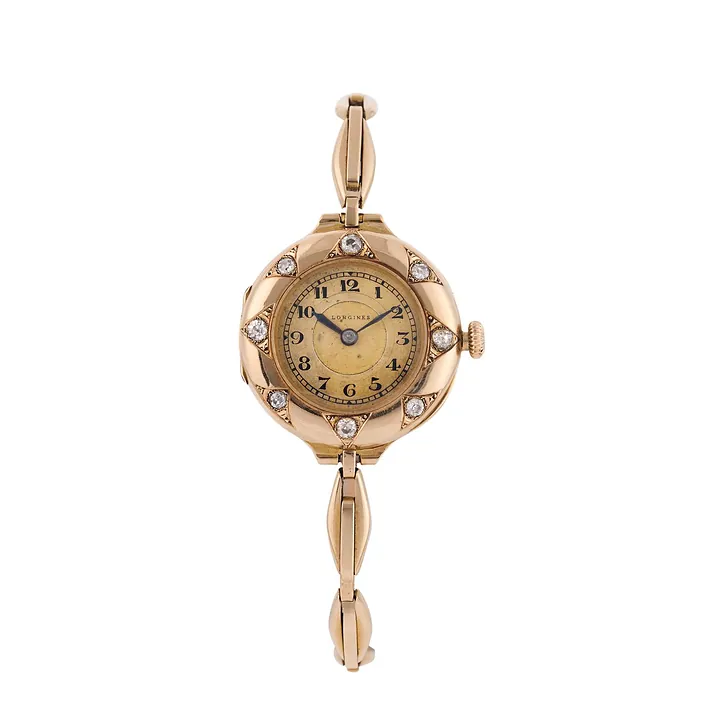
Longines watch, c. 1910-1920s
Antiquorum auction archive, Geneva
Pocket Watches · c. 1915
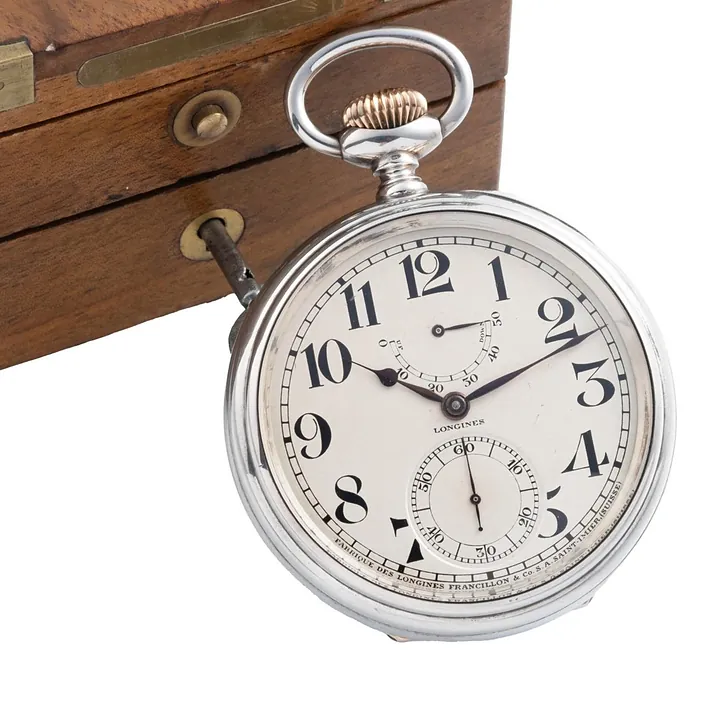
Longines ''torpedo-Boat Watch'', c. 1915
Antiquorum auction archive, Geneva
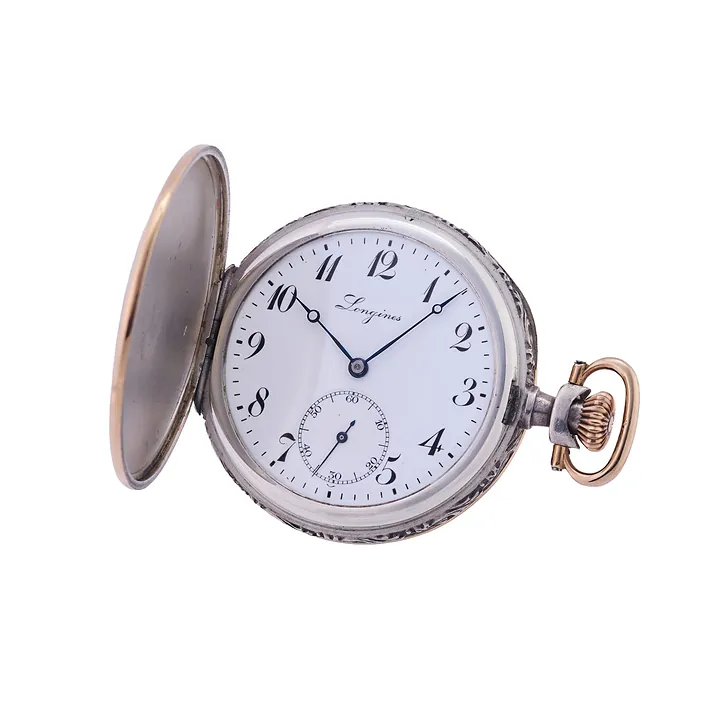
Pocket Watches · c. 1920s
Longines pocket watch, c. 1920s (Antiquorum Lot 389-59)
Antiquorum auction archive, Geneva

Wristwatches · 1945
Wristwatch by Eterna, 1945
Museum Rotterdam

Wristwatches · c. 1945
Breitling Premier, ref. 790, c. 1945
Antiquorum auction archive, Geneva

Wristwatches · c. 1945
Universal Genève Uni-Compax, ref. 22492, c. 1945
Antiquorum auction archive, Geneva

Wristwatches · c. 1950s
Baume & Mercier wristwatch, c. 1950s
Antiquorum auction archive, Geneva