
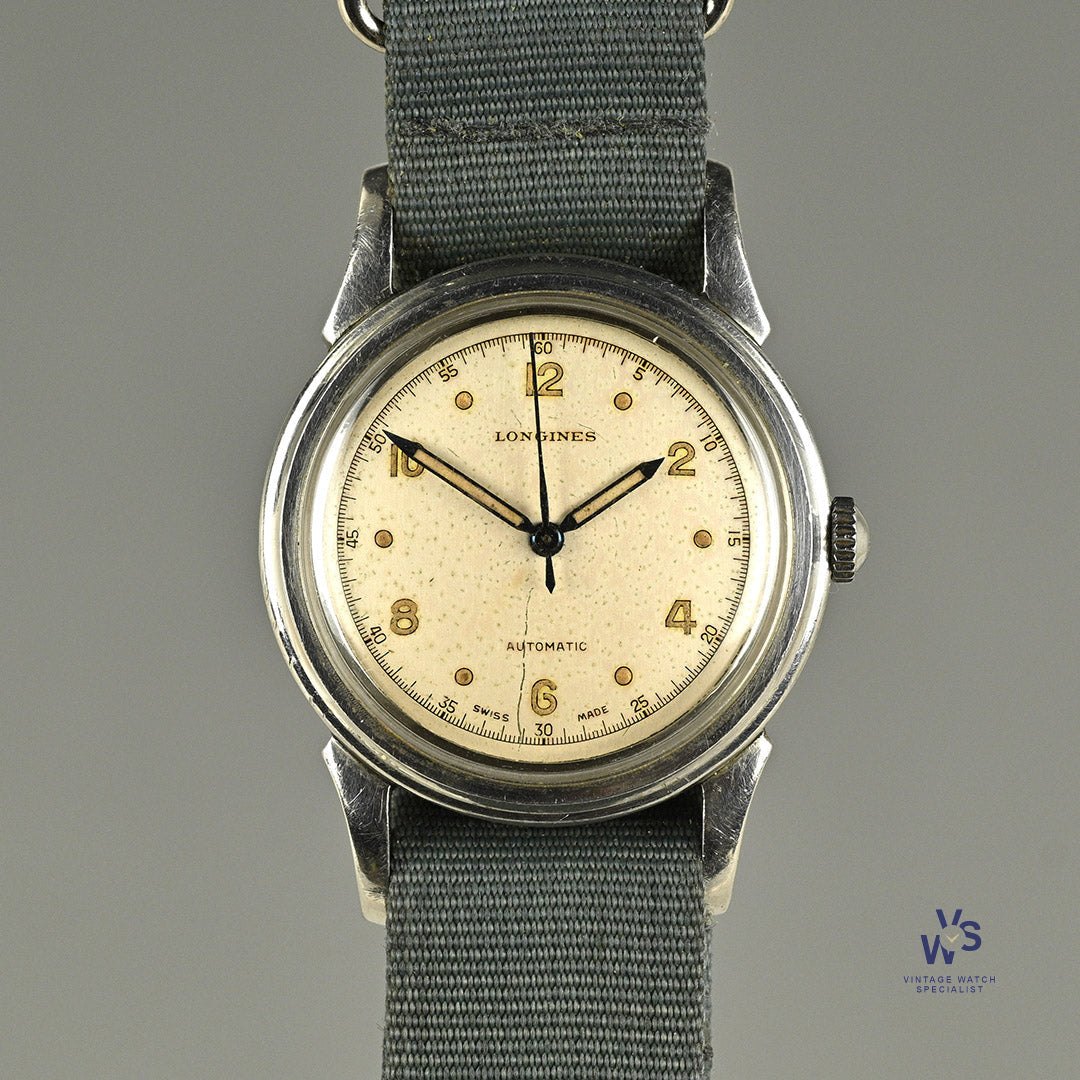
Wristwatches · Wristwatch
Longines Automatic, ref. 6001, Original Lume, circa 1951
- Maker / attribution
- Longines (maker)
- Date
- c. 1951
- Historical period
- Modern Mechanical Horology (1945 – 1969)
- Country of origin
- Switzerland
- Object type
- Wristwatch
- Dimensions
- Case 35 mm
- Stock no.
- vws4360cs
- Credit line
- Dealer listing, Vintage Watch Specialist (vws4360cs)
- Catalogue title (original)
- Longines Automatic - Reference 6001 - 105 - Original Lume - c.1951 (English)
View the source record (dealer listing) ↗ (opens another website in a new tab)Suggest a correction
Record summary
Catalogued by Vintage Watch Specialist (dealer), United Kingdom (stock number vws4360cs), this is a wristwatch by Longines, made in Switzerland, dated c. 1951. The Atlas places it in the Modern Mechanical Horology period (1945 – 1969) of its Wristwatches collection. Recorded dimensions: Case 35 mm. The record is illustrated with 6 photographs.
Assembled from the source record's structured fields. Dates and attributions are given as the source states them; where a field is missing the Atlas leaves it blank rather than estimating.
Catalogue description
Dealer description — Vintage Watch Specialist
Longines was an early adopter of automatic wristwatch technology, introducing its first self-winding calibre, the 22A, during the 1940s. Its successor, the 22AS, belongs to this important early generation of Longines automatic movements, produced when the manufacture was developing its own sophisticated solutions to self-winding. By the early 1950s, watches such as this combined the convenience of automatic winding with the restrained, highly legible styling that characterised Longines' post-war production. What's on Offer Dating to circa 1951, this stainless-steel Longines is powered by the 18-jewel calibre 22AS automatic movement , numbered 8,452,534 . Particularly pleasing are the matching case and lug markings: the inside caseback is marked 6001.6 / Longines 105 , with the corresponding number stamped to the lug at approximately 11 o'clock. The off-white dial has developed wonderful character over the intervening 75 years, with warm patination, spotting and surface marks giving it the unmistakable appearance of a genuinely well-preserved vintage watch. Particularly attractive are the applied Arabic numerals marking the even hours and the circular pips positioned between them, all retaining their original luminous material, which has aged beautifully to a warm golden tone . The dial is completed by a finely detailed outer minute track with five-minute numerals, dark luminous hands and a slender central seconds hand. LONGINES sits neatly beneath 12 o'clock, with AUTOMATIC above six and SWISS MADE at the foot of the dial. There is no date aperture to interrupt the layout, leaving the dial beautifully balanced and remarkably legible. The stainless-steel case measures 35mm across and 47mm lug-to-lug , giving it elegant period proportions while remaining very wearable today. The case displays scratches and marks consistent with its age and use but retains a good overall profile. Engraved on the case back is the coat of arms of the City of London (upper) and the Bridge Mark of the Tower Bridge (lower). The former is identifiable by the shield bearing the Red Cross of St. George, and a sword in the top left quarter. The latter is the symbol of the Bridge House Estates, which features prominently on Tower Bridge in London. Its original meaning has been lost to history, though some say it represents the martyrdom of St. George. These engravings suggest the watch may have been a presentation watch, perhaps gifted to a conservation architect or benefactor for the bridge. Very unique provenance for such a beautiful watch. A Plexiglass crystal maintains the correct vintage appearance, while the watch is currently fitted to a grey-blue NATO-style strap , giving the otherwise classically styled Longines a slightly more utilitarian edge. Overall, we have rated the watch 8/10 , taking its considerable age into account. The dial shows visible age-related patination and spotting, the case carries the expected surface wear and the Plexiglass shows signs of use, but these elements sit comfortably with the wonderfully original character of the watch. Most importantly, the aged dial, original luminous numerals and pips, matching case details and early Longines automatic movement make this a particularly appealing survivor.
Historical context
Modern Mechanical Horology (1945 – 1969)
Tool watches for divers, pilots and astronauts; electric watches anticipate the electronic age.
The classic era of the mechanical wristwatch: dive watches, chronographs for motor racing and space flight, GMT watches for jet travel, slim dress watches, automatic calendars, and the rise of Japanese manufacturers alongside Swiss, American, German and Soviet industries.
Read the period in the timelineMore wristwatches from this periodEarlier: Golden Age of Mechanical Watchmaking
Atlas type guide
Automatic (self-winding) watches
Self-winding watches use the wearer's motion to wind the mainspring. Abraham-Louis Perrelet and Breguet made 'perpétuelle' pocket watches with oscillating weights in the late eighteenth century, but the principle only became practical in the wristwatch. John Harwood patented a bumper automatic in 1923; Rolex's Perpetual rotor (1931) winding in one direction, and later bidirectional rotors (Eterna, Felsa Bidynator), established the modern form. Micro-rotors (Universal Genève, Buren) and peripheral rotors made automatic watches thinner.
What to look for
- A semicircular rotor turning 360° over the movement, or a 'bumper' weight that rebounds between springs.
- 'Automatic', 'Perpetual' or 'Self-winding' on the dial.
- A sealed screw-back case, since automatic watches are wound less often by the crown.
Dating clues
- Bumper automatics: 1923–c. 1955.
- Full rotors: from 1931 (Rolex); widespread after c. 1950.
- Micro-rotors: from 1954–1958.
General guidance written by the Atlas editors about this kind of object. It is not a statement about this particular piece; for that, rely on the source record above and on physical examination.
Related records
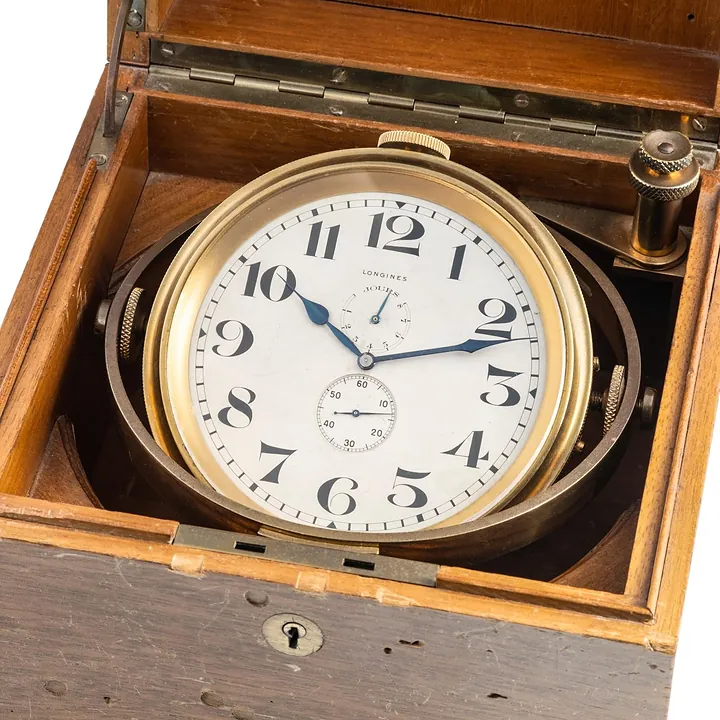
Instruments · c. 1940
Longines marine chronometer, c. 1940
Antiquorum auction archive, Geneva
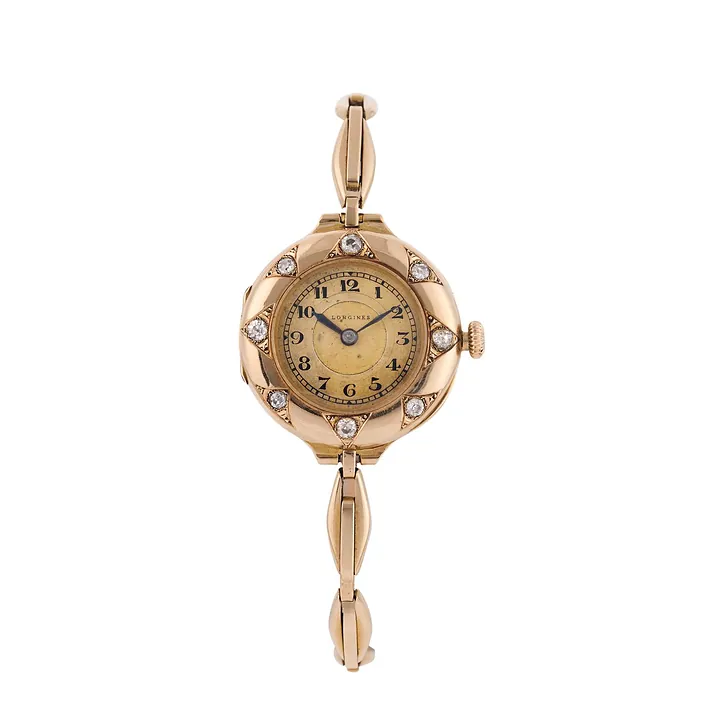
Pocket Watches · c. 1910-1920s
Longines watch, c. 1910-1920s
Antiquorum auction archive, Geneva
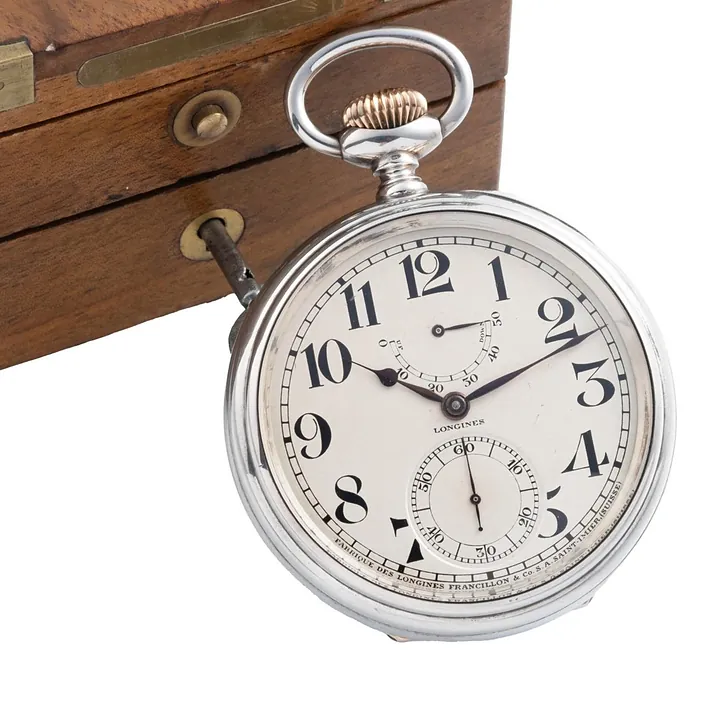
Pocket Watches · c. 1915
Longines ''torpedo-Boat Watch'', c. 1915
Antiquorum auction archive, Geneva
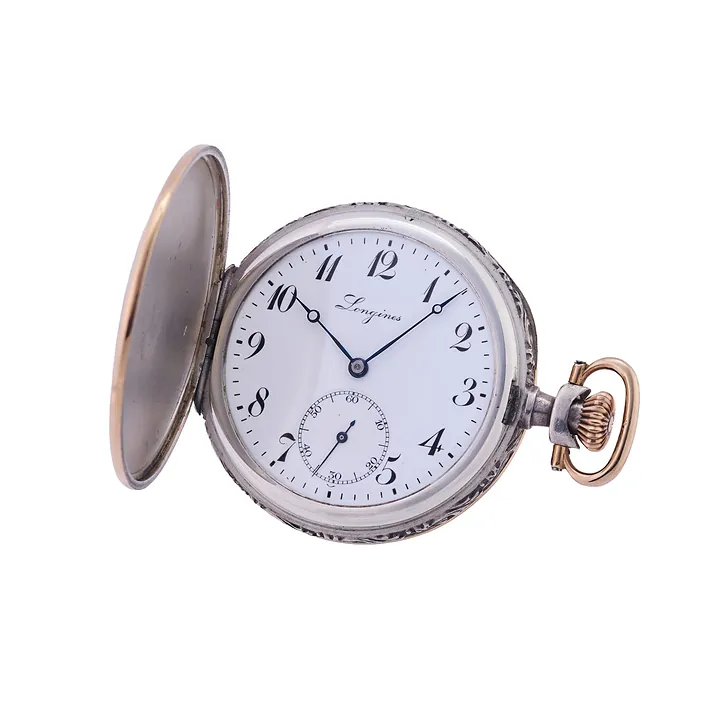
Pocket Watches · c. 1920s
Longines pocket watch, c. 1920s (Antiquorum Lot 389-59)
Antiquorum auction archive, Geneva

Wristwatches · 1945
Wristwatch by Eterna, 1945
Museum Rotterdam

Wristwatches · c. 1945
Breitling Premier, ref. 790, c. 1945
Antiquorum auction archive, Geneva

Wristwatches · c. 1945
Universal Genève Uni-Compax, ref. 22492, c. 1945
Antiquorum auction archive, Geneva

Wristwatches · c. 1950s
Baume & Mercier wristwatch, c. 1950s
Antiquorum auction archive, Geneva