
Clocks · Longcase clock
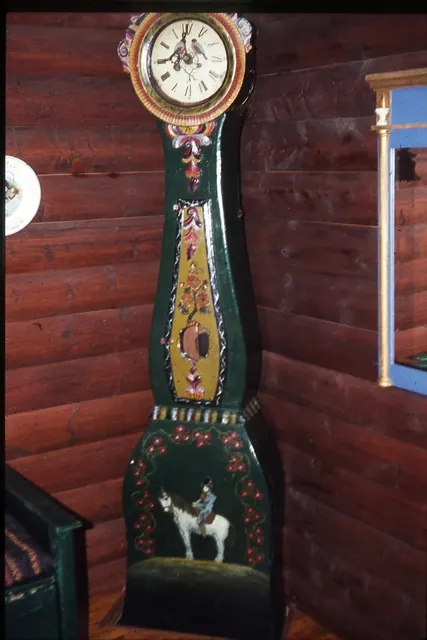
Longcase clock, Sweden, 1770–1800
- Maker / attribution
- Unrecorded in source
- Date
- 1770–1800
- Historical period
- Precision & Scientific Horology (1750 – 1850)
- Country of origin
- Sweden
- Place
- Sverige Östersund
- Object type
- Longcase clock
- Materials / technique
- Furu
- Dimensions
- Djup 20.0 cm Bredd 64.0 cm
- Holding institution
- Västernorrlands museum
- Accession / object no.
- M7112_A
- Credit line
- Västernorrlands museum
- Catalogue title (original)
- Golvur (Swedish)
View the source record ↗ (opens another website in a new tab)Suggest a correction
Record summary
Held and catalogued by Västernorrlands museum (object number M7112_A), this is a longcase clock, made in Sverige Östersund, Sweden, dated 1770–1800. The Atlas places it in the Precision & Scientific Horology period (1750 – 1850) of its Clocks collection. Materials and techniques recorded by the source: Furu. Recorded dimensions: Djup 20.0 cm Bredd 64.0 cm. The record is illustrated with 3 photographs.
Assembled from the source record's structured fields. Dates and attributions are given as the source states them; where a field is missing the Atlas leaves it blank rather than estimating.
Catalogue description
Catalogue description from Västernorrlands museum
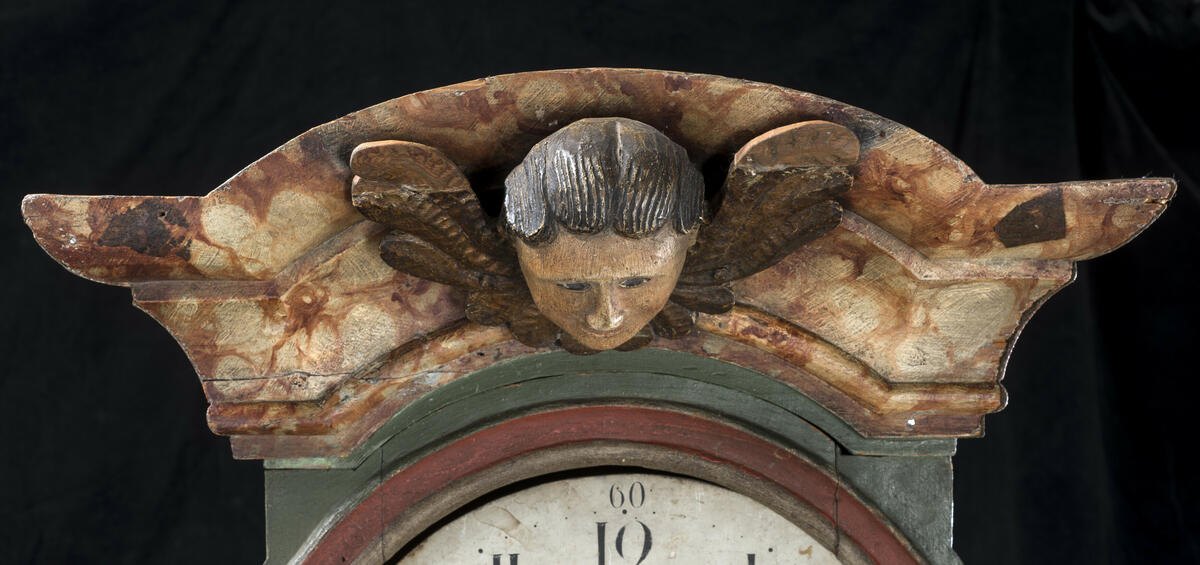
Klockfodralet består av sockel, mellandel och huv. Sockeln har en bredare nedre kantlist som är något profilerad. Sockeln avsmalnar lite i mitten men blir igen något bredare längst upp där den avslutas med mjukt avrundad kant. Sockeln är grönmålad med en svart kant längst upp. Päronformad mellandel vilar på en något utsvängd fris som är marmorerad i vitt-rött. Mellandelen i grön färg har en rikt dekorerad avlång dörr. Dekoren består av profilerade kanter i grönt och rött, målade röda och vita blommor i mittfältet samt skulpterade guldmålade blommor i mitten och en musseldekor i guldfärg vid nedre kanten. En inskription "kpd" och en otydlig datering "1846" finns målad på dörren. Mellandelen avslutas med en framskjutande och bruten gesims i brun marmorering. Huven är rund med en fyrkantig, grön ram och rund öppning för urtavlan. Den runda ramen är rödmålad. Huven är krönt med likadan gesims som under huven och dessutom försedd med ett skulpterat kvinnohuvud med ett par vingar på gesimsens mitt.
Shown in the original language of the source catalogue. An editor-reviewed English translation has not yet been published; we do not publish machine translations as authoritative text.
Historical context
Precision & Scientific Horology (1750 – 1850)
Harrison solves longitude; Mudge invents the lever; Breguet's Paris workshop defines the modern watch.
The age of the deadbeat escapement, compensated pendulums and observatory regulators. Domestic clocks spread through the middle classes: English longcase and bracket clocks, French gilt-bronze mantel clocks, Viennese Biedermeier wall clocks, Black Forest painted-shield clocks, and the first American shelf clocks.
Read the period in the timelineMore clocks from this periodEarlier: Early Modern Horology
Atlas type guide
Longcase (tall-case or grandfather) clocks
The longcase clock was born from two seventeenth-century innovations: Christiaan Huygens's pendulum (1656–57) and the anchor escapement (c. 1670). A long seconds pendulum, nearly a metre long, swings with a small arc, and enclosing it together with the driving weights in a tall wooden case protected the mechanism and created a new piece of furniture. London makers such as Ahasuerus Fromanteel, Thomas Tompion and Joseph Knibb set the pattern.
By the eighteenth century longcase clocks were made throughout Britain, the Netherlands, Scandinavia (the Swedish Mora clock), France (the Comtoise from the Franche-Comté), Germany and colonial America. Eight-day movements with two weights became standard in better clocks; thirty-hour clocks with one weight and a rope or chain were cheaper alternatives.
What to look for
- Winding holes in the dial: two (eight-day, going and striking) or none (thirty-hour, pulled up by a chain).
- Brass dials with applied chapter rings (earlier) versus painted iron 'white' dials (after c. 1770 in Britain).
- Moon-phase arches, date apertures, seconds dials and maker's name on the dial.
- Case woods and style: ebonised, walnut marquetry, lacquer, oak or mahogany; regional styles from London, Lancashire, Scotland or America.
- Whether the movement and dial match the case — 'marriages' are common.
Dating clues
- Square brass dials suggest c. 1670–1720; arched brass dials c. 1715–1790.
- Painted (white) dials were made by Birmingham dial-makers from about 1772.
- Comtoise clocks with repoussé pendulums are mostly nineteenth century.
General guidance written by the Atlas editors about this kind of object. It is not a statement about this particular piece; for that, rely on the source record above and on physical examination.
Read next:Anchor (recoil) escapementDeadbeat escapementAnchor escapement
Related records
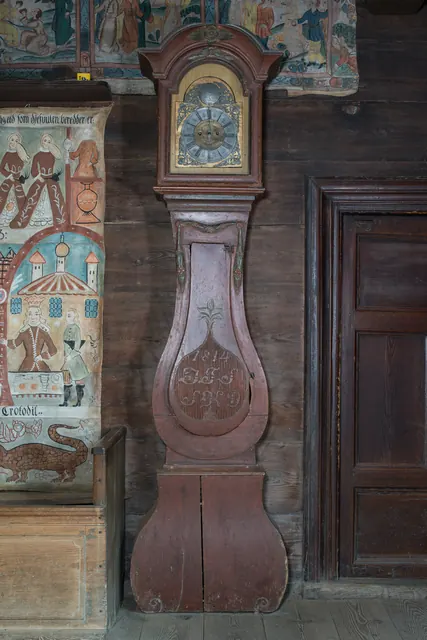
Clocks · 1814
Clock by Ola Svensson, Sweden, 1814
Skansen
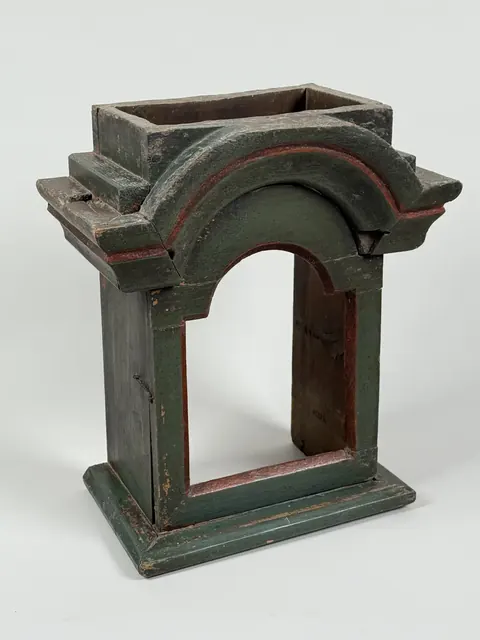
Clocks · 1833
Clock, Sweden, 1833
Skansen
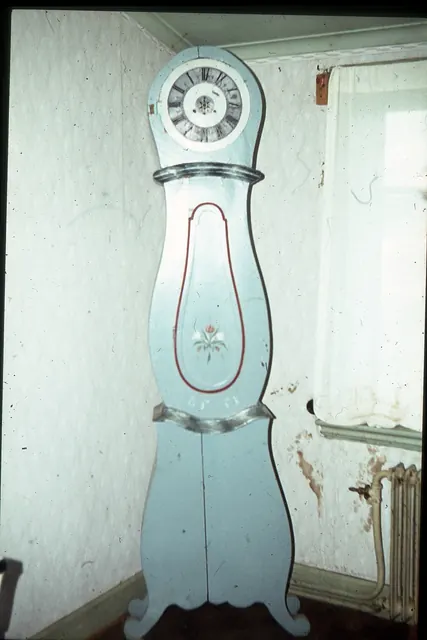
Clocks · 1775
Longcase clock, Sweden, 1775
National Association of Swedish Handicraft Societies
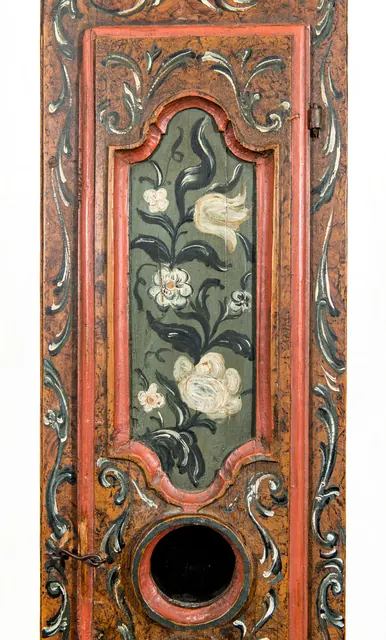
Clocks · 1772
Longcase clock, Sweden, 1772
Skelleftea museum
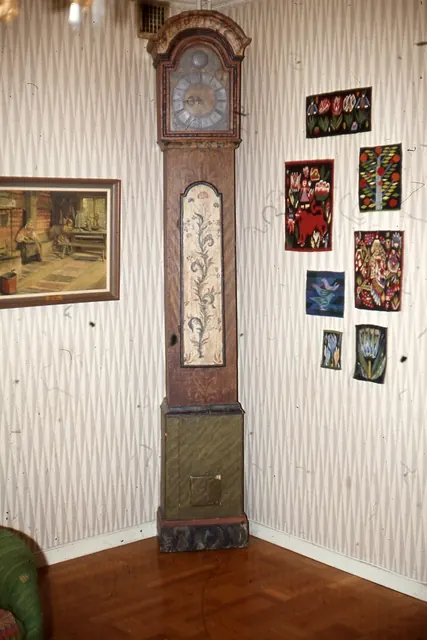
Clocks · 1775
Longcase clock, Sweden, 1775
National Association of Swedish Handicraft Societies
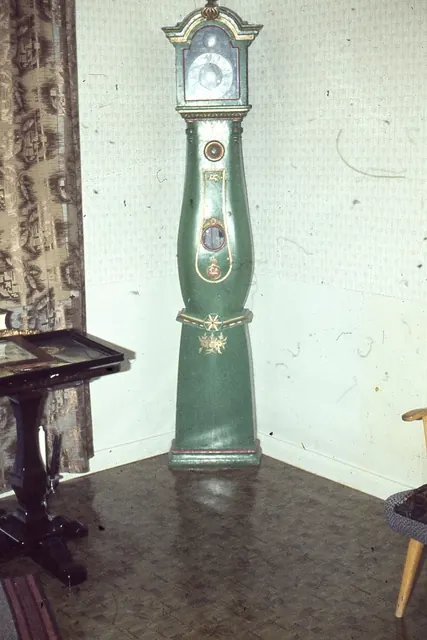
Clocks · 1799
Longcase clock, Sweden, 1799
National Association of Swedish Handicraft Societies
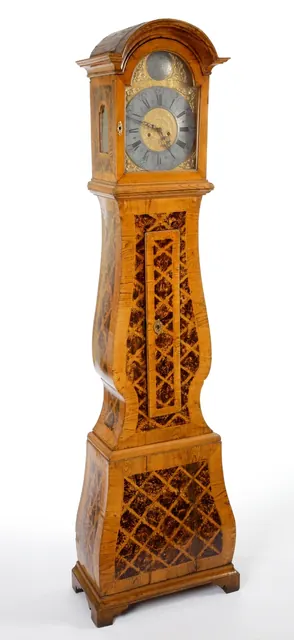
Clocks · 1766
Longcase clock by Sven Fogelberg, Sweden, 1766
Kulturparken Småland
Clocks · 1761
Longcase clock, Sweden, 1761
National Association of Swedish Handicraft Societies