
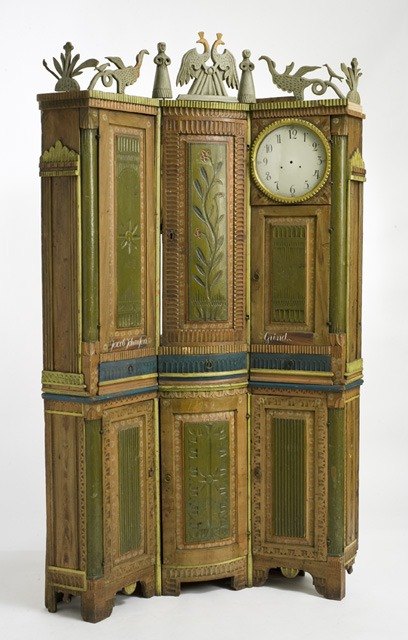
Clocks · Longcase clock
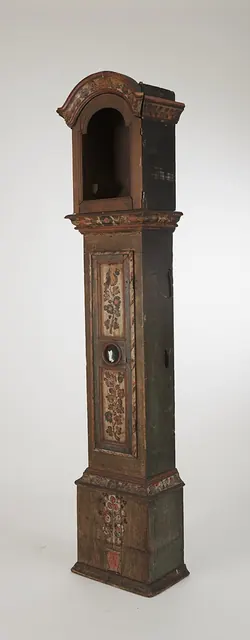
Longcase clock, Finland, 1852, 1800s
- Maker / attribution
- Unrecorded in source
- Date
- 1852, 1800s
- Historical period
- Precision & Scientific Horology (1750 – 1850)
- Country of origin
- Finland
- Place
- Vöyri, Ostrobothnia
- Object type
- Longcase clock
- Materials / technique
- wood, saranat, renkaat, lukko, metal
- Dimensions
- width: 127 cm; depth: 87 cm; height: 188 cm
- Holding institution
- Suomen kansallismuseo
- Accession / object no.
- KB105
- Credit line
- Suomen kansallismuseo (via Finna)
- Catalogue title (original)
- kaappi; kaappikello; huonekalu (Finnish)
View the source record ↗ (opens another website in a new tab)Suggest a correction
Record summary
Held and catalogued by Suomen kansallismuseo (object number KB105), this is a longcase clock, made in Vöyri, Ostrobothnia, Finland, dated 1852, 1800s. The Atlas places it in the Precision & Scientific Horology period (1750 – 1850) of its Clocks collection. Materials and techniques recorded by the source: wood, saranat, renkaat, lukko, metal. Recorded dimensions: width: 127 cm; depth: 87 cm; height: 188 cm. The record is illustrated with 6 photographs.
Assembled from the source record's structured fields. Dates and attributions are given as the source states them; where a field is missing the Atlas leaves it blank rather than estimating.
Catalogue description
Description — Suomen kansallismuseo
fyysinen kuvaus: Kaksikerroksinen, kolmiosainen kulmakaappi, jonka yläosan oikea puoli muodostaa kellokaapin. Kaappi on kauttaaltaan leikkauskoristeltu. Keskimmäisen oven peilissä oleva koriste kuvaa ruukussa kasvavaa kukkaa. Muiden ovien peileissä on kukka- ja pystyurakoristeita. Peilin kehykset ovat oranssinpunaiset ja niihin on sabluunalla painettu valkoisia kukan kuvia. Peilien keskusta on vaaleanvihreä. Myös kaapin kaikki kulmat on leikkauskoristeltu. Pystyurien lisäksi leikkauskoristeena esiintyy sauva- ja akantuksenlehtisarjan tyyppistä koristelua. Kaapin keskellä on kolme vetolaatikkoa rinnakkain. Laatikot on maalattu siniseksi. Osa kaapin koristeista on maalattu keltaiseksi. Kaapin päällä on useita puuveistoksia. Keskellä on vastakkain kaksi riikinkukkoa muistuttavaa lintua. Niiden molemmin puolin on kädet puuskassa olevat naishahmot. Seuraavina ovat lohikäärmeitä muistuttavat siivelliset hahmot, joiden hännän päällä istuu pienemmät linnut. Reunimmaisina on kasviaiheiset veistokset. Koristekuviot on maalattu vihreän ja keltaisen sävyillä, muutoin kaappi on ruskeaksi maalattu. Laatikossa ja kaapeissa on metallivetimet. Kellokaapissa on kellotaulu mutta ei viisareita, eikä kellokoneistoa. Kaapin yläovien alareunaan on maalattu teksti 1852 Jacob Johanson Grind. Koristelu: puuleikkaus ja maalauskoristelua
Shown in the original language of the source catalogue. An editor-reviewed English translation has not yet been published; we do not publish machine translations as authoritative text.
Inscriptions & marks
merkintä: 1852 Jacob Johanson Grind, yläovien alareunssa
Historical context
Precision & Scientific Horology (1750 – 1850)
Harrison solves longitude; Mudge invents the lever; Breguet's Paris workshop defines the modern watch.
The age of the deadbeat escapement, compensated pendulums and observatory regulators. Domestic clocks spread through the middle classes: English longcase and bracket clocks, French gilt-bronze mantel clocks, Viennese Biedermeier wall clocks, Black Forest painted-shield clocks, and the first American shelf clocks.
Read the period in the timelineMore clocks from this periodEarlier: Early Modern Horology
Atlas type guide
Longcase (tall-case or grandfather) clocks
The longcase clock was born from two seventeenth-century innovations: Christiaan Huygens's pendulum (1656–57) and the anchor escapement (c. 1670). A long seconds pendulum, nearly a metre long, swings with a small arc, and enclosing it together with the driving weights in a tall wooden case protected the mechanism and created a new piece of furniture. London makers such as Ahasuerus Fromanteel, Thomas Tompion and Joseph Knibb set the pattern.
By the eighteenth century longcase clocks were made throughout Britain, the Netherlands, Scandinavia (the Swedish Mora clock), France (the Comtoise from the Franche-Comté), Germany and colonial America. Eight-day movements with two weights became standard in better clocks; thirty-hour clocks with one weight and a rope or chain were cheaper alternatives.
What to look for
- Winding holes in the dial: two (eight-day, going and striking) or none (thirty-hour, pulled up by a chain).
- Brass dials with applied chapter rings (earlier) versus painted iron 'white' dials (after c. 1770 in Britain).
- Moon-phase arches, date apertures, seconds dials and maker's name on the dial.
- Case woods and style: ebonised, walnut marquetry, lacquer, oak or mahogany; regional styles from London, Lancashire, Scotland or America.
- Whether the movement and dial match the case — 'marriages' are common.
Dating clues
- Square brass dials suggest c. 1670–1720; arched brass dials c. 1715–1790.
- Painted (white) dials were made by Birmingham dial-makers from about 1772.
- Comtoise clocks with repoussé pendulums are mostly nineteenth century.
General guidance written by the Atlas editors about this kind of object. It is not a statement about this particular piece; for that, rely on the source record above and on physical examination.
Read next:Anchor (recoil) escapementDeadbeat escapementAnchor escapement
Related records
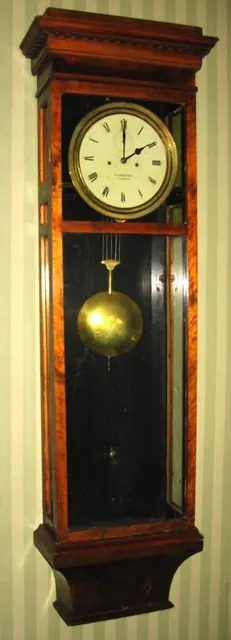
Clocks · 1842–1849
Wall clock by Niclas Lagerstrand, Finland, 1842–1849
HKM / Kulttuurihistoriallinen
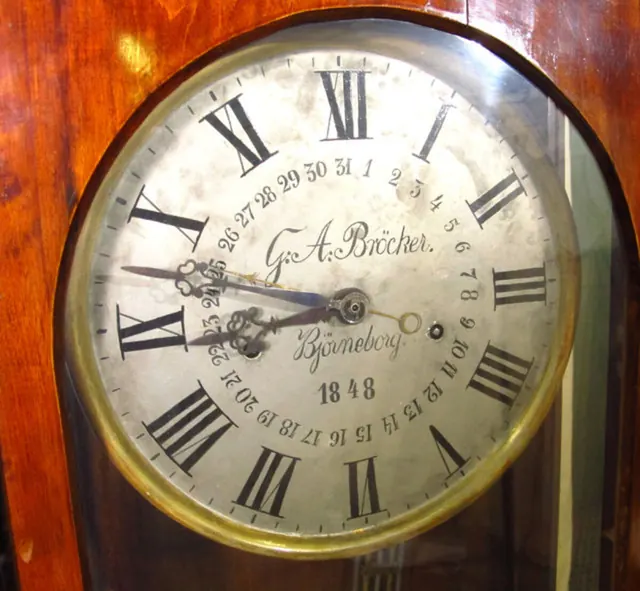
Clocks · 1848
Wall clock by G.A. Bröcker, Finland, 1848
Satakunnan Museo
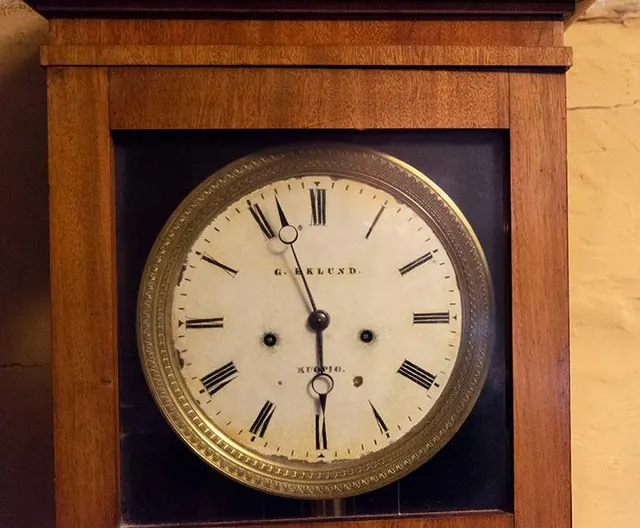
Clocks · 02.11.1835-18.12.1861, 1835-1861
Clock by Gustaf Eklund, Finland, 02.11.1835-18.12.1861, 1835-1861
Kuopion kulttuurihistoriallinen museo
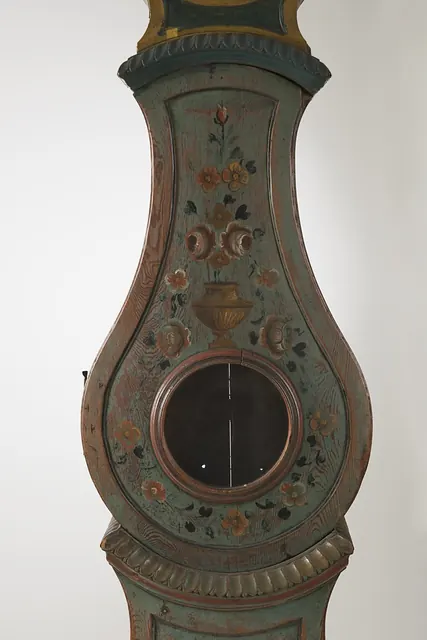
Clocks · 1797–1841
Longcase clock, Finland, 1797–1841
Suomen kansallismuseo
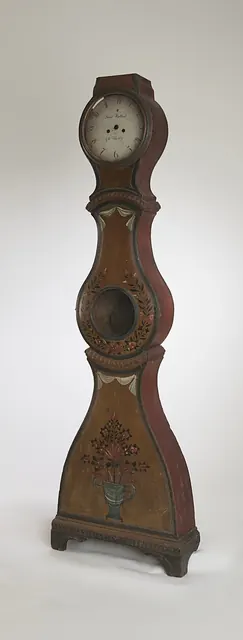
Clocks · 1848, 1800s
Longcase clock by Daniel Hallback, Finland, 1848, 1800s
Suomen kansallismuseo
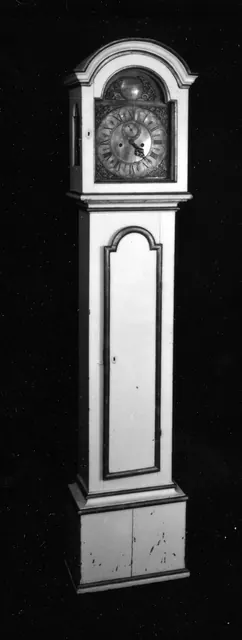
Clocks · mid-1700s
Longcase clock by Wrigstadius (Wrigstedt), Johan, Finland, mid-1700s
Suomen kansallismuseo
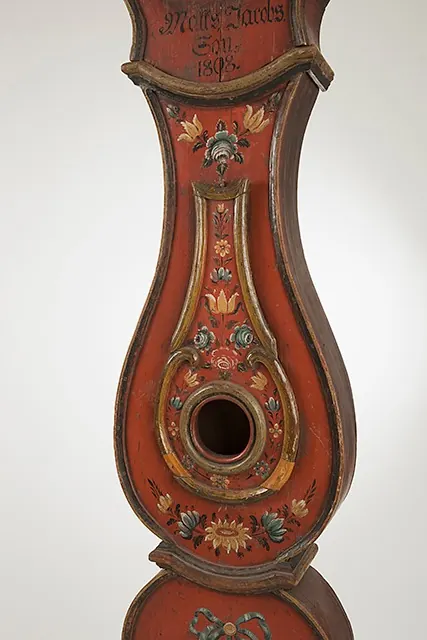
Clocks · 1808, 1800s
Longcase clock, Finland, 1808, 1800s
Suomen kansallismuseo
Clocks · 1800-1824, 1800s
Longcase clock, Finland, 1800-1824, 1800s
Suomen kansallismuseo