
Wristwatches · Wristwatch
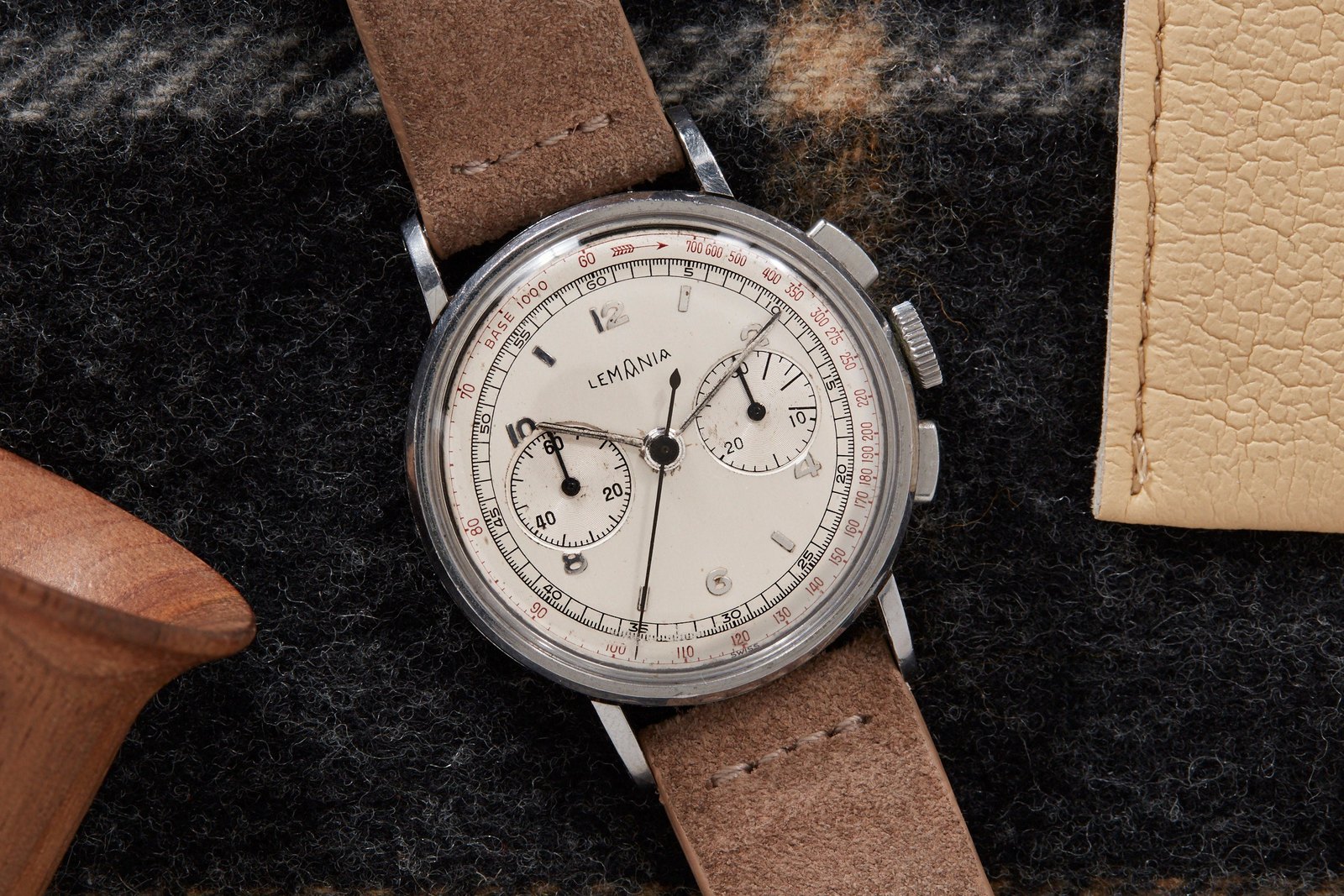
Lemania Dual Register Chronograph, 1950s
- Maker / attribution
- Lemania (maker)
- Date
- 1950s
- Historical period
- Modern Mechanical Horology (1945 – 1969)
- Country of origin
- Switzerland
- Object type
- Wristwatch
- Dimensions
- Case 34 mm
- Stock no.
- Product 454770655262
- Credit line
- Dealer listing, Analog/Shift (product 454770655262)
- Catalogue title (original)
- Lemania Dual Register Chronograph (English)
View the source record (dealer listing) ↗ (opens another website in a new tab)Suggest a correction
Record summary
Catalogued by Analog/Shift (dealer), New York (stock number Product 454770655262), this is a wristwatch by Lemania, made in Switzerland, dated 1950s. The Atlas places it in the Modern Mechanical Horology period (1945 – 1969) of its Wristwatches collection. Recorded dimensions: Case 34 mm. The record is illustrated with 6 photographs.
Assembled from the source record's structured fields. Dates and attributions are given as the source states them; where a field is missing the Atlas leaves it blank rather than estimating.
Catalogue description
Dealer description — Analog/Shift
The moon landing of 1969 was without question one of the most monumental achievements in human history, and the men who first stepped foot on the Sea of Tranquility have entered the pantheon of heroes. But Neil Armstrong and Buzz Aldrin did not fly to the Moon, Icarus-like, on their own power. They were brought there by a rocket: Saturn V, a liquid-fueled, three-stage, super heavy-lift launch vehicle that was the astronauts’ ferry to the stars. In sheer size and scope, the Saturn V—at 363 feet in height, 33 feet wide, and over 6.5 million pounds in mass—was absolutely gargantuan, with most of that mass consisting of RP-1 fuel that generated over 7.6 million pounds of thrust at launch. In the Command Service Module, the Apollo Guidance Computer—masterminded by some of the brightest minds in the world—was one of the most sophisticated computers made at the time, and was used by the astronauts for communication and navigation. And yet Saturn V and the AGS, as complex as they were, were not the only machines instrumental in bringing man to the Moon. Each astronaut had another little machine, strapped to his wrist, that would prove indispensable: the Omega Speedmaster. However small, however humble, the Speedmaster worked when other machines failed. When the electronic timer in Apollo 11 malfunctioned, or when an explosion in the oxygen tank on Apollo 13 forced the astronauts to power down all equipment in the Command Module, the Speedmaster ticked on. Neil Armstrong’s, left in the Lunar Module, marked time as he and Buzz Aldrin took their first historic steps on the lunar surface. In Apollo 13, Jim Lovell and Jack Swigert—without the aid of computers—used theirs to make the precise calculations that enabled them to get home. The Speedmaster itself was powered by the Omega Calibre .321, which first saw life as the Lemania CH27—the same movement that beats inside this watch. Designed by Albert Piguet in the 1940s, the CH27 was itself—like the Saturn V and the AGS—a marvel of technical precision. It was the smallest chronograph movement available at the time, no mean feat considering what went into its construction. In addition to a column wheel, the movement encompassed Incabloc shock protection, an antimagnetic balance spring, and had a power reserve of over 46 hours. Although Lemania loaned out the CH27 to other manufactures, Lemania also retained it for use in its own self-branded chronographs. This particular example dates from the 1950s. With its compact 34mm stainless steel case and elegant dial and hands, it illustrates the versatility of this movement. For sheer historic impact, the CH27—with its connection to the Speedmaster—is not easily surpassed by any other calibre. However, versions retailed by Omega—particularly early “pre-Moon” Speedmasters—command a heavy premium on the vintage watch market. For the collector who wishes to make a space for a CH27 in his watch box, this watch is the perfect opportunity.
Historical context
Modern Mechanical Horology (1945 – 1969)
Tool watches for divers, pilots and astronauts; electric watches anticipate the electronic age.
The classic era of the mechanical wristwatch: dive watches, chronographs for motor racing and space flight, GMT watches for jet travel, slim dress watches, automatic calendars, and the rise of Japanese manufacturers alongside Swiss, American, German and Soviet industries.
Read the period in the timelineMore wristwatches from this periodEarlier: Golden Age of Mechanical Watchmaking
Atlas type guide
Chronographs and split-seconds watches
A chronograph is a watch with an additional seconds hand that can be started, stopped and returned to zero independently of the timekeeping. Louis Moinet built an early example in 1816 and Nicolas Rieussec a recording 'chronographe' in 1821; Adolphe Nicole's heart-shaped reset cam (patented 1862) made the modern return-to-zero possible. Split-seconds (rattrapante) chronographs add a second hand that can be stopped for intermediate times; flyback chronographs restart instantly.
Chronographs were essential tools for doctors (pulsometer scales), artillery (telemeter), engineers and sport. In wristwatches, Valjoux, Venus, Lemania and later the automatic chronographs of 1969 (Zenith El Primero, the Chronomatic Calibre 11 group and Seiko 6139) are milestones.
What to look for
- Push-pieces on the case band or a single button in the crown (monopusher).
- Subsidiary registers for minutes and hours; tachymeter, telemeter or pulsometer scales.
- Column wheel versus cam control visible in the movement.
- Calibre markings of specialist makers (Valjoux, Lemania, Venus, Landeron).
Dating clues
- Pocket chronographs with heart cam reset: after 1862.
- Wrist chronographs: from c. 1910; two-button designs from the 1930s.
- Automatic chronographs: from 1969.
General guidance written by the Atlas editors about this kind of object. It is not a statement about this particular piece; for that, rely on the source record above and on physical examination.
Read next:Flyback chronographChronograph
Related records
Instruments · 1950–1970
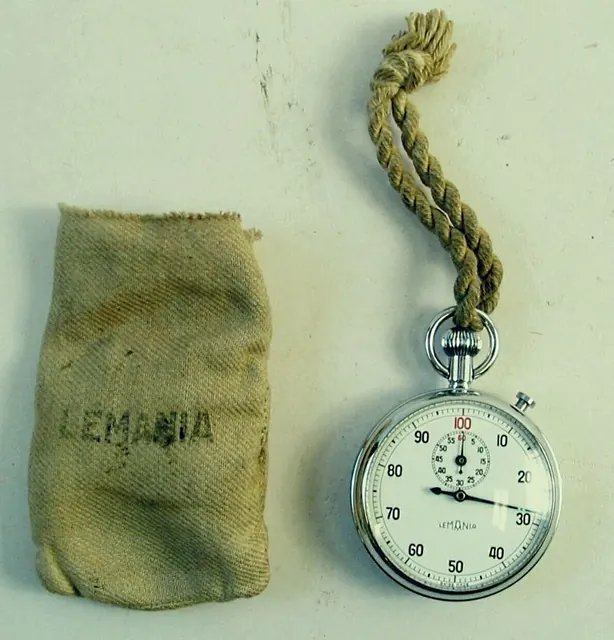
Stopwatch by Lemania, Switzerland, 1950–1970
Museokeskus Vapriikki
Wristwatches · c. 1970s
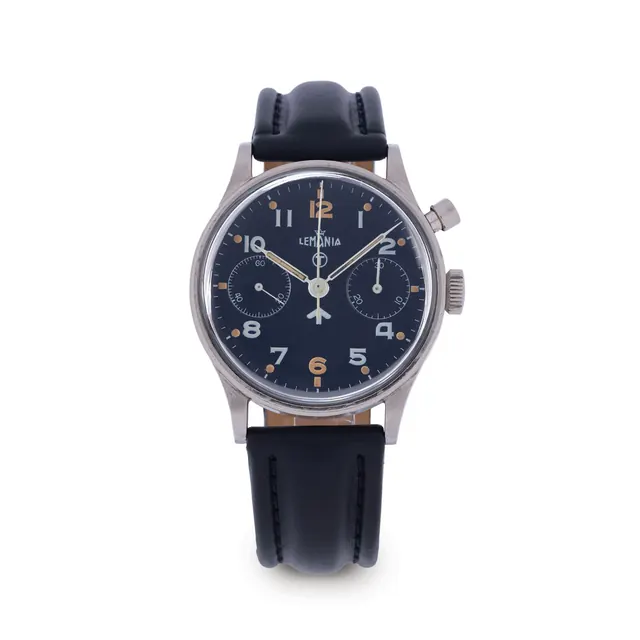
Lemania wristwatch, Series 2 Monopusher Chronograph, circa 1970s
Antiquorum auction archive, Geneva
Wristwatches · c. 1960s-1980s
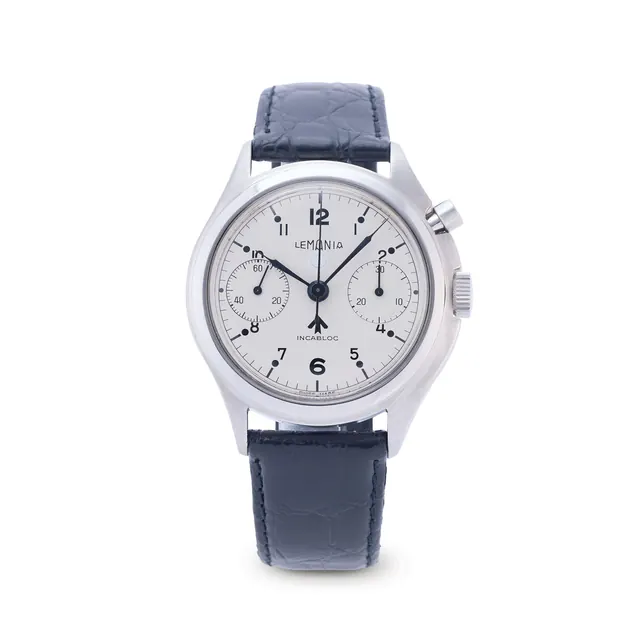
Lemania wristwatch, ref. 35-64, Series 3 Monopusher Chronograph, circa 1960s-1980s
Antiquorum auction archive, Geneva
Pocket Watches · c. 1940
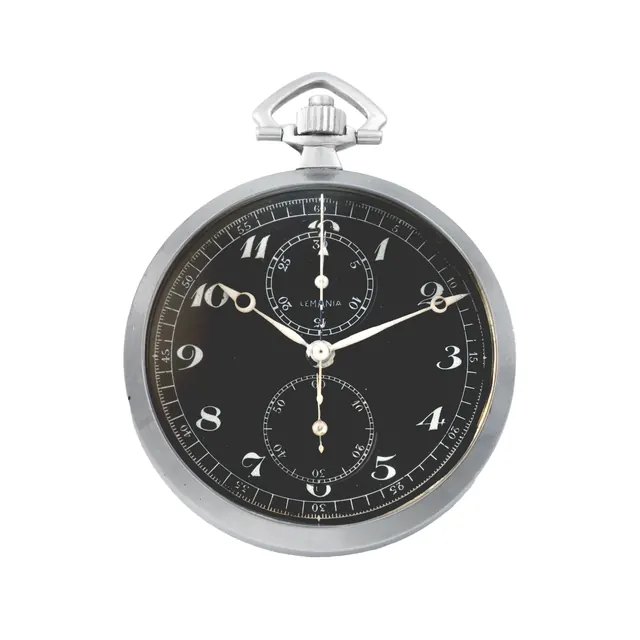
Lemania pocket watch, Single Button Chronograph, circa 1940
Antiquorum auction archive, Geneva

Wristwatches · 1945
Wristwatch by Eterna, 1945
Museum Rotterdam

Wristwatches · c. 1945
Breitling Premier, ref. 790, c. 1945
Antiquorum auction archive, Geneva

Wristwatches · c. 1945
Universal Genève Uni-Compax, ref. 22492, c. 1945
Antiquorum auction archive, Geneva

Wristwatches · c. 1950s
Baume & Mercier wristwatch, c. 1950s
Antiquorum auction archive, Geneva