
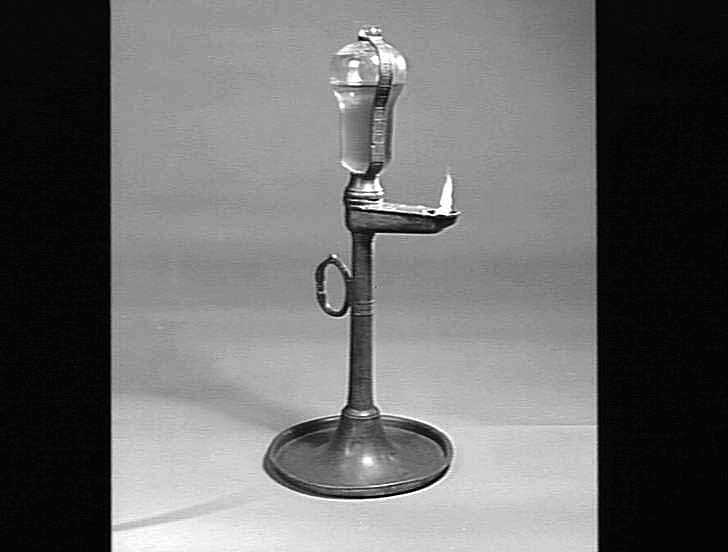
Clocks · Lamp clock
Lamp Clock - Germany, c. 1800
- Maker / attribution
- Unrecorded in source
- Date
- c. 1800
- Historical period
- Precision & Scientific Horology (1750 – 1850)
- Country of origin
- Germany
- Object type
- Lamp clock
- Dimensions
- 35 cm (Height), 15 cm (Outside Diameter)
- Holding institution
- Museums Victoria, Melbourne
- Accession / object no.
- ST 19113
- Catalogue title (original)
- Lamp Clock - Germany, circa 1800 (English)
View the source record ↗ (opens another website in a new tab)Suggest a correction
Record summary
Held and catalogued by Museums Victoria, Melbourne (object number ST 19113), this is a lamp clock, made in Germany, dated c. 1800. The Atlas places it in the Precision & Scientific Horology period (1750 – 1850) of its Clocks collection. Recorded dimensions: 35 cm (Height), 15 cm (Outside Diameter). The record is illustrated with 1 photograph.
Assembled from the source record's structured fields. Dates and attributions are given as the source states them; where a field is missing the Atlas leaves it blank rather than estimating.
Catalogue description
Summary — Museums Victoria
Lamp clock, Germany, circa 1800. Glass bowl on pewter stem above circular base. Oil drains to wick in horizontal spout. Thin pewter strip over glass calibrated 7 to 12, 1 to 6. The shape of the glass is designed to give a constant flow of oil by compensating for changes of depth.
Inscriptions & marks
Inside cover of spout marked 'Weyoan, C.'
Provenance
Loan & Subsequent Bequest from Mr John Askew, 29 May 1930
Historical context
Precision & Scientific Horology (1750 – 1850)
Harrison solves longitude; Mudge invents the lever; Breguet's Paris workshop defines the modern watch.
The age of the deadbeat escapement, compensated pendulums and observatory regulators. Domestic clocks spread through the middle classes: English longcase and bracket clocks, French gilt-bronze mantel clocks, Viennese Biedermeier wall clocks, Black Forest painted-shield clocks, and the first American shelf clocks.
Read the period in the timelineMore clocks from this periodEarlier: Early Modern Horology
Atlas type guide
Water, fire and incense clocks
Before the mechanical clock, intervals and hours were measured by flow and combustion. Outflow and inflow water clocks were used in Egypt, Mesopotamia, Greece, China and the Islamic world; Chinese and Japanese incense clocks burned powdered incense along a maze-like path; oil-lamp clocks with graduated glass reservoirs were popular in German-speaking Europe in the seventeenth and eighteenth centuries.
These timekeepers needed constant correction and could not keep the hour automatically for long periods, but they underpinned temple ritual, legal procedure, astronomy and the earliest monumental astronomical clocks such as Su Song's clock tower (1090s) and al-Jazari's designs (1206).
What to look for
- Graduated vessels or glass reservoirs with hour scales.
- Incense trays with stencils for laying the powder trail.
- Pewter oil-lamp clocks with a glass reservoir marked in Roman numerals.
Dating clues
- Oil-lamp clocks are mostly eighteenth century and often reproduced later.
- Incense clocks were made in China and Japan into the twentieth century.
General guidance written by the Atlas editors about this kind of object. It is not a statement about this particular piece; for that, rely on the source record above and on physical examination.
Read next:Su Song's astronomical clock tower
Related records
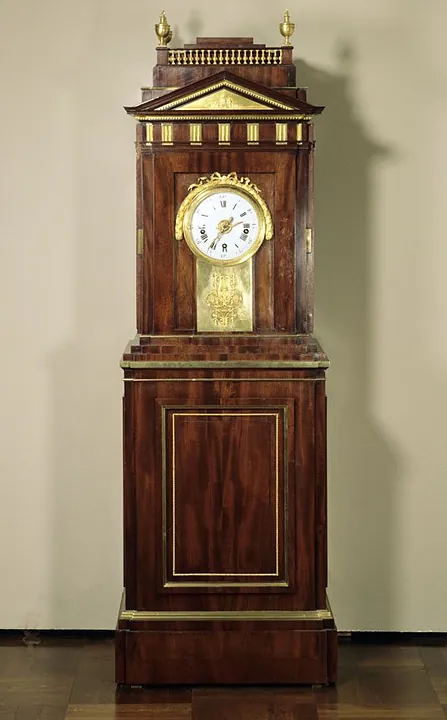
Clocks · 1780s (inferred: the museum dates the style to the 1780s and the music includes Gluck's Iphigénie en Tauride of 1779)
Musical longcase clock, Roentgen workshop, Neuwied, 1780s
Badisches Landesmuseum Karlsruhe
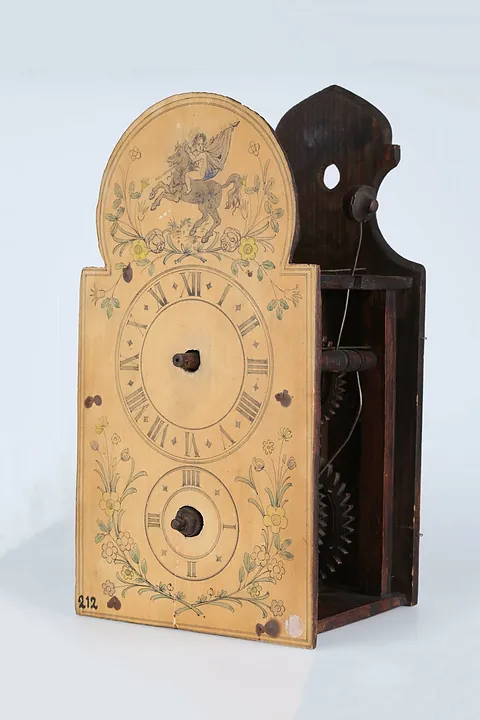
Clocks · c. 1750
Clock by Georg Gfell, Germany, c. 1750
German Clock Museum
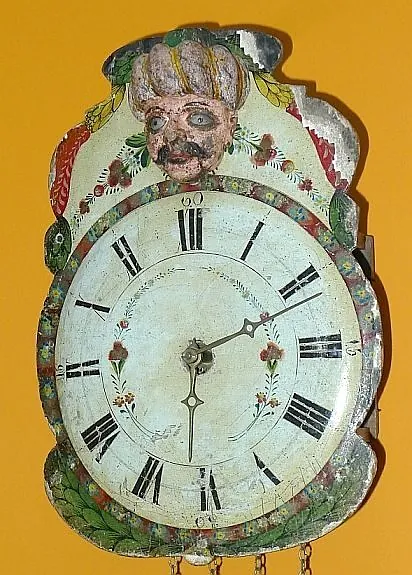
Clocks · 1750–1799
Cuckoo / black forest clock, Germany, 1750–1799
Badisches Landesmuseum Karlsruhe
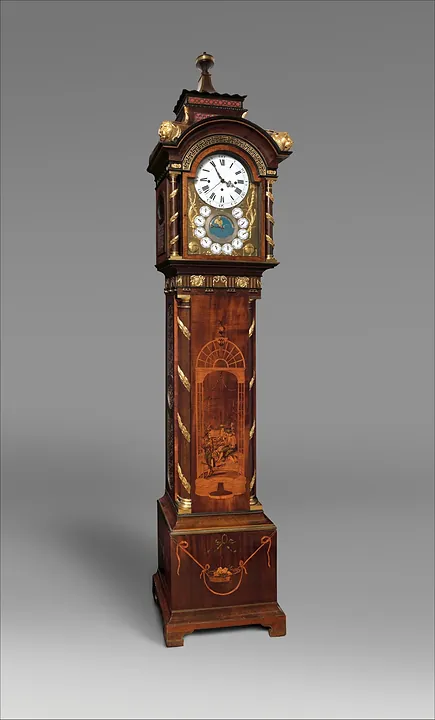
Clocks · c. 1774–75
Longcase clock by Hermann Achenbach, Germany, c. 1774–75
The Metropolitan Museum of Art, New York
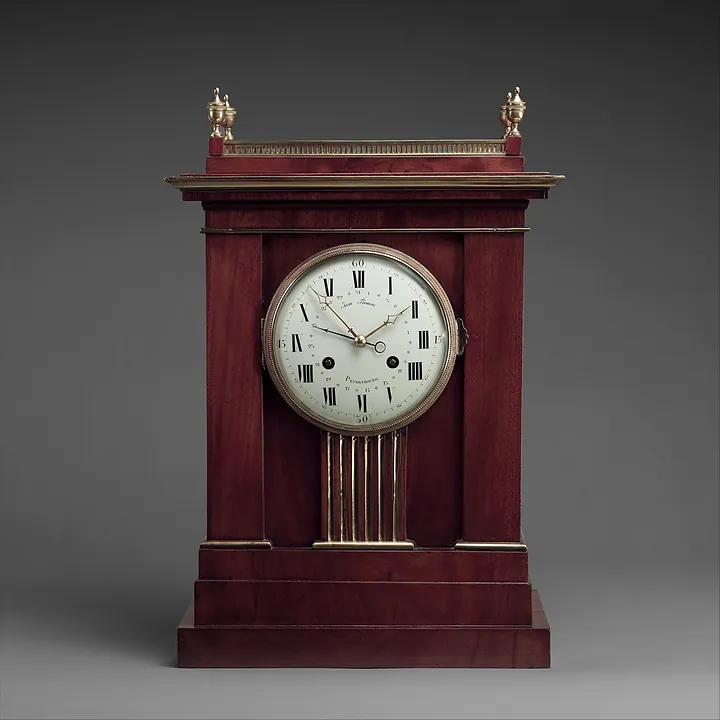
Clocks · c. 1780–90
Clock, workshop of David Roentgen, Germany, c. 1780–90
The Metropolitan Museum of Art, New York
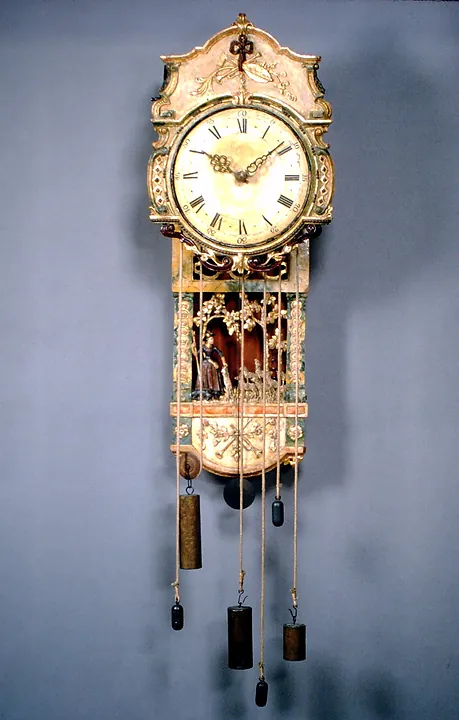
Clocks · c. 1800
Musical clock by Martin Vanlo?, Germany, c. 1800
The Metropolitan Museum of Art, New York
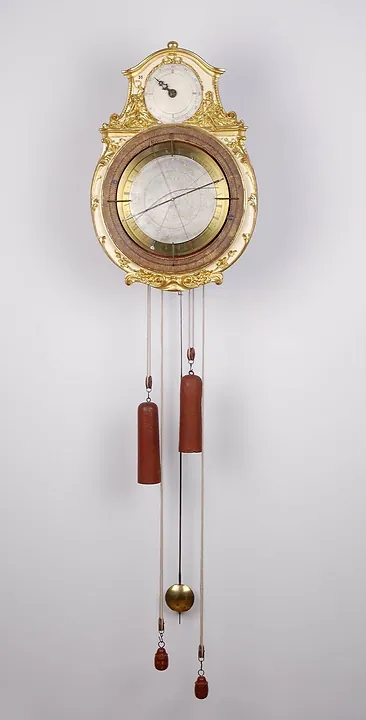
Clocks · 1787
Astronomical clock, Germany, 1787
German Clock Museum
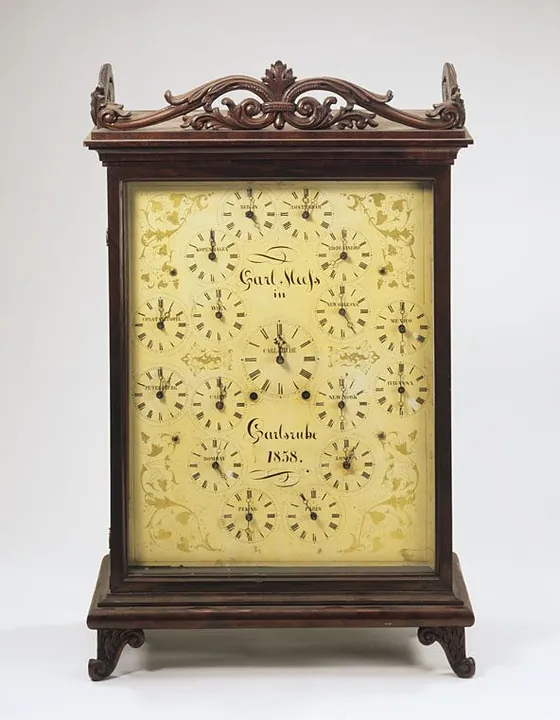
Clocks · 1800–1899
Clock by Carl Meeß, Germany, 1800–1899
Badisches Landesmuseum Karlsruhe