
Wristwatches · Wristwatch
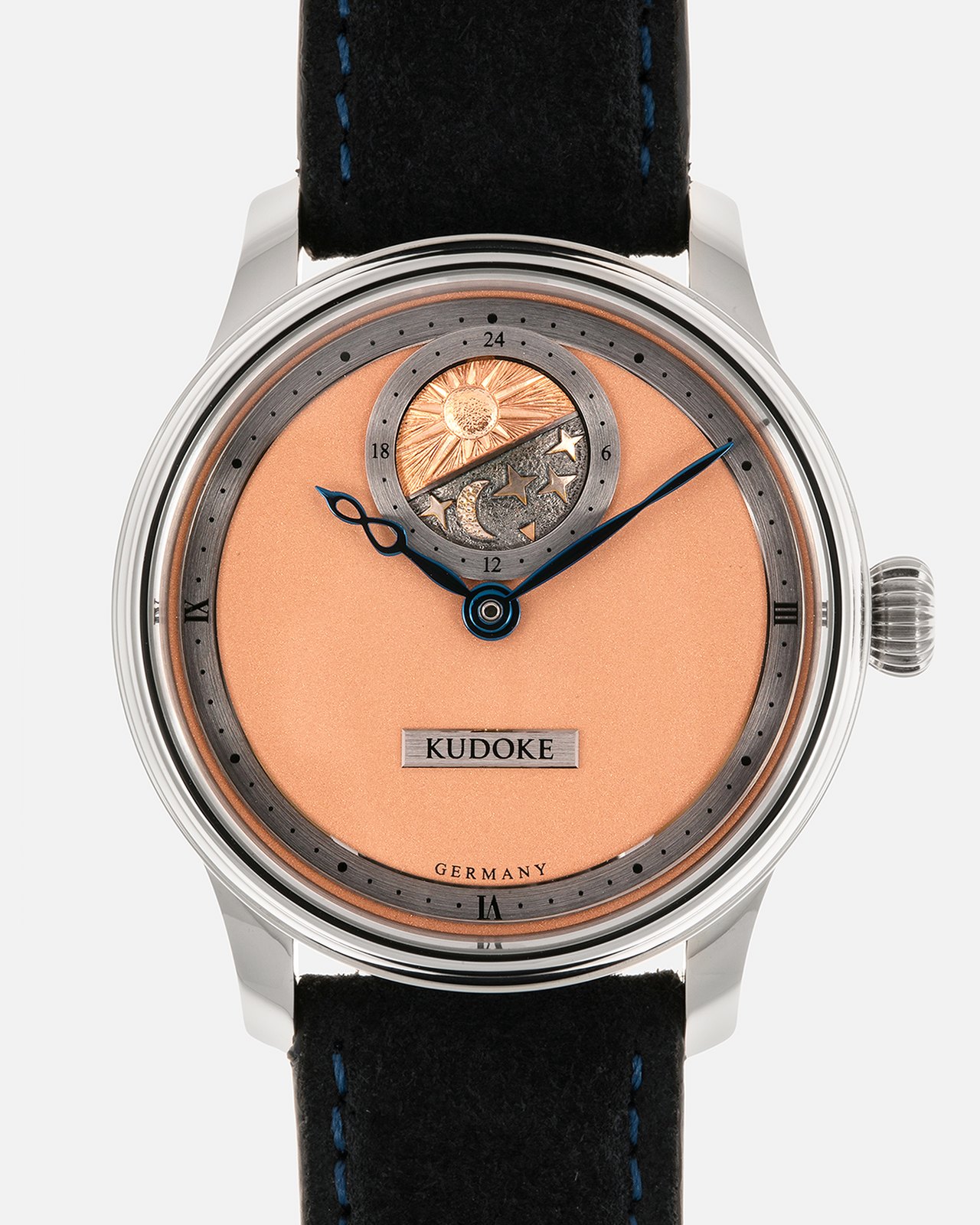
Kudoke K2 Salmon Engraved Movement, 2022
- Maker / attribution
- Kudoke (maker)
- Date
- 2022
- Historical period
- Contemporary Horology (2010 – Present)
- Country of origin
- Unrecorded in source
- Object type
- Wristwatch
- Dimensions
- Case 39 mm
- Stock no.
- Product 7433056354391
- Credit line
- Dealer listing, S.Song Watches (product 7433056354391)
- Catalogue title (original)
- Kudoke K2 Salmon Engraved Movement (English)
View the source record (dealer listing) ↗ (opens another website in a new tab)Suggest a correction
Record summary
Catalogued by S.Song Watches (dealer), Seattle (stock number Product 7433056354391), this is a wristwatch by Kudoke, dated 2022. The Atlas places it in the Contemporary Horology period (2010 – Present) of its Wristwatches collection. Recorded dimensions: Case 39 mm. The record is illustrated with 6 photographs.
Assembled from the source record's structured fields. Dates and attributions are given as the source states them; where a field is missing the Atlas leaves it blank rather than estimating.
Catalogue description
Dealer description — S.Song Watches
In this wonderful world of watchmaking, timepieces made by manufactures or brands from different worldly regions often exhibit and project specific traits on their respective horological creations. For instance, when I think about German watches, they tend to have the innate tendency to display information with stereotypical efficiency, without any hindrance or inhibiting elements on the dial. Hailing from the capital city of Dresden, German watchmaker Stefan Kudoke began his watchmaking journey at a very young age. Prior to setting up his eponymous brand in 2008, he had several stints at Glashütte Original, Blancpain, Omega, Jaquet Droz, and Breguet. During the early days of Kudoke, Stefan greatly emphasised the brand’s German heritage and origin despite using only Unitas calibres at the time. In the years that followed, Stefan eventually went on and produced his very own first in-house movement, the Kaliber 1, which is also the beating heart of the timepiece that we have on offer here today—the Kudoke K2. For those who are unaware, the Kudoke K2 recently triumphed over fierce competition to win one of the watch industry’s most coveted awards—the Petit Aiguille prize at the 2019 GPHG ceremony. The first time I held the Kudoke 2 in my hands, I was immediately struck by how gorgeous and captivating it actually is in person. While it may appear simple at first glance, a closer look at its vibrant salmon dial reveals a masterful blend of technical sophistication, design restraint, and artistic expression. The lightly frosted finish on the dial allows it to subtly interact with different lighting conditions, creating a mesmerising visual effect. In my view, the execution on all levels shown here on the dial of the Kudoke 2 is nothing short of exceptional. That said, the focal point here is the beautiful domed disc located at the 12:00 position. It is hand-engraved, galvanised in gold, black, and white rhodium, and rotates in a 24-hour cycle which poetically depicts the sun, the moon, and stars as well as the day or the night. You will also find a tastefully discreet golden arrow that indicates the time of the day. The chapter rings surrounding the disc and the dial are both rhodiumised as well, and lend a much-needed visual contrast to the watch as a whole. The steel hour and minute hands here are thermally blued and feature a Kudoke Handwerk signature ‘infinity’ motif, which is a nice touch to such a simple yet elegant dial. As far as case size goes, the polished stainless steel case of the Kudoke 2 measures 39mm x 10.7mm, which I find quite appealing and appropriate for modern wrist sizes. Turn the watch over and you will find the magnificent hand-wound Kaliber 1-24H greeting you in all of its glory beneath the exhibition case back. What makes this movement especially fascinating is its inspiration: early English pocket watch calibres from the 17th century. This influence is most evident in the elongated balance cock, a signature feature that adds a distinct old-world charm. Further elevating the movement is the exquisite hand-engraving that adorns nearly every visible surface—a level of craftsmanship that, as I understand it, was customizable for clients ordering directly from Kudoke. It’s an absolute visual treat, no question about it. In terms of power reserve, the Kaliber 1-24 can hold a charge of approximately 46 hours on a full wind, making it not just beautiful to look at, but practical as a daily wearer as well. All things considered, the Kudoke K2 is the type of watch that requires you to, in the words of John Mayer, “look closer, look closer still”. Because only by looking closer will this understated work of art reveal to you its true beauty. To me, this is why watches from independent watchmakers are so special and exciting—the amount of attention given to the tiniest little details makes the watch a real pleasure to wear and experience. The Kudoke 2 is a truly special timepiece, and it is not difficult to see why it managed to steal the hearts of connoisseurs around the world as well as the GPHG jury. Every element, from the movement finishing to the overall design, is executed to an impressively high standard. If you’ve been following the site, you’ll know we’ve had the pleasure of handling and listing a few Kudoke 2s in the past—and truthfully, they never get old.
Historical context
Contemporary Horology (2010 – Present)
Silicon components, connected watches, optical-lattice research clocks and a thriving independent scene.
Smartwatches became the world's best-selling watches, while mechanical watchmaking focuses on craft, innovation (silicon components, new escapements) and independent makers.
Read the period in the timelineMore wristwatches from this periodEarlier: Mechanical Renaissance
Atlas type guide
Wristwatches
Bracelet watches were worn by women from the early nineteenth century — Breguet made one for Caroline Murat, Queen of Naples, in 1810–12 — but the wristwatch only became a man's instrument with military use and aviation in the early twentieth century. Between the World Wars it overtook the pocket watch; the 1920s and 1930s brought rectangular Art Deco cases, water-resistant cases and the first automatic winding systems.
After 1945 the wristwatch became a carrier of identity — dress watches, sports and dive watches, chronographs, calendars — produced by Swiss, American, Japanese, German, Soviet and Chinese industries. The quartz revolution after 1969 and the mechanical renaissance since the 1990s, including the rise of independent watchmakers, complete the story.
What to look for
- The reference number (between the lugs or inside the case back) and serial number, the starting point for dating.
- The calibre: its maker and number are often stamped under the dial or on the bridge.
- Originality of dial, hands and crown — refinished ('redial') dials are common.
- Case material marks: 18K/750, 14K/585, stainless steel, gold-filled, plated.
Dating clues
- Wire-lug cases: before c. 1925.
- Water-resistant screw-down cases: from 1926.
- Quartz movements: from 1969; sapphire crystals widespread after c. 1980.
General guidance written by the Atlas editors about this kind of object. It is not a statement about this particular piece; for that, rely on the source record above and on physical examination.
Related records
Wristwatches · 2021
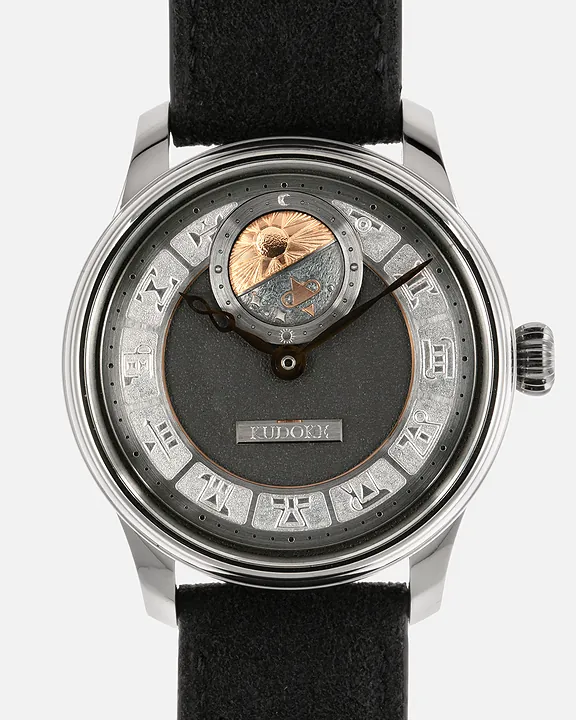
Kudoke K2 Zodiac SJX, 2021
S.Song Watches (dealer), Seattle
Wristwatches · 2022
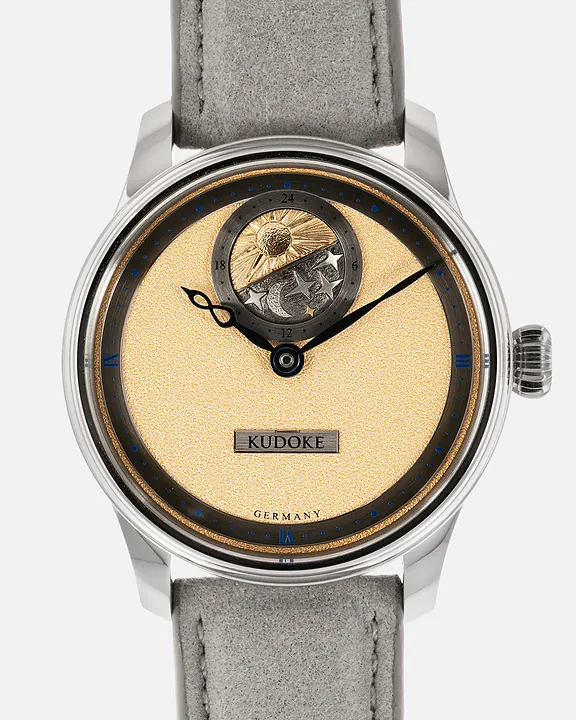
Kudoke K2 The Limited Edition 'British Heritage', 2022
S.Song Watches (dealer), Seattle
Wristwatches · 2023
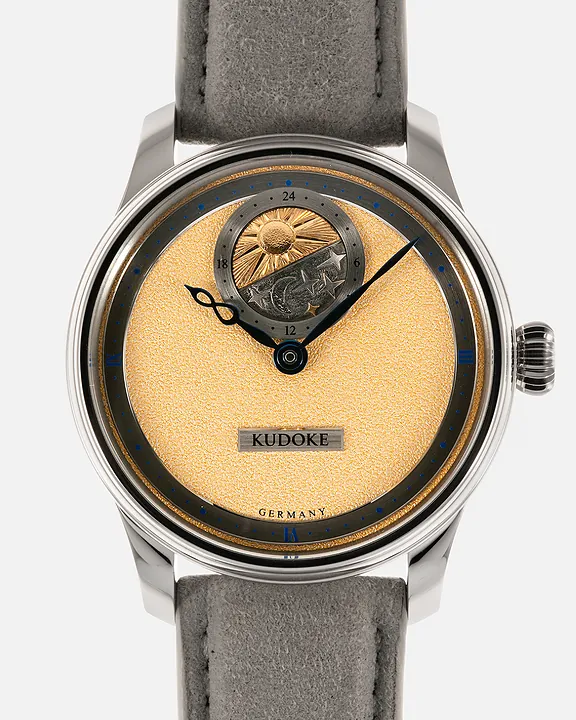
Kudoke K2 The Limited Edition 'British Heritage', 2023
S.Song Watches (dealer), Seattle
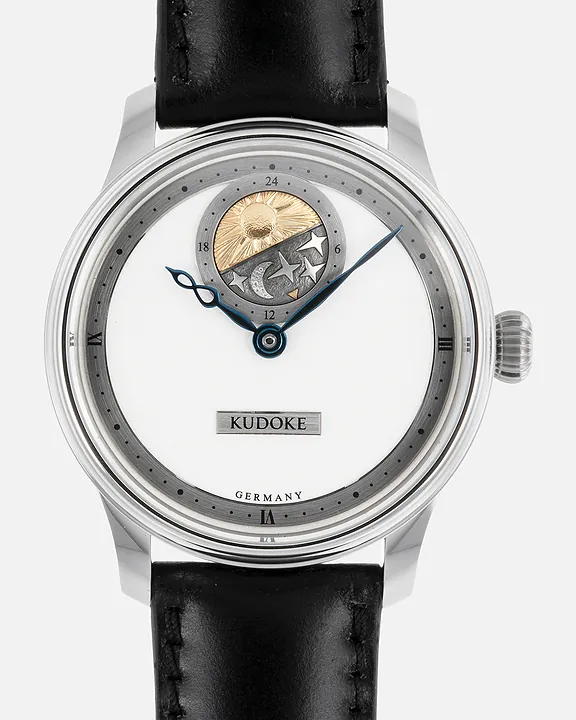
Wristwatches · 2022
Kudoke K2, 2022
S.Song Watches (dealer), Seattle
Wristwatches · 2010
Wristwatch, 2010
Modemuseum Hasselt
Wristwatches · 2018 (Series 4 released in September 2018; '1977' in the source is the model number A1977)
Apple Watch Series 4 (GPS, 40 mm, model A1977), 2018
Vienna Museum of Science and Technology
Wristwatches · c. 2010s
Bertolucci Stria III, ref. 11513.50.45.B88.6C1.501, c. 2010s
Antiquorum auction archive, Geneva
Wristwatches · c. 2010s
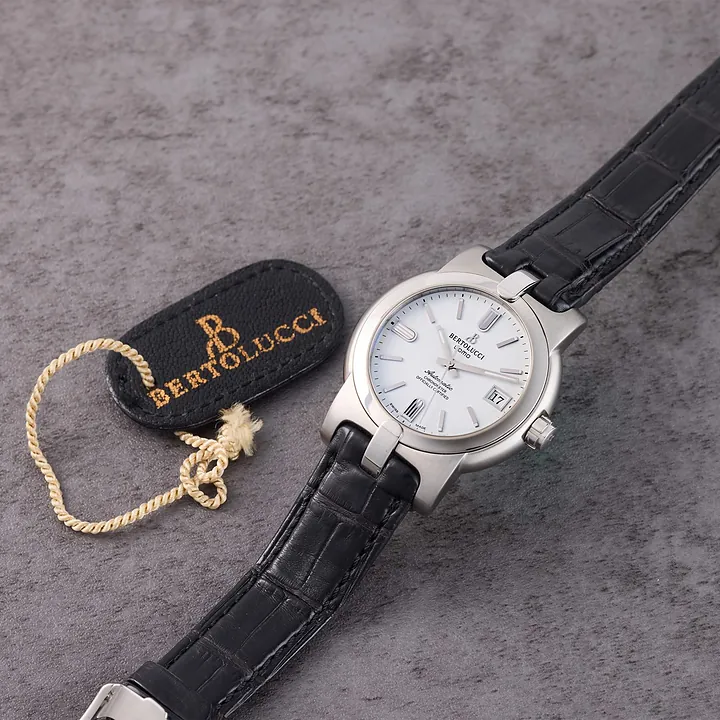
Bertolucci Uoma, ref. 824.51.41.10B, c. 2010s
Antiquorum auction archive, Geneva