
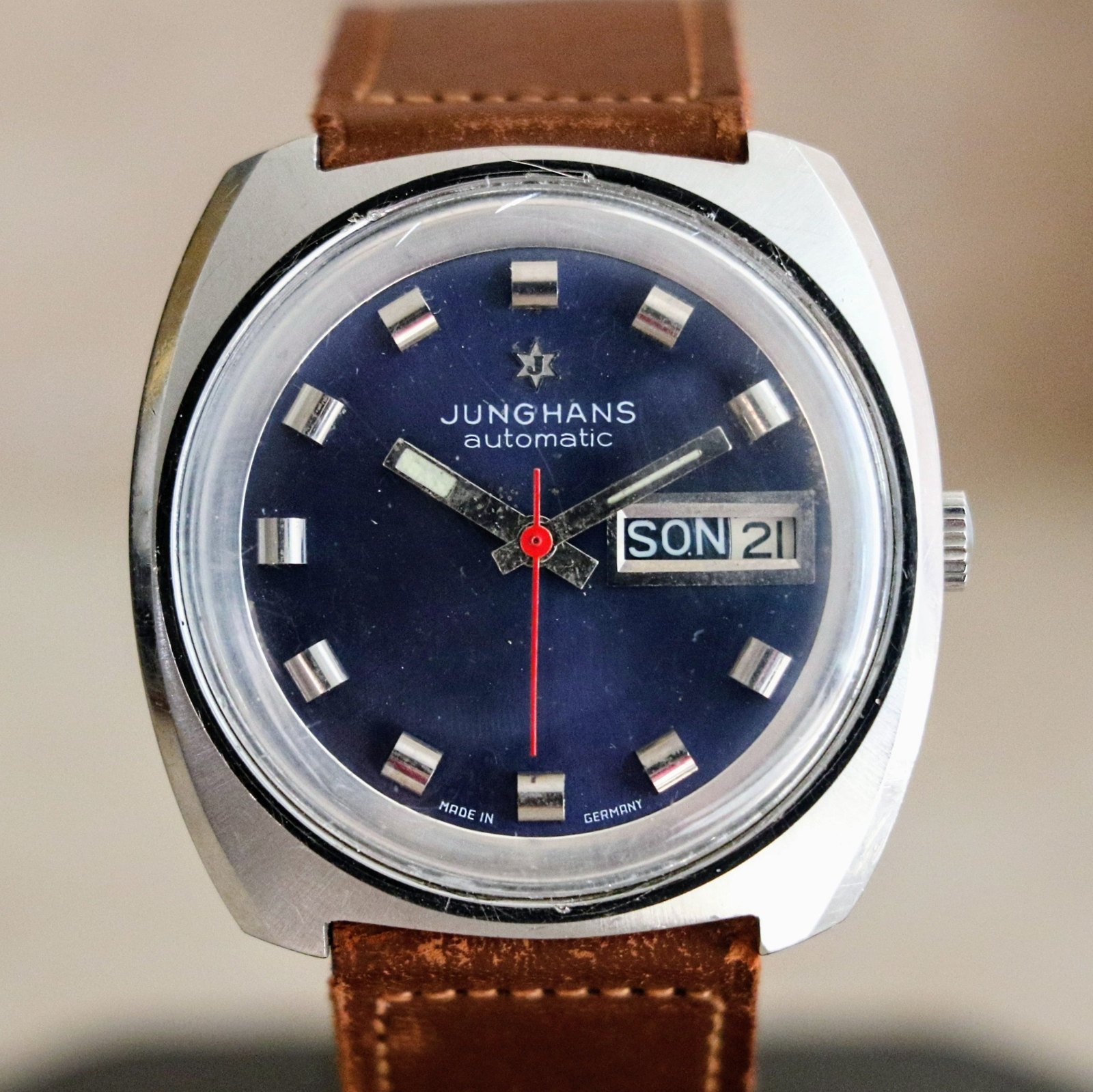
Wristwatches · Automatic day-date wristwatch
Junghans Automatic Caliber 653 Wristwatch
- Maker / attribution
- Junghans (source attribution)
- Date
- early 1970s
- Historical period
- Quartz Revolution (1969 – 1990)
- Country of origin
- Germany
- Object type
- Automatic day-date wristwatch
- Holding institution
- Second Hand Horology
- Accession / object no.
- WA-3164
- Credit line
- Second Hand Horology
- Catalogue title (original)
- JUNGHANS Automatic Vintage Wristwatch 25 Jewels, German Movement Calib – SECOND HAND HOROLOGY (English)
View the source record ↗ (opens another website in a new tab)Suggest a correction
Record summary
Held and catalogued by Second Hand Horology (object number WA-3164), this is an automatic day-date wristwatch attributed to Junghans, made in Germany, dated early 1970s. The Atlas places it in the Quartz Revolution period (1969 – 1990) of its Wristwatches collection. The record is illustrated with 1 photograph.
Assembled from the source record's structured fields. Dates and attributions are given as the source states them; where a field is missing the Atlas leaves it blank rather than estimating.
Catalogue description
Original object description
According to vendor information, this self-winding wristwatch dates to the early 1970s and is powered by a 25-jewel Junghans caliber 653 (Durowe 7526/1) movement featuring a quickset calendar. The movement is reportedly inscribed "Junghans 653 7526/1 1600 INT D", while the exterior case reverse is stated to read "Shock and Water Resistant Stainless Steel"; these mechanical and case back details, alongside the rapid-setting date feature, are unconfirmed due to documentation being restricted to one frontal image. Formed of stainless steel with vertical brushing across its top surface and an integrated bezel, the cushion case measures 36 mm across (37.4 mm including the crown), 36.7 mm from lug to lug, and 12.4 mm in total thickness. The 19 mm lug space holds an 18.5 mm wide, two-piece brown leather strap with contrasting stitching, a silver-toned buckle, and a reported "Made in England" impression. Underneath, the navy blue sunburst dial features elevated silver-toned block batons, luminous baton hands, a vivid red sweeping center seconds pointer, and an aperture at 3 o'clock showing day abbreviations in German (notably displaying "SON" for Sonntag in photographs). Below 12 o'clock, the dial displays the Junghans name, a six-pointed star emblem, and "Automatic", while "Made in Germany" borders the bottom edge.
Historical context
Quartz Revolution (1969 – 1990)
Seiko's Astron begins mass quartz timekeeping; traditional industries contract sharply.
Quartz and digital watches transformed the market after 1969. Swiss employment collapsed, Japanese and Hong Kong production soared, and the Swatch (1983) helped the Swiss industry recover; mechanical watches survived as luxury goods.
Read the period in the timelineMore wristwatches from this periodEarlier: Modern Mechanical Horology
Atlas type guide
Calendar, moon-phase and perpetual calendar watches
Calendar complications range from a simple date to the perpetual calendar, which automatically allows for months of different lengths and leap years until 2100. Pocket watches with perpetual calendars were made in the eighteenth and nineteenth centuries; Patek Philippe made the first perpetual calendar wristwatch in 1925, and series production followed in 1941. The annual calendar (Patek Philippe, 1996) needs correction only once a year.
Moon-phase displays use a disc with two moons and 59 teeth advanced daily, approximating the 29.5-day lunation; more precise trains reduce the error to one day in over a century.
What to look for
- Apertures or subsidiary dials for day, date, month and leap year.
- Moon disc under a 'bosom' shaped aperture.
- Recessed correctors on the case band for setting the calendar.
Dating clues
- Triple-date wristwatches: popular c. 1940–1955.
- Perpetual calendar wristwatches: from 1925 (unique) and 1941 (series).
General guidance written by the Atlas editors about this kind of object. It is not a statement about this particular piece; for that, rely on the source record above and on physical examination.
Related records
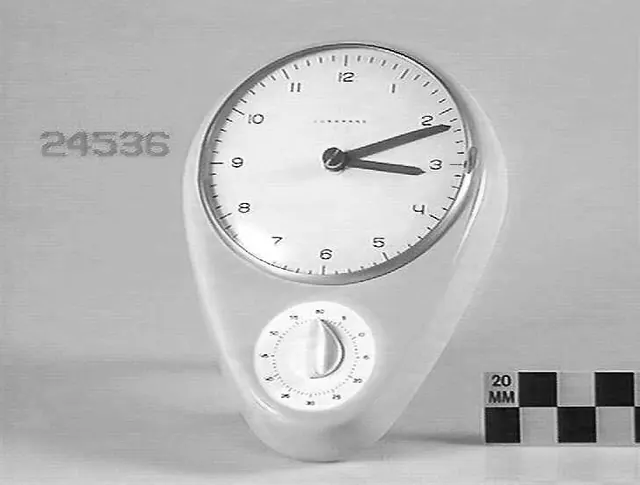
Clocks · c. 1955
Electric Clock - Junghans, 'Electora', c. 1955
Museums Victoria, Melbourne
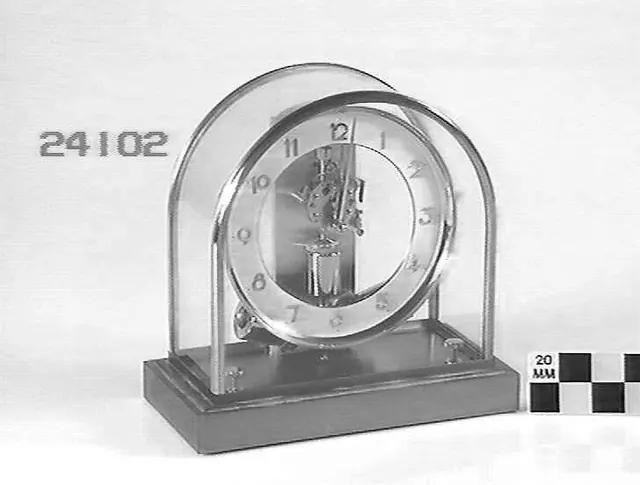
Clocks · 1956
Electric Clock - Junghans, 'ATO, Germany, 1956
Museums Victoria, Melbourne
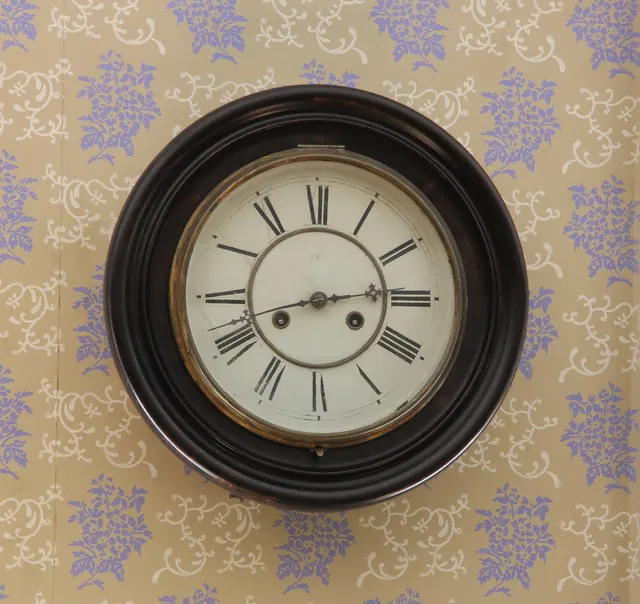
Clocks · 1888–1900
Clock by Junghans, Sweden, 1888–1900
Skansen
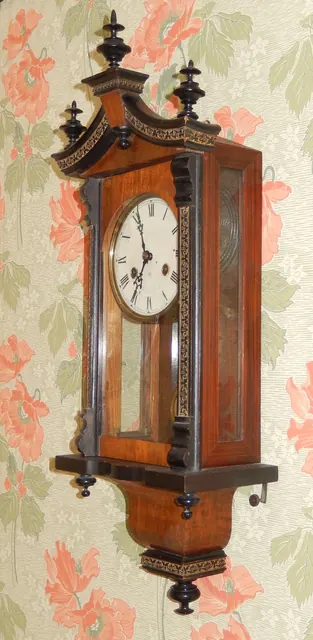
Clocks · 1890–1910
Clock by Junghans, Sweden, 1890–1910
Skansen
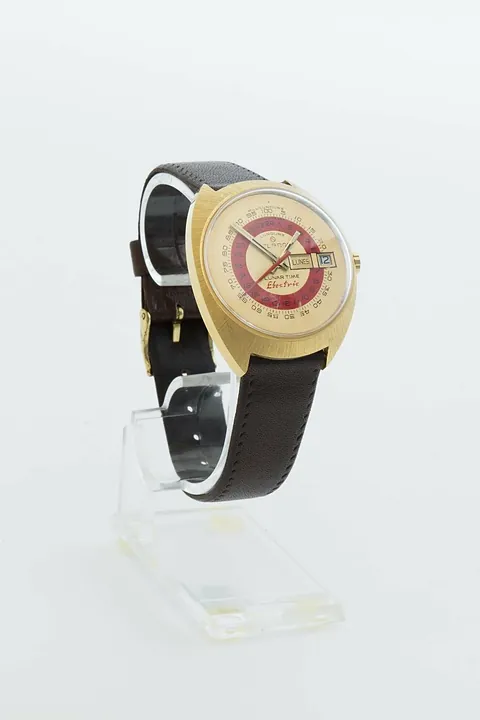
Wristwatches · 1970
Wristwatch by Helbros, Germany, 1970
German Clock Museum
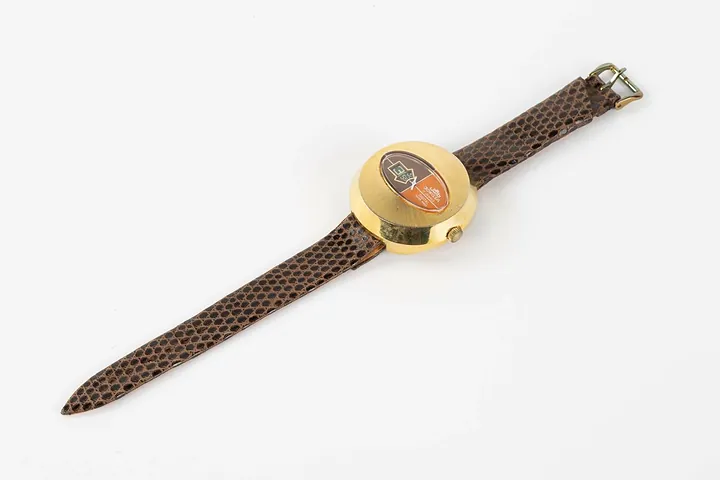
Wristwatches · c. 1970
Wristwatch by JWB (Josef Wyss Bettlach), Germany, c. 1970
German Clock Museum
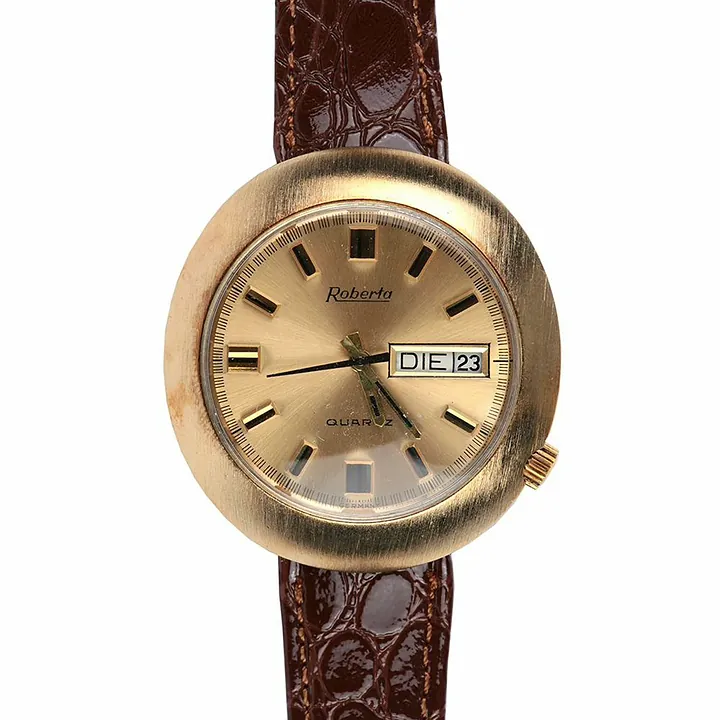
Wristwatches · 1972
Wristwatch by PUW Pforzheimer Uhrenrohwerke, Germany, 1972
German Clock Museum
Wristwatches · 1972
Wristwatch by Weber und Aeschbach, Germany, 1972
German Clock Museum