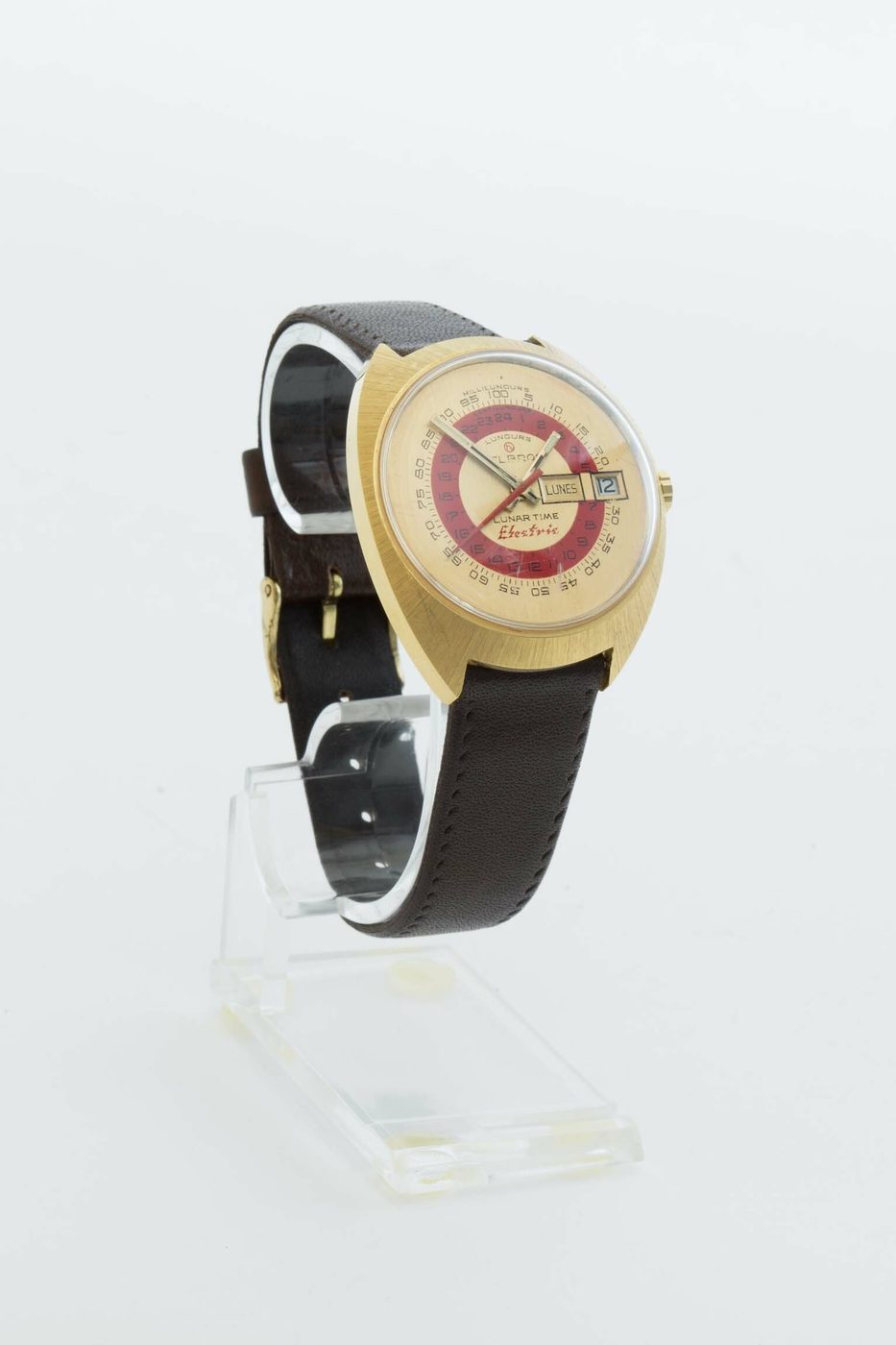
Wristwatches · Wristwatch
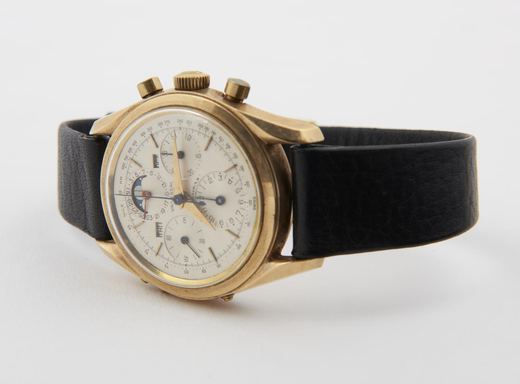
Wristwatch by Helbros, Germany, 1970
- Maker / attribution
- Helbros (creator); PUW Pforzheimer Uhrenrohwerke (creator); Franklin, Kenneth, Dr. (creator)
- Date
- 1970
- Historical period
- Quartz Revolution (1969 – 1990)
- Country of origin
- Germany
- Place
- Pforzheim
- Object type
- Wristwatch
- Holding institution
- German Clock Museum
- Accession / object no.
- Museu_ProvidedCHO_museum_digital_65318__technical_number_
- Catalogue title (original)
- Armbanduhr Helbros Lunar Time, PUW, Pforzheim, 1970 (German)
Record summary
Held and catalogued by German Clock Museum (object number Museu_ProvidedCHO_museum_digital_65318__technical_number_), this is a wristwatch by Helbros, made in Pforzheim, Germany, dated 1970. The Atlas places it in the Quartz Revolution period (1969 – 1990) of its Wristwatches collection. The record is illustrated with 1 photograph.
Assembled from the source record's structured fields. Dates and attributions are given as the source states them; where a field is missing the Atlas leaves it blank rather than estimating.
Catalogue description
Catalogue description from German Clock Museum (German)
Im Juli 1969 wurde Science-Fiction Wirklichkeit: Neil Armstrong betrat als erster Mensch den Mond. Das bahnbrechende Ereignis inspirierte auch die Uhrenindustrie. Die Firma Helbros ließ eine Uhr produzieren, die Mondzeit anzeigt. Doch wie vergeht die Zeit auf dem Mond? Wie auf der Erde geht die Sonne auf und unter, aber ein Mondtag dauert gut 29,5 Erdtage. Mit der herkömmlichen Anzeige mittels Zeigern ließ sich das nicht vernünftig darstellen. So unterteilte Helbros den Mondtag in 30 Teile, die Lunes, jeweils etwa 23,5 Stunden lang. Die Lunes wurden weiter unterteilt. Ein Lunes besteht beispielsweise aus 24 Lunours. Doch dies sagt nichts über das Zeitempfinden auf dem Mond. Darüber berichtete der Astronaut Eugene Cernan: Ich habe gesehen, wie die Zeit auf der Erde verstrich. Doch so, wie wir sie verstehen, hat Zeit uns auf dem Mond überhaupt nicht berührt. (Deutsches Uhrenmuseum Furtwangen)
Shown in the original language of the source catalogue. An editor-reviewed English translation has not yet been published; we do not publish machine translations as authoritative text.
Historical context
Quartz Revolution (1969 – 1990)
Seiko's Astron begins mass quartz timekeeping; traditional industries contract sharply.
Quartz and digital watches transformed the market after 1969. Swiss employment collapsed, Japanese and Hong Kong production soared, and the Swatch (1983) helped the Swiss industry recover; mechanical watches survived as luxury goods.
Read the period in the timelineMore wristwatches from this periodEarlier: Modern Mechanical Horology
Atlas type guide
Wristwatches
Bracelet watches were worn by women from the early nineteenth century — Breguet made one for Caroline Murat, Queen of Naples, in 1810–12 — but the wristwatch only became a man's instrument with military use and aviation in the early twentieth century. Between the World Wars it overtook the pocket watch; the 1920s and 1930s brought rectangular Art Deco cases, water-resistant cases and the first automatic winding systems.
After 1945 the wristwatch became a carrier of identity — dress watches, sports and dive watches, chronographs, calendars — produced by Swiss, American, Japanese, German, Soviet and Chinese industries. The quartz revolution after 1969 and the mechanical renaissance since the 1990s, including the rise of independent watchmakers, complete the story.
What to look for
- The reference number (between the lugs or inside the case back) and serial number, the starting point for dating.
- The calibre: its maker and number are often stamped under the dial or on the bridge.
- Originality of dial, hands and crown — refinished ('redial') dials are common.
- Case material marks: 18K/750, 14K/585, stainless steel, gold-filled, plated.
Dating clues
- Wire-lug cases: before c. 1925.
- Water-resistant screw-down cases: from 1926.
- Quartz movements: from 1969; sapphire crystals widespread after c. 1980.
General guidance written by the Atlas editors about this kind of object. It is not a statement about this particular piece; for that, rely on the source record above and on physical examination.
Related records
Wristwatches · 1970
Wristwatch by JWB (Josef Wyss Bettlach), Germany, 1970
German Clock Museum
Wristwatches · 1972
Wristwatch by PUW Pforzheimer Uhrenrohwerke, Germany, 1972
German Clock Museum
Wristwatches · 1972
Wristwatch by Weber und Aeschbach, Germany, 1972
German Clock Museum
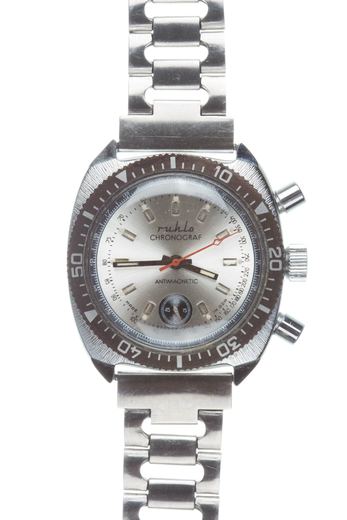
Wristwatches · 1975
Wristwatch, Germany, 1975
German Clock Museum
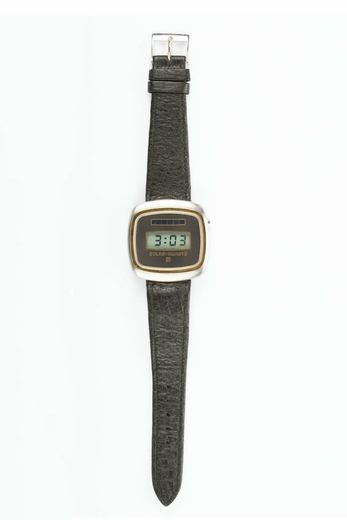
Wristwatches · 1976
Wristwatch by Cristalonic, Germany, 1976
German Clock Museum
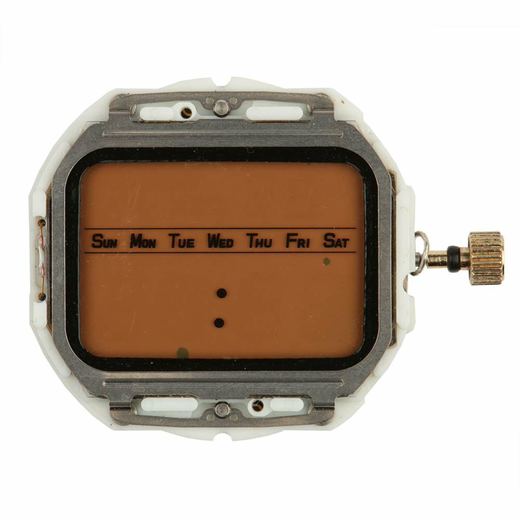
Wristwatches · 1977
Wristwatch by Fixoflex, Germany, 1977
German Clock Museum
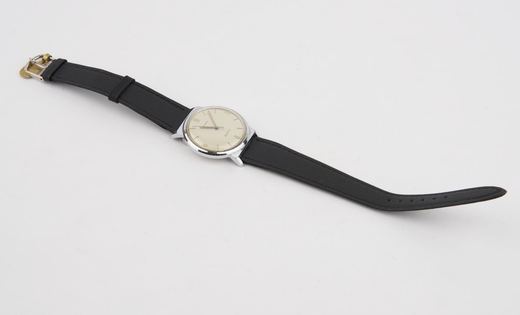
Wristwatches · 1949-1992
Timex `Electric' wristwatch, with electrically operated balance wheel mechanism, United States, 1949-1992
Science Museum Group, London
Wristwatches · 1960-1986
'Tri-Compax' calendar chronograph wristwatch in gold case, by Universal, Geneva, Switzerland, 1960-1986.
Science Museum Group, London