
Instruments · Two-day marine chronometer
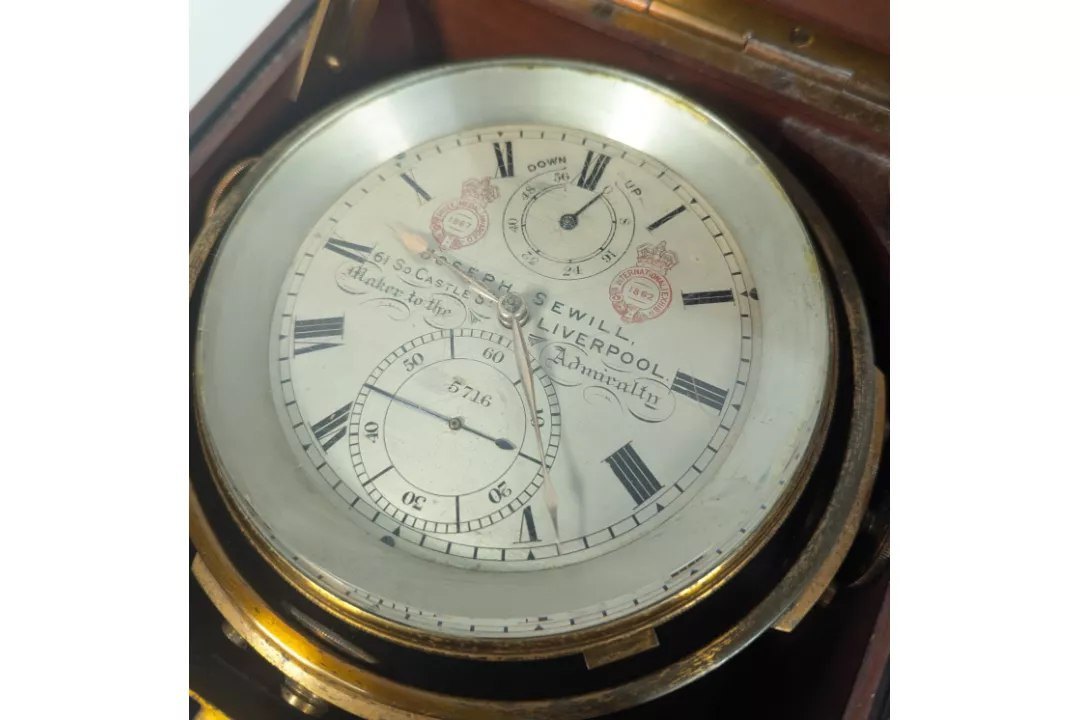
Joseph Sewill two-day marine chronometer
- Maker / attribution
- Joseph Sewill (source attribution)
- Date
- 19th Century
- Historical period
- Precision & Scientific Horology (1750 – 1850)
- Country of origin
- United Kingdom
- Object type
- Two-day marine chronometer
- Auction house
- Auctioneum Ltd - East Bristol & Bath
- Lot
- 6
- Credit line
- Auctioneum Ltd - East Bristol & Bath
- Catalogue title (original)
- A 19th Century Joseph Sewill (Liverpool) two-day marine chronometer housed in a 3 tier oak case w (English)
View the source record (auction lot) ↗ (opens another website in a new tab)Suggest a correction
Record summary
Catalogued by Auctioneum Ltd - East Bristol & Bath (lot 6), this is a two-day marine chronometer attributed to Joseph Sewill, made in United Kingdom, dated 19th Century. The Atlas places it in the Precision & Scientific Horology period (1750 – 1850) of its Instruments collection. The record is illustrated with 1 photograph.
Assembled from the source record's structured fields. Dates and attributions are given as the source states them; where a field is missing the Atlas leaves it blank rather than estimating.
Catalogue description
Original object description
Attributed to Liverpool clockmaker Joseph Sewill, this 19th-century marine chronometer is engraved with serial number 5716 within its seconds subdial. Its silvered dial features a outer minute ring, Roman numerals for the hours, and a winding indicator at 12 o'clock flanked by red and gold medallions celebrating distinctions awarded in 1862 and 1867. Prominent inscriptions on the dial read 'JOSEPH SEWILL, LIVERPOOL', 'Maker to the Admiralty', and list the workshop address at '61 So Castle St'. According to auction records, the two-day mechanism runs smoothly and retains an original 'tipsy' winding key, although its escapement and inner gear trains have not been inspected. Suspended in an exposed brass gimbal to preserve level alignment, the chronometer is documented as housed in a three-tier brass-bound oak box that bears an attached bone plaque marked 'Supplied by N.V Observer', none of which appear in the main dial photograph.
Inscriptions & marks
5716
Historical context
Precision & Scientific Horology (1750 – 1850)
Harrison solves longitude; Mudge invents the lever; Breguet's Paris workshop defines the modern watch.
The longitude problem was solved by the marine chronometer and lunar distance methods; dividing engines made precision scales possible, and observatories set time by transit instruments.
Read the period in the timelineMore instruments from this periodEarlier: Early Modern Horology
Atlas type guide
Marine chronometers
A marine chronometer is a precision timekeeper carried at sea to find longitude: the navigator compares local noon, observed with a sextant, with the time at a reference meridian kept by the chronometer. Each hour of difference corresponds to fifteen degrees of longitude. John Harrison proved the method in the 1760s; Pierre Le Roy, Ferdinand Berthoud, John Arnold and Thomas Earnshaw then developed the detent escapement and the compensation balance that made chronometers practical to manufacture.
By the nineteenth century London, Liverpool, Le Locle and Glashütte supplied navies and merchant fleets. A typical box chronometer has a spring-detent escapement, a fusee to equalise mainspring torque, a bimetallic compensation balance with a helical balance spring, and is mounted in gimbals inside a wooden box so that it stays level.
What to look for
- Gimbals and a three-tier wooden box with a glazed inner lid.
- A power-reserve ('up and down') indicator on the dial, usually showing 56 hours on two-day instruments.
- Spring-detent escapement and a cylindrical (helical) balance spring visible through the movement.
- Admiralty or navy marks (broad arrow), and rating certificates from observatories.
- The maker's number on the dial and movement; many makers' registers survive, allowing dating.
Dating clues
- Earnshaw-type spring-detent chronometers became standard after about 1800.
- Auxiliary compensation devices on the balance appear from the mid-nineteenth century.
- Quartz and radio time signals ended routine use of mechanical chronometers in the 1970s and 1980s.
General guidance written by the Atlas editors about this kind of object. It is not a statement about this particular piece; for that, rely on the source record above and on physical examination.
Read next:Spring detent (chronometer) escapementFuseeBalance spring (hairspring)Detent escapement
Related records
Pocket Watches · c. 1880
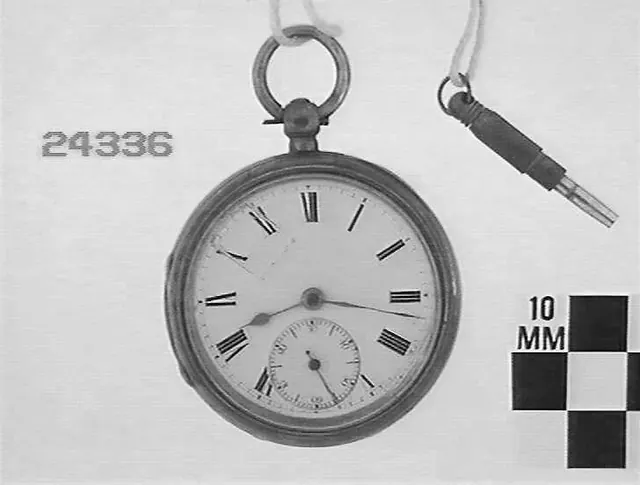
Pocket Watch - Sewill, Glasgow, c. 1880
Museums Victoria, Melbourne
Instruments · c. 1880
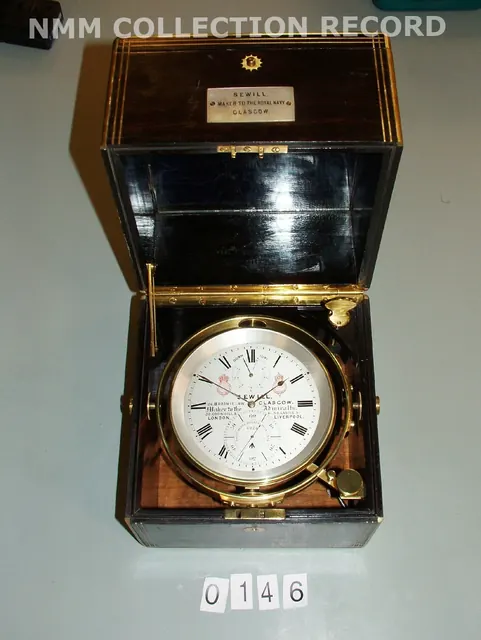
Marine chronometer no. 6020 by Joseph Sewill
Royal Museums Greenwich
Instruments · c. 1876
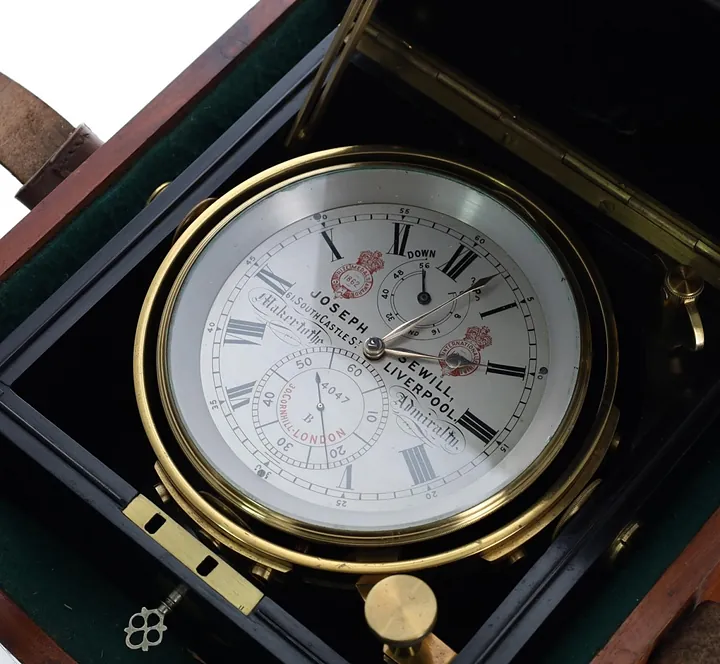
Two-day marine chronometer by Joseph Sewill, circa 1876
Gardiner Houlgate (auction house), Corsham
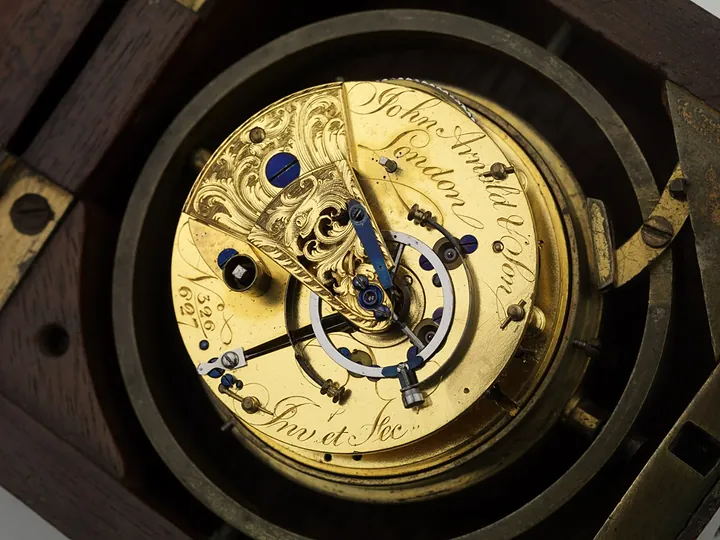
Instruments · c. 1788-1810
John Arnold & Son No. 326 Marine Chronometer
National Maritime Museum, Greenwich, London, Rev. George Fisher Collection
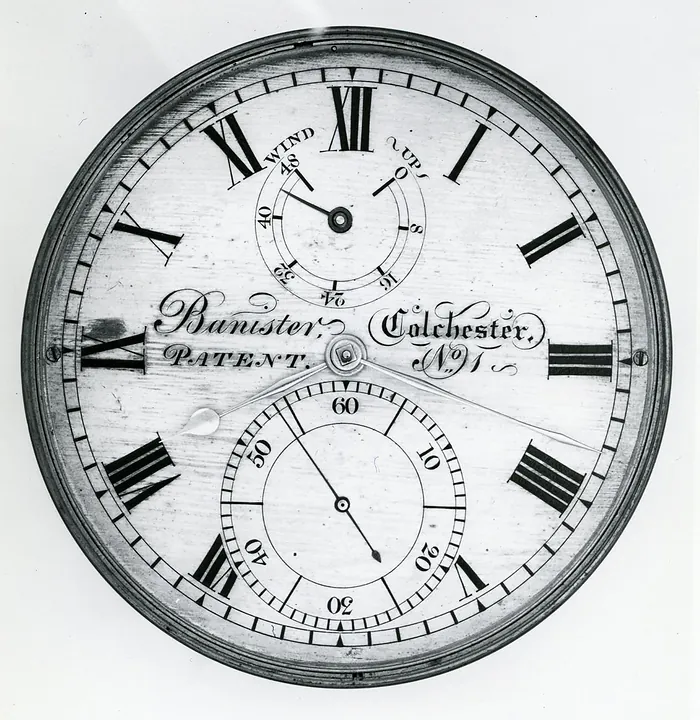
Instruments · 1830–1840
Joseph Banister Marine Chronometer 'Patent No. 1'
British Museum
Instruments · 1726–1775
Universal equinoctial sundial of the Augsburg type, signed on the base "L T M" (Ludwig Theodatus Muller). In original case. German, mid 18th century. (B1670)
Science Museum Group, London
Instruments · 1731–1776
Azimuth compass sundial by James Ferguson, London, England, 1731–1776. Could also be used as a tablet sundial - string gnomon is missing (see note).
Science Museum Group, London
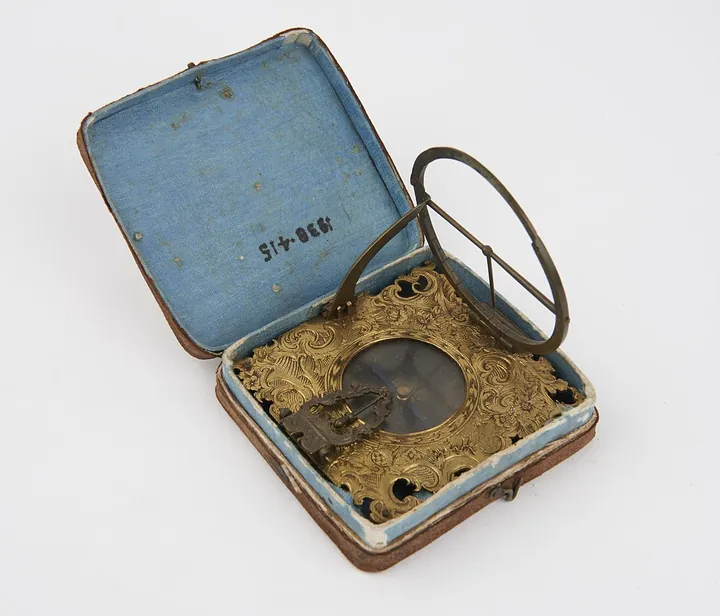
Instruments · 1734–1770
Sundial by Ludwig Theodatus Muller, Germany, 1734–1770 (no. 1938-415)
Science Museum Group, London