
Wristwatches · Wristwatch
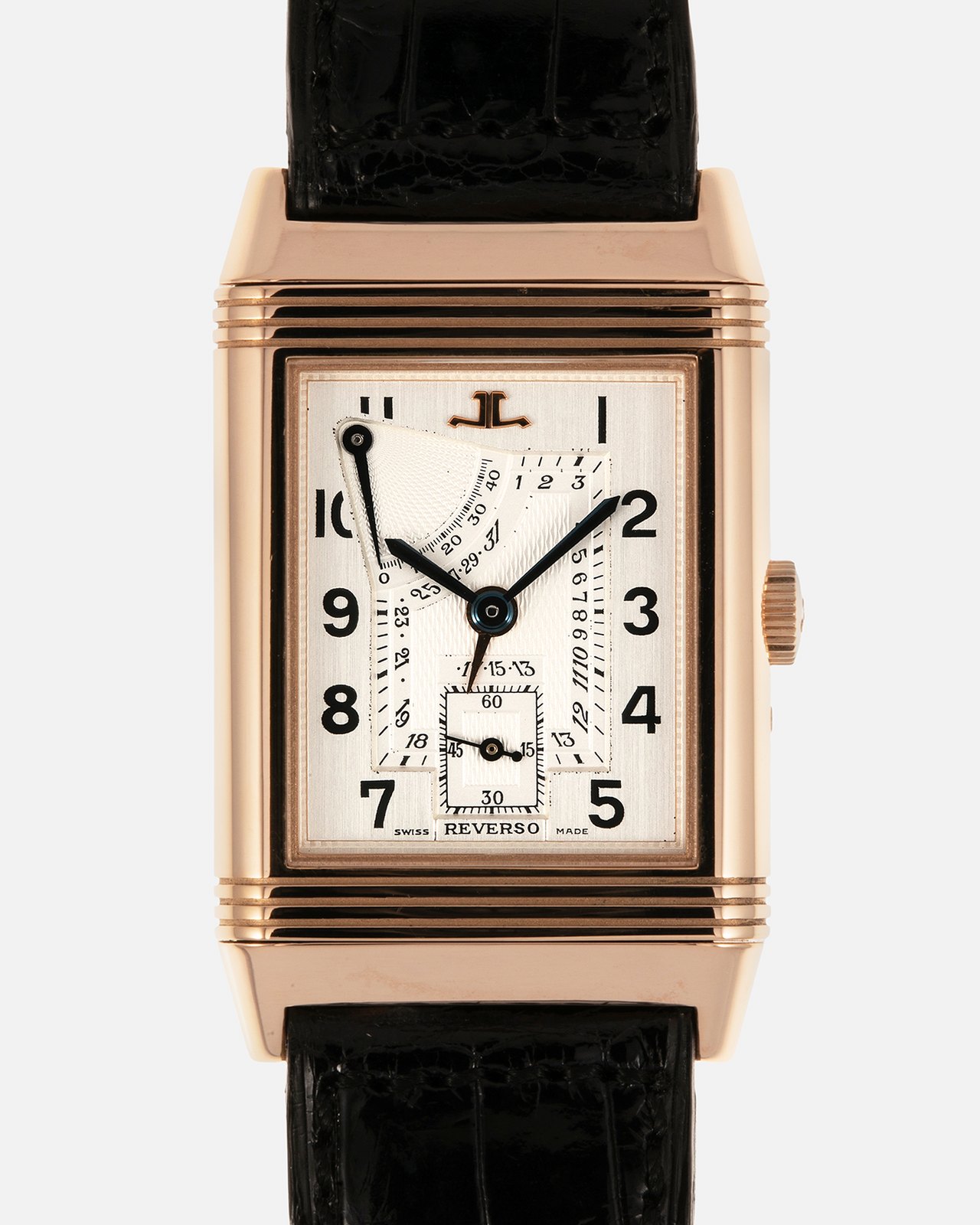
Jaeger-LeCoultre Reverso Soixantième 60th Anniversary Ref. 270.2.64, 1991
- Maker / attribution
- Jaeger-LeCoultre (maker)
- Date
- 1991
- Historical period
- Mechanical Renaissance (1990 – 2010)
- Country of origin
- Switzerland
- Object type
- Wristwatch
- Dimensions
- Case 42 mm
- Stock no.
- Product 7433041281111
- Credit line
- Dealer listing, S.Song Watches (product 7433041281111)
- Catalogue title (original)
- Jaeger-LeCoultre Reverso Soixantième 60th Anniversary Ref. 270.2.64 (English)
View the source record (dealer listing) ↗ (opens another website in a new tab)Suggest a correction
Record summary
Catalogued by S.Song Watches (dealer), Seattle (stock number Product 7433041281111), this is a wristwatch by Jaeger-LeCoultre, made in Switzerland, dated 1991. The Atlas places it in the Mechanical Renaissance period (1990 – 2010) of its Wristwatches collection. Recorded dimensions: Case 42 mm. The record is illustrated with 6 photographs.
Assembled from the source record's structured fields. Dates and attributions are given as the source states them; where a field is missing the Atlas leaves it blank rather than estimating.
Catalogue description
Dealer description — S.Song Watches
Created by Jacques-David LeCoultre in 1931, the Reverso was initially conceived to withstand the harsh beating a watch would endure during a game of polo. With the need for the watch to be more durable, the Reverso's genius reveals itself through its eponymous design—a reversible case. With its case able to be turned around on itself, the Reverso's dial can be protected while playing sports and returned to its original position with a quick flick and slide. Thanks to its iconic heritage, the Reverso has evolved into one of Jaeger LeCoultre's most important design vehicles to date, with a healthy number of contemporary variations to suit the palate of modern enthusiasts and connoisseurs alike. Presented today is a rare variant of a Reverso: the Reverso Soixantième 60th Anniversary 270.2.64 in 18-carat rose gold. Released in 1991 to commemorate the model’s 60th anniversary, production was limited to just 500 pieces worldwide. Aesthetically, this Reverso is particularly unique; it is imbued with a character and presence unlike any other example I’ve encountered or handled before. Allow me to explain. Before we dive into what makes the Soixantième so special, I believe it is important for us to preface this: At the time when the Soixantième was released, Jaeger LeCoultre had just gone through a turbulent period known as the quartz crisis. The visionary Günter Blümlein, who oversaw Jaeger LeCoultre's operations at the time, recognised the Maison's exceptional technical potential stemming from its rich history as an in-house movement maker. This realisation later became pivotal in the brand's resurgence during the post-quartz crisis era. The Soixantième was subsequently unveiled as part of a series of six limited edition Reverso models launched between 1991 and 2000 to commemorate the 60th anniversary of the iconic Reverso. These milestones contributed significantly to solidifying Jaeger-LeCoultre's esteemed position within the industry as we know it today. Starting with the Soixantième’s 18-carat rose gold ‘Grande Taille’ style case, it measures a compact 42mm x 26mm in size and with a slim case profile of only 9.5mm. Like many Reversos, the case features two pairs of squared lugs with conical profiles, and rounded, barrel-like case flanks on each side. It is also polished entirely and reveals a beautiful perlage and its hallmarks on the inner chassis. As for the front dial, it is crafted from galvanised silver and showcases a set of blued steel hands, a contrasting central date pointer just beneath it, as well as a decorative guilloché pattern in the centre portion. An overlapping power reserve indicator can also be found between the 10:00 and 12:00 positions. Upon flipping the dial onto its opposite side, you will quickly realise that the business end of the Soixantième is just as magnificent as the front. Here, you'll be treated to a stunning visual of the 23-jewelled, manual-winding, in-house Cal. 824, with its plates and bridges all crafted entirely out of solid rose gold. This movement holds particular significance: as the Reverso Soixantième marked the beginning of a new chapter for the Reverso line in the 1990s, reestablishing it as Jaeger-LeCoultre’s flagship model, an all-new movement had to be developed. The result was the Cal. 824, a rectangular calibre designed specifically for this case. In today’s climate, it’s difficult to imagine many brands committing the same level of resources to develop a dedicated form movement for a limited series—an effort that speaks volumes about the Maison’s ambition at the time. While the time-telling side is, of course, intended to face outward on the wrist, I often found myself flipping it over just to admire the movement. It is, without question, the most captivating feature of this extraordinary piece. Overall, the Reverso Soixantième is an exceptional and captivating work of horological art, one that represents the pinnacle of Jaeger-LeCoultre’s watchmaking savoir-faire and a defining moment in the Reverso’s revival. For the discerning watch connoisseur, this is an important Reverso reference that simply cannot be overlooked.
Historical context
Mechanical Renaissance (1990 – 2010)
Mechanical watches return as cultural objects; independent watchmaking flourishes.
Mechanical watches returned as cultural and luxury objects. Complications, tourbillons and new materials proliferated; independent watchmakers such as George Daniels, F.P. Journe and Philippe Dufour revived artisanal watchmaking; collecting vintage watches became a major field.
Read the period in the timelineMore wristwatches from this periodEarlier: Quartz Revolution
Atlas type guide
Wristwatches
Bracelet watches were worn by women from the early nineteenth century — Breguet made one for Caroline Murat, Queen of Naples, in 1810–12 — but the wristwatch only became a man's instrument with military use and aviation in the early twentieth century. Between the World Wars it overtook the pocket watch; the 1920s and 1930s brought rectangular Art Deco cases, water-resistant cases and the first automatic winding systems.
After 1945 the wristwatch became a carrier of identity — dress watches, sports and dive watches, chronographs, calendars — produced by Swiss, American, Japanese, German, Soviet and Chinese industries. The quartz revolution after 1969 and the mechanical renaissance since the 1990s, including the rise of independent watchmakers, complete the story.
What to look for
- The reference number (between the lugs or inside the case back) and serial number, the starting point for dating.
- The calibre: its maker and number are often stamped under the dial or on the bridge.
- Originality of dial, hands and crown — refinished ('redial') dials are common.
- Case material marks: 18K/750, 14K/585, stainless steel, gold-filled, plated.
Dating clues
- Wire-lug cases: before c. 1925.
- Water-resistant screw-down cases: from 1926.
- Quartz movements: from 1969; sapphire crystals widespread after c. 1980.
General guidance written by the Atlas editors about this kind of object. It is not a statement about this particular piece; for that, rely on the source record above and on physical examination.
Related records
Clocks · 1937–1938
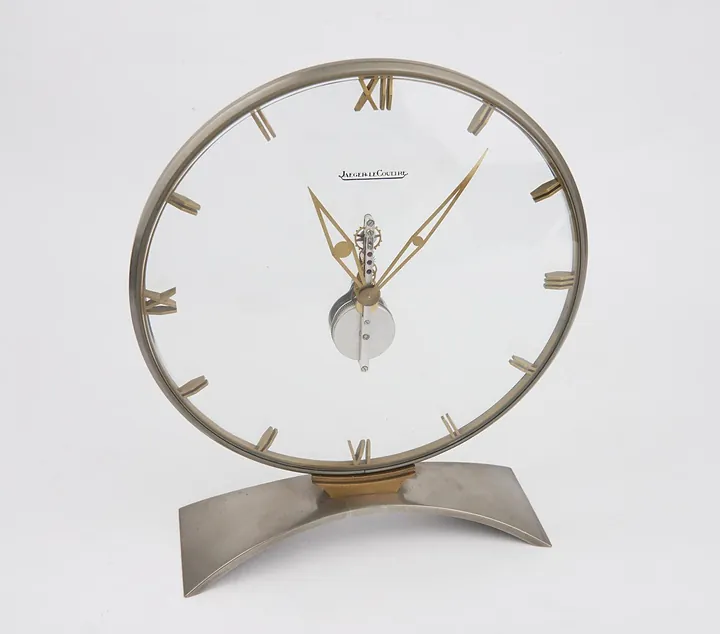
Skeleton clock by Jaeger-LeCoultre, Switzerland, 1937–1938
Science Museum Group, London
Movements & Components · 1953
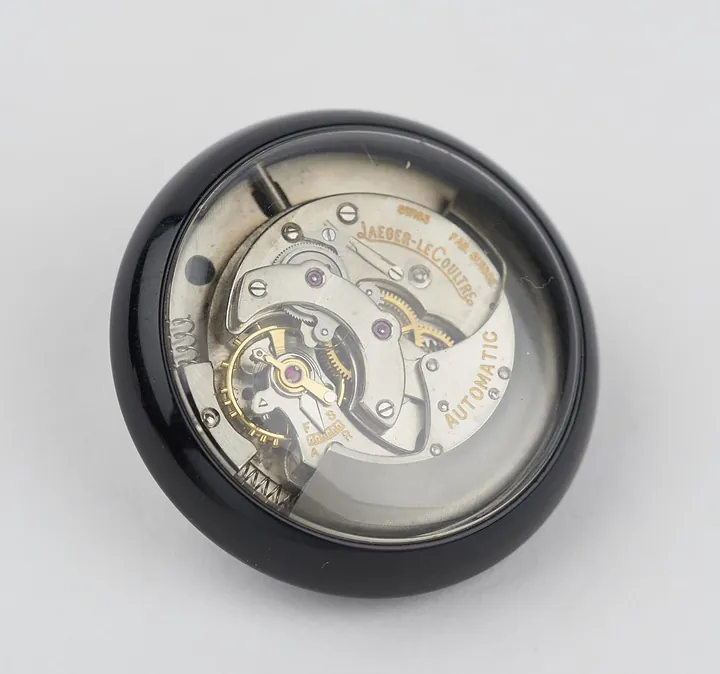
Automatic watch movement, Jaeger-LeCoultre, 1953, Geneva, Switzerland, showing self-winding mechanism
Science Museum Group, London
Wristwatches · 1953
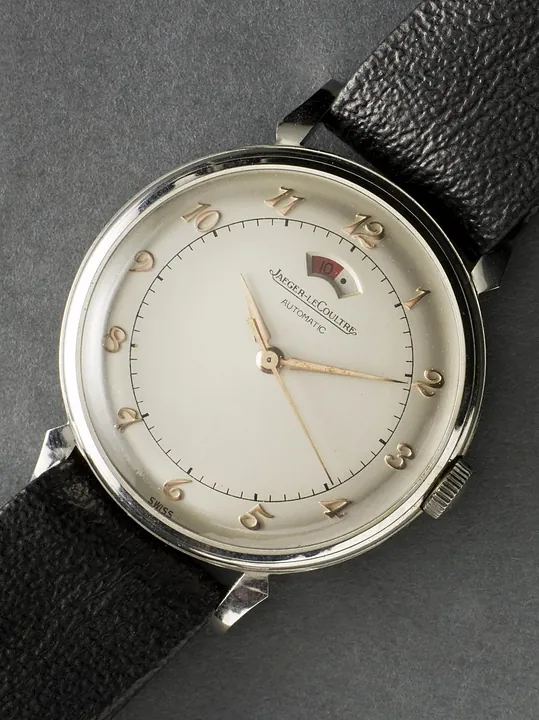
Automatic Wrist-watch, Jaeger-LeCoultre, Geneva, Switzerland, with reserve power indicator complete in steel case, 1953. Back numbered 564556.
Science Museum Group, London
Wristwatches · 1953
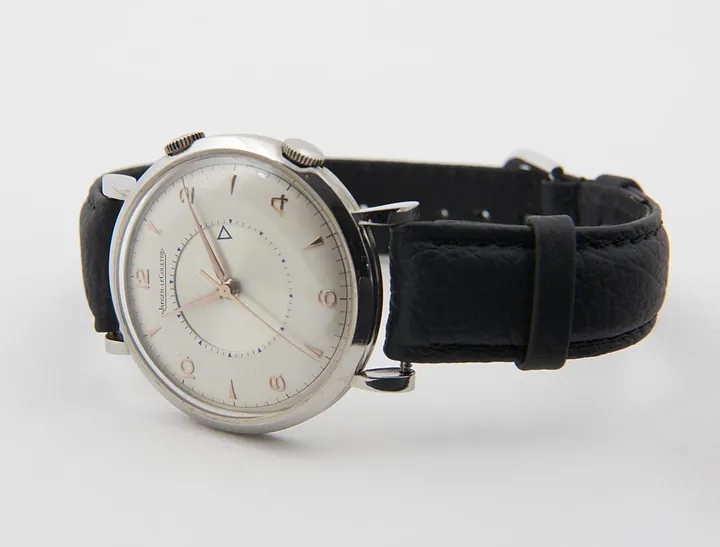
Wrist-watch, 'Memovox' alarm, Jaeger-LeCoultre, Geneva, Switzerland, complete in steel case, 1953.
Science Museum Group, London

Wristwatches · 2008
Wristwatch by Breitling?, 2008
Museum Rotterdam

Wristwatches · c. 1990s
Audemars Piguet Bamboo, c. 1990s
Antiquorum auction archive, Geneva

Wristwatches · c. 1990
Audemars Piguet Huitieme Perpetual Calendar, ref. 25696PT, c. 1990
Antiquorum auction archive, Geneva

Wristwatches · c. 1990
Breitling Chronomat, ref. b13050.1, c. 1990
Antiquorum auction archive, Geneva