
Wristwatches · Wristwatch
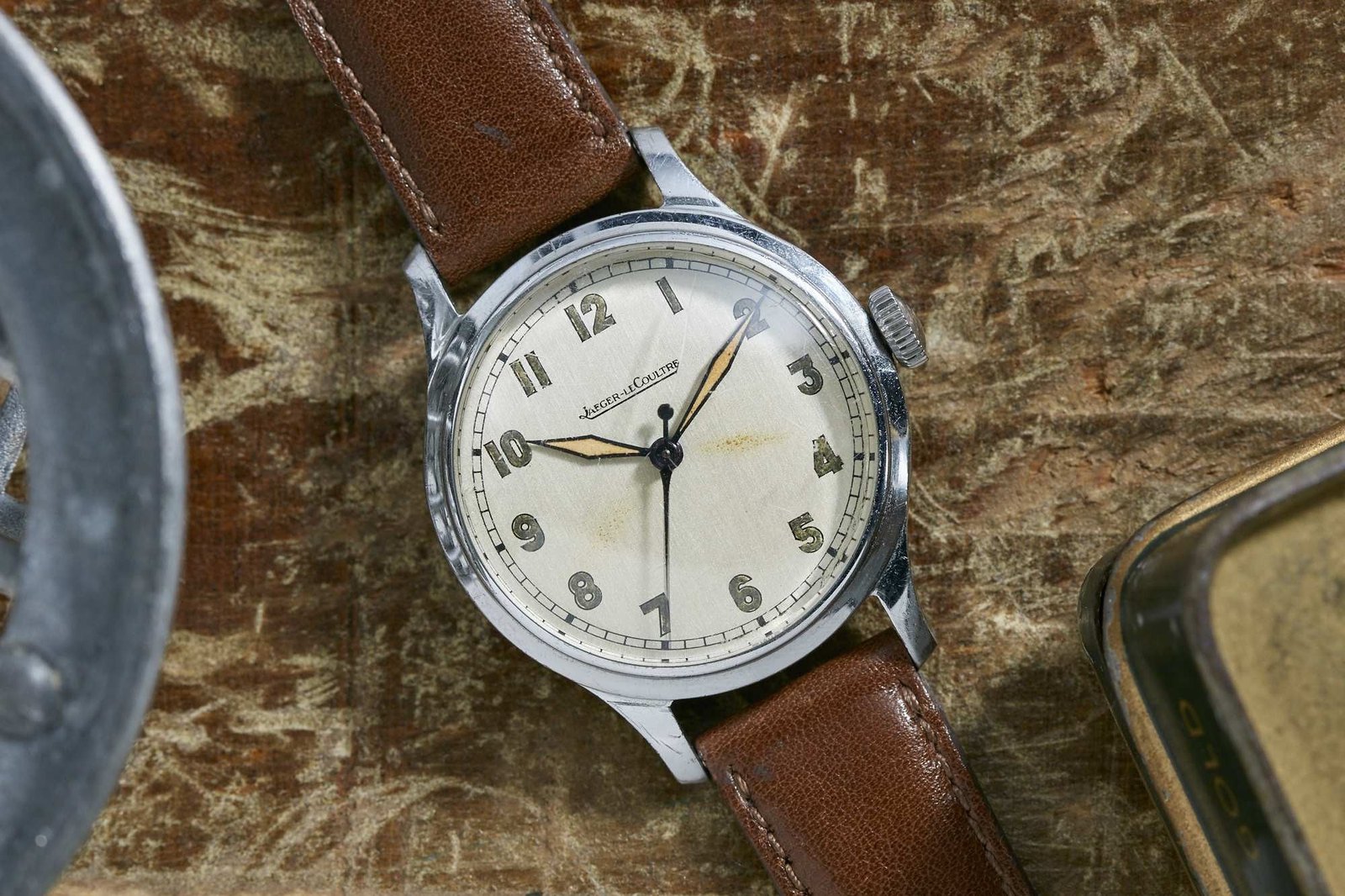
Jaeger-LeCoultre Reference 2892B with Extract from the Archives, 1946
- Maker / attribution
- Jaeger LeCoultre (maker)
- Date
- 1946
- Historical period
- Modern Mechanical Horology (1945 – 1969)
- Country of origin
- Unrecorded in source
- Object type
- Wristwatch
- Dimensions
- Case 33.5 mm
- Stock no.
- Product 6750629057
- Credit line
- Dealer listing, Analog/Shift (product 6750629057)
- Catalogue title (original)
- Jaeger-LeCoultre Reference 2892B with Extract from the Archives (English)
View the source record (dealer listing) ↗ (opens another website in a new tab)Suggest a correction
Record summary
Catalogued by Analog/Shift (dealer), New York (stock number Product 6750629057), this is a wristwatch by Jaeger LeCoultre, dated 1946. The Atlas places it in the Modern Mechanical Horology period (1945 – 1969) of its Wristwatches collection. Recorded dimensions: Case 33.5 mm. The record is illustrated with 6 photographs.
Assembled from the source record's structured fields. Dates and attributions are given as the source states them; where a field is missing the Atlas leaves it blank rather than estimating.
Catalogue description
Dealer description — Analog/Shift
During World War II, the British Ministry of Defense saw the need for their armed forces to have durable timepieces that could withstand the rigors of combat while keeping accurate time. Jaeger-LeCoultre's military watches from this period--particularly their Mark X "W.W.W" and their Mark XI aviator's watches--are enduring examples of tool watches whose movements are as beautiful as they are reliable. The Mark X or "Watch Wristlet Waterproof," one of the Dirty Dozen produced by twelve watch manufacturers for general issue from 1945 to 1948, combined a spartan exterior with a robust, no-frills movement, the caliber 479. Later, the manufacture (along with IWC ) conceived of the Mark XI aviator's watch, whose movement--the Calibre 488--answered the MoD's more rigorous specifications of anti-magnetism with a iron covering. However, in the years immediately preceding the introduction of the Mark XI in 1949, JLC developed another Mark series of pilots' watches that saw service from 1940 to 1946. The Mark VII and Mark VIIA were veritable tool watches that made their way onto the wrists of many British and Allied pilots. These war-time pieces were driven by the Calibre 470, a sturdy and very accurate precursor to the movement used in the Mark XI. This particular piece, a Reference 2982B, falls in between the Mark VII and the Mark XI. Produced in 1946, it's driven by the Calibre P478. The Calibre P478, derived from the Calibre 488 that drove the Mark XI, is a venerable workhorse movement that would later gain chronometer certification and find its way into the original Geophysic Chronometer a decade later in 1957. The Reference 2982B transitioned into civilian life with the Reference 159 , which was produced from 1946 to the 1960s. With its 33.5mm chromium-plated case, brushed silver dial with Arabic numerals, Feuille-style blued-steel luminescent hour and minute hands with matching blued-steel sweep hand, the Reference 2982B is quintessentially military in appearance. Additionally, with an Extract from the Archives of Jaeger LeCoultre verifying its complete authenticity, this watch should be on the radar of anyone looking for an enjoyable piece of horological history.
Historical context
Modern Mechanical Horology (1945 – 1969)
Tool watches for divers, pilots and astronauts; electric watches anticipate the electronic age.
The classic era of the mechanical wristwatch: dive watches, chronographs for motor racing and space flight, GMT watches for jet travel, slim dress watches, automatic calendars, and the rise of Japanese manufacturers alongside Swiss, American, German and Soviet industries.
Read the period in the timelineMore wristwatches from this periodEarlier: Golden Age of Mechanical Watchmaking
Atlas type guide
Wristwatches
Bracelet watches were worn by women from the early nineteenth century — Breguet made one for Caroline Murat, Queen of Naples, in 1810–12 — but the wristwatch only became a man's instrument with military use and aviation in the early twentieth century. Between the World Wars it overtook the pocket watch; the 1920s and 1930s brought rectangular Art Deco cases, water-resistant cases and the first automatic winding systems.
After 1945 the wristwatch became a carrier of identity — dress watches, sports and dive watches, chronographs, calendars — produced by Swiss, American, Japanese, German, Soviet and Chinese industries. The quartz revolution after 1969 and the mechanical renaissance since the 1990s, including the rise of independent watchmakers, complete the story.
What to look for
- The reference number (between the lugs or inside the case back) and serial number, the starting point for dating.
- The calibre: its maker and number are often stamped under the dial or on the bridge.
- Originality of dial, hands and crown — refinished ('redial') dials are common.
- Case material marks: 18K/750, 14K/585, stainless steel, gold-filled, plated.
Dating clues
- Wire-lug cases: before c. 1925.
- Water-resistant screw-down cases: from 1926.
- Quartz movements: from 1969; sapphire crystals widespread after c. 1980.
General guidance written by the Atlas editors about this kind of object. It is not a statement about this particular piece; for that, rely on the source record above and on physical examination.
Related records
Wristwatches · 1953–1956
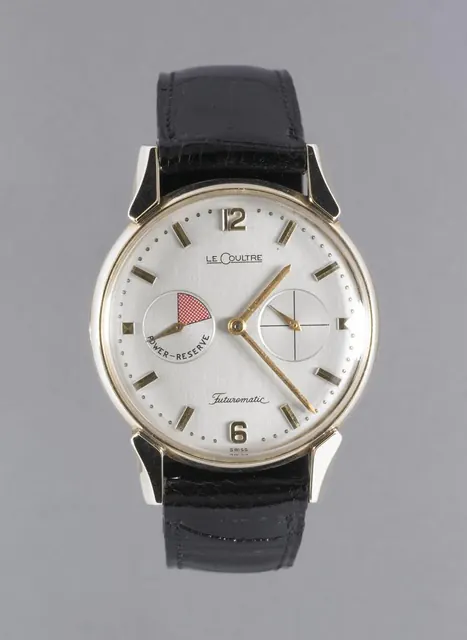
Automatic wristwatch with subsidiary seconds and power-reserve dial
British Museum
Wristwatches · mid 1960s
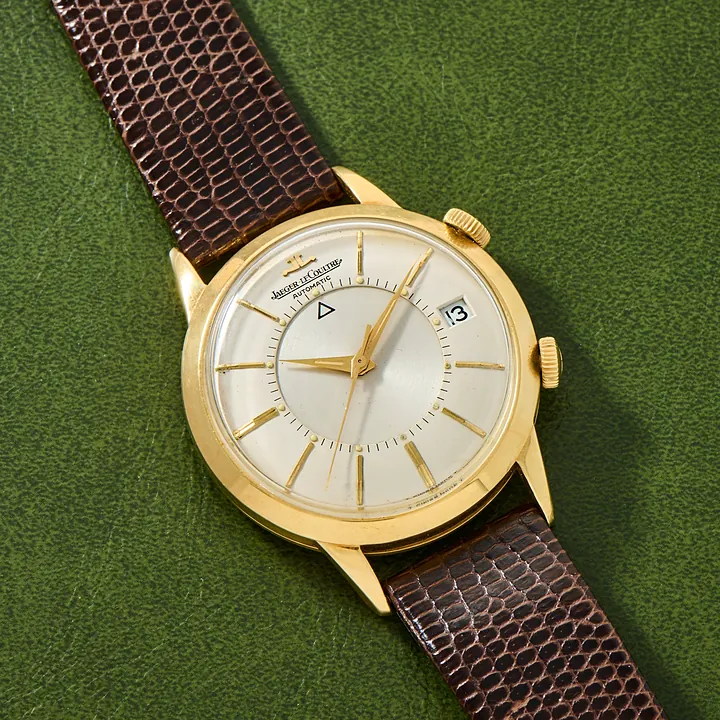
Jaeger-LeCoultre Memovox, mid 1960s
Analog/Shift (dealer), New York
Wristwatches · 1960
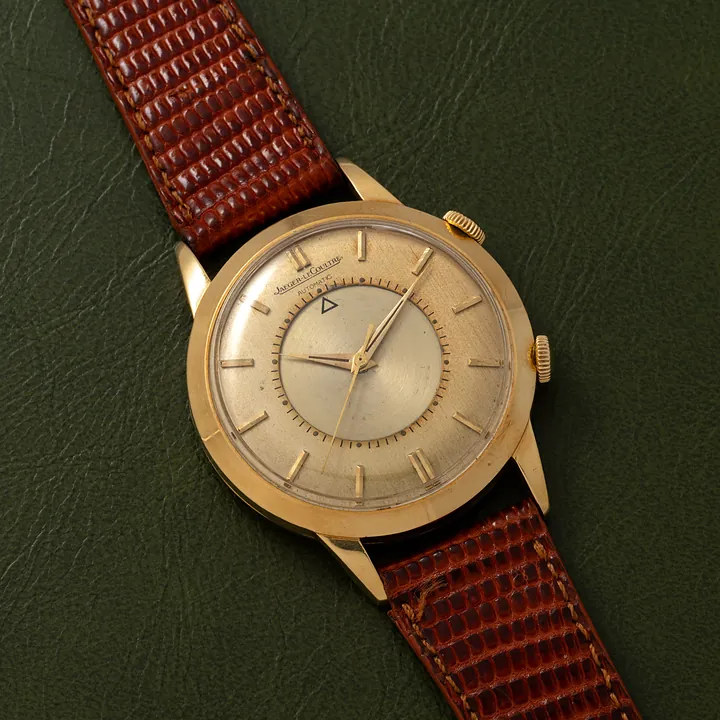
Jaeger-LeCoultre 'European Market' Memovox, 1960
Analog/Shift (dealer), New York
Wristwatches · 2010s
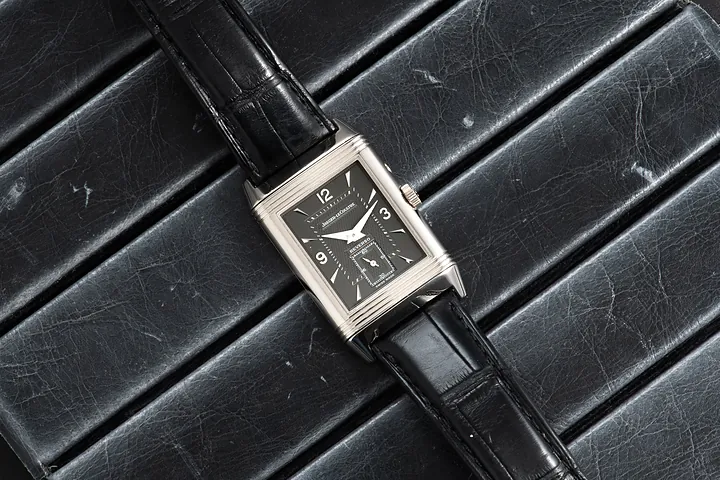
Jaeger-LeCoultre Reverso Duoface Day/Night, 2010s
Analog/Shift (dealer), New York

Wristwatches · 1945
Wristwatch by Eterna, 1945
Museum Rotterdam

Wristwatches · c. 1945
Breitling Premier, ref. 790, c. 1945
Antiquorum auction archive, Geneva

Wristwatches · c. 1945
Universal Genève Uni-Compax, ref. 22492, c. 1945
Antiquorum auction archive, Geneva
Wristwatches · c. 1950s
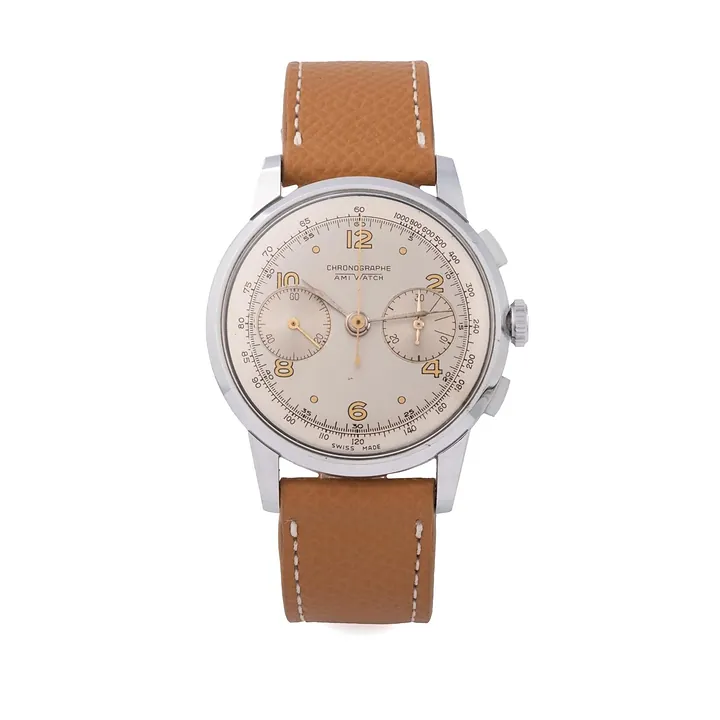
Ami Watch Chronographe, c. 1950s
Antiquorum auction archive, Geneva