
Wristwatches · Wristwatch
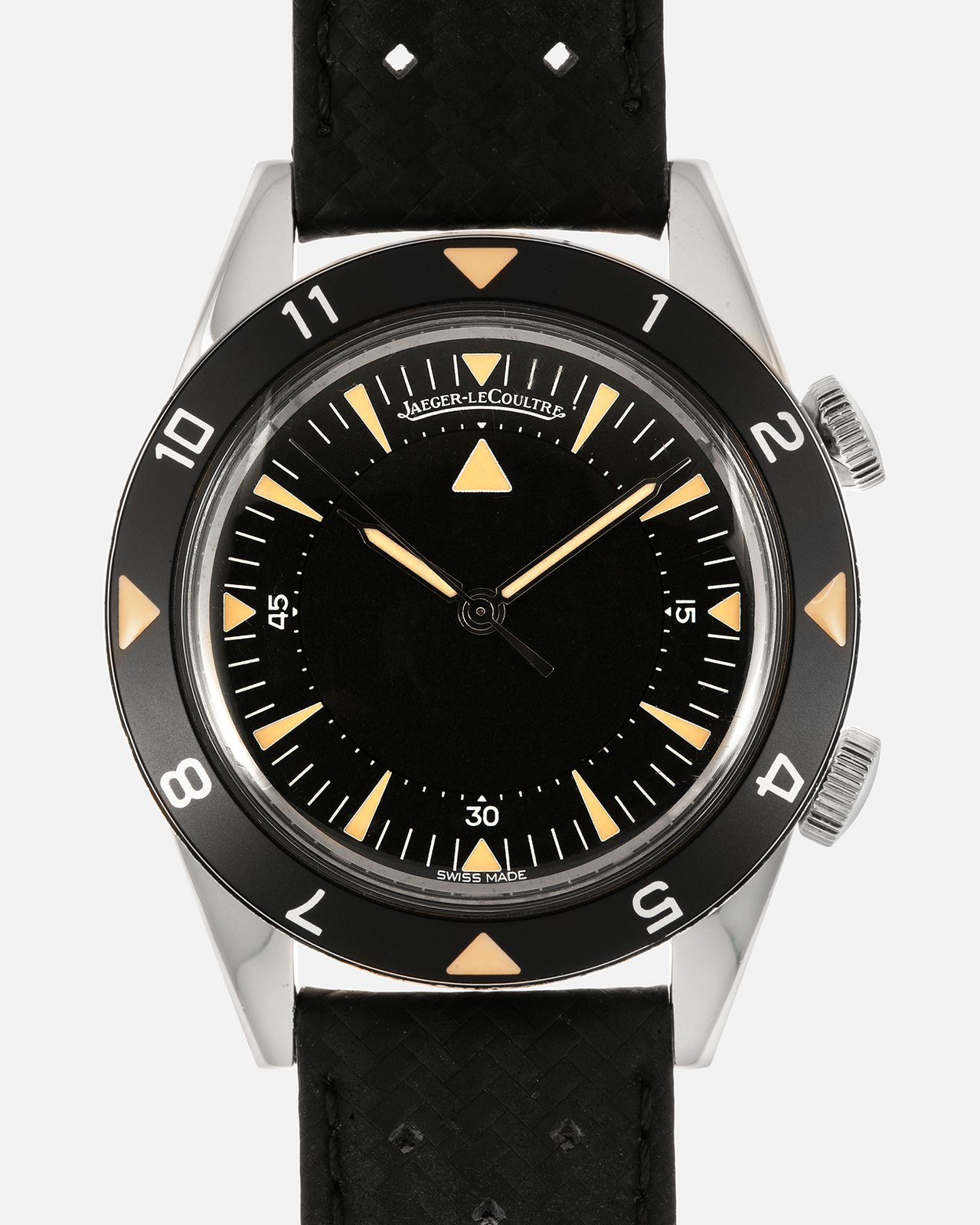
Jaeger-LeCoultre Memovox Tribute to Deep Sea European Edition, 2020
- Maker / attribution
- Jaeger-LeCoultre (maker)
- Date
- 2020
- Historical period
- Contemporary Horology (2010 – Present)
- Country of origin
- Switzerland
- Object type
- Wristwatch
- Dimensions
- Case 40.5 mm
- Stock no.
- Product 7250441404503
- Credit line
- Dealer listing, S.Song Watches (product 7250441404503)
- Catalogue title (original)
- Jaeger-LeCoultre Memovox Tribute to Deep Sea European Edition (English)
View the source record (dealer listing) ↗ (opens another website in a new tab)Suggest a correction
Record summary
Catalogued by S.Song Watches (dealer), Seattle (stock number Product 7250441404503), this is a wristwatch by Jaeger-LeCoultre, made in Switzerland, dated 2020. The Atlas places it in the Contemporary Horology period (2010 – Present) of its Wristwatches collection. Recorded dimensions: Case 40.5 mm. The record is illustrated with 6 photographs.
Assembled from the source record's structured fields. Dates and attributions are given as the source states them; where a field is missing the Atlas leaves it blank rather than estimating.
Catalogue description
Dealer description — S.Song Watches
Right off the bat, I want to say that Jaeger-LeCoultre makes the best reissues hands down and was one of the first brands that started today’s trend of drawing upon vintage pieces to create a modern incarnation. Spanning from the iconic Reversos to robust models like the Polaris, Jaeger-LeCoultre has embraced a diverse array of reissued watches. Nevertheless, this Memovox Tribute to Deep Sea, introduced in 2011, is widely revered among enthusiasts as one of their most exceptional creations. Originally introduced in 1959 as the Jaeger-LeCoultre Deep Sea Alarm, this watch stood alongside other legendary dive watches of its time such as the Rolex Submariner, Omega Seamaster 300, and Blancpain Fifty Fathoms. It distinguished itself as the first dive watch equipped with an alarm function. Notably, instead of a traditional rotating bezel for tracking dive time and ascent, Jaeger-LeCoultre utilized an inner rotating dial that activated an alarm within the watch to signal the end of a dive. The watch featured a distinctive case design with dual crowns: one positioned at two o’clock for winding and setting the alarm, and another at four o’clock for adjusting the time. Fast forward to the present day, and what we have before us today is the stunning reissue of the legendary dive watch. What captivated collectors most was Jaeger-LeCoultre's meticulous attention to detail in faithfully resurrecting the Deep Sea Alarm. Beginning with the 40.5mm stainless steel case, it's only 1mm larger than the original (which was 39.8mm), fitting impeccably and proportionally on the wrist. Completing the look, the case features beveled edges, brushed sides, and polished surfaces on the lug tops, completing its elegant aesthetic. The black dial showcases a matte finish that closely mirrors the original, down to the LeCoultre branding and the luminous syringe hands. Additionally, it features a matte anodized aluminium bezel adorned with luminous triangles at the 12, 3, 6, and 9 o'clock positions. Rather than opting for a modern sapphire crystal, Jaeger-LeCoultre chose to use plexiglass to achieve a domed crystal. While this decision might appear minor, the domed shape significantly enhances the vintage appeal—a detail which I think most connoisseurs will certainly appreciate. On the wrist, it's quite challenging to distinguish between the reissue and the original, thanks to this thoughtful little detail. All this is impressive enough, but Jaeger-LeCoultre took it a step further by making it a strictly limited piece. They introduced two versions: an American variant (inspired by the ‘LeCoultre Spécial Amérique 1959’) and a European variant (inspired by the ‘Jaeger-LeCoultre Classique 1959’)—the latter being the one presented here—with each showcasing a slightly different dial layout. The American edition was limited to 359 pieces, while the European edition, like the one shown and offered here, was limited to 959 pieces. The last two digits of each edition pay homage to the birth year of this legendary reference. Powering the watch from within is Jaeger-LeCoultre's in-house, self-winding Cal. 956, the same movement utilized in all their Memovox alarm watches. It boasts a power reserve of 45 hours when fully wound. Combining modern functionality with tasteful design restraint, the Memovox Tribute to Deep Sea stands as a formidable contender among the finest vintage reissues ever crafted, without question.
Historical context
Contemporary Horology (2010 – Present)
Silicon components, connected watches, optical-lattice research clocks and a thriving independent scene.
Smartwatches became the world's best-selling watches, while mechanical watchmaking focuses on craft, innovation (silicon components, new escapements) and independent makers.
Read the period in the timelineMore wristwatches from this periodEarlier: Mechanical Renaissance
Atlas type guide
Dive and water-resistant watches
Keeping water and dust out of a wristwatch was a long-standing challenge. Rolex's screw-down Oyster case (1926) and Omega's Marine (1932) were landmarks; in the early 1950s Blancpain's Fifty Fathoms and Rolex's Submariner defined the professional dive watch with rotating bezels for timing dives, luminous dials and high water resistance. The ISO 6425 standard (1982) later codified what a 'diver's watch' must do.
Dive watches became icons of post-war design and exploration, and their evolution — helium escape valves, ceramic bezels, saturation-diving depth ratings — records the history of underwater work.
What to look for
- Unidirectional or bidirectional rotating bezel with minute markings.
- Screw-down crown and case back; depth rating printed on the dial.
- Luminous hands and markers (radium before c. 1960, tritium c. 1960–1998, then Super-LumiNova).
- Reference numbers on the case between the lugs or inside the back.
Dating clues
- Screw-down Oyster cases: from 1926.
- Professional dive watches: from 1953.
- Tritium 'T' marks on dials: c. 1960–1998.
General guidance written by the Atlas editors about this kind of object. It is not a statement about this particular piece; for that, rely on the source record above and on physical examination.
Related records
Clocks · 1937–1938
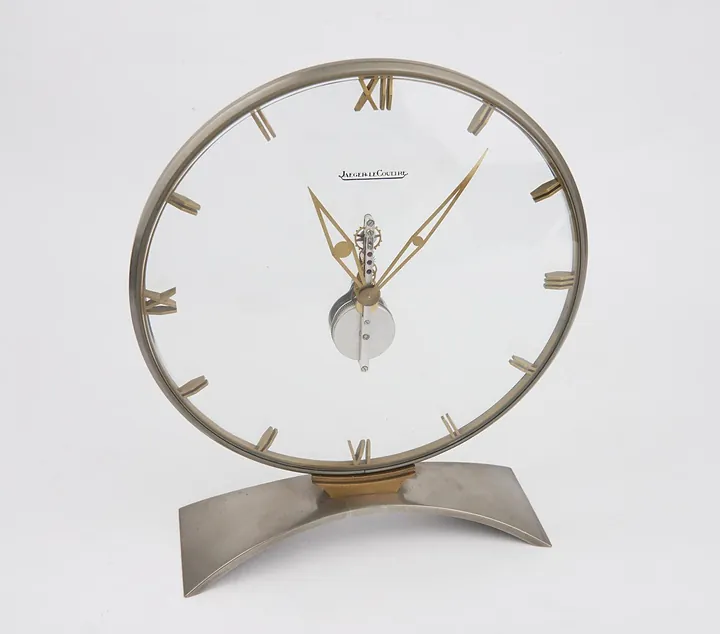
Skeleton clock by Jaeger-LeCoultre, Switzerland, 1937–1938
Science Museum Group, London
Movements & Components · 1953
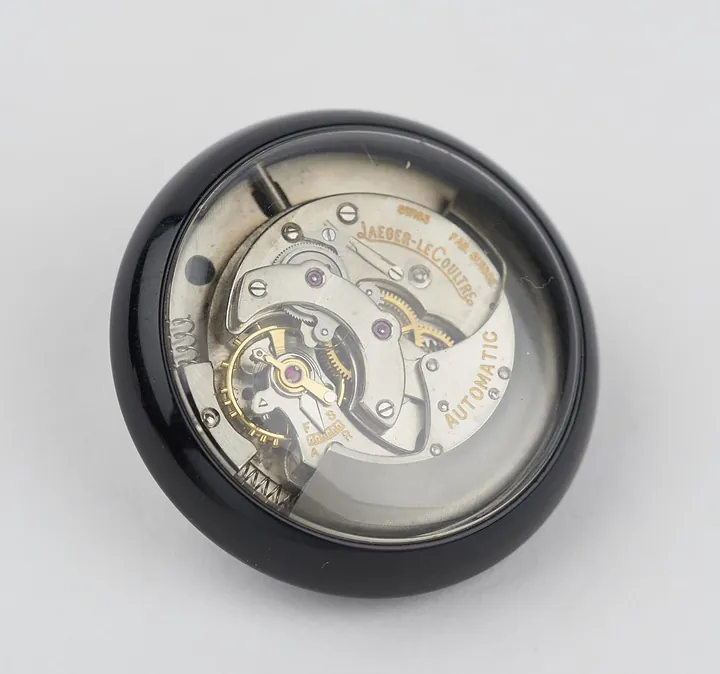
Automatic watch movement, Jaeger-LeCoultre, 1953, Geneva, Switzerland, showing self-winding mechanism
Science Museum Group, London
Wristwatches · 1953
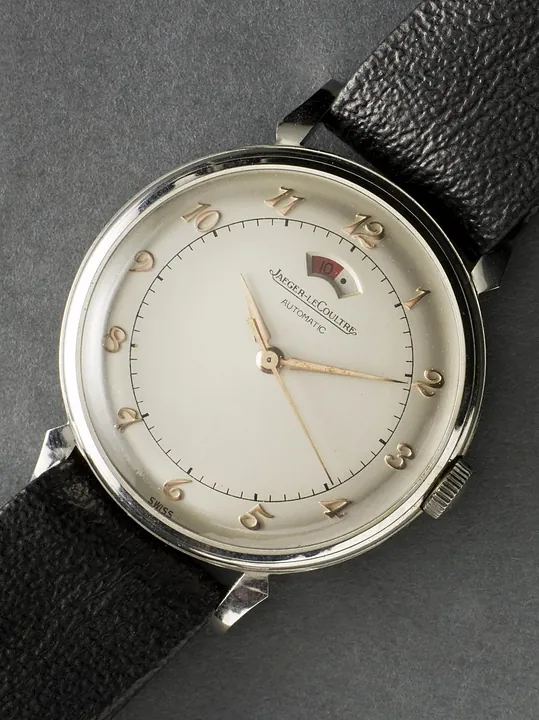
Automatic Wrist-watch, Jaeger-LeCoultre, Geneva, Switzerland, with reserve power indicator complete in steel case, 1953. Back numbered 564556.
Science Museum Group, London
Wristwatches · 1953
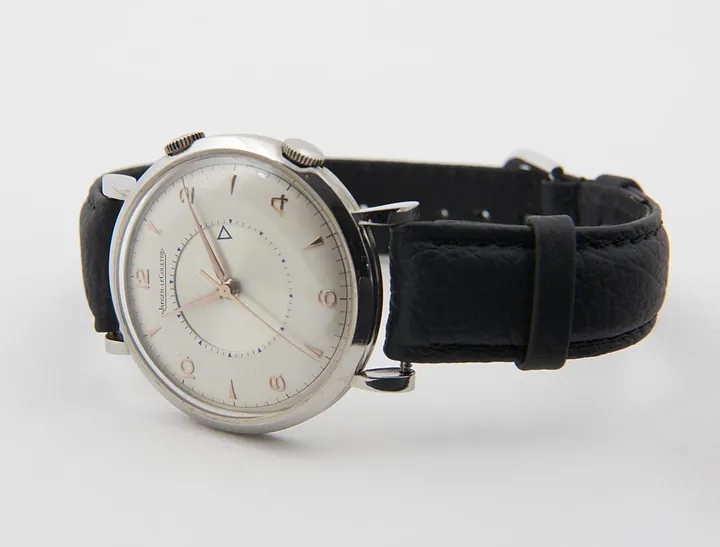
Wrist-watch, 'Memovox' alarm, Jaeger-LeCoultre, Geneva, Switzerland, complete in steel case, 1953.
Science Museum Group, London

Wristwatches · c. 2010s
Breguet Type XXI, ref. 3810, c. 2010s (Antiquorum Lot 381-24)
Antiquorum auction archive, Geneva

Wristwatches · c. 2010s
Breguet Type XXI, ref. 3810, c. 2010s (Antiquorum Lot 386-229)
Antiquorum auction archive, Geneva

Wristwatches · Sold in September 2010
Breitling Cosmonaute, ref. A 22322, Sold in September 2010
Antiquorum auction archive, Geneva

Wristwatches · c. 2010
Corum Bubble Chrono, ref. 396.150.20, c. 2010
Antiquorum auction archive, Geneva