
Wristwatches · Wristwatch
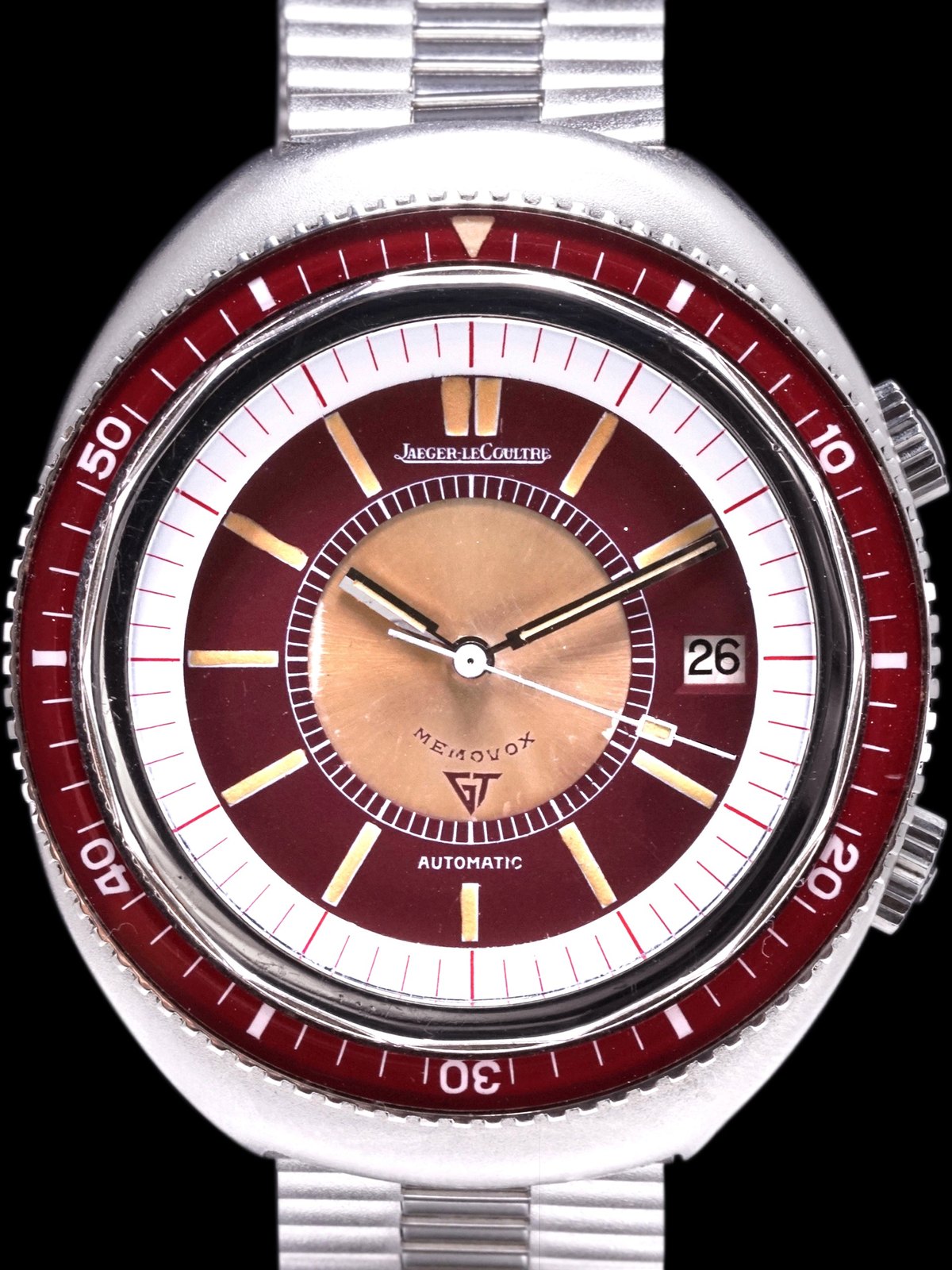
Jaeger-LeCoultre Memovox Polaris II (Ref. E870) "Cranberry", 1970s
- Maker / attribution
- Jaeger-LeCoultre (maker)
- Date
- 1970s
- Historical period
- Quartz Revolution (1969 – 1990)
- Country of origin
- Switzerland
- Object type
- Wristwatch
- Stock no.
- JLCMVPIIE870
- Credit line
- Dealer listing, Craft & Tailored (JLCMVPIIE870)
- Catalogue title (original)
- 1970s Jaeger-LeCoultre Memovox Polaris II (Ref. E870) "Cranberry" (English)
View the source record (dealer listing) ↗ (opens another website in a new tab)Suggest a correction
Record summary
Catalogued by Craft & Tailored (dealer), Los Angeles (stock number JLCMVPIIE870), this is a wristwatch by Jaeger-LeCoultre, made in Switzerland, dated 1970s. The Atlas places it in the Quartz Revolution period (1969 – 1990) of its Wristwatches collection. The record is illustrated with 6 photographs.
Assembled from the source record's structured fields. Dates and attributions are given as the source states them; where a field is missing the Atlas leaves it blank rather than estimating.
Catalogue description
Dealer description — Craft & Tailored
The Memovox is one of Jaeger-LeCoultre's most iconic and well-performing line of watches, and even though the Memovox wasn't the first alarm watch created, JLC is definitely the brand that marketed its alarm function the best. The Memovox alarm went on to inspire some of Jaeger-LeCoultre's most interesting timepieces including the Deep Sea Alarm, the original Polaris, and countless dress models. The original Jaeger-LeCoultre Polaris debuted in 1968 but only lasted until 1969 as the Quartz Crisis started to gain traction, and is one of the most sought after vintage JLC's for collectors for its innovative marriage of the dive and alarm watch designs. In the 1970s JLC revised the Polaris design, introducing vibrant color palettes and a large tonneau case design for the Polaris II, which perfectly embodies the 1970s diving watch aesthetic and maintained the iconic Memovox alarm function. SPECS Stock # JLCMVPIIE870 Brand Jaeger-LeCoultre Style Polaris II Memovox Model E870 Serial 126XXXX Size Men's Material Stainless Steel Dial Red, Gold Millimeters 43X49 Strap NSA Stretch Clasp Stainless Steel Bracelet CASE & BRACELET The large tonneau style case is believed to remain unpolished, retaining its original non-reflective bead blasted finishing. The original bi-directional ratcheting red bakelite bezel is in superb condition and exhibits no cracks or separation, the tritium triangle at the 12 o'clock position is fully intact and matches the dial patina nicely. The case retains its original twin "JL" signed crowns. The mineral glass crystal shows minimal signs of use on its surface, the white outer minute track on the underside of the crystal is in near perfect condition. The scalloped case back also retains its original finishing and displays some tool marks from previous services. The rare and original NSA stretch-clasp bracelet features a similar finishing as the case and displays almost not stretch from use and retains 29 links, which will fit an 8in. wrist. DIAL & HANDS The deep red or "cranberry" outer portion of the dial retains its strong matte texture and shows no imperfections. The inner rotating dial for setting the Memovox alarm function has aged to a beautiful champagne coloration and shows only light signs of age. The tritium markers have achieved a vibrant yellow coloration and exhibit no degradation under U.V. light inspection. The original tritium hands match the dial perfectly and show no degradation when inspected under U.V. light. ACCESSORIES
Historical context
Quartz Revolution (1969 – 1990)
Seiko's Astron begins mass quartz timekeeping; traditional industries contract sharply.
Quartz and digital watches transformed the market after 1969. Swiss employment collapsed, Japanese and Hong Kong production soared, and the Swatch (1983) helped the Swiss industry recover; mechanical watches survived as luxury goods.
Read the period in the timelineMore wristwatches from this periodEarlier: Modern Mechanical Horology
Atlas type guide
Wristwatches
Bracelet watches were worn by women from the early nineteenth century — Breguet made one for Caroline Murat, Queen of Naples, in 1810–12 — but the wristwatch only became a man's instrument with military use and aviation in the early twentieth century. Between the World Wars it overtook the pocket watch; the 1920s and 1930s brought rectangular Art Deco cases, water-resistant cases and the first automatic winding systems.
After 1945 the wristwatch became a carrier of identity — dress watches, sports and dive watches, chronographs, calendars — produced by Swiss, American, Japanese, German, Soviet and Chinese industries. The quartz revolution after 1969 and the mechanical renaissance since the 1990s, including the rise of independent watchmakers, complete the story.
What to look for
- The reference number (between the lugs or inside the case back) and serial number, the starting point for dating.
- The calibre: its maker and number are often stamped under the dial or on the bridge.
- Originality of dial, hands and crown — refinished ('redial') dials are common.
- Case material marks: 18K/750, 14K/585, stainless steel, gold-filled, plated.
Dating clues
- Wire-lug cases: before c. 1925.
- Water-resistant screw-down cases: from 1926.
- Quartz movements: from 1969; sapphire crystals widespread after c. 1980.
General guidance written by the Atlas editors about this kind of object. It is not a statement about this particular piece; for that, rely on the source record above and on physical examination.
Related records
Clocks · 1937–1938
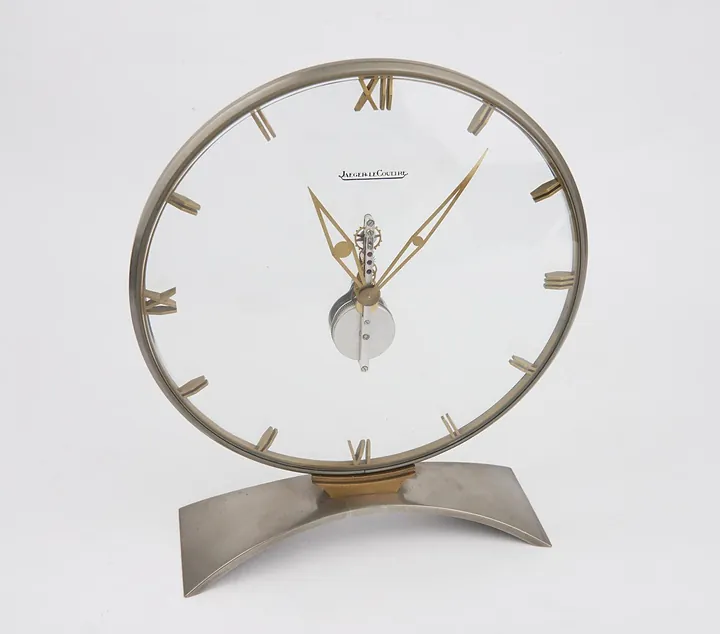
Skeleton clock by Jaeger-LeCoultre, Switzerland, 1937–1938
Science Museum Group, London
Movements & Components · 1953
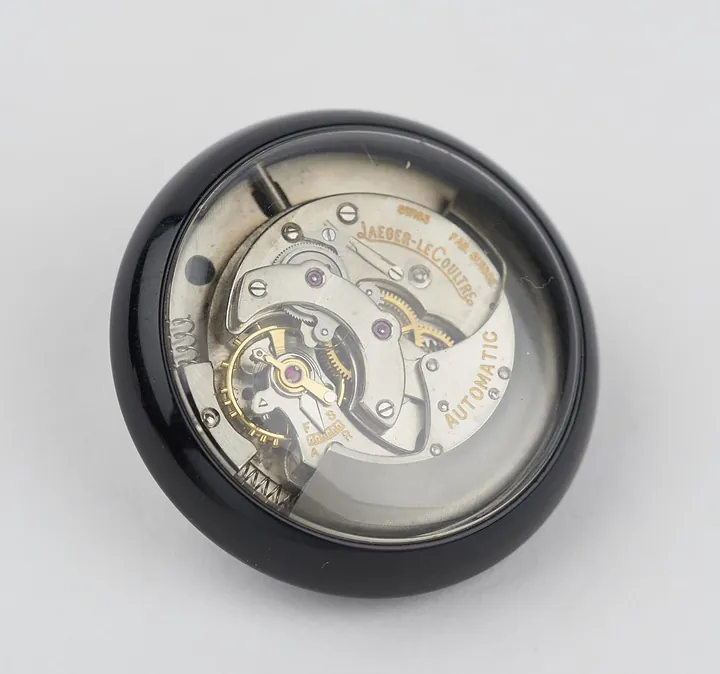
Automatic watch movement, Jaeger-LeCoultre, 1953, Geneva, Switzerland, showing self-winding mechanism
Science Museum Group, London
Wristwatches · 1953
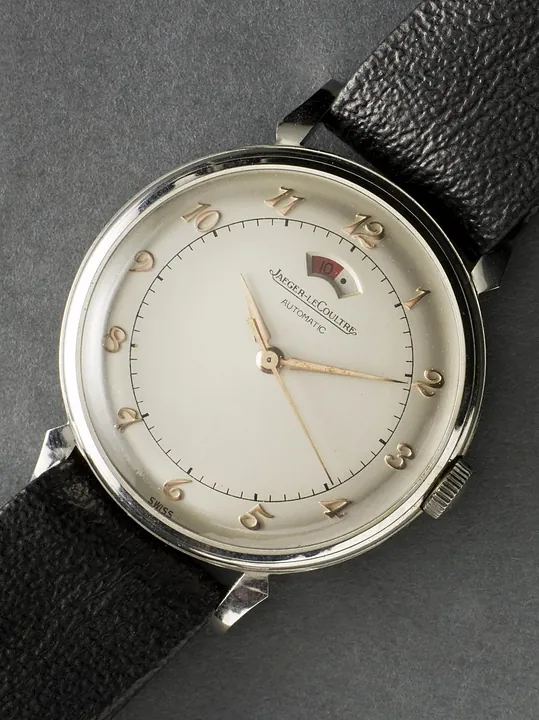
Automatic Wrist-watch, Jaeger-LeCoultre, Geneva, Switzerland, with reserve power indicator complete in steel case, 1953. Back numbered 564556.
Science Museum Group, London
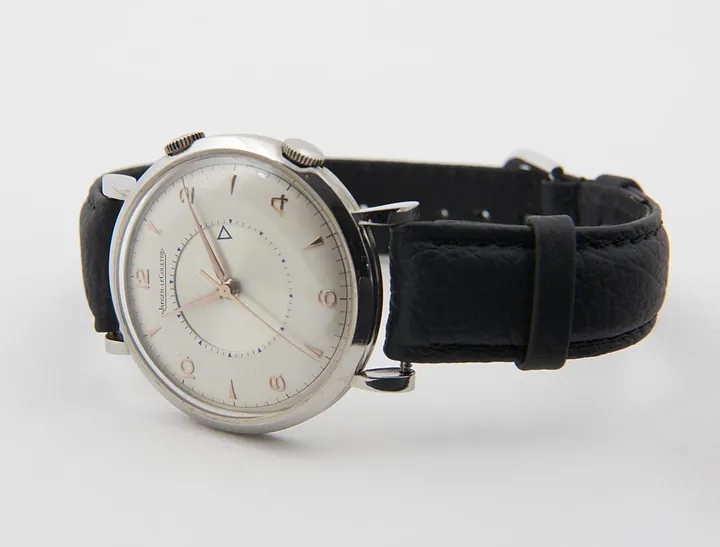
Wristwatches · 1953
Wrist-watch, 'Memovox' alarm, Jaeger-LeCoultre, Geneva, Switzerland, complete in steel case, 1953.
Science Museum Group, London

Wristwatches · 1970
Wristwatch by Heno, Switzerland, 1970
Museum Rotterdam

Wristwatches · 1960–1986
'Tri-Compax' calendar chronograph wristwatch in gold case, by Universal, Geneva, Switzerland, 1960–1986.
Science Museum Group, London

Wristwatches · 1969–1970
Beta 21 Quartz wristwatch movement, made in Switzerland, 1970.
Science Museum Group, London

Wristwatches · c. 1969
Omega Speedmaster Moonwatch, ref. 145022-69st, c. 1969
Antiquorum auction archive, Geneva