
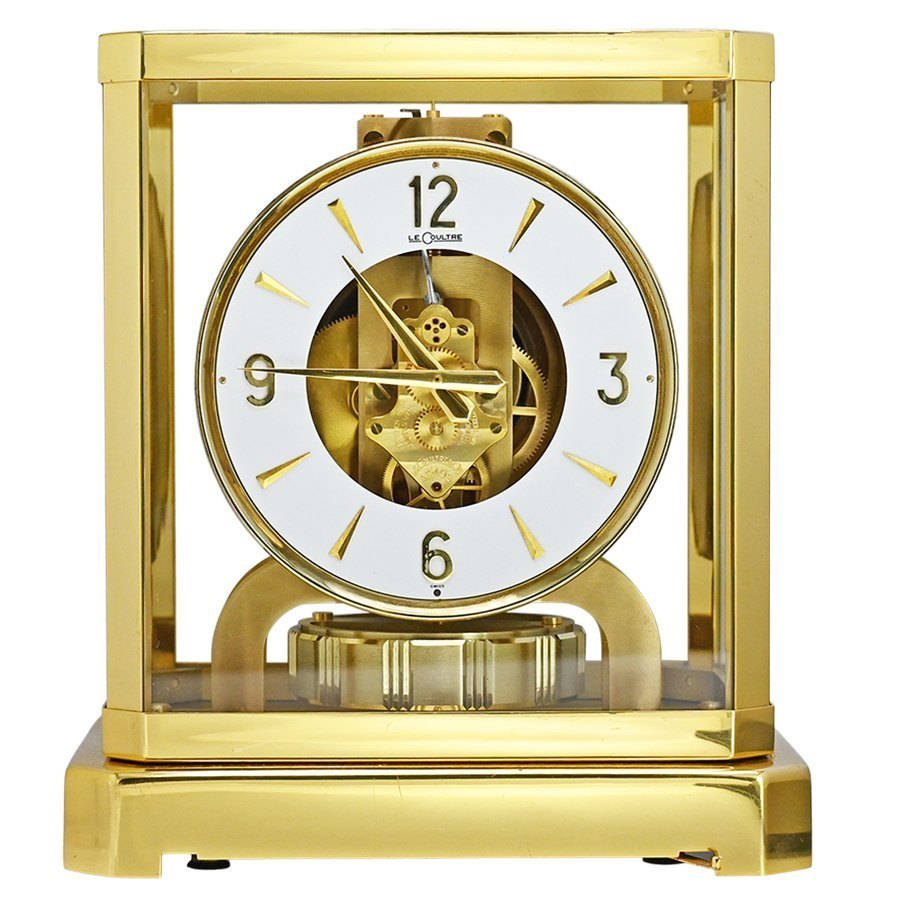
Clocks · Torsion pendulum mantel clock
Jaeger-LeCoultre Atmos Perpetual Motion Clock
- Maker / attribution
- Jaeger-LeCoultre (source attribution)
- Date
- c. 1970
- Historical period
- Quartz Revolution (1969 – 1990)
- Country of origin
- Switzerland
- Object type
- Torsion pendulum mantel clock
- Dimensions
- 9 1/2″H x 8″W x 6 1/4″D
- Holding institution
- Renaissance Antiques
- Accession / object no.
- JOLE 1 P
- Credit line
- Renaissance Antiques
- Catalogue title (original)
- Swiss Atmos Perpetual Motion Clock By Jaeger-LeCoultre - Renaissance Antiques (English)
View the source record ↗ (opens another website in a new tab)Suggest a correction
Record summary
Held and catalogued by Renaissance Antiques (object number JOLE 1 P), this is a torsion pendulum mantel clock attributed to Jaeger-LeCoultre, made in Switzerland, dated c. 1970. The Atlas places it in the Quartz Revolution period (1969 – 1990) of its Clocks collection. Recorded dimensions: 9 1/2″H x 8″W x 6 1/4″D. The record is illustrated with 1 photograph.
Assembled from the source record's structured fields. Dates and attributions are given as the source states them; where a field is missing the Atlas leaves it blank rather than estimating.
Catalogue description
Original object description
Originating in Switzerland, this Jaeger-LeCoultre Atmos mantel timepiece is housed in a rectangular gilt-brass case measuring 9 1/2 inches high by 8 inches wide and 6 1/4 inches deep. Glazed panels set into the front, flanks, and upper surface grant complete visibility of the internal mechanics, including its suspended, fluted cylindrical torsion pendulum. The timepiece is driven by an 11-jewel mechanism powered mechanically by shifts in environmental temperature and barometric pressure, operating via the thermal expansion and contraction of atmospheric gases. Its dial design pairs an openwork skeletonized center revealing the brass movement plates and gear train with a white chapter ring, alternatively described in vendor notes as white enamel. Gilt hands—termed sword hands in seller documentation—sweep across applied dart indices (or sword markers) and Arabic numerals positioned at the quarter hours. Inscriptions on the dial include 'LECOULTRE' located under the 12 o'clock hour and 'SWISS' positioned at the base below the 6 o'clock index. While dated by the seller to circa 1970, no specific movement caliber, serial number, or model reference is identified in the records or apparent in the catalogue photographs.
Historical context
Quartz Revolution (1969 – 1990)
Seiko's Astron begins mass quartz timekeeping; traditional industries contract sharply.
Quartz movements and digital displays made accurate clocks cheap and ubiquitous after the early 1970s. LED and LCD clocks, clock radios and radio-controlled clocks appeared, while traditional mechanical clockmaking contracted sharply in Germany, France and Britain.
Read the period in the timelineMore clocks from this periodEarlier: Modern Mechanical Horology
Atlas type guide
Mantel and French pendule clocks
The mantel clock — the French pendule de cheminée — is as much decorative art as timekeeper. From the late seventeenth century Parisian clockmakers worked with cabinet-makers, bronze founders and gilders (ciseleurs-doreurs) to create cases in Boulle marquetry, gilt bronze and marble, while the movements were often supplied by specialist makers. Clocks of the Louis XIV, Louis XV and Louis XVI periods, and Empire clocks with allegorical figures, set fashions copied across Europe.
The nineteenth century industrialised the type. The 'Paris movement', a standardised round movement with silk-thread or Brocot suspension and count-wheel striking, was made in huge numbers by firms such as Japy and Vincenti, and fitted into cases of every style and material.
What to look for
- Round 'Paris' movements with makers' stamps (e.g. Japy Frères, Vincenti, S. Marti) and medal marks from exhibitions.
- Suspension type: silk thread (earlier) or Brocot adjustable suspension (after c. 1840).
- Visible Brocot escapement on the dial in later clocks.
- Fire-gilt (mercury) gilding on bronzes versus later electro-gilding.
- Signed dials naming a retailer rather than the movement maker.
Dating clues
- Silk-suspension Paris movements: c. 1800–1850.
- Brocot suspension and visible escapements: after c. 1840.
- Exhibition medal stamps on movements give dates after the medal year.
General guidance written by the Atlas editors about this kind of object. It is not a statement about this particular piece; for that, rely on the source record above and on physical examination.
Read next:Anchor (recoil) escapement
Related records
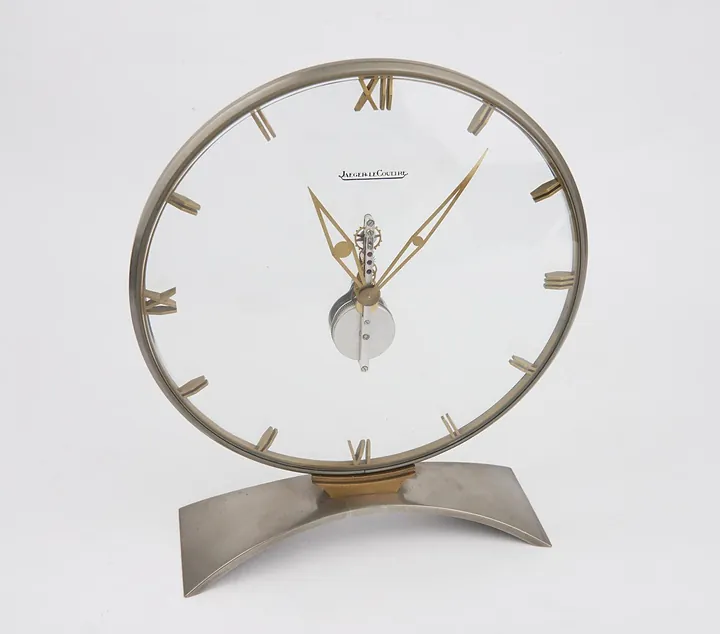
Clocks · 1937–1938
Skeleton clock by Jaeger-LeCoultre, Switzerland, 1937–1938
Science Museum Group, London
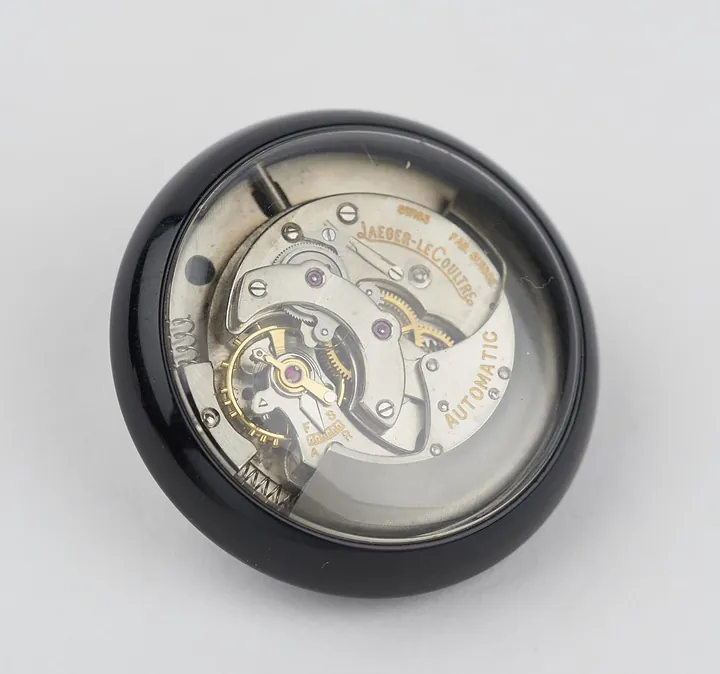
Movements & Components · 1953
Automatic watch movement, Jaeger-LeCoultre, 1953, Geneva, Switzerland, showing self-winding mechanism
Science Museum Group, London
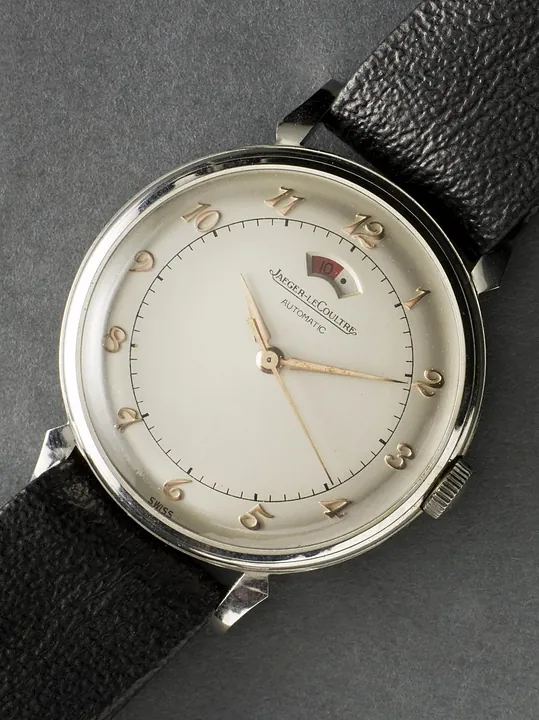
Wristwatches · 1953
Automatic Wrist-watch, Jaeger-LeCoultre, Geneva, Switzerland, with reserve power indicator complete in steel case, 1953. Back numbered 564556.
Science Museum Group, London
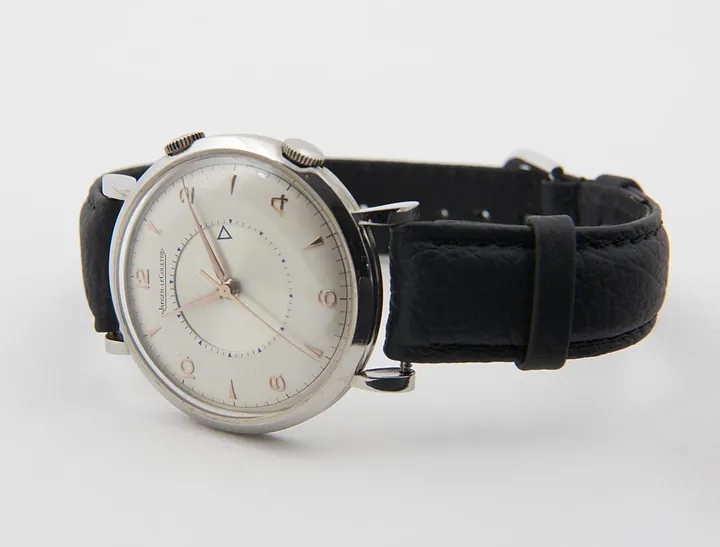
Wristwatches · 1953
Wrist-watch, 'Memovox' alarm, Jaeger-LeCoultre, Geneva, Switzerland, complete in steel case, 1953.
Science Museum Group, London
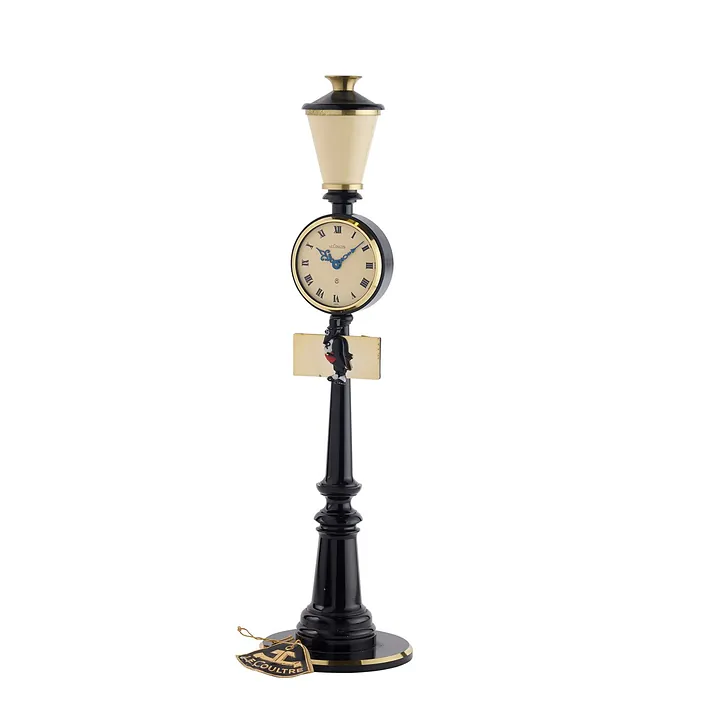
Clocks · c. 1960-1970s
Lecoultre Street Light Lamp, ref. 397, c. 1960-1970s
Antiquorum auction archive, Geneva
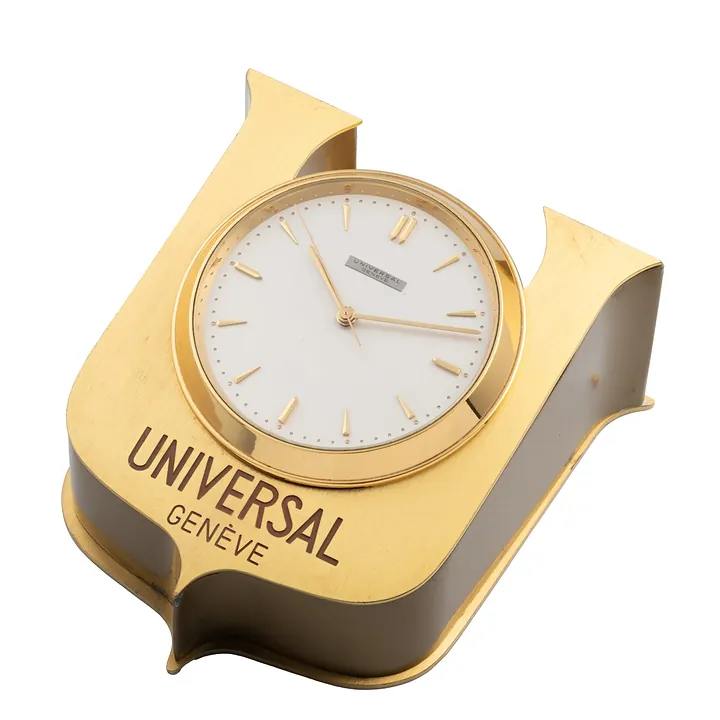
Clocks · c. 1960-1970s
Universal Genève clock, ref. 999.116.01, c. 1960-1970s
Antiquorum auction archive, Geneva

Clocks · 1965–1975
Quartz master clock QM 1, with movement by Patek Phillippe, Switzerland, 1965–1975. Supplied by English Clock Systems.
Science Museum Group, London
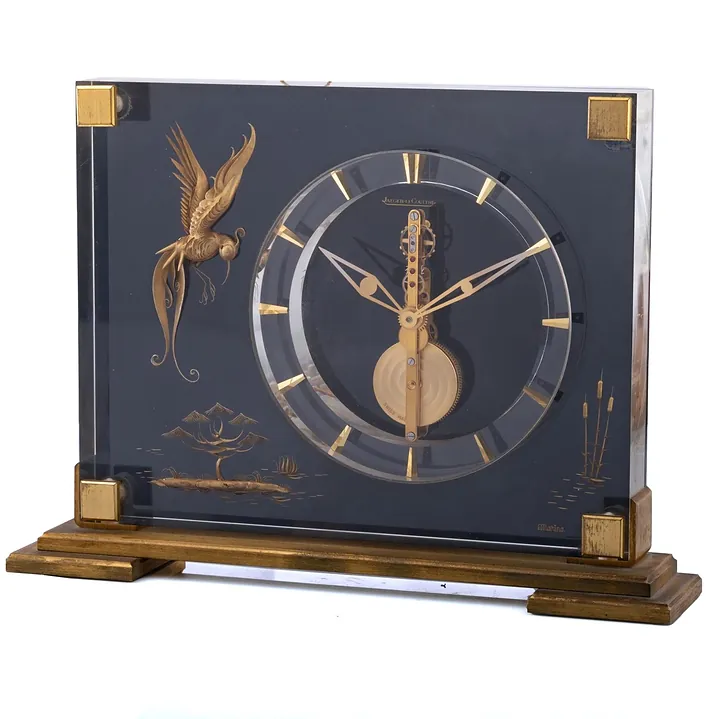
Clocks · c. 1970
Jaeger Lecoultre Table Clock, c. 1970
Antiquorum auction archive, Geneva