
Instruments · Deck watch
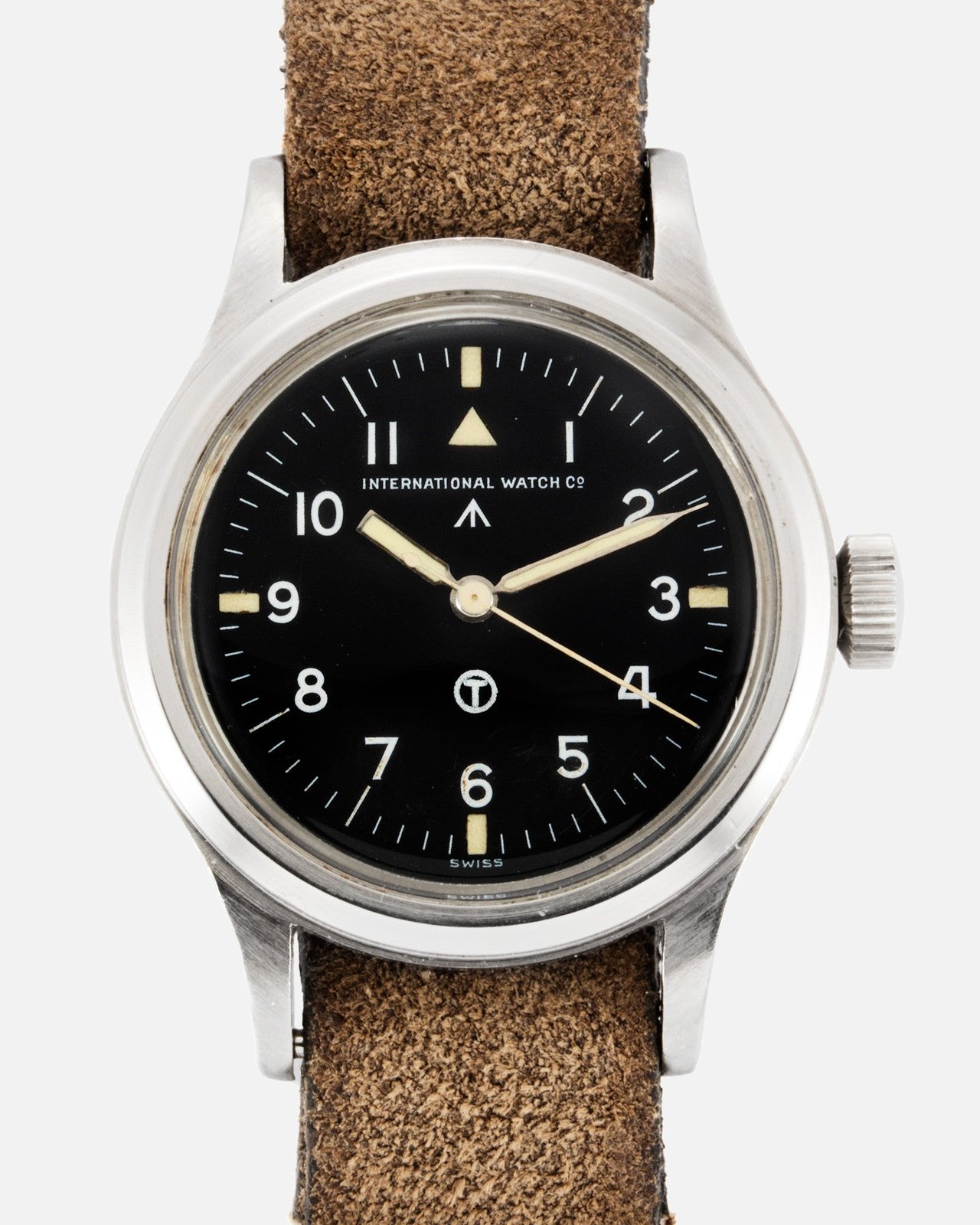
IWC Mk 11 RAF, 1950
- Maker / attribution
- IWC (maker)
- Date
- 1950
- Historical period
- Modern Mechanical Horology (1945 – 1969)
- Country of origin
- Switzerland
- Object type
- Deck watch
- Stock no.
- Product 11079264268
- Credit line
- Dealer listing, S.Song Watches (product 11079264268)
- Catalogue title (original)
- IWC Mk 11 RAF (English)
View the source record (dealer listing) ↗ (opens another website in a new tab)Suggest a correction
Record summary
Catalogued by S.Song Watches (dealer), Seattle (stock number Product 11079264268), this is a deck watch by IWC, made in Switzerland, dated 1950. The Atlas places it in the Modern Mechanical Horology period (1945 – 1969) of its Instruments collection. The record is illustrated with 6 photographs.
Assembled from the source record's structured fields. Dates and attributions are given as the source states them; where a field is missing the Atlas leaves it blank rather than estimating.
Catalogue description
Dealer description — S.Song Watches
The Mk 11 wristwatch issued to the British Royal Air Force (RAF) was aviation’s equivalent to the marine chronometer- aptly nicknamed the air chronometer. Considered by many to be the original Pilot’s watch, it was made to the incredibly strict 6B/346 specifications and was one of the costliest commissions for a wristwatch by a military. Some of the 6B/346 specs included the need to be regulated or adjusted to a chronometer level, the need for a hacking function, for it to be waterproof and to be anti-magnetic. These all stemmed from real needs from pilot’s in the RAF who relied on these watches both for navigation and timing purposes. The Mk 11 watches can lay claim to be the first watch that was built from the ground up to be antimagnetic. With a thick iron dial and a soft iron dust cap, this created a Faraday cage, protecting the movement from any interference from the other equipment on the plane. It was, without doubt the most advanced watch issued to the military at the time. This example features a ’T’ stamped dial, indicating that at some point, the luminous material was changed by the Ministry of Defence (MoD) from the harmful radium to tritium. Often misnamed as a Mark 11 or Mark XI, the correct spelling according to the MoD is actually Mk 11. A perennial favourite amongst collectors partly due to its utilitarian no-nonsense layout and incredible quality, the Mk 11 is a great casual watch to wear as a daily beater. With only roughly 8000 pieces produced, this is considered a rare timepiece rich in historical provenance.
Historical context
Modern Mechanical Horology (1945 – 1969)
Tool watches for divers, pilots and astronauts; electric watches anticipate the electronic age.
Electronic instruments, quartz frequency standards and the first atomic clocks transformed precision timing in laboratories and broadcasting.
Read the period in the timelineMore instruments from this periodEarlier: Golden Age of Mechanical Watchmaking
Atlas type guide
Marine chronometers
A marine chronometer is a precision timekeeper carried at sea to find longitude: the navigator compares local noon, observed with a sextant, with the time at a reference meridian kept by the chronometer. Each hour of difference corresponds to fifteen degrees of longitude. John Harrison proved the method in the 1760s; Pierre Le Roy, Ferdinand Berthoud, John Arnold and Thomas Earnshaw then developed the detent escapement and the compensation balance that made chronometers practical to manufacture.
By the nineteenth century London, Liverpool, Le Locle and Glashütte supplied navies and merchant fleets. A typical box chronometer has a spring-detent escapement, a fusee to equalise mainspring torque, a bimetallic compensation balance with a helical balance spring, and is mounted in gimbals inside a wooden box so that it stays level.
What to look for
- Gimbals and a three-tier wooden box with a glazed inner lid.
- A power-reserve ('up and down') indicator on the dial, usually showing 56 hours on two-day instruments.
- Spring-detent escapement and a cylindrical (helical) balance spring visible through the movement.
- Admiralty or navy marks (broad arrow), and rating certificates from observatories.
- The maker's number on the dial and movement; many makers' registers survive, allowing dating.
Dating clues
- Earnshaw-type spring-detent chronometers became standard after about 1800.
- Auxiliary compensation devices on the balance appear from the mid-nineteenth century.
- Quartz and radio time signals ended routine use of mechanical chronometers in the 1970s and 1980s.
General guidance written by the Atlas editors about this kind of object. It is not a statement about this particular piece; for that, rely on the source record above and on physical examination.
Read next:Spring detent (chronometer) escapementFuseeBalance spring (hairspring)Detent escapement
Related records
Pocket Watches · c. 1950
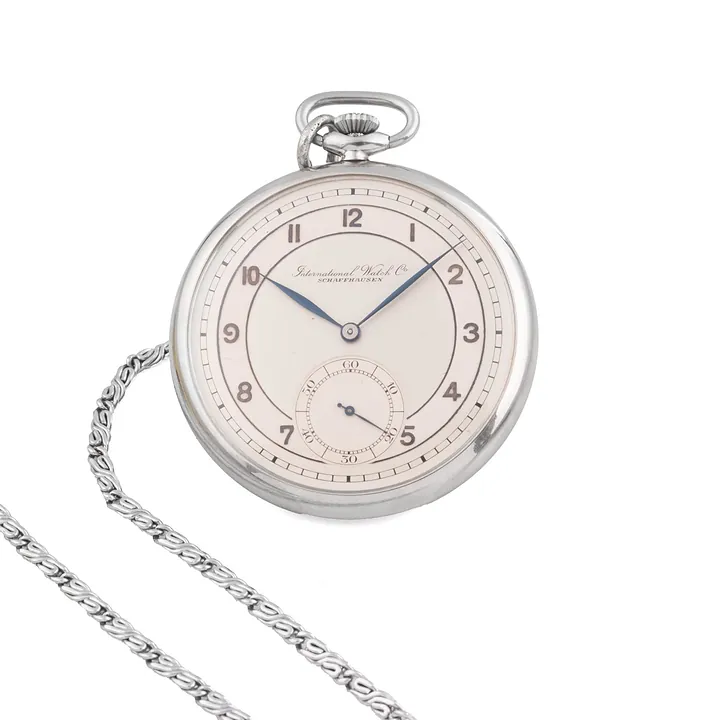
IWC Pocket Watch, c. 1950
Antiquorum auction archive, Geneva
Pocket Watches · c. 1980
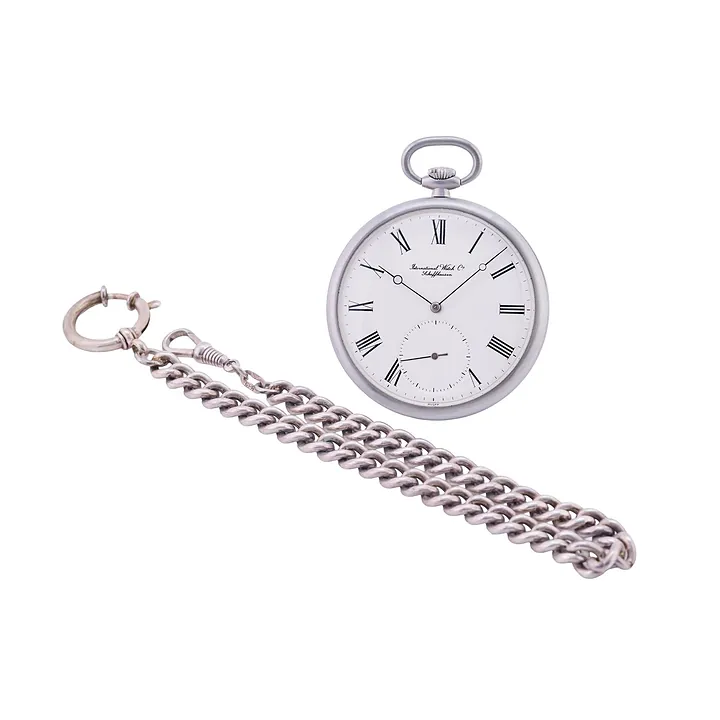
IWC pocket watch, ref. 5301, c. 1980
Antiquorum auction archive, Geneva
Wristwatches · originally sold in April 2016 (per the lot record)
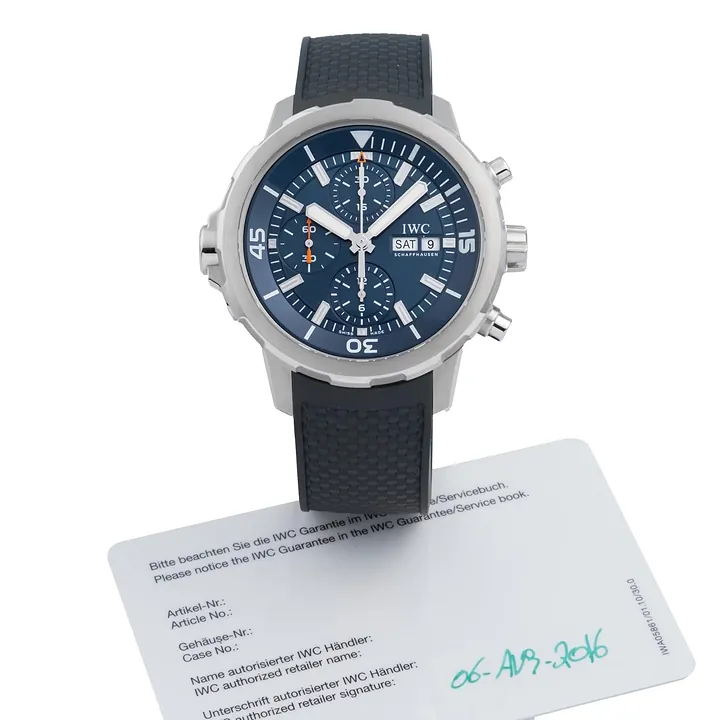
IWC Aquatimer Chronograph Cousteau, ref. IW3768, originally sold in April 2016
Antiquorum auction archive, Geneva
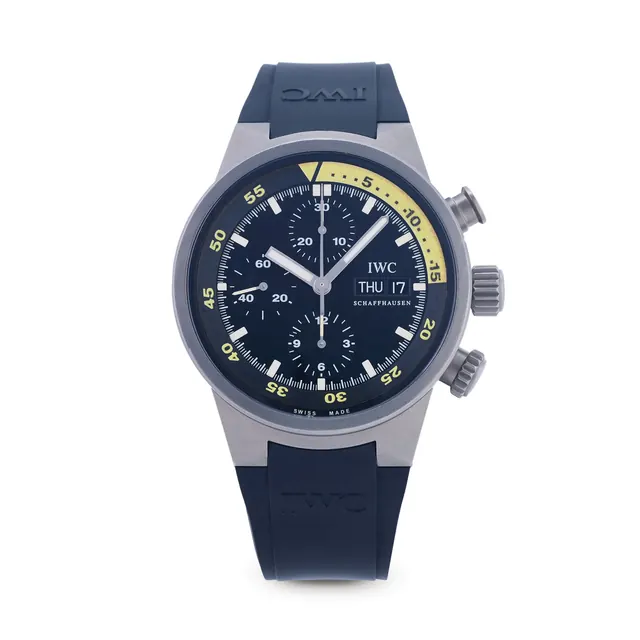
Wristwatches · c. 2010s
IWC wristwatch, ref. IW371918, Aquatimer, circa 2010s
Antiquorum auction archive, Geneva

Instruments · 1950–1976
Omega Megaquartz 2400 marine chronometer, 1950–1976
Science Museum Group, London
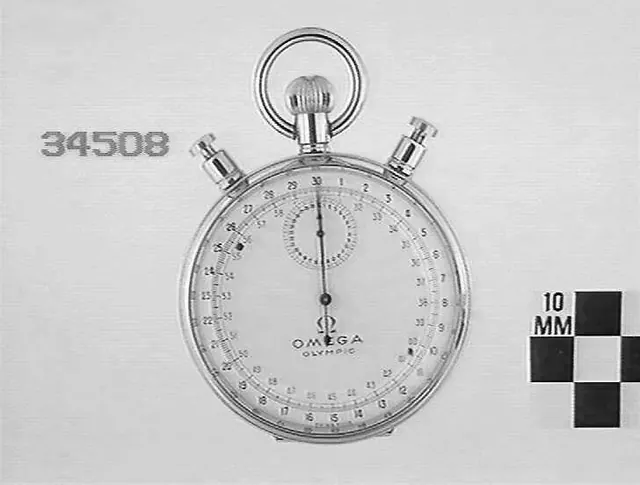
Instruments · c. 1955
Stop Watch - Omega, Switzerland, c. 1955
Museums Victoria, Melbourne
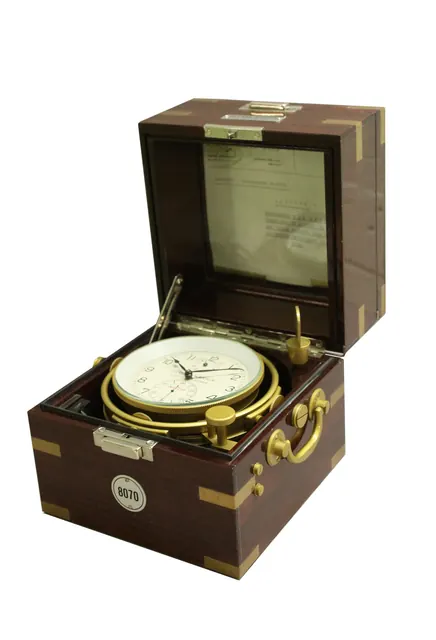
Instruments · 1954–1957
Marine chronometer by Ulysse Nardin, Switzerland, 1954–1957
Tiedemuseo Liekki
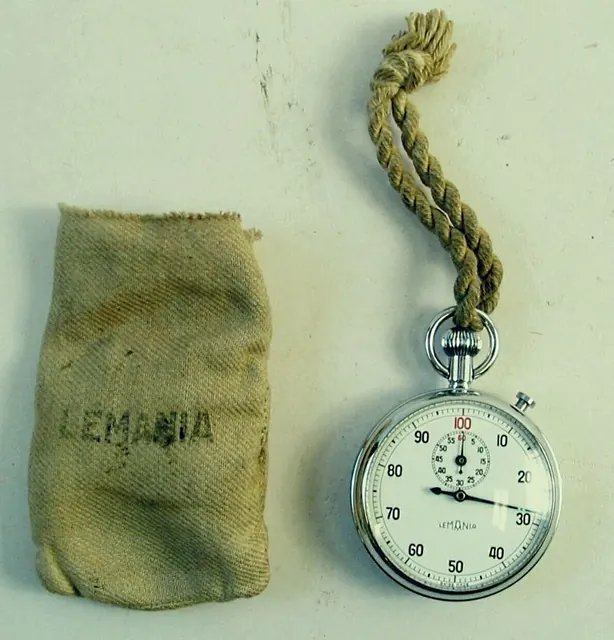
Instruments · 1950–1970
Stopwatch by Lemania, Switzerland, 1950–1970
Museokeskus Vapriikki