
Wristwatches · Wristwatch
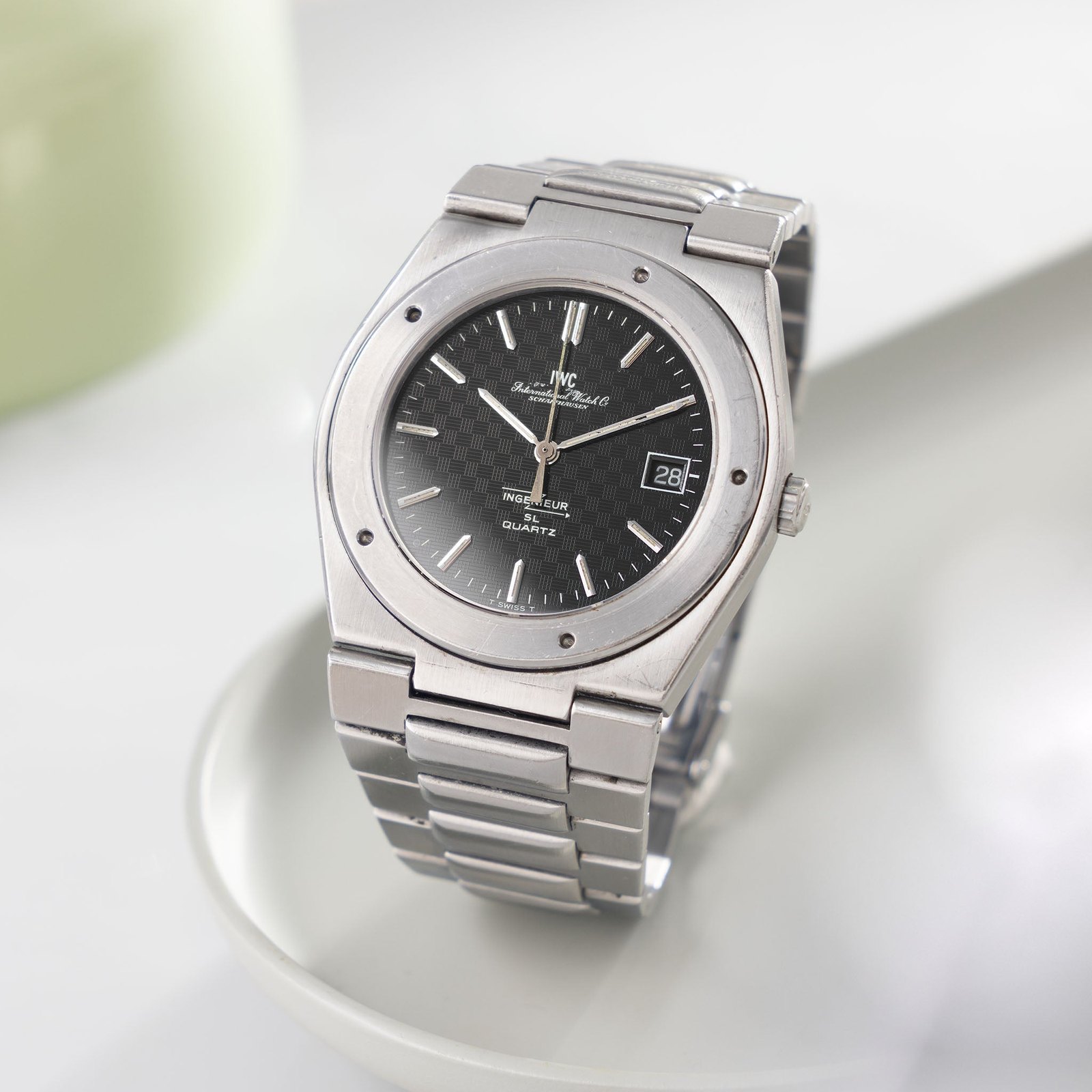
IWC Ingenieur SL Jumbo Quartz Black Dial Ref. 3303, early 1980s
- Maker / attribution
- IWC (maker)
- Date
- early 1980s
- Historical period
- Quartz Revolution (1969 – 1990)
- Country of origin
- Switzerland
- Object type
- Wristwatch
- Dimensions
- Case 40 mm
- Stock no.
- W-3079
- Credit line
- Dealer listing, Bulang & Sons (W-3079)
- Catalogue title (original)
- IWC Ingenieur SL Jumbo Quartz Black Dial Ref. 3303 (English)
View the source record (dealer listing) ↗ (opens another website in a new tab)Suggest a correction
Record summary
Catalogued by Bulang & Sons (dealer), Copenhagen (stock number W-3079), this is a wristwatch by IWC, made in Switzerland, dated early 1980s. The Atlas places it in the Quartz Revolution period (1969 – 1990) of its Wristwatches collection. Recorded dimensions: Case 40 mm. The record is illustrated with 6 photographs.
Assembled from the source record's structured fields. Dates and attributions are given as the source states them; where a field is missing the Atlas leaves it blank rather than estimating.
Catalogue description
Dealer description — Bulang & Sons
The IWC Ingenieur was first introduced in 1954 as a tool watch specifically designed for engineers and technicians who needed a timepiece that could withstand magnetic fields and harsh environments. The original model featured a soft iron inner case to protect the movement from magnetic interference. Over the years, while the design has evolved, the Ingenieur has always remained true to its original purpose: a rugged, reliable timepiece built for professionals. In the mid-1970s, IWC enlisted the renowned designer Gerald Genta to update the Ingenieur’s design, resulting in a more modern, fashionable aesthetic. The “Genta” Ingenieur debuted in 1976 and hit stores in 1977, featuring a large case with an integrated bracelet and powered by the automatic c.8541ES movement. To adapt, IWC released two quartz versions: the first with the quartz calibre 2405, followed by a slimmer model with the quartz calibre 2250, a more comfortable bracelet, and a refined case design. In 1980, the ref. 3303 replaced the ref. 3003, offering a flatter case and the same quartz calibre 2250. The present watch is a rare and highly sought-after IWC “Genta” Ingenieur reference 3303, featuring a quartz movement. With only 149 examples ever produced, and even fewer appearing on the market, this timepiece is truly a collector's gem! We’re especially fond of the stunning black "waffle dial," a signature design element from IWC that almost resembles carbon fiber. The iconic Genta-designed three-row bracelet is in excellent condition, fitting wrists up to 18.5 cm, and the signature “fish crown” remains intact. The watch has been fully checked by our watchmaker and is fitted with a fresh battery. Reach out to us to learn more about this cool, iconic IWC designed by Genta! Specifications: - IWC Ingenieur SL Reference 3303 - 40mm steel case - Serial 226xxx dating to the early 1980s - Black ‘waffle’ dial - Pencil hands - Integrated three-row steel bracelet - IWC calibre 2250 quartz movement - Fully checked by our watchmaker
Historical context
Quartz Revolution (1969 – 1990)
Seiko's Astron begins mass quartz timekeeping; traditional industries contract sharply.
Quartz and digital watches transformed the market after 1969. Swiss employment collapsed, Japanese and Hong Kong production soared, and the Swatch (1983) helped the Swiss industry recover; mechanical watches survived as luxury goods.
Read the period in the timelineMore wristwatches from this periodEarlier: Modern Mechanical Horology
Atlas type guide
Quartz, digital and electronic watches
Electronic watches arrived in three steps. The Hamilton Electric 500 (1957) was the first battery-powered wristwatch, still with a balance; Bulova's Accutron (1960) used a tuning fork. On 25 December 1969 Seiko released the Astron 35SQ, the first quartz wristwatch, closely followed by the Swiss Beta 21 group. In 1972 Hamilton's Pulsar introduced the LED digital watch, and LCD displays soon made digital watches cheap.
The 'Quartz Crisis' that followed devastated the Swiss mechanical industry, which lost two-thirds of its workforce between 1970 and 1984 before recovering with the Swatch (1983) and the luxury mechanical revival. Solar, radio-controlled, kinetic and connected smartwatches continue the electronic line.
What to look for
- Battery hatch in the case back and calibre markings with 'Quartz' or a crystal frequency.
- Display technology: LED (red, push-button) versus LCD (always-on).
- Tuning-fork hum and a smoothly sweeping seconds hand on Accutrons.
- Model and reference numbers, often printed on the back.
Dating clues
- Electric balance watches: from 1957.
- Tuning-fork watches: 1960–c. 1977.
- Quartz analogue: from December 1969; LED digital: 1972–c. 1978; LCD from 1973.
General guidance written by the Atlas editors about this kind of object. It is not a statement about this particular piece; for that, rely on the source record above and on physical examination.
Read next:Seiko calibre 35A (Astron)
Related records
Pocket Watches · c. 1950
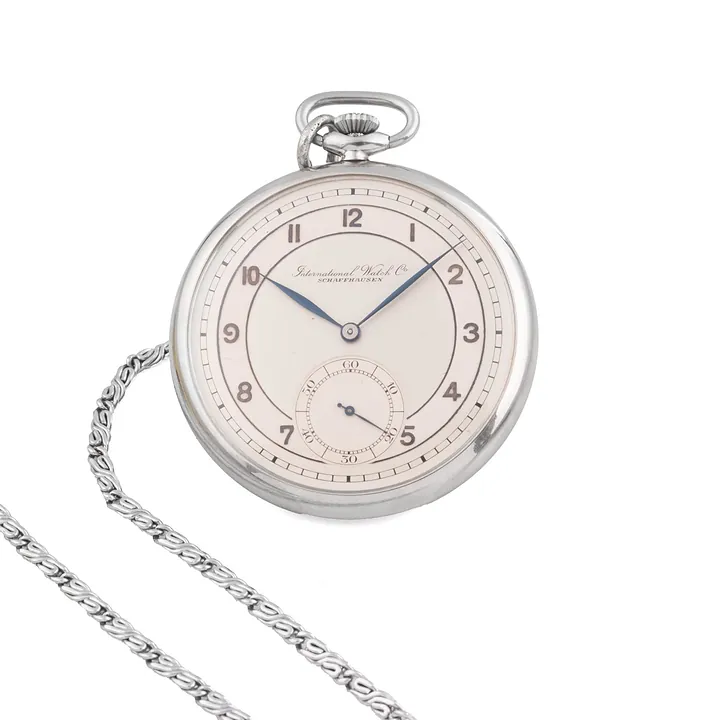
IWC Pocket Watch, c. 1950
Antiquorum auction archive, Geneva
Pocket Watches · c. 1980
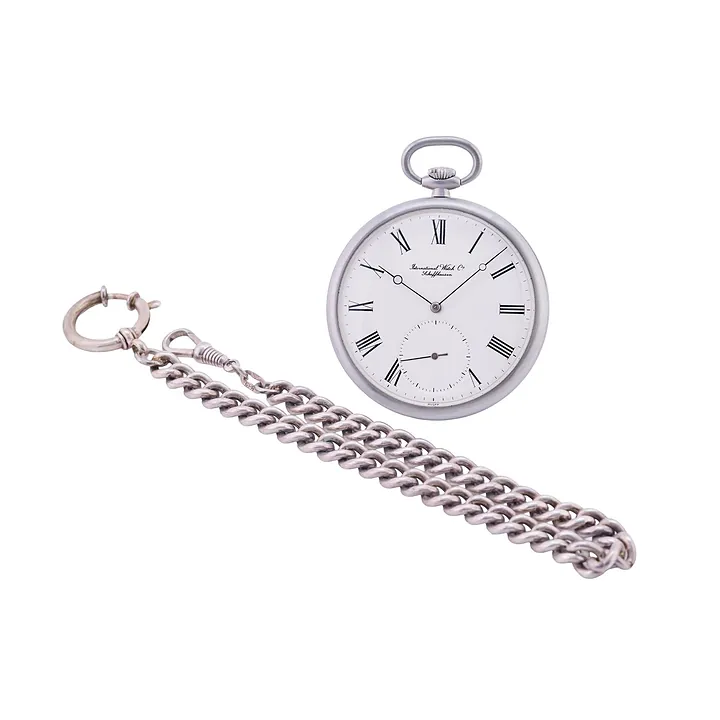
IWC pocket watch, ref. 5301, c. 1980
Antiquorum auction archive, Geneva
Wristwatches · originally sold in April 2016 (per the lot record)
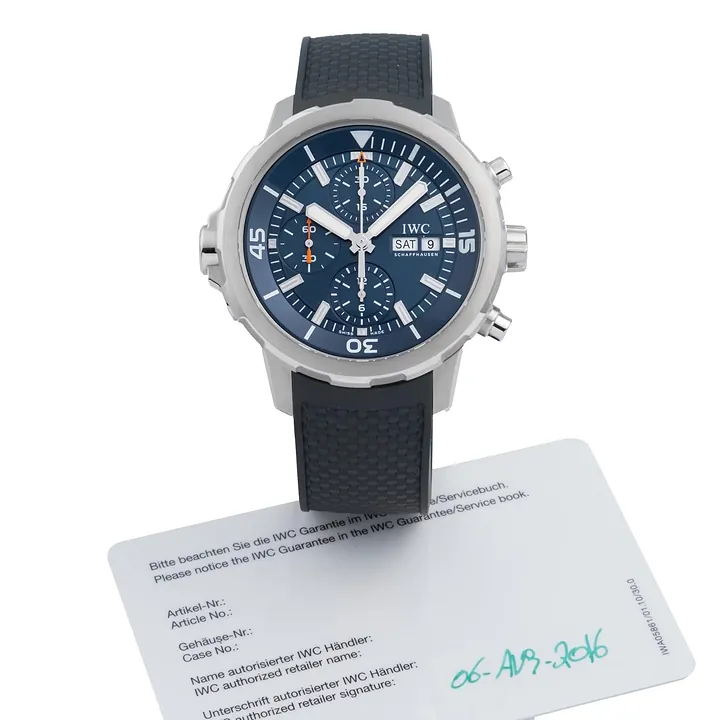
IWC Aquatimer Chronograph Cousteau, ref. IW3768, originally sold in April 2016
Antiquorum auction archive, Geneva
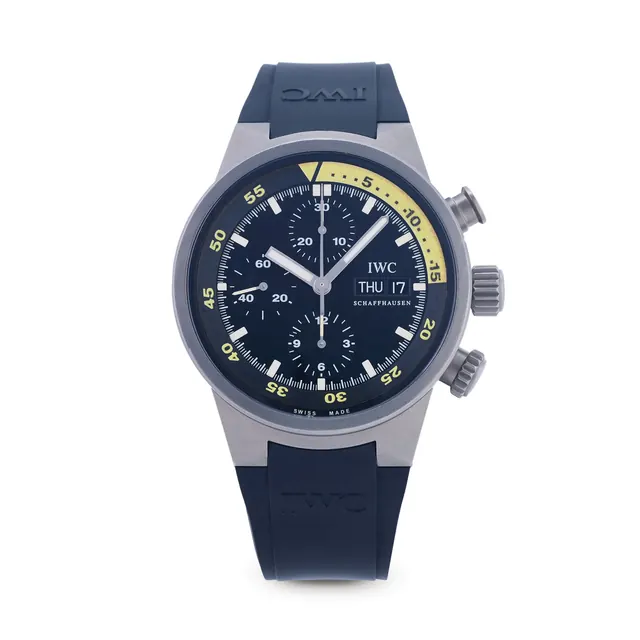
Wristwatches · c. 2010s
IWC wristwatch, ref. IW371918, Aquatimer, circa 2010s
Antiquorum auction archive, Geneva

Wristwatches · 1970
Wristwatch by Heno, Switzerland, 1970
Museum Rotterdam

Wristwatches · 1960–1986
'Tri-Compax' calendar chronograph wristwatch in gold case, by Universal, Geneva, Switzerland, 1960–1986.
Science Museum Group, London

Wristwatches · 1969–1970
Beta 21 Quartz wristwatch movement, made in Switzerland, 1970.
Science Museum Group, London

Wristwatches · c. 1969
Omega Speedmaster Moonwatch, ref. 145022-69st, c. 1969
Antiquorum auction archive, Geneva