
Wristwatches · Wristwatch
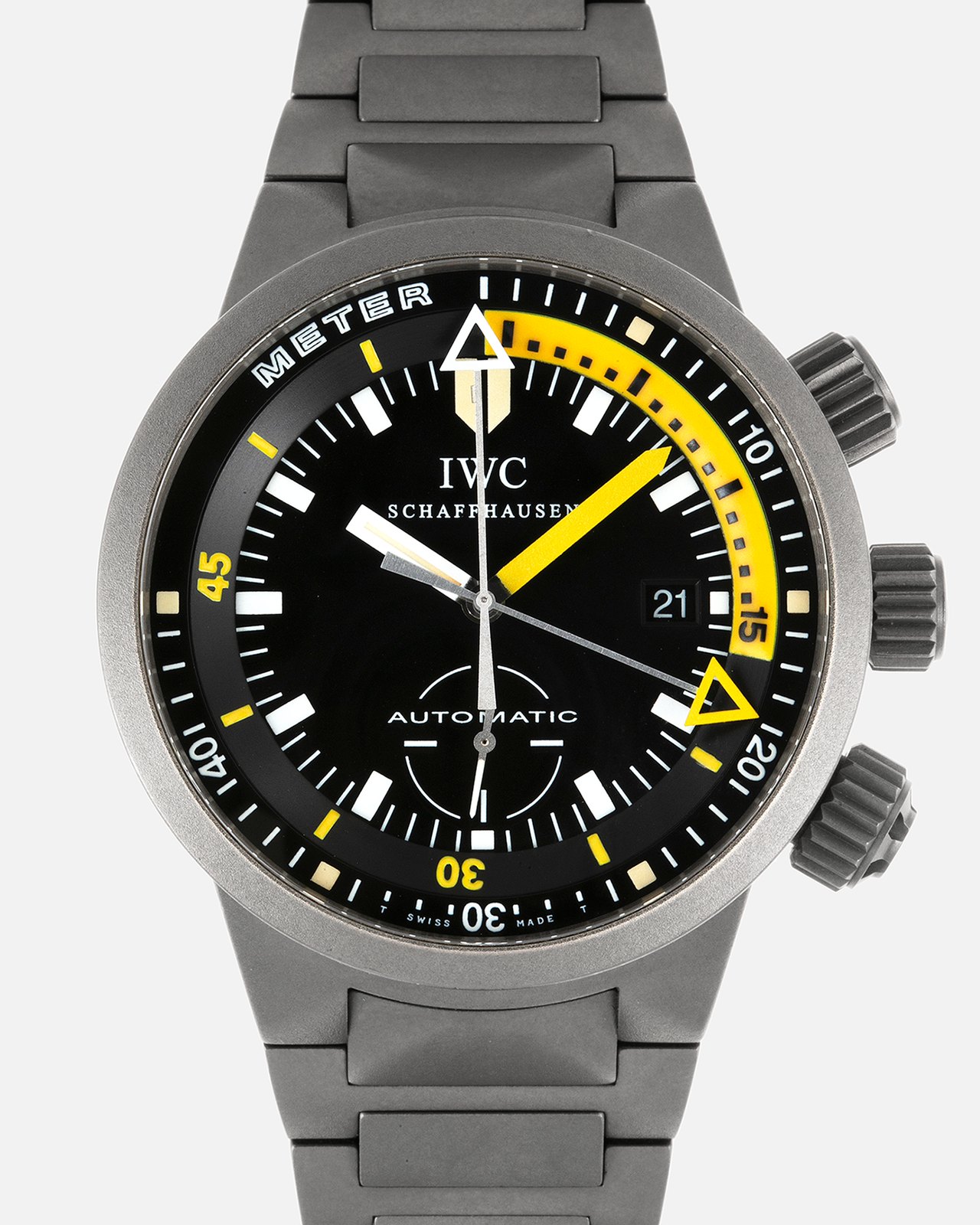
IWC Gst 3527 Deep One, 1999
- Maker / attribution
- IWC (maker)
- Date
- 1999
- Historical period
- Mechanical Renaissance (1990 – 2010)
- Country of origin
- Switzerland
- Object type
- Wristwatch
- Dimensions
- Case 42.8 mm
- Stock no.
- Product 6847199281239
- Credit line
- Dealer listing, S.Song Watches (product 6847199281239)
- Catalogue title (original)
- IWC GST 3527 Deep One (English)
View the source record (dealer listing) ↗ (opens another website in a new tab)Suggest a correction
Record summary
Catalogued by S.Song Watches (dealer), Seattle (stock number Product 6847199281239), this is a wristwatch by IWC, made in Switzerland, dated 1999. The Atlas places it in the Mechanical Renaissance period (1990 – 2010) of its Wristwatches collection. Recorded dimensions: Case 42.8 mm. The record is illustrated with 6 photographs.
Assembled from the source record's structured fields. Dates and attributions are given as the source states them; where a field is missing the Atlas leaves it blank rather than estimating.
Catalogue description
Dealer description — S.Song Watches
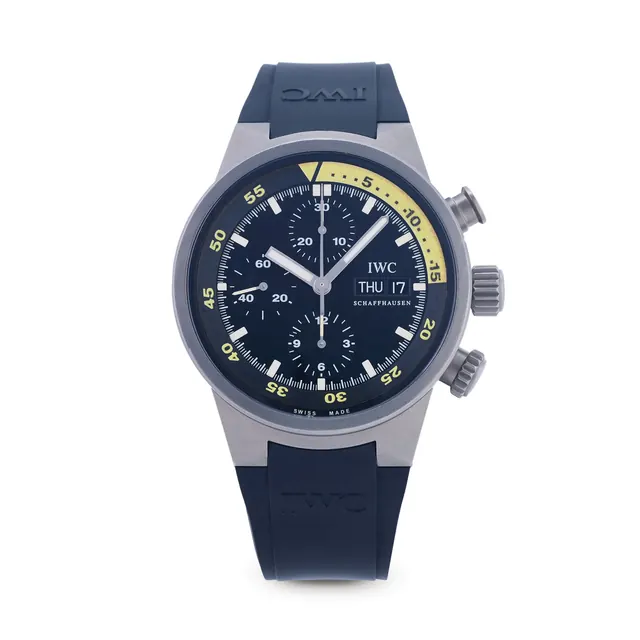
When IWC’s 20-year collaboration with Porsche Design came to an eventual close in 1997, there was a clear need for the manufacture to fill a gaping void in its product portfolio. The ‘GST’ collection was IWC’s answer to this requirement, which stood for “gold, steel, titanium”. The collection spanned alarm watches, chronographs, and famously the Aquatimer. Released in 1999 as part of the GST collection, the IWC Deep One Ref. 3527 is a landmark model and grail-level watch to many dive watch enthusiasts. It is also an excellent example of ‘90s watchmaking and represents the emergence of modern watchmaking after the industry rose from its own ashes as a result of the quartz crisis. This reference is considered by many a rare timepiece as it only saw two short production years, and although there were never any official production figures, it was estimated that less than 1,000 pieces were ever produced. At the time of its introduction, it was the very first dive watch to incorporate a depth gauge. This feature alone broke new ground and pushed the limits of what could be accomplished with purely mechanical technology at the time. To me, the Ref. 3527 is more than just an exercise in mechanical engineering and watchmaking, it is without a doubt, an elusive collector’s piece due to its historical connection to a seemingly fading era of purpose-driven, no-nonsense IWC tool watches. The Ref. 3527 measures 42.8mm in diameter and 14.75mm in height. Encased within the bead-blasted titanium case is a carefully selected movement that is the IWC Cal. 8914 - due to technical constraints, the ebauche had to be slim enough to accommodate the mounting of the depth gauge mechanism on the dial-side and for it to be robust enough, for obvious reasons. This is also the main reason why IWC had opted out of a central seconds-hand as the results would mean that the dial would simply be too thick. Coming to its aesthetics, the first thing you’d notice is how deep the dial actually is (no pun intended). A no-nonsense white-on-black printing was used for maximum legibility and a date window was discreetly tucked away at the 3 o’clock position. The Ref. 3527 also features a running seconds indicator at 6 o’clock and an internal rotating bezel (accessible via the top titanium crown) which was used because it was deemed to offer protection from any unwanted and accidental external adjustments. Last but not least, on the periphery of the dial, you’d find a track labeled “METER” and it goes up to 45, this is the depth display and it is supposed to be read in conjunction with the two skeletonized arrow hands at the center. Now, obviously, the depth gauge on the Ref. 3527 is the star of the show, and although it may seem like a simple function, it is actually more than meets the eye. Depth is calculated via a Bourdon tube installed within the case that acts like a mechanical pressure-sensing element. As water enters the coil tube, the tube will subsequently rigidify. The pressure is then indicated on the dial with the white skeletonized arrow hand. Pushing the crown at 4 o’clock resets the calibration of the depth hands to zero. Today, the Ref. 3527 is considered an absolute cult classic amongst collectors, especially dive watch enthusiasts, and it is not hard to see why. Something about the Ref. 3527 just ticks all the boxes for me, it is the perfect combination of rarity, utility, historical significance, technical prowess, and collectability. Looking back now, everything about the Ref. 3527 is designed in a way that is deemed ahead of its time when it was first introduced – it was able to keep you alive in the event your electronic dive computer fails. How cool is that?
Historical context
Mechanical Renaissance (1990 – 2010)
Mechanical watches return as cultural objects; independent watchmaking flourishes.
Mechanical watches returned as cultural and luxury objects. Complications, tourbillons and new materials proliferated; independent watchmakers such as George Daniels, F.P. Journe and Philippe Dufour revived artisanal watchmaking; collecting vintage watches became a major field.
Read the period in the timelineMore wristwatches from this periodEarlier: Quartz Revolution
Atlas type guide
Wristwatches
Bracelet watches were worn by women from the early nineteenth century — Breguet made one for Caroline Murat, Queen of Naples, in 1810–12 — but the wristwatch only became a man's instrument with military use and aviation in the early twentieth century. Between the World Wars it overtook the pocket watch; the 1920s and 1930s brought rectangular Art Deco cases, water-resistant cases and the first automatic winding systems.
After 1945 the wristwatch became a carrier of identity — dress watches, sports and dive watches, chronographs, calendars — produced by Swiss, American, Japanese, German, Soviet and Chinese industries. The quartz revolution after 1969 and the mechanical renaissance since the 1990s, including the rise of independent watchmakers, complete the story.
What to look for
- The reference number (between the lugs or inside the case back) and serial number, the starting point for dating.
- The calibre: its maker and number are often stamped under the dial or on the bridge.
- Originality of dial, hands and crown — refinished ('redial') dials are common.
- Case material marks: 18K/750, 14K/585, stainless steel, gold-filled, plated.
Dating clues
- Wire-lug cases: before c. 1925.
- Water-resistant screw-down cases: from 1926.
- Quartz movements: from 1969; sapphire crystals widespread after c. 1980.
General guidance written by the Atlas editors about this kind of object. It is not a statement about this particular piece; for that, rely on the source record above and on physical examination.
Related records
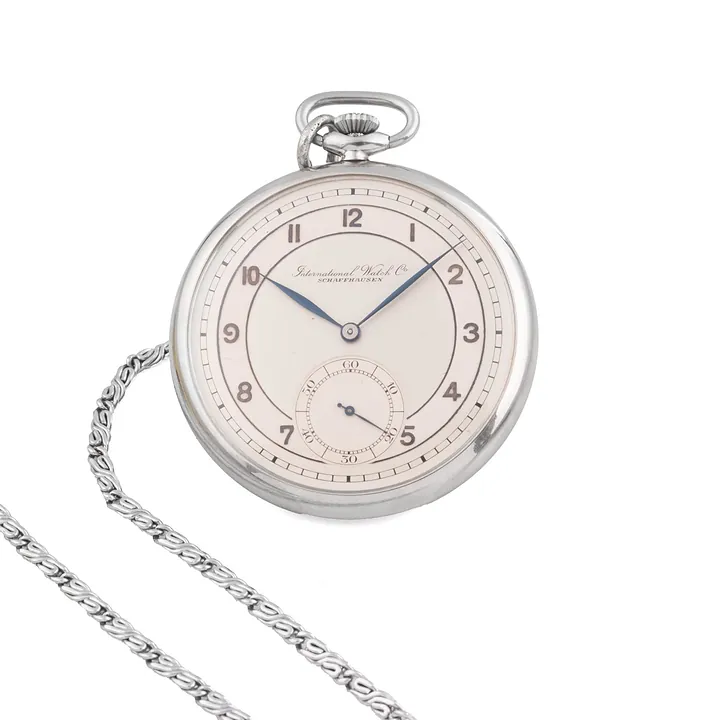
Pocket Watches · c. 1950
IWC Pocket Watch, c. 1950
Antiquorum auction archive, Geneva
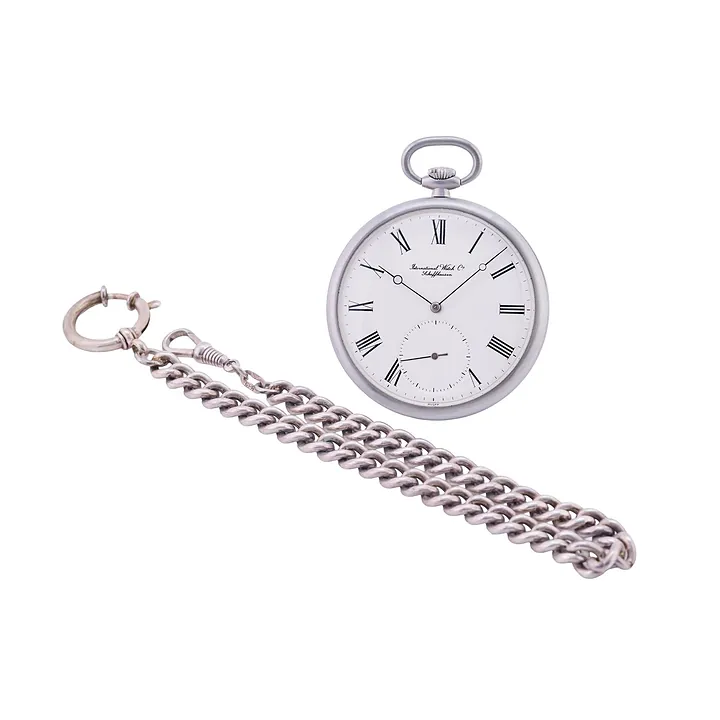
Pocket Watches · c. 1980
IWC pocket watch, ref. 5301, c. 1980
Antiquorum auction archive, Geneva
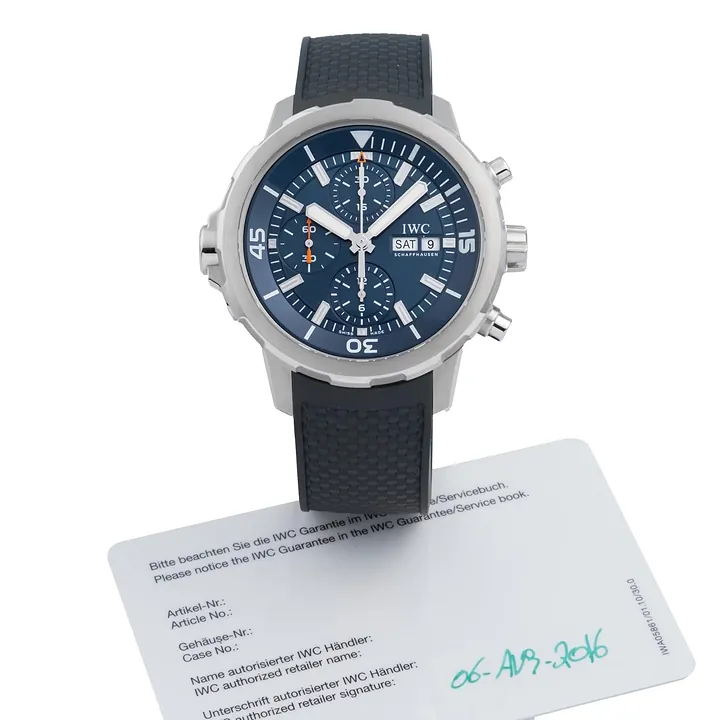
Wristwatches · originally sold in April 2016 (per the lot record)
IWC Aquatimer Chronograph Cousteau, ref. IW3768, originally sold in April 2016
Antiquorum auction archive, Geneva
Wristwatches · c. 2010s
IWC wristwatch, ref. IW371918, Aquatimer, circa 2010s
Antiquorum auction archive, Geneva

Wristwatches · 2008
Wristwatch by Breitling?, 2008
Museum Rotterdam

Wristwatches · c. 1990s
Audemars Piguet Bamboo, c. 1990s
Antiquorum auction archive, Geneva

Wristwatches · c. 1990
Audemars Piguet Huitieme Perpetual Calendar, ref. 25696PT, c. 1990
Antiquorum auction archive, Geneva

Wristwatches · c. 1990
Breitling Chronomat, ref. b13050.1, c. 1990
Antiquorum auction archive, Geneva