
Wristwatches · Wristwatch
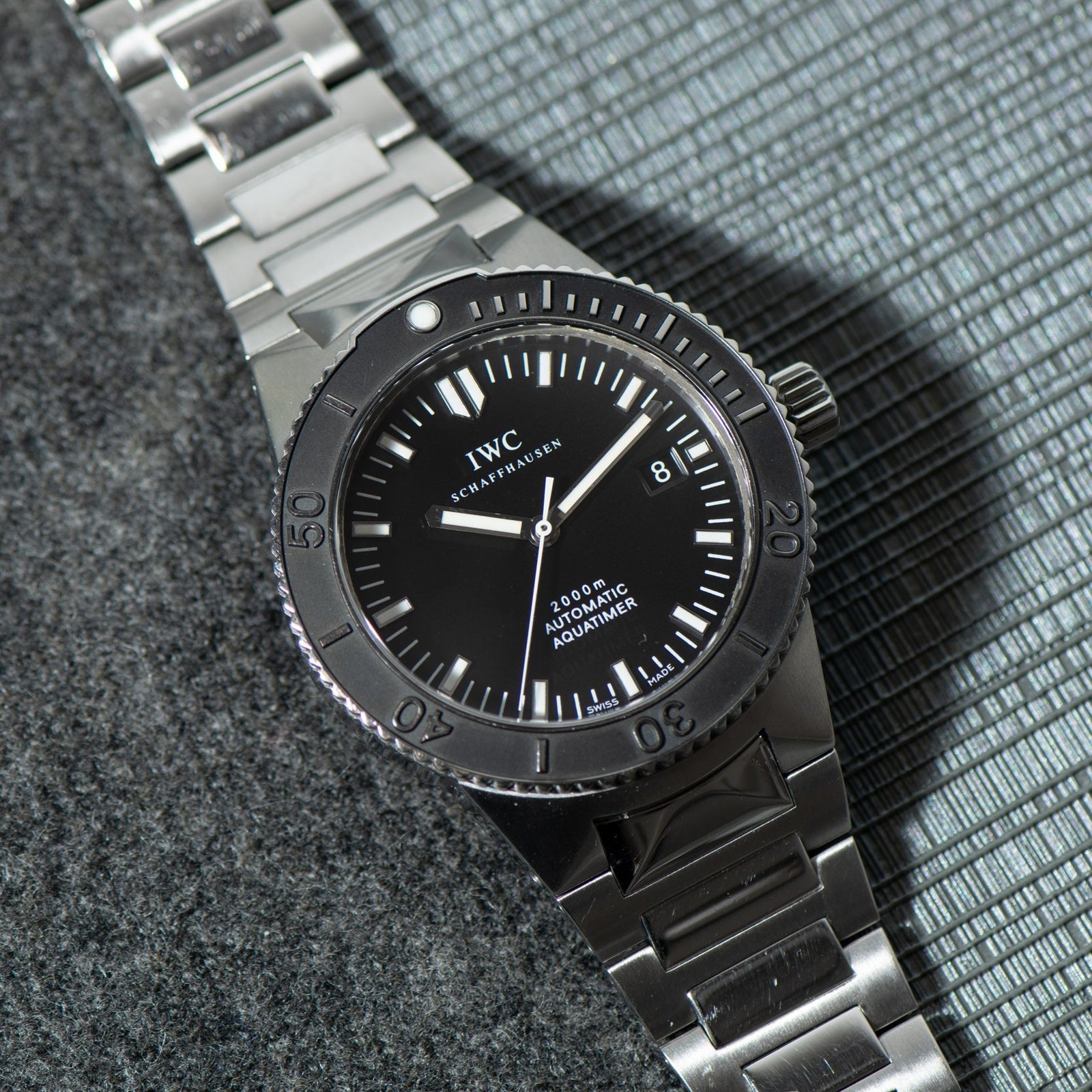
IWC Aquatimer GST 2000
- Maker / attribution
- IWC (maker)
- Date
- early 2000s
- Historical period
- Mechanical Renaissance (1990 – 2010)
- Country of origin
- Switzerland
- Object type
- Wristwatch
- Dimensions
- Case 42 mm
- Stock no.
- 40970078
- Credit line
- Dealer listing, Analog/Shift (40970078)
- Catalogue title (original)
- IWC Aquatimer GST 2000 (English)
View the source record (dealer listing) ↗ (opens another website in a new tab)Suggest a correction
Record summary
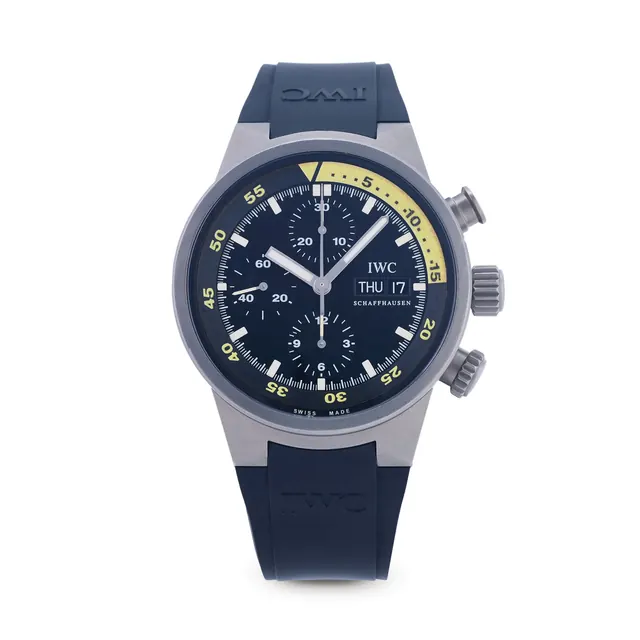
Catalogued by Analog/Shift (dealer), New York (stock number 40970078), this is a wristwatch by IWC, made in Switzerland, dated early 2000s. The Atlas places it in the Mechanical Renaissance period (1990 – 2010) of its Wristwatches collection. Recorded dimensions: Case 42 mm. The record is illustrated with 6 photographs.
Assembled from the source record's structured fields. Dates and attributions are given as the source states them; where a field is missing the Atlas leaves it blank rather than estimating.
Catalogue description
Dealer description — Analog/Shift
Despite being a relatively modern wristwatch, the IWC Aquatimer Reference 3536 has a storied history. It represents the triumphant return of the classic Aquatimer line in the modern era, which was first launched in 1967 with the Reference 1815. This original model was IWC's first attempt at a dive watch, released in an era when the brand had tough competition from brands such as Rolex, Blancpain, and DOXA. At the time, IWC was known mainly for its pilot's watches, epitomized by their legendary Mark XI. Despite the developing dive watch market caused by the emergence of recreational SCUBA diving, IWC seemed resistant to enter the fray. With the Fifty Fathoms’s association with Jacques Cousteau and the Submariner's as-then unsurpassed depth rating of 200m, there seemed little room for improvement in dive watches. But IWC quietly developed a prototype of the watch that would become the Aquatimer in 1964, releasing the Ref. 1815, powered by the same automatic movement used in the Ingenieur, the Calibre 8542. In appearance the Aquatimer owed much to that storied timepiece, giving it a similar dial and bracelet. However, the Aquatimer featured a thicker crystal and case, with patented compressor case sealing technology and a rotating inner bezel to help it withstand greater depths. Despite the poor performance of the Reference 1815's successor, the 1816 — and the encroaching Japanese quartz technology looming on the horizon — IWC continued to develop new Aquatimer models, the most iconic of which was the Ocean 2000. Designed in concert with Ferdinand A. Porsche in 1978 and released in 1982, it was IWC's answer to the latest, hottest quartz watches styles: a mechanical watch with an unusual, distinctive case completely different from that of the iconic, Gerald Genta-designed Ingenieur. Like the Heuer Bundeswehr, the Ocean 2000 was also developed for the German military, and was the first dive watch with a case made of titanium. This reference revitalized a foundering line, and was its benchmark until the release of the GST Aquatimer in 1997. The GST Aquatimer (Ref. 3536) is IWC's answer to the notion of a “professional dive watch” posed by the Rolex Sea-Dweller. It combined a classic, sturdy round case with an elegant dial featuring distinct Bauhaus influences — yet lest its appearance deceive you, it featured a depth rating of 2,000m! The Reference 3536 was available in stainless steel with a black dial (Ref. 3536-002), titanium (Ref. 3536-001), and in stainless steel with a white dial (Ref. 3536-003). This particular -002 example dates from the early 2000s, and saw a production run of just 6,000 pieces. Featuring \ a 42mm stainless steel case with a signed, screw-down crown and a push-down, unidirectional, rotating dive bezel with a black insert, it sports a luminous, matte black dial with applied indices, color-matched black date window at 3 o’clock, and a highly legible luminous stick handset. Paired with a matching, integrated stainless steel bracelet and powered by the workhorse ETA Calibre 2892 automatic movement, the overall picture is of a dive watch that forms a perfect alternative to more mainstream professional-grade divers. While somewhat bulky and imposing, its sturdy build and clean, legible dial make this piece an eye-catching option for any dive watch enthusiast!
Historical context
Mechanical Renaissance (1990 – 2010)
Mechanical watches return as cultural objects; independent watchmaking flourishes.
Mechanical watches returned as cultural and luxury objects. Complications, tourbillons and new materials proliferated; independent watchmakers such as George Daniels, F.P. Journe and Philippe Dufour revived artisanal watchmaking; collecting vintage watches became a major field.
Read the period in the timelineMore wristwatches from this periodEarlier: Quartz Revolution
Atlas type guide
Wristwatches
Bracelet watches were worn by women from the early nineteenth century — Breguet made one for Caroline Murat, Queen of Naples, in 1810–12 — but the wristwatch only became a man's instrument with military use and aviation in the early twentieth century. Between the World Wars it overtook the pocket watch; the 1920s and 1930s brought rectangular Art Deco cases, water-resistant cases and the first automatic winding systems.
After 1945 the wristwatch became a carrier of identity — dress watches, sports and dive watches, chronographs, calendars — produced by Swiss, American, Japanese, German, Soviet and Chinese industries. The quartz revolution after 1969 and the mechanical renaissance since the 1990s, including the rise of independent watchmakers, complete the story.
What to look for
- The reference number (between the lugs or inside the case back) and serial number, the starting point for dating.
- The calibre: its maker and number are often stamped under the dial or on the bridge.
- Originality of dial, hands and crown — refinished ('redial') dials are common.
- Case material marks: 18K/750, 14K/585, stainless steel, gold-filled, plated.
Dating clues
- Wire-lug cases: before c. 1925.
- Water-resistant screw-down cases: from 1926.
- Quartz movements: from 1969; sapphire crystals widespread after c. 1980.
General guidance written by the Atlas editors about this kind of object. It is not a statement about this particular piece; for that, rely on the source record above and on physical examination.
Related records
Pocket Watches · c. 1950
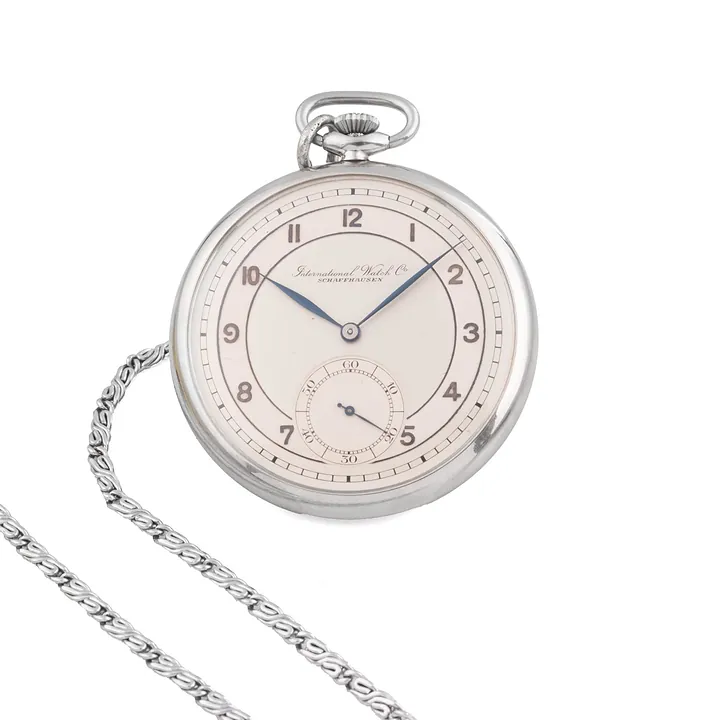
IWC Pocket Watch, c. 1950
Antiquorum auction archive, Geneva
Pocket Watches · c. 1980
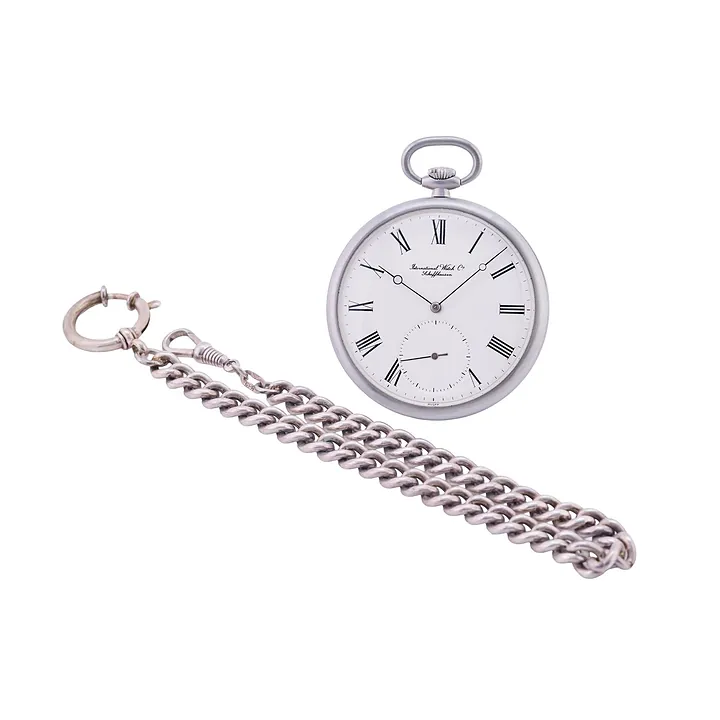
IWC pocket watch, ref. 5301, c. 1980
Antiquorum auction archive, Geneva
Wristwatches · originally sold in April 2016 (per the lot record)
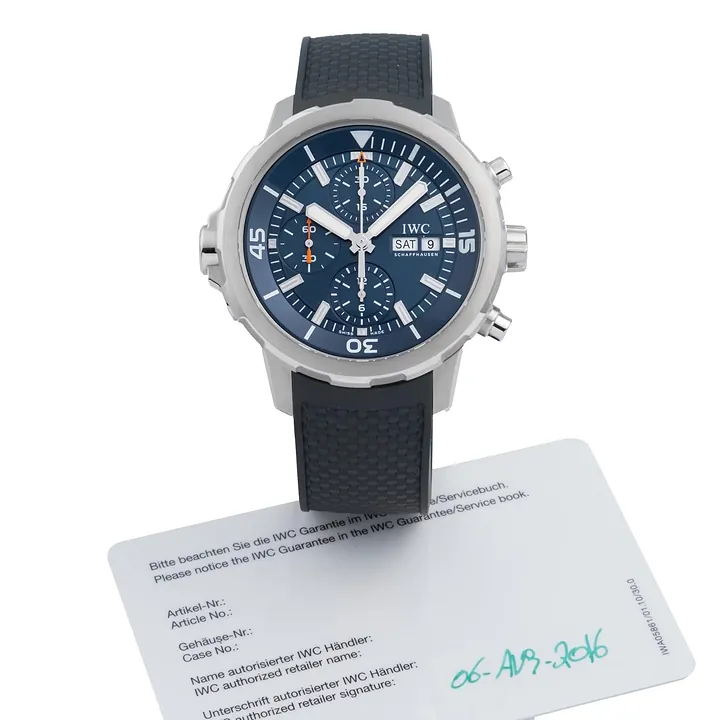
IWC Aquatimer Chronograph Cousteau, ref. IW3768, originally sold in April 2016
Antiquorum auction archive, Geneva
Wristwatches · c. 2010s
IWC wristwatch, ref. IW371918, Aquatimer, circa 2010s
Antiquorum auction archive, Geneva

Wristwatches · 2008
Wristwatch by Breitling?, 2008
Museum Rotterdam

Wristwatches · c. 1990s
Audemars Piguet Bamboo, c. 1990s
Antiquorum auction archive, Geneva

Wristwatches · c. 1990
Audemars Piguet Huitieme Perpetual Calendar, ref. 25696PT, c. 1990
Antiquorum auction archive, Geneva

Wristwatches · c. 1990
Breitling Chronomat, ref. b13050.1, c. 1990
Antiquorum auction archive, Geneva